

Federal procurement is one of the most misunderstood opportunities in American business. Most owners hear “government contracting” and picture a slow, bureaucratic buying process reserved for large defense firms. The reality is far more accessible — and more profitable. What is federal procurement, exactly? It is a structured, end-to-end process that governs how the U.S. federal government acquires goods and services, from the moment a need is identified to the final contract closeout. For small and medium-sized businesses, understanding this process is the difference between leaving billions on the table and claiming a steady slice of recession-proof government revenue.
Table of Contents
- What is federal procurement and why does it matter?
- Key federal regulations guiding procurement: Understanding the FAR
- How small and medium businesses access federal procurement opportunities
- The federal acquisition lifecycle: Planning, solicitations, and types of solicitations
- Navigating the GSA Multiple Award Schedule (MAS) contract process
- What most businesses miss about federal procurement — and how to succeed
- How we can help your business navigate and win federal contracts
- Frequently asked questions
Key Takeaways
| Point | Details |
|---|---|
| Federal procurement lifecycle | Federal procurement covers all stages from need identification to contract completion. |
| Central role of FAR | The Federal Acquisition Regulation governs acquisition rules for federal agencies. |
| GSA contract access | Small and medium businesses must obtain GSA Schedule contracts to access many federal opportunities. |
| Importance of acquisition planning | Proper acquisition planning and market research align your offerings with government needs. |
| Mandatory GSA training | Completing the Pathways to Success training is required to submit offers for GSA MAS contracts. |
What is federal procurement and why does it matter?
Federal procurement is not just shopping with a government credit card. It is a legally defined lifecycle. Procurement covers every stage from identifying the need through contract completion and closeout, including planning, funding approval, solicitation, evaluation, award, administration, and documentation. Every dollar spent follows a prescribed path, governed by statutes and agency-specific rules.
The scope is enormous. The federal government spends over $700 billion annually on contracts for products, services, and construction. That money flows through thousands of agencies, each operating under the same overarching procurement framework but with their own internal procedures. For a small business, knowing how this machinery works is not optional background knowledge. It is a competitive advantage.
“In the federal context, ‘procurement’ is the end-to-end process of acquiring property or services — from identifying the need through contract completion and closeout.” — 41 U.S.C. Chapter 7, Office of Federal Procurement Policy
Federal procurement policies exist to protect taxpayers and ensure fair competition. They require agencies to promote economy, efficiency, and full and open competition when awarding contracts. For your business, those same policies create a level playing field. Large corporations do not automatically win. Agencies are required to consider qualified small businesses, and in many cases they are required to set contracts aside exclusively for them.
Now that you understand what federal procurement means legally, let’s explore the key regulations that govern these processes.
Key federal regulations guiding procurement: Understanding the FAR
The Federal Acquisition Regulation, universally called the FAR, is the rulebook every federal agency uses when buying goods or services with taxpayer funds. Federal contracting explained at its most foundational level comes down to this: the FAR sets the rules, and everyone in the process, agencies and contractors alike, plays by them.
Federal procurement is governed primarily by the FAR, which is implemented by executive agencies when acquiring supplies and services with appropriated funds, issued under the Office of Federal Procurement Policy framework. The FAR covers everything from how agencies advertise a need to how disputes are resolved after a contract is awarded.
Here is what the FAR specifically requires and controls:
- Competition requirements: Agencies must generally pursue full and open competition unless a specific exception applies.
- Small business considerations: Set-aside programs, subcontracting plans, and socioeconomic classifications are all embedded in FAR policy.
- Contract types: Fixed-price, time-and-materials, cost-reimbursement contracts — the FAR defines when each type is appropriate.
- Ethics and compliance: Contractors must certify representations about their business and maintain compliance throughout the contract period.
- Proposal evaluation criteria: Agencies must disclose how they will evaluate proposals, so you know exactly what they are scoring.
The practical implication for your business is this: if you want to win federal contracts, your proposals, pricing structures, and business practices need to align with what FAR compliance requires before you submit a single document. Discovering a compliance gap after you have won a contract is far more painful than preparing correctly from the start.
With regulations clear, the next step is to see how small and medium businesses can enter federal procurement through key contracting vehicles.
How small and medium businesses access federal procurement opportunities
Not every federal contract opportunity is open to every vendor. Access depends on the contracting vehicle you hold, the certifications you carry, and the agency’s specific requirements. The most practical entry point for most small and medium-sized businesses is the GSA Multiple Award Schedule, known as the MAS or GSA Schedule.

GSA explains that businesses typically access opportunities by first becoming a Schedule (MAS) or other contract holder, requiring business tenure, financials, and past performance. Holding a GSA Schedule means federal buyers can purchase directly from you through a pre-negotiated contract vehicle, without going through a full competitive bidding process for every purchase. That efficiency is why agencies love MAS contracts and why holding one puts your business in a position competitors without a schedule simply cannot match.
Here is how to qualify and position yourself:
- Meet the tenure requirement. You need at least two years of operating history in the business. Startups cannot apply — agencies want vendors with a track record.
- Prepare your financial statements. Agencies review two years of financial data. Clean, organized financials signal stability.
- Document past performance. Collect references and performance records from clients. Government buyers weight this heavily.
- Register in SAM.gov. The System for Award Management is the government’s central contractor database. No registration, no contracts. Period.
- Identify your NAICS codes. The North American Industry Classification System codes define what your business does. Choosing the right codes puts you in front of the right agency buyers.
Pro Tip: Do not try to cover every possible NAICS code on your initial application. Target the two or three codes that best match your core offering. A focused, credible profile beats a sprawling one that raises more questions than it answers.
Beyond the GSA Schedule, Governmentwide Acquisition Contracts (GWACs) and Multi-Agency Contracts (MACs) offer access to IT and other specialized categories. However, these vehicles come with competitive windows that open and close, often requiring you to compete against many vendors simultaneously. The GSA Schedule approach for small businesses is generally more accessible because the pathway is defined and repeatable.
If you are specifically offering professional services, getting a GSA professional service schedule follows the same core framework but with additional nuances around labor categories and service descriptions.
Having identified how to gain access, it is critical to understand the planning and solicitation stages that precede contract awards.
The federal acquisition lifecycle: Planning, solicitations, and types of solicitations
Before an agency awards a contract, it does extensive preparation. Understanding this preparation stage changes how you respond to opportunities and dramatically improves your win rate.
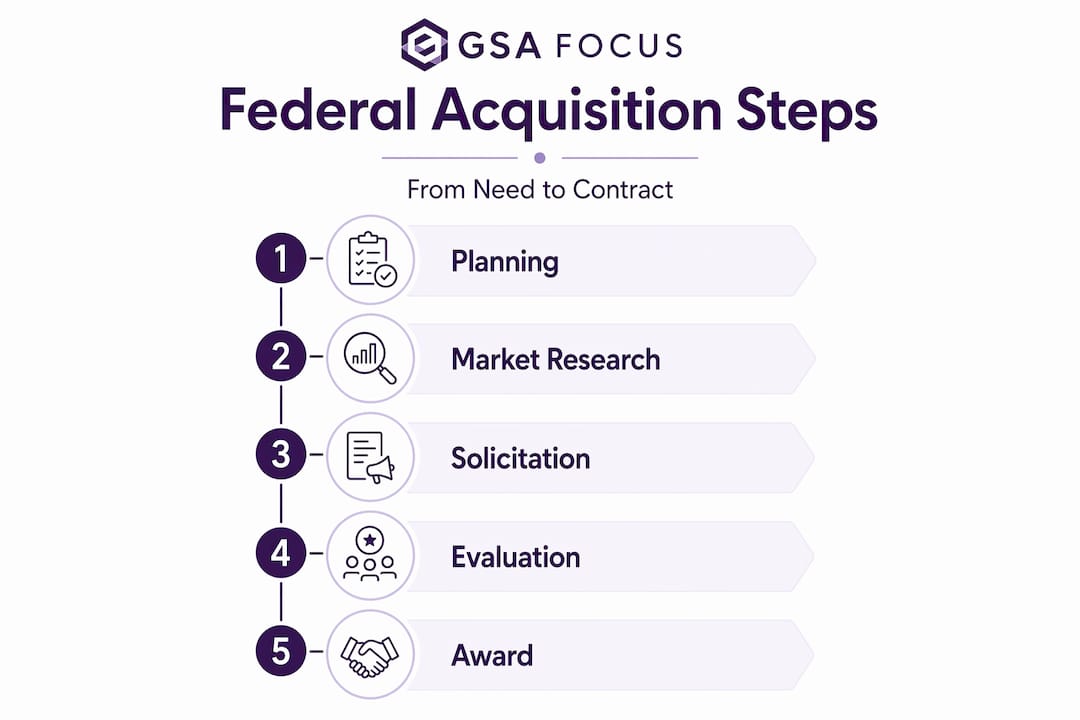
Agencies perform acquisition planning and market research per FAR Part 7 to meet needs effectively and in a timely manner. Acquisition planning is not bureaucratic box-checking. It defines the scope, timeline, budget, and evaluation approach for a potential contract. When you understand what went into that planning, your proposal speaks directly to the agency’s documented priorities rather than addressing what you think they want.
Market research is the stage where agencies actively look at existing vendors, pricing benchmarks, and industry capabilities. This is your window. Participating in industry days, responding to Requests for Information, and maintaining an updated GSA Schedule catalog all put your business in front of agencies during their research phase, before solicitations ever drop.
Solicitations explain requirements and evaluation factors; main types include RFP, RFQ, IFB, and Sources Sought/RFI. Here is how each type differs in practice:
| Solicitation type | What it requests | Evaluation method |
|---|---|---|
| RFP (Request for Proposal) | Full technical and price proposal | Best value, tradeoff analysis |
| RFQ (Request for Quotation) | Price and basic qualifications | Lowest price technically acceptable or best value |
| IFB (Invitation for Bid) | Sealed price bid only | Lowest price, no technical evaluation |
| Sources Sought / RFI | Market research, capabilities | No award, informs future solicitation |
The critical insight most businesses miss: a Sources Sought notice is not a throwaway document. Responding to one tells the agency you exist, shapes the final solicitation requirements, and positions you as a known quantity when the real opportunity drops.
Pro Tip: When you receive an RFP, read the evaluation criteria before you read the scope of work. Agencies score exactly what they say they will score. Building your proposal structure around evaluation factors, not your own narrative preferences, is the fastest way to improve your technical scores.
The GSA contract acquisition process follows this same lifecycle logic, with specific stages and documentation requirements unique to the Schedule program.
Understanding solicitations positions you to tackle the specific requirements of GSA Schedule offers.
Navigating the GSA Multiple Award Schedule (MAS) contract process
Getting a GSA MAS contract is not complicated if you follow the steps in order. Where most businesses stumble is treating the process as a form-filling exercise rather than a structured qualification process with hard requirements.
Mandatory “Pathways to Success” training takes 3 to 4 hours and must be completed and acknowledged within the past year for your offer submission. This is not a suggestion. If your training acknowledgment is expired, your offer cannot be submitted. GSA blocks it.
Here are the core steps to submitting a complete MAS offer:
- Complete “Pathways to Success” training. Log in through the GSA Vendor Support Center and complete the online course. Save your completion certificate.
- Gather your documentation. This includes financial statements, corporate experience narratives, past performance references, and pricing data.
- Build your price list. Your GSA price list must be commercially reasonable and consistent with your pricing practices. GSA will negotiate. Expect it.
- Prepare your eOffer submission. The eOffer portal is where you compile every document, complete the solicitation requirements, and acknowledge your training.
- Submit and respond to clarification requests. Contracting officers will often send requests for clarification or additional documentation. Respond quickly. Delays extend your timeline significantly.
Pro Tip: Do not submit an offer until every required document is finalized. Partial or rushed submissions generate clarification requests that can add months to your award timeline. A complete, well-organized initial submission is the single biggest factor within your control.
For businesses looking to increase their odds of a successful first submission, reviewing tips for a GSA MAS offer and understanding how the GSA Schedule works in practice will save you significant time and frustration.
With these practical steps clear, let’s explore expert perspectives on common pitfalls and strategic insights for federal procurement success.
What most businesses miss about federal procurement — and how to succeed
Here is the uncomfortable truth most articles on this topic skip: the majority of small businesses that fail in federal procurement do not fail because the process is too hard. They fail because they treat it like a marketing campaign rather than a contract performance lifecycle.
From the moment you respond to a Sources Sought notice to the day your contract closes out, every document you create is part of a formal record. GSA treats solicitation documents as binding contract specifications, not mere marketing materials, and differing solicitation types require tailored responses. That means the narrative you write in your technical proposal needs to align with what you can actually deliver and document over the life of the contract.
Most businesses spend 90% of their energy on getting the contract and 10% thinking about performing it. The agencies evaluating your proposal know this pattern. They score past performance heavily precisely because it is the best predictor of future contract execution.
Another overlooked reality: the mandatory training and market research phases are not administrative hurdles. They are your preparation time. Skipping or rushing them because you want to move faster almost always slows you down. Businesses that complete “Pathways to Success” training thoughtfully, read the FAR provisions they are certifying to, and research agency buying patterns before submitting win at a higher rate. Not because the rules favor them, but because their submissions are coherent and complete.
The GSA Schedule contract landscape rewards patience and preparation far more than urgency and volume. One well-prepared, fully compliant submission beats five rushed ones every time.
How we can help your business navigate and win federal contracts
Understanding how federal procurement works is the first step. Executing it correctly, under real timelines with real documentation requirements, is where the work lives. At GSA Schedule Services, we work with small and medium-sized businesses to handle exactly that gap. From readiness assessments that tell you where you actually stand, to proposal preparation, FAR compliance review, pricing negotiation support, and post-award marketing strategy, we cover the process end to end. Our clients do not just get contracts. They get contracts they can win work through. If you are ready to stop watching government contracts go to competitors, let’s talk about what your path to a GSA Schedule looks like.
Frequently asked questions
What does federal procurement include beyond just buying?
Federal procurement covers every stage from need identification to contract closeout, including acquisition planning, solicitation, evaluation, award, contract administration, and formal documentation requirements.
Why is the Federal Acquisition Regulation important for small businesses?
The FAR is the primary regulation guiding federal acquisitions with appropriated funds, standardizing rules across agencies to ensure transparency and fairness that every competing business must follow.
How can a small business get started with government contracting?
SMBs access opportunities by becoming Schedule (MAS) contract holders, meeting prerequisites such as two years in business, organized financial statements, and documented past performance references.
What are the common solicitation types and their differences?
Four common solicitation types exist with distinct purposes: RFPs request full proposals evaluated on best value, RFQs request quotes, IFBs accept sealed bids evaluated on price alone, and Sources Sought notices gather market research without resulting in an award.
What mandatory training is required for GSA MAS contract offers?
Completing “Pathways to Success” training within the past year is a hard requirement to submit a GSA MAS offer. Expired acknowledgments block submission entirely.
Recommended
- Navigating Federal Procurement Guidelines Effectively
- Federal Procurement Training Essentials Guide
- Federal Government Procurement Forecast 2023 Guide
- Navigating Federal Procurement Policy Guidelines