

You’ve watched federal contracts go to competitors while your business sits on the outside looking in. The government spends hundreds of billions on goods and services every year, and most of that money flows through a single, powerful vehicle: the GSA Schedule. Getting listed isn’t simple, but it’s absolutely achievable with the right roadmap. This guide walks you through every stage of the process, from understanding what the Schedule is, to submitting your application, to winning real government customers after award.
Table of Contents
- Understanding the GSA Schedule and why it matters
- Before you apply: Requirements and essential documents
- The GSA Schedule application process: Step-by-step
- Troubleshooting, common mistakes, and how to stand out
- What happens after award? Managing and maximizing your GSA Schedule
- A practical perspective: Why getting on the GSA Schedule is just the beginning
- Get expert guidance for your GSA Schedule journey
- Frequently asked questions
Key Takeaways
| Point | Details |
|---|---|
| Know the prerequisites | Bring your registration, NAICS codes, and sales history in order before applying. |
| Follow a stepwise process | Tackle readiness, training, document prep, and submission in a clear sequence. |
| Avoid common pitfalls | Double-check documentation and consider training or professional help for tricky sections. |
| Engage after the award | Post-award management and marketing are crucial for real returns from your GSA Schedule. |
Understanding the GSA Schedule and why it matters
The GSA Schedule, officially called the Multiple Award Schedule (MAS), is a long-term government contract that allows federal agencies to purchase products and services directly from pre-approved commercial vendors. Think of it as a vetted vendor list for the entire federal government. Once you’re on it, agencies can buy from you without going through a lengthy bidding process for every single purchase.
The program is managed by the U.S. General Services Administration, and it covers everything from IT solutions and professional services to furniture and janitorial supplies. There are thousands of Special Item Numbers (SINs) that categorize what each vendor sells. You pick the SINs that match your offerings when you apply.

Why does this matter for your business?
The federal government is the largest single buyer of goods and services on the planet. Getting listed on the Schedule gives your business credibility, a built-in pipeline of potential clients, and access to the kind of steady, predictable revenue that private sector clients rarely provide.
Key eligibility requirements include:
- A valid SAM.gov registration with a Unique Entity Identifier (UEI) and matching NAICS codes, commercial sales history, and a U.S. business presence
- At least two years of operations and a track record of commercial sales
- Products or services that comply with the Trade Agreements Act (TAA)
- A clean financial and legal record
| Schedule benefit | What it means for your business |
|---|---|
| Pre-approved vendor status | Agencies skip the lengthy RFP process and buy directly from you |
| Credibility signal | Being on the Schedule tells buyers you’ve been vetted |
| Long-term contract | Schedules last up to 20 years with proper management |
| Market visibility | Your offerings appear in GSA Advantage and eBuy for agencies to find |
| Small business set-asides | GSA promotes small business utilization across Schedule contracts |
Our GSA Schedule contracts guide breaks down how this translates into real revenue opportunities across dozens of industries.
Before you apply: Requirements and essential documents
The GSA Schedule application is detailed. Showing up unprepared is one of the most common reasons businesses get rejected or stall for months. Before you touch the eOffer portal, your paperwork needs to be clean, complete, and consistent.
The MAS application requires SAM.gov registration with your UEI, verified NAICS codes, documented commercial sales history, and confirmed U.S. operations. Every one of these elements has to match across your documents, your SAM.gov profile, and your eOffer submission. A single mismatch can stall your entire application.
Readiness checklist:
- Active SAM.gov registration with current UEI
- NAICS codes that accurately reflect your products or services
- Two to three years of audited or reviewed financial statements
- Two to three past performance references from commercial or government clients
- A Commercial Sales Practices (CSP) document or a commitment to Transactional Data Reporting (TDR)
- TAA-compliant products or services
- A digital certificate for eOffer submission
| Must-have documents | Optional but helpful documents |
|---|---|
| SAM.gov registration confirmation | Letters of recommendation from past clients |
| Financial statements (2-3 years) | Relevant certifications (WOSB, SDVOSB, 8(a)) |
| Past performance references | Marketing materials and capabilities statement |
| Commercial Sales Practices disclosure | Partnership or teaming agreements |
| Technical and price proposals | Industry awards or recognition |
| TAA compliance confirmation | Subcontracting plan (if applicable) |
Pro Tip: Your NAICS codes in SAM.gov must exactly match the SINs you select in your Schedule application. Even a minor mismatch is a fast track to rejection. Review both side by side before you start.
If you’re still exploring whether you’re ready, our guide on starting a GSA contract covers eligibility in plain language. For a more structured approach, the GSA application guide walks through document prep with real examples.
The GSA Schedule application process: Step-by-step
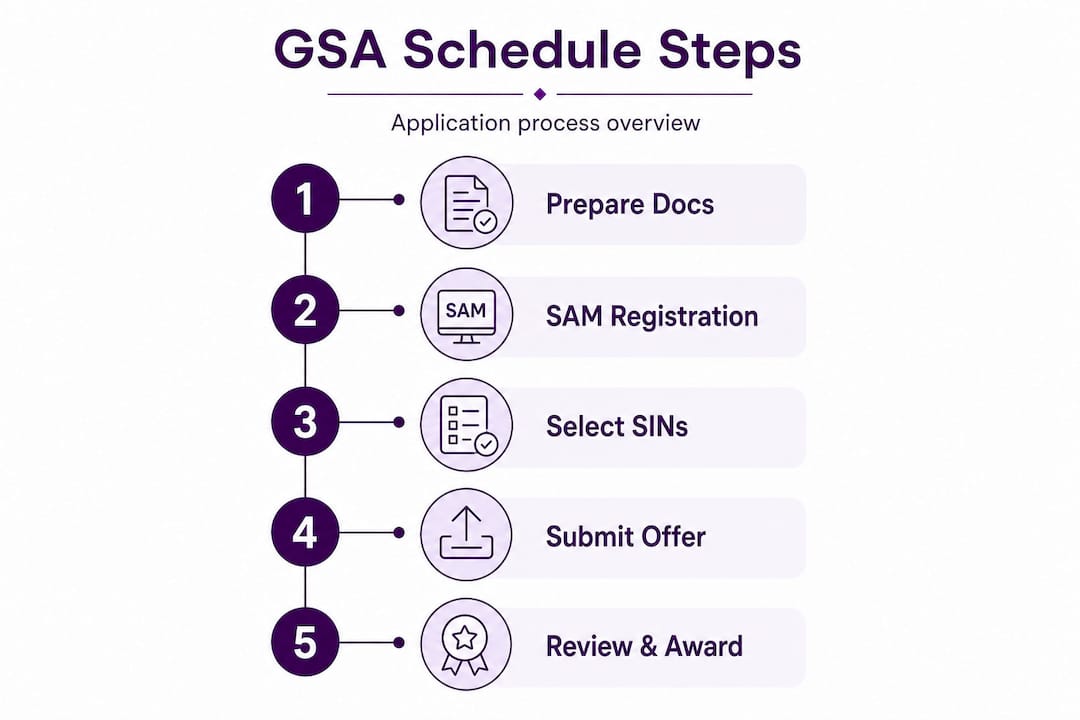
With everything in hand, here’s your roadmap for getting on the GSA Schedule. The full process takes anywhere from 3 to 12 months depending on your preparation, your SINs, and how quickly GSA reviewers respond.
The five major steps:
- Complete the readiness assessment and Pathways to Success training. GSA requires all applicants to finish their Pathways to Success training before submitting. This free online program takes a few hours and covers pricing, compliance, and contract management basics. Don’t skip it.
- Review the MAS solicitation (47QSMD20R0001). This is the official solicitation document that governs every Schedule contract. It’s long, but you need to know it. Focus on the SINs relevant to your business and the specific attachments required for each.
- Identify your SINs. SINs are product and service categories within the Schedule. Pick the ones that match your offerings most closely. More is not always better. Choosing too many SINs you can’t realistically support weakens your application.
- Gather all required documents. This includes your technical proposal, pricing proposal, CSP or TDR commitment, financial statements for two to three years, and two to three past performance references. Details on each are in the roadmap to MAS contract process published by GSA.
- Submit via eOffer with your digital certificate. eOffer is GSA’s online submission portal. You’ll need a digital certificate registered through SAM.gov to sign and submit. Once submitted, a contracting officer will review your package and may send a Request for Information (RFI) asking for clarifications or additional data.
| Application phase | Estimated time | Common delay point |
|---|---|---|
| Readiness and training | 1-2 weeks | Skipping Pathways to Success |
| Document preparation | 4-8 weeks | Incomplete financials or CSP errors |
| eOffer submission | 1-2 days | Digital certificate issues |
| GSA review and negotiation | 3-6 months | RFIs left unanswered or slow responses |
| Award and onboarding | 2-4 weeks | Missing post-award compliance steps |
Pro Tip: If you’re in IT, look into the FASt Lane program. It can cut your timeline to 3-6 months. For everyone else, responding to RFIs within 24-48 hours is the single best thing you can do to move your application forward.
For more detail on specific steps, our post on GSA Schedule number steps covers the administrative side, while GSA contract 5 steps provides a practical business perspective on the process.
Troubleshooting, common mistakes, and how to stand out
Even the best-prepared applicants face hurdles. Here’s how to get ahead of them before they cost you time and money.
The most common mistakes businesses make:
- Mismatched NAICS codes. If your SAM.gov profile lists different NAICS codes than your eOffer submission, expect an immediate flag.
- Incomplete or inconsistent CSP. The Commercial Sales Practices form is where businesses most often trip up. Every discount, price, and customer type you list must be accurate and defensible.
- Weak past performance. References that don’t describe the scope, value, and outcome of your work are nearly worthless. Brief your references and make sure they respond promptly.
- Pricing that doesn’t match your commercial catalog. GSA reviewers compare your government pricing against what you charge commercial customers. Unexplained gaps will generate RFIs or rejections.
- Ignoring TAA compliance. If any of your products are manufactured in non-TAA-compliant countries, they cannot be listed on your Schedule. This is non-negotiable.
“GSA official sources emphasize free training and readiness tools for applicants. However, the reality on the ground is that rejection rates remain high due to the process’s complexity, particularly around CSP disclosures and TAA compliance requirements. Free resources are available, but the nuances often require expert guidance.”
Our breakdown of 25 GSA rejection reasons covers the full list of pitfalls reviewers commonly catch. And if you want a deeper look at strategic errors, GSA Schedule mistakes covers exactly what experienced applicants wish they’d known earlier.
Pro Tip: If you’re not yet eligible for a prime contract, consider teaming with an existing Schedule holder as a subcontractor. This lets you build past performance, learn how federal contracts work, and generate revenue while you prepare your own application.
What happens after award? Managing and maximizing your GSA Schedule
You’ve secured your GSA Schedule. Now make it work for you. This is where most new Schedule holders make a critical error: they assume the work is done. It isn’t. In fact, having a Schedule and generating revenue from it are two very different things.
Core post-award responsibilities:
- eMod for modifications. Any time your prices, terms, or offerings change, you must update your contract through eMod, GSA’s online contract modification tool. Letting your catalog go stale is a compliance risk and a missed sales opportunity.
- TDR reporting. If your Schedule uses Transactional Data Reporting instead of a CSP, you’ll need to submit monthly sales data. Missing TDR deadlines can result in contract termination.
- GSA Advantage listings. Your products and services must be actively listed on GSA Advantage for agencies to find and purchase them. An unlisted or poorly described catalog is invisible to buyers.
- eBuy participation. Federal buyers post Requests for Quote (RFQs) on eBuy. Responding consistently and professionally to relevant RFQs is one of the fastest ways to build early revenue.
Marketing on the Schedule matters more than most people realize. The federal government spent over $75 billion through GSA Schedule contracts in a recent fiscal year. That money doesn’t flow automatically to every Schedule holder. Agencies have to find you, trust you, and choose you. That takes active relationship-building, capability statements, agency-specific outreach, and consistent eBuy participation.
Building a visible presence in your target agencies takes time, but it compounds. Agencies that buy from you once tend to come back, and they refer you to other contracting officers within their networks.
For strategies on turning your contract into actual growth, grow with a GSA Schedule and next steps after GSA Schedule are both worth reading in full.
A practical perspective: Why getting on the GSA Schedule is just the beginning
Here’s something most step-by-step guides won’t say plainly: the GSA Schedule is not a revenue machine. It’s a permission slip.
Getting awarded your Schedule means the federal government has verified that your business meets its standards. That’s genuinely valuable. But the award itself doesn’t generate a single dollar of revenue. Not one. We’ve worked with businesses that spent months getting on the Schedule, celebrated the award, and then sat quietly waiting for orders that never came.
The businesses that actually win on the Schedule treat it like a sales channel, not a destination. They assign someone to manage the contract. They update their GSA Advantage listings regularly. They respond to eBuy RFQs within hours, not days. They build relationships with contracting officers before there’s an active procurement on the table.
The other myth worth busting is the “set it and forget it” idea. Your Schedule has to be actively maintained. Prices need to reflect your current commercial rates. Modifications have to be submitted when your offerings change. Mass modification events from GSA require responses within strict deadlines. Miss enough of them, and your contract gets canceled.
What do experienced Schedule holders wish they’d done from day one? Most say the same things. First, they wish they’d invested in a strong capabilities statement tailored to their top target agencies before award, not after. Second, they wish they’d set up a clear internal process for contract management before going live. Third, they wish they’d avoided GSA contract problems by treating compliance as an ongoing discipline rather than a one-time checkbox.
The competition on the Schedule is real. You’re listed alongside thousands of other vendors in your category. The ones who win consistently are the ones who show up, follow through, and make it easy for agencies to say yes.
Get expert guidance for your GSA Schedule journey
Navigating the GSA Schedule process on your own is possible, but it’s slow, detail-heavy, and unforgiving of small errors. At GSA Schedule Services, we specialize in moving small and medium-sized businesses through the application process faster, with fewer setbacks and a higher rate of success. From readiness assessments and document preparation to pricing strategy and post-award marketing, we handle the parts that slow most businesses down.
If you’re ready to stop guessing and start moving, our team is here to help you every step of the way. Connect with a specialist through our GSA Schedule expert help page and get a clear picture of where you stand and what it takes to get listed.
Frequently asked questions
How long does it take to get on the GSA Schedule?
The process typically takes 6-12 months, but IT contractors using the FASt Lane program can be awarded in as little as 3-6 months. Preparation quality and response speed to RFIs are the biggest factors in your timeline.
What are the most common reasons GSA Schedule applications are rejected?
The top reasons include incomplete documentation, mismatched NAICS codes, inadequate financial statements, and errors or inconsistencies in the Commercial Sales Practices disclosure. TAA compliance issues are also a frequent cause of rejection.
Can a startup or new business get on the GSA Schedule?
Generally, a business needs at least two years of operations, a verified U.S. presence, matching NAICS codes in SAM.gov, and documented commercial sales history before it qualifies for a Schedule contract.
Is it necessary to hire a consultant for the GSA Schedule process?
No, it’s not required. However, rejection rates are high due to the process’s complexity, and many businesses find that working with an experienced consultant saves time, reduces errors, and improves their chances of approval.
How do I keep my GSA Schedule active after award?
You must update via eMod when your offerings or prices change, meet TDR reporting requirements if applicable, and actively market your products or services through GSA Advantage and eBuy to maintain compliance and generate sales.
Recommended
- How to Get a GSA Schedule: A Step by Step Guide
- How to Obtain a GSA Schedule Number: Step-by-step
- How to get on the GSA IT Schedule 70, a Step-by-Step Guide
- Step-by-Step Guide to GSA Schedule Application