

Landing a federal government contract sounds like a game-changer for your business, and it absolutely can be. But the path through federal procurement is notoriously complex, filled with acronyms, paperwork requirements, and compliance rules that trip up even seasoned business owners. The GSA Schedule, formally called the Multiple Award Schedule (MAS), offers a powerful shortcut by pre-qualifying your business to sell directly to federal agencies, and GSA Schedule contracts can provide that access for up to 20 years. This guide breaks down every critical step, flags the most common mistakes, and shows you exactly what to expect at each stage.
Table of Contents
- Understanding federal procurement: What is the GSA Schedule?
- Requirements and preparation: Essential qualifications and documents
- Step-by-step: Applying for your GSA Schedule contract
- Avoiding mistakes: Common pitfalls and troubleshooting
- What to expect after award: Sales potential and contract management
- The uncomfortable truths most guides miss about federal procurement
- Take your next step toward federal sales success
- Frequently asked questions
Key Takeaways
| Point | Details |
|---|---|
| Preparation is critical | Gather all required documents and complete registrations before starting your GSA Schedule application. |
| Most favored customer pricing | Make sure your proposed pricing matches your best commercial rates to meet GSA requirements. |
| Active marketing wins | Success depends on promoting your contract after award, not just listing your offerings. |
| Consultant can accelerate | Using a consultant often speeds up the process and improves your odds, but GSA provides free resources for DIY applicants. |
| Expect long-term value | GSA Schedule contracts can help your business earn millions and provide a pathway to ongoing federal sales. |
Understanding federal procurement: What is the GSA Schedule?
Think of the GSA Schedule as a pre-approved vendor list for the entire federal government. Instead of competing for every single contract from scratch, you negotiate your pricing and terms once with the General Services Administration (GSA), and then federal agencies can buy from you directly. That simplicity is a massive advantage.
Technically, the GSA Schedule is a long-term IDIQ contract with a base period of five years and options to extend up to 20 years total. IDIQ stands for Indefinite Delivery, Indefinite Quantity, which means the government isn’t committing to a specific purchase volume upfront. Instead, agencies place orders as their needs arise. This is fundamentally different from a traditional fixed-bid contract where one agency awards one project to one vendor.
The GSA Schedule benefits extend well beyond just simplified purchasing. You gain credibility, visibility on GSA Advantage (the government’s online marketplace), and the ability to market to thousands of contracting officers across every federal agency. The advantages of GSA Schedule also include access to eBuy, GSA’s request-for-quote system, where agencies post solicitations exclusively to Schedule holders.
The scale of opportunity here is real. Small businesses earned $18.2 billion in sales through GSA Schedules in FY2024, representing roughly 35% of total Schedule sales. Yet thousands of eligible small businesses still haven’t tapped into this market.
Here’s a quick comparison to clarify the landscape:
| Contract Type | Who Sets It Up | Buyer Pool | Price Negotiation |
|---|---|---|---|
| GSA Schedule (MAS) | GSA on behalf of all agencies | All federal agencies | Negotiated once upfront |
| Agency-specific IDIQ | Individual agency | That agency only | Negotiated per contract |
| Open market purchase | Vendor and buyer | One agency | Negotiated per purchase |
| Sole source contract | Agency CO direct | One agency | Limited competition |
Key things to know before you apply:
- The GSA Schedule covers thousands of product and service categories, organized into Special Item Numbers (SINs).
- Your pricing on the Schedule must represent your most favored customer (MFC) rates, meaning the government gets pricing at least as good as your best commercial clients.
- Multiple agencies can buy from your Schedule simultaneously, meaning real revenue diversification.
- Schedule holders must complete annual reporting and maintain compliance throughout the contract life.
Now that you understand the scale and opportunity, let’s look at what you’ll need to qualify.
Requirements and preparation: Essential qualifications and documents
Preparation is where most small businesses either set themselves up for a smooth application or create months of headaches. The GSA has clear eligibility requirements, and understanding them early saves significant time.
Small businesses need at least 2 years of operational history, current financial statements, and commercial sales proof from a minimum of three customers. These aren’t suggestions. They’re hard requirements that GSA contracting officers verify during the review process.

Beyond operational history, applying for a GSA Schedule requires an active registration in SAM.gov (the System for Award Management) and completion of GSA’s Pathways to Success training, a free online course that covers vendor responsibilities and compliance expectations. You cannot submit a proposal without both.
Here’s a breakdown of the critical document categories you’ll need to gather:
| Document Category | Specific Items Required | Purpose |
|---|---|---|
| Financial records | Two years of financial statements | Proves financial stability |
| Commercial sales | Invoices, purchase orders, references | Establishes pricing basis |
| Business registration | SAM.gov registration, DUNS/UEI number | Mandatory for all federal contracts |
| Pricing documentation | Commercial price list, discount policies | Basis for MFC pricing review |
| Past performance | Three or more client references | Demonstrates delivery capability |
| Corporate documents | Articles of incorporation, licenses | Confirms business legitimacy |
Your document checklist should include:
- Most recent two years of company financial statements (income statements, balance sheets)
- Pathways to Success training certificate from GSA’s online portal
- Commercial price list showing current rates and discount structures
- Signed and dated customer references from at least three commercial or government clients
- Active SAM.gov registration with current Unique Entity Identifier (UEI)
- Any relevant licenses, certifications, or small business set-aside designations (WOSB, SDVOSB, HUBZone, etc.)
Working with a GSA Schedule consultant at this stage can prevent costly missteps. Many applicants underestimate how precise the formatting and documentation standards need to be.
Pro Tip: Compile every required document into a single organized folder before you open the eOffer portal. Incomplete submissions are one of the most common reasons for delays, and common GSA Schedule mistakes like missing attachments or misformatted price lists can push your timeline back by weeks or even months.
“The biggest mistake businesses make is treating the GSA application like a job application you can polish along the way. It’s more like a legal filing. Precision from day one is non-negotiable.”
With your documents and preparations in place, you’ll begin the application process.
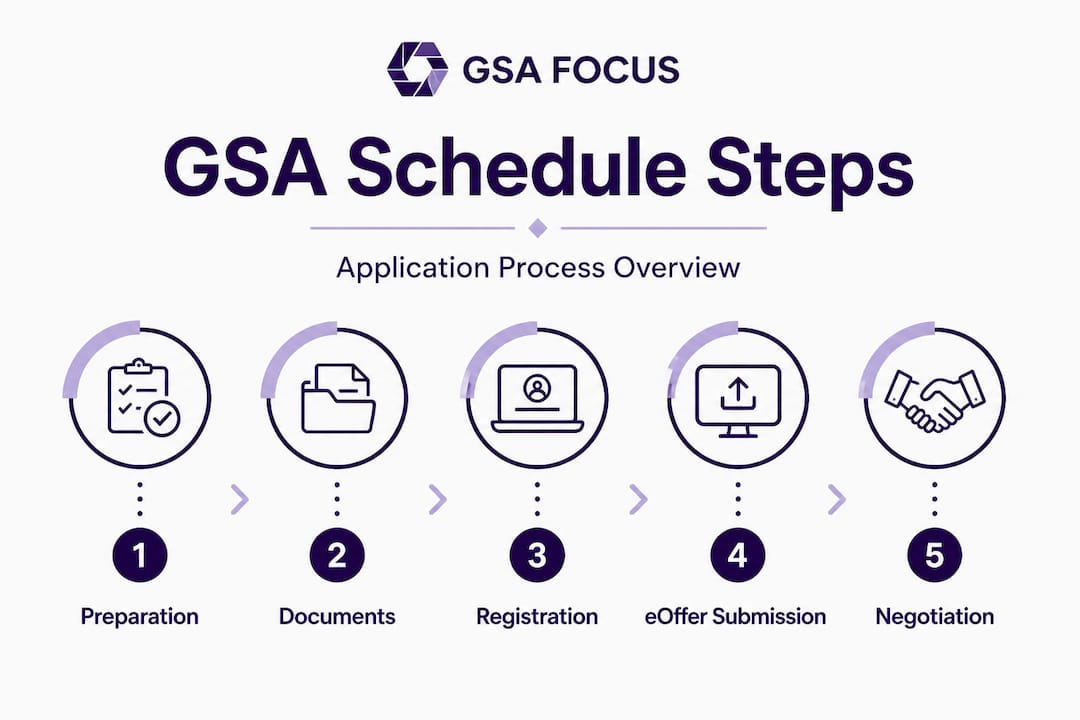
Step-by-step: Applying for your GSA Schedule contract
The application process typically takes 3 to 6 months from start to award, depending on how prepared you are and how quickly you respond to GSA’s questions. Here are the six main stages:
Register in SAM.gov. This is the starting point for all federal contracting. Your registration must be active and accurate, including your business size, NAICS codes, and banking information for electronic payments. Allow up to two weeks for SAM.gov to process new registrations.
Complete Pathways to Success training. Log into the GSA Vendor Support Center and complete this mandatory online course. It covers your obligations as a Schedule holder, pricing requirements, and the importance of the Trade Agreements Act (TAA) compliance for products.
Select your Special Item Numbers (SINs). SINs are the category codes that define what you’re allowed to sell on your Schedule. Choosing the right SINs is critical. Too narrow and you limit your market. Too broad and GSA may push back during review. Use the GSA eLibrary to research SIN definitions and find competitors already on Schedule for reference.
Build your proposal package. Your proposal includes your company narrative, past performance documentation, pricing proposal, and a completed copy of the Mass Modifications acknowledgment. The pricing section is the most scrutinized part. Every rate must tie back to your commercial price list with a clear discount logic.
Submit through eOffer. The eOffer system is GSA’s online portal for proposal submission. Once submitted, your package enters the GSA review queue. Expect a first response within 30 to 90 days. GSA contracting officers may request clarifications or additional documentation, so monitor your email closely.
Negotiate and receive your award. GSA will negotiate pricing, scope, and terms before issuing your final contract. This stage can feel intense, but it’s actually a sign of progress. Once negotiations close and you accept the final terms, your Schedule contract is awarded and posted to GSA Advantage.
Review the GSA Schedule application steps in detail before diving into eOffer so you understand what each field is asking. If your business offers professional services, the GSA professional services process has specific nuances around labor categories and rates that are worth reviewing separately.
Pro Tip: Plan for at least two rounds of clarification requests from GSA reviewers before reaching negotiation. Businesses that respond within 48 hours consistently move through the queue faster. Set a calendar reminder to check your eOffer inbox daily once submitted.
Even with preparation, common pitfalls can disrupt your progress. Let’s look at how to avoid them.
Avoiding mistakes: Common pitfalls and troubleshooting
Getting your application rejected or delayed is frustrating. But what’s even more frustrating is winning your Schedule and then generating zero revenue because you didn’t understand what happens after award. Both problems are preventable.
The most consequential early mistake involves pricing. Your Schedule rates must reflect your most favored customer (MFC) pricing. That means if you charge a commercial client $150/hour, you can’t charge the government $175/hour. GSA audits your commercial invoices and references to verify this, so any inconsistency will trigger a lengthy back-and-forth.
Common mistakes to watch for throughout the process:
- Submitting a proposal before SAM.gov registration is fully active and verified
- Using federal agencies as your primary “test market” without prior commercial sales history
- Listing SINs that don’t align with your actual service or product descriptions
- Failing to disclose discounts given to commercial clients, which affects your MFC calculation
- Ignoring post-award compliance requirements like sales reporting and modification tracking
Consultants report 98% success rates and significantly faster timelines compared to do-it-yourself applicants, but even with a consultant, active post-award marketing is absolutely required. A Schedule contract is not a revenue guarantee. It’s a license to sell.
Official GSA sources emphasize using their checklists and training materials to minimize revision cycles. These resources are free and genuinely useful. The GSA Vendor Support Center contains templates, recorded webinars, and direct contact information for your assigned contracting officer.
Understanding the GSA Schedule consulting pros and cons before you decide whether to go it alone or hire help is a smart first step. The DIY vs. consultant comparison really comes down to your internal capacity and how much time delays would cost your business. For specific service categories, GSA Schedule 70 consultant tips can help you evaluate vendor claims critically.
Pro Tip: Use GSA’s official modification checklist when updating your Schedule post-award. Every price increase, new SIN addition, or scope change requires a formal modification. Missing this process can put your contract out of compliance and expose you to audit risk.
Once you secure your GSA Schedule, it’s crucial to understand the results you can expect and how to leverage them.
What to expect after award: Sales potential and contract management
Here’s the number that matters most: small businesses averaged $1.5 million in annual sales through GSA Schedules in FY2024, across approximately 12,300 small business Schedule holders. That’s a meaningful revenue stream, but it requires active effort to achieve.
Fixed-price contracts are the standard model under current federal policy, offering predictability for both vendors and agencies. For context, the government spent $120 billion on cost-reimbursement consulting contracts in FY2024, but recent executive policy is pushing agencies toward fixed-price models wherever possible. Knowing this shapes how you structure your Schedule pricing strategy.
| Post-award activity | Why it matters | Frequency |
|---|---|---|
| GSA Advantage listing maintenance | Agencies browse it before buying | Ongoing |
| eBuy response | Direct quote requests from agencies | As received |
| Sales reporting (72A Report) | Required compliance, shows activity | Quarterly |
| Contract modification management | Pricing changes, SIN additions | As needed |
| Agency relationship building | Drives repeat orders | Ongoing |
Post-award strategies that actually move revenue:
- Actively respond to eBuy solicitations, even on contracts that feel like long shots, as consistent engagement builds your visibility with contracting officers.
- Maintain a polished GSA Advantage profile with current product or service descriptions, photos, and pricing.
- Attend agency industry days and small business matchmaking events to introduce yourself to contracting officers before they have an active need.
- Build teaming relationships with public sector partnership networks to access prime contractor opportunities that flow through your Schedule.
- Use your post-award sales strategies as a structured plan, not a collection of one-off attempts.
Your Schedule contract can be extended through option years up to that 20-year maximum, but only if you maintain compliance and meet the minimum sales threshold of $25,000 over the life of the contract. Falling below that threshold can result in contract cancellation.
Having guided you through every stage, let’s offer a perspective on the real keys to success in this process.
The uncomfortable truths most guides miss about federal procurement
Most guides stop at “get your Schedule and the revenue flows.” That’s a dangerous oversimplification. Here’s what we’ve seen working directly with hundreds of small businesses through this process.
A GSA Schedule is closer to a fishing license than a guaranteed catch. The license gets you legal access to the water. But the fish don’t jump into your boat. Passive listing isn’t enough to generate meaningful revenue. Real success comes from building genuine relationships with contracting officers, responding fast to eBuy quotes, and staying visible at agency events.
Many small businesses also underestimate the ongoing compliance burden. Modifications, pricing updates, annual representations, and sales reporting are not optional administrative tasks. They’re contractual obligations. Falling behind on any of them can flag your contract for review or termination. We’ve seen businesses lose contracts they worked months to win because they treated compliance as an afterthought.
The consultant question also deserves a frank answer. Yes, experienced consultants accelerate timelines and improve proposal quality. But no consultant can do your post-award marketing for you. The businesses that thrive on their Schedules are the ones that treat their service business growth as an active pursuit, not a passive income stream.
Pro Tip: Treat your GSA Schedule as a launchpad, not an end-point. Build a 12-month marketing plan that includes eBuy monitoring, agency outreach, and teaming strategy before your contract is even awarded. The businesses that win early revenue are the ones that hit the ground running on day one of their award.
The final uncomfortable truth: many small businesses pursue a GSA Schedule because they hear “billions in government spending” and imagine easy contracts. The opportunity is absolutely real. But it rewards preparation, persistence, and active engagement, not just paperwork completion.
Take your next step toward federal sales success
If you’ve made it through this guide, you understand that winning a GSA Schedule contract requires more than filling out forms. It requires a strategic approach, precise documentation, and a post-award marketing plan. At GSA Schedule Services, we work one-on-one with small and medium-sized businesses to handle every stage of the process, from readiness assessments and proposal preparation to negotiation support and post-award compliance management. Our team knows exactly what GSA contracting officers look for, and we help you avoid the costly revision cycles that drag out timelines. Whether you’re starting your first application or optimizing an existing Schedule for more revenue, expert guidance makes the difference between a contract that sits idle and one that actively grows your business.
Frequently asked questions
How long does the GSA Schedule application process take?
The application process typically takes 3 to 6 months from start to finish, depending on how complete your documentation is and how quickly you respond to GSA reviewer requests.
What documents do small businesses need for a GSA Schedule application?
You need 2 years of operational history, financial statements, a commercial price list, and commercial sales proof including invoices or references from at least three customers.
What are the typical sales results for small businesses after securing a GSA Schedule?
On average, small businesses earn about $1.5 million in annual sales through their GSA Schedule contracts, based on FY2024 data across approximately 12,300 small business Schedule holders.
Is hiring a GSA Schedule consultant necessary or can I apply on my own?
Consultants can speed up timelines and improve success rates significantly, but GSA provides free training and resources so both approaches can lead to a successful award. The real differentiator is your post-award marketing effort.
What is the difference between fixed-price and cost-reimbursement contracts?
Fixed-price contracts are the preferred standard for predictability and accountability, while cost-reimbursement contracts are used for complex or unpredictable consulting work and totaled $120 billion in federal spending during FY2024.
Recommended
- GSA Schedule Contracts: Your Guide to Success
- Navigating GSA Contract Vehicles: Your Guide
- Navigating GSA Contract Vehicles: Your Guide
- How to Obtain a GSA Schedule Number: Step-by-step