

Many small business owners spend months chasing federal contracts, sending proposal after proposal, and watching the effort drain time and resources with little to show for it. The problem usually isn’t your product or service. It’s the process. Government procurement operates on a completely different logic than commercial sales, and without a clear map, you’re guessing. This guide gives you that map. You’ll learn how the GSA procurement system works, where real opportunities live, and what separates the businesses winning steady government revenue from those still stuck on the outside looking in.
Table of Contents
- What is government procurement and why does it matter?
- The GSA procurement pathway: How the process actually works
- Forecasting and finding opportunities: Planning ahead for procurement wins
- Order-level decisions: Set-asides, small business strategies, and contract types
- Scoring and improving your procurement game
- Why most SMBs stumble—and what actually works in practice
- Take your next step toward government contracting success
- Frequently asked questions
Key Takeaways
| Point | Details |
|---|---|
| Master the process | Step-by-step GSA procurement knowledge transforms SMB success rates with federal contracts. |
| Plan ahead | Use forecasting tools and SAM.gov to spot and prepare for opportunities before competitors. |
| Leverage set-asides | Order-level set-asides and contract strategies can elevate your win potential as a small business. |
| Track annual goals | Following agency scorecards and category targets helps you align bids where success probability is highest. |
| Refine, don’t just bid | Iterating your procurement strategies is essential—don’t rely on volume, focus on best-fit contracts. |
What is government procurement and why does it matter?
Government procurement is the process federal agencies use to purchase goods and services from outside vendors. Unlike commercial sales, where a buyer and seller can shake hands and close a deal quickly, federal procurement follows strict legal frameworks, competition rules, and documentation requirements. These rules exist to ensure fairness, accountability, and responsible use of taxpayer money. For small businesses, this means the playing field has very specific rules you have to know before you can compete.
What makes this worth learning? Scale. The federal government is the single largest buyer of goods and services in the world, spending hundreds of billions of dollars annually. Even capturing a small slice of that spending can transform a small or medium-sized business. Better still, government contracts typically come with reliable, on-time payment, something commercial clients can’t always guarantee.
Understanding why agencies use GSA contracts is the first step. GSA, the General Services Administration, acts as a kind of centralized marketplace that pre-negotiates contracts with vetted vendors, making it easier and faster for federal agencies to buy. For your business, getting on a GSA Schedule means you’re already approved to sell, which dramatically reduces the friction in each transaction.
Here’s a quick look at the main benefits for SMBs that land GSA contracts:
- Reliable, structured payment protected by federal appropriations
- Access to recurring revenue through multi-year contract vehicles
- Credibility and reputational lift from being a vetted federal supplier
- Broader reach across hundreds of agencies using a single contract
- Set-aside advantages for qualifying small businesses
GSA contracts for dummies style thinking works here: the Schedule is essentially your ticket to a very large, very stable buyer’s club.
The federal government’s procurement structure is intentionally designed to channel significant spend toward small businesses. Agencies are held accountable through annual scorecards and measurable goals, meaning your opportunity is embedded in policy, not just possibility.
How to sell to the government starts with understanding this framework, because every step after it builds on this foundation.
The GSA procurement pathway: How the process actually works
Once you understand why procurement matters, knowing the process details makes all the difference. The GSA Multiple Award Schedule (MAS) is the primary vehicle most SMBs use to enter federal contracting. It’s a long-term government-wide contract that lets agencies buy from a pre-approved pool of commercial vendors at pre-negotiated prices. Getting onto the MAS isn’t instant, but it’s more structured and predictable than chasing individual open-bid solicitations.
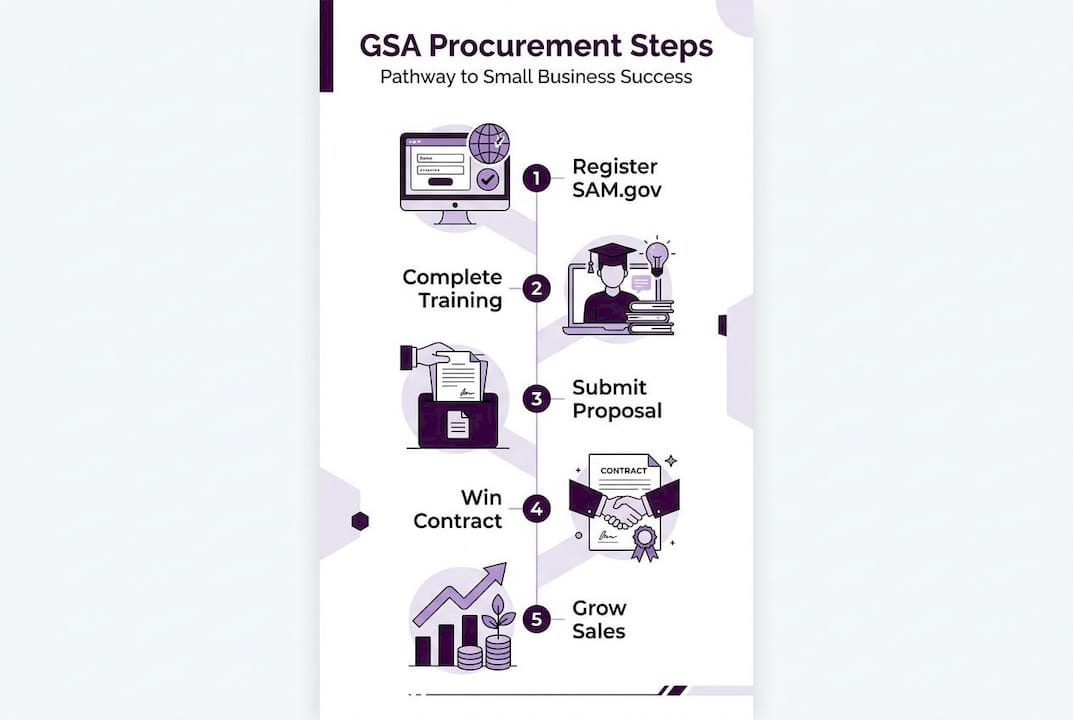
The roadmap to get a MAS contract follows a clear sequence of steps:
- Complete Pathways to Success training — This mandatory online training is required before submitting an offer. Skip it and your application goes nowhere.
- Review the MAS solicitation and category attachments — Each category has specific requirements. You need to match your offerings to the right Special Item Numbers (SINs).
- Register in SAM.gov — Your System for Award Management registration must be active and accurate before you submit anything.
- Prepare and submit your offer through eOffer — This is GSA’s online portal for submitting your pricing, past performance, and documentation.
- Negotiate with your Contracting Officer — GSA reviews your submission and typically negotiates pricing, terms, and scope.
- Receive your award — Once awarded, your contract is live and agencies can begin purchasing from you directly.
Compare this to open-bid procurement and the advantages become clear:
| Factor | GSA MAS pathway | Open-bid procurement |
|---|---|---|
| Process clarity | Structured, step-by-step | Varies widely by agency |
| Speed to first sale | Faster after award | Slower, bid-by-bid |
| Repeat business | Built into contract vehicle | Must rebid constantly |
| Support tools | eOffer, training, GSA support | Minimal standardized support |
| Competitive environment | Pre-vetted vendor pool | Open to all comers |
Pro Tip: Don’t treat the training and readiness steps as administrative hurdles. GSA uses them to filter out underprepared applicants. Businesses that arrive with documentation ready and training completed consistently move through the process faster.
Growing your small business with GSA isn’t just about getting the contract. It’s about understanding the system well enough to use it consistently. The steps to get a GSA contract follow a logical flow, and each one builds on the last.

Forecasting and finding opportunities: Planning ahead for procurement wins
After knowing the roadmap, the next key is knowing where to find and plan for real opportunities so you’re first in line, not last to react. Most SMBs make the mistake of waiting for solicitations to drop before taking action. By then, larger competitors have already built relationships, prepared responses, and positioned their offerings. Proactive businesses use GSA’s forecasting tools to get ahead of the curve.
GSA’s opportunity-forecast tool, the Federal Forecast of Contracting Opportunities (FCO), gives small businesses advance visibility into planned procurement activity. This means you can see what agencies intend to buy months before the official solicitation hits, giving you time to prepare, make contact, and position your business as the obvious choice.
Here’s what a typical FCO entry contains:
- NAICS code — Tells you what type of business the agency wants
- Set-aside designation — Flags opportunities reserved for small businesses
- Estimated value — Helps you assess whether pursuing it makes sense
- Period of performance — Indicates how long the work will run
- Point of contact — The person you can reach out to for clarification
- Anticipated award date — Lets you plan your proposal timeline
Use this data proactively. If you see a forecasted opportunity in your category, reach out early, research the agency’s needs, and tailor your positioning before the competition even knows the opportunity exists.
| FCO field | What it tells you | How to act on it |
|---|---|---|
| NAICS code | Defines the work category | Confirm your business matches this code |
| Set-aside type | Shows who’s eligible to bid | Verify your small business status applies |
| Estimated value | Signals contract size | Assess capacity and teaming needs |
| Anticipated award | Timeline for decision | Plan your proposal and outreach calendar |
Pro Tip: Register in SAM.gov well before you start pursuing opportunities. SAM.gov registration can take a few days to process, and an inactive or expired registration disqualifies you from receiving a contract award regardless of how strong your proposal is.
Understanding strategies to boost GSA MAS sales means treating forecasting as an ongoing practice, not a one-time task. Build it into your weekly business development routine.
Order-level decisions: Set-asides, small business strategies, and contract types
Now that you’re planning your pipeline, let’s dig into the order-level decisions that drive real wins and execution quality for SMBs. Two decisions matter most at this stage: whether an order includes a set-aside for small businesses, and what contract type applies to the work.
Set-asides under the MAS program allow contracting officers to restrict specific task orders or Blanket Purchase Agreements (BPAs) to eligible small businesses. Order-level strategy for small businesses also includes subcontracting plans, where prime contractors commit to using small business subcontractors to meet agency socioeconomic goals. Knowing which socioeconomic categories you qualify for, such as Woman-Owned Small Business, Service-Disabled Veteran-Owned, or HUBZone, can meaningfully increase the number of opportunities you’re eligible to pursue.
Contract type is the second critical variable. Here’s what each means for your business risk:
- Identify the socioeconomic categories your business qualifies for — Check certifications you hold and confirm they’re current in SAM.gov.
- Determine if the opportunity includes a set-aside or subcontracting evaluation factor — Read the solicitation carefully for language about small business participation requirements.
- Assess whether the contract type is fixed-price or cost-reimbursable — Fixed-price means you commit to delivering at a set cost. Cost-reimbursable means the government reimburses your actual costs.
- Price your offer accordingly — Under fixed-price arrangements, underpricing is just as dangerous as overpricing. Build in realistic margin.
- Evaluate your delivery capacity — Be honest about whether your team can execute within the contract’s defined scope and timeline.
Current federal contracting policy strongly favors fixed-price contracts as the default and preferred vehicle, with the intent to hold vendors accountable for defined outcomes and incentivize efficiency. For SMBs, this means your pricing strategy and cost controls have to be sharp before you submit.
Understanding federal services growth secrets often comes down to mastering these order-level decisions early, because they shape your profitability on every contract you win.
Scoring and improving your procurement game
With clarity on order and contract types, let’s explore how to position your SMB for ongoing success by using scorecard data and annual goals. One of the most underused advantages small businesses have in federal contracting is access to transparent, publicly published performance data. GSA and the Small Business Administration publish annual small business contracting goals and track agency-by-agency progress.
GSA’s Small Business Procurement Scorecard assigns measurable targets to federal agencies and measures performance against them every year. This means you can see exactly which agencies are underperforming on their small business spending goals, which category types are underrepresented, and where the unmet demand is concentrated. That’s actionable intelligence most businesses never bother to look for.
For FY2026, the government has maintained a 23% prime contracting goal for small businesses overall, with a separate 33.5% target for small business subcontracting participation. When agencies fall short, they face pressure to close that gap, creating urgency that benefits positioned small businesses.
Here’s how to use scorecard data actively in your strategy:
- Identify low-performing agencies in your service category and prioritize outreach to their contracting officers
- Monitor category-specific goals to find where your NAICS code or SIN aligns with unmet demand
- Adjust your marketing calendar around fiscal year end, typically September, when agencies rush to meet annual spending targets
- Track trends year over year to spot emerging opportunities and agencies increasing small business commitment
The GSA Schedule guide covers how contract vehicles feed into these broader participation numbers. Businesses that treat scorecard data as market research consistently find more relevant opportunities than those relying on generic search tools alone.
Why most SMBs stumble—and what actually works in practice
Here’s the uncomfortable truth most guides won’t tell you. Volume doesn’t win in federal contracting. Submitting more proposals without improving your process is just a faster way to waste time and money. We see this pattern repeatedly: businesses get their GSA Schedule, fire off responses to every opportunity that appears vaguely related to their work, and then wonder why their win rate is low.
The businesses that break through do one thing differently. They treat procurement as a practice rather than a transaction. That means studying the process, refining their offer, and being strategic about where they spend their proposal energy.
The most common pitfalls we see are specific and avoidable. Skipping or rushing the Pathways to Success training is the first. Misaligning your offerings to the wrong SINs or NAICS codes is the second, and it kills your search visibility before the competition even starts. Ignoring the forecast tools and reacting to solicitations instead of anticipating them is the third. And failing to use scorecard data to target the right agencies is the fourth. Each of these is fixable with a bit of discipline.
Growing your small business through a GSA schedule is a long game played with short-term precision. The initial investment in learning the system, including the training, the classification research, the forecasting routine, pays off exponentially as you build institutional knowledge and win rate.
The role of GSA Schedules for small businesses isn’t just about access to contracts. It’s about joining a system that, when navigated well, creates compounding returns. Each win teaches you something. Each relationship with a contracting officer is an asset. Each refined proposal is a template for the next one.
Pro Tip: After each bid, whether you win or lose, document what you submitted, how you priced it, and what feedback you received. This debrief habit creates a proprietary knowledge base that gives you a real edge over competitors who start from scratch every time.
Take your next step toward government contracting success
Understanding procurement is one thing. Executing it consistently without expert support is another challenge entirely. If you’re serious about turning your GSA Schedule into a steady revenue stream, you don’t have to figure it out alone. At GSA Schedule Services, we work directly with SMBs to handle the complexity, from readiness assessments and offer preparation to negotiation support and ongoing marketing strategy.
Whether you’re just starting out or looking to accelerate an existing contract, our GSA Schedule discovery service is designed to show you exactly where you stand and what your next move should be. Thousands of businesses have used structured guidance to cut months off their path to award and dramatically improve their win rates. Your federal sales potential is real. The question is whether you have the right support to unlock it.
Frequently asked questions
How do I know if my business is eligible for GSA contracts?
Eligibility depends on your business size, NAICS code alignment, past performance, and financial stability. Review the MAS solicitation and category attachments for your specific category to confirm requirements before you invest time in an application.
What is a set-aside in federal contracting?
A set-aside reserves a contract opportunity exclusively for small businesses or specific socioeconomic groups, such as veteran-owned or woman-owned firms. Order-level set-asides under the MAS program can significantly increase a qualifying small business’s competitive advantage on specific task orders.
How does fixed-price contracting impact small businesses?
Fixed-price contracts give you cost certainty and reduce administrative burden, but they also transfer delivery risk to you as the vendor. Because fixed-price contracting is now the preferred federal default, your pricing accuracy and execution planning need to be tight before you commit.
How can I find upcoming federal contract opportunities?
Use GSA’s Federal Forecast of Contracting Opportunities to see planned procurement activity before solicitations are officially posted. Combining this with regular SAM.gov searches puts you ahead of most competitors who only react to live opportunities.
What is the Small Business Procurement Scorecard?
It’s a publicly available annual report that tracks each federal agency’s progress toward small business contracting goals. GSA’s scorecard lets you identify which agencies have unmet targets in your category, giving you a data-driven way to prioritize your outreach and proposal efforts.
Recommended
- Federal Government Procurement Forecast 2023 Guide
- Your Guide to Securing Government Contracts Successfully
- Guide to Becoming a Government Contractor: Your Path To Success
- Navigating Federal Procurement Guidelines Effectively
- Prime contractor guide: Partnering for public sector IT