

Small businesses generated $18.2 billion in GSA Schedule sales in FY2024, yet most business owners never seriously consider the federal market. The reason is usually a mix of intimidation and misinformation. Many assume government contracting is reserved for massive defense corporations or politically connected firms. In reality, thousands of small businesses across IT, professional services, construction, and more land recurring federal deals every year through the GSA Multiple Award Schedule (MAS) program. This article breaks down the real numbers, the actual requirements, the challenges you need to know about, and the strategies that separate small businesses that thrive in this space from those that give up early.
Table of Contents
- The size and scope of federal opportunities
- What makes government contracting attractive for small businesses?
- What does it take to succeed? Process, investment, and key challenges
- Alternative paths: Subcontracting and building experience first
- Why treating government contracting as a strategic channel matters
- Ready to pursue government contracting?
- Frequently asked questions
Key Takeaways
| Point | Details |
|---|---|
| Federal market is massive | Small businesses accessed over $178 billion in reserved government contracts last year. |
| Stability and growth | Government contracts can offer recession-resistant, long-term revenue streams for committed firms. |
| Rigorous requirements | Expect significant investment, tight compliance, and a multi-step application process before winning contracts. |
| Subcontracting is a strong start | Many business owners build track records by subcontracting before pursuing prime GSA awards. |
| Strategic approach wins | Treating government contracting as a dedicated channel—backed by expert help and high visibility—leads to the highest ROI. |
The size and scope of federal opportunities
The federal procurement market is enormous. In FY2025, the government awarded approximately $681 billion in total contracts, a figure that dwarfs most commercial industry segments. What often surprises small business owners is how much of that pie is specifically reserved for them.
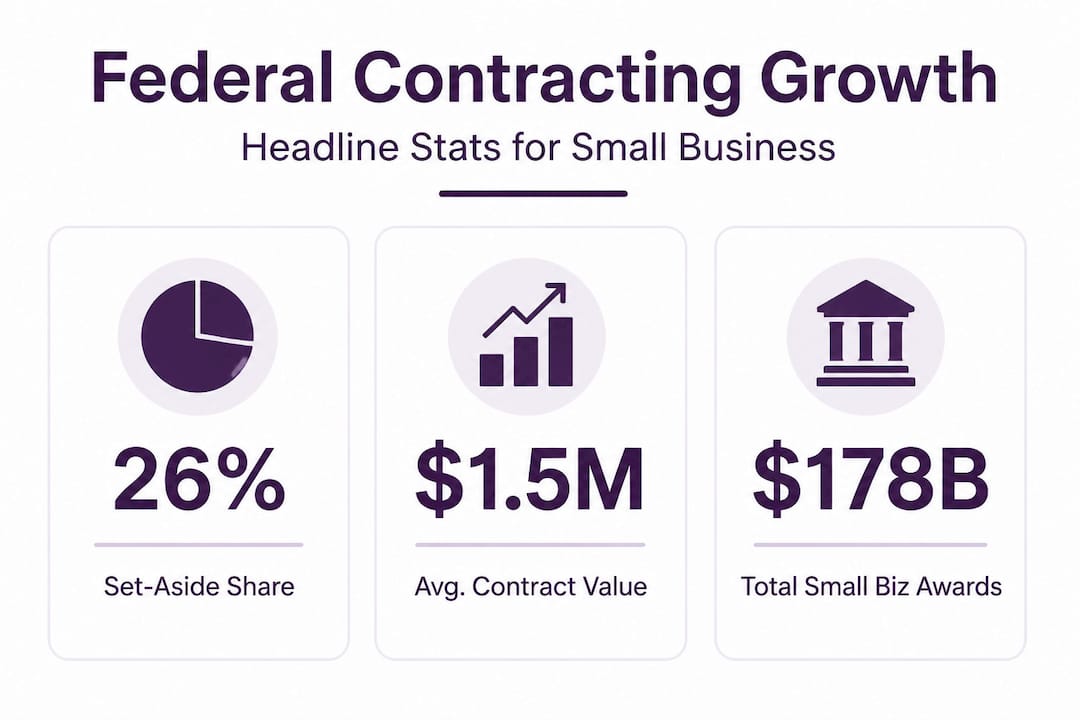
The government awarded $178.3 billion in small business set-aside prime contracts in FY2025, which represented 26.2% of total federal spending and actually exceeded the statutory 23% goal set by Congress. That’s not a minor side channel. That’s a deliberate government policy designed to channel hundreds of billions toward smaller firms.
| Market segment | FY2025 approximate value |
|---|---|
| Total federal procurement | $681 billion |
| Small business set-asides | $178.3 billion |
| GSA Schedule small biz sales (FY2024) | $18.2 billion |
| Average sales per small biz GSA holder | ~$1.5 million |
Set-aside contracts are a critical concept to understand. These are contracts that federal agencies are legally required to offer only to small businesses, or to specific subcategories like veteran-owned, women-owned, or HUBZone firms. This means you are not competing with Lockheed Martin or IBM for these dollars. You are competing with businesses your size.
A few key industries where new entrants regularly find traction include:
- IT and cybersecurity services, which represent some of the highest-volume GSA categories
- Professional and management consulting
- Facilities maintenance and janitorial services
- Training and education
- Healthcare products and staffing
Understanding GSA contract eligibility often reveals that companies already meeting commercial standards qualify for the program. Many of the myths about GSA contracts stem from people assuming the barriers are far higher than they actually are.
What makes government contracting attractive for small businesses?
Now that we know the numbers, let’s clarify exactly why so many small businesses view government contracts as uniquely attractive beyond the hype.
The most cited reason is revenue stability. Federal agencies operate on multi-year budgets, and contracts often run for five years or more with option periods. Unlike commercial clients who can delay payments, cancel orders, or pivot strategy mid-stream, government agencies pay consistently and on defined schedules. During economic downturns, the federal budget does not simply disappear. That makes government revenue a natural hedge against the commercial volatility that crushes small businesses in recessions.

Here is a quick comparison of government versus commercial contracting from a strategic standpoint:
| Factor | Government contracts | Commercial contracts |
|---|---|---|
| Payment reliability | Very high (31-day standard) | Variable |
| Contract length | 1 to 5+ years | Often short-term or ad hoc |
| Competition | Set-asides limit field | Open to all sizes |
| Compliance burden | High | Moderate |
| Marketing required post-award | Yes, ongoing | Variable |
| Revenue predictability | High | Low to moderate |
For small businesses, key GSA Schedule info reveals that a single contract vehicle gives you access to all federal agencies simultaneously, rather than having to pitch each client individually.
Certifications matter enormously here. Firms with a strong DSBS (Dynamic Small Business Search) profile and relevant certifications such as 8(a), WOSB, SDVOSB, or HUBZone see dramatically better results. Research shows that high-visibility firms with complete profiles and active certifications achieve 3x higher win rates and generate up to 17x more lifetime federal revenue compared to firms with minimal online presence in the federal ecosystem.
“Treat your GSA Schedule like a strategic sales channel, not a passive listing. The businesses winning the most federal dollars are the ones actively marketing within the federal marketplace, not simply waiting for awards to arrive.”
The GSA process is a platform, not a guarantee. But for firms that treat it seriously, even a single initial contract win at $200,000 to $500,000 can deliver significant ROI and build the past performance record needed to pursue larger, more complex awards in subsequent years.
Small business contracts averaged nearly $1.5 million per GSA holder. That figure represents a realistic revenue target for a focused small business operating in a strong category.
Pro Tip: When evaluating whether government contracting fits your business model, calculate your current average deal size and contract length in commercial work. If federal contracts would represent a 2x to 3x improvement in revenue per engagement with greater predictability, the math strongly favors exploring the GSA route.
What does it take to succeed? Process, investment, and key challenges
Appreciating the upside isn’t enough. Here’s what the real journey to government contracts involves, so you can decide if the trade-offs fit your goals and capabilities.
The application process for a GSA Multiple Award Schedule contract runs through GSA’s eOffer system. Here are the core steps:
- Register in SAM.gov (System for Award Management). This is mandatory for any government contractor and must stay active annually.
- Select your SIN (Special Item Number). Each SIN corresponds to a product or service category. Choosing the right one affects your competition and visibility significantly.
- Prepare your technical proposal. This explains your qualifications, experience, relevant past performance, and why your offerings meet federal standards.
- Prepare your pricing proposal along with the Commercial Sales Practices (CSP) disclosure. The CSP document discloses how you price your offerings to commercial customers so the government can negotiate favorable rates.
- Confirm TAA (Trade Agreements Act) compliance. Products and some services must originate from TAA-compliant countries.
- Submit past performance data. Federal contracting officers want proof that you’ve delivered similar work successfully before.
The GSA application steps outline this in more detail, and understanding the process ahead of time saves costly mistakes.
Typical timelines run 3 to 6 months with some reaching 12 months depending on how complete your documentation is and how quickly GSA reviews your submission. One important data point: the first-try DIY success rate is approximately 15%, while firms guided by experienced consultants reach success rates as high as 98%. That’s not a small gap. It reflects just how nuanced the compliance requirements and pricing negotiations are.
Cost expectations are important to set early. Upfront investment typically runs $5,000 to $50,000 for initial setup, compliance work, and proposal preparation. Ongoing costs for compliance reporting, marketing, and maintaining your schedule can reach $30,000 to $100,000 annually. Timeline to steady, predictable federal revenue is generally 18 to 36 months from initial application.
Those numbers can sound steep, but consider the return: even one contract win at $200,000 covers most of the annual investment and positions you for repeat business. Initial win rates typically start at 3 to 5% for new entrants and improve to 15 to 25% as you build past performance and federal marketplace visibility.
“The single biggest mistake new entrants make is treating post-award marketing as optional. Getting the schedule is just the license. Winning contracts requires active engagement with contracting officers, regular GSA Advantage catalog updates, and consistent federal market outreach.”
There are real drawbacks to GSA schedules that every business owner should weigh honestly. The price reduction clause limits your ability to adjust rates for federal buyers if you lower prices for commercial customers. Compliance audits can be burdensome. And the time from contract award to first purchase order can be longer than most small business cash flows accommodate comfortably.
Before committing, reviewing what to look for in a GSA consultant can prevent costly choices. And if you want a clear roadmap, the step-by-step GSA process explains each phase in detail.
Government contracting is an outstanding fit for businesses with existing commercial track records, strong service delivery operations, and 18 to 36 months of financial runway to invest in building the channel. It is not a strong fit for firms in financial distress, those without documented past performance, or companies expecting fast returns without sustained marketing effort.
Alternative paths: Subcontracting and building experience first
If the main process sounds too steep right now, there’s a practical and strategic alternative. Subcontracting is a legitimate and often underused entry point for small businesses that aren’t yet ready for a prime GSA Schedule contract.
Large prime contractors who win major federal contracts are typically required by law to develop small business subcontracting plans. These plans commit them to awarding portions of their work to small businesses, and they are reviewed and enforced by contracting officers. Subcontracting through large primes offers a structured way for beginners to enter the federal market without the full compliance burden of prime contracting.
Benefits of starting as a subcontractor include:
- Building documented past performance with real federal project references
- Learning federal compliance norms in a lower-risk environment where the prime absorbs the administrative burden
- Developing relationships with contracting officers, program managers, and agency staff
- Earning certifications and past performance ratings that strengthen a future GSA prime application
- Generating federal revenue while you prepare your own GSA application in parallel
To find subcontracting opportunities, start by searching USASpending.gov for large prime awards in your industry, then reach out directly to those prime contractors with your capabilities and small business certifications. Many primes actively seek qualified subcontractors and will add vetted small businesses to their preferred supplier lists.
Leveraging the GSA process as a subcontractor builds real experience that makes your eventual prime application dramatically stronger. Think of subcontracting as your federal market internship that actually pays.
Why treating government contracting as a strategic channel matters
Here is where most articles stop short, and where we want to give you a more honest perspective.
The data is clear: firms with high federal visibility generate 17 times more lifetime federal dollars and win contracts three times more often. But visibility isn’t just about having a complete profile. It’s about a consistent, deliberate strategy. The businesses that fail at government contracting almost always made one of two mistakes. They either treated their GSA Schedule as a passive listing, waiting for phone calls that never came, or they pursued government contracting as a side effort while their main attention stayed on commercial work.
Government contracting rewards commitment in a way few commercial channels do. Federal contracting officers buy from vendors they trust, and trust is built through consistent outreach, updated pricing, responsive communication, and delivered performance on every contract regardless of size. A $15,000 task order handled flawlessly opens doors to $1.5 million contract renewals.
The uncomfortable truth is that many small businesses spend thousands to get their GSA Schedule, then do almost nothing with it for 12 to 24 months, and eventually conclude that “government contracting doesn’t work.” It worked fine. They just didn’t show up for the work.
Choosing the right GSA consultant from the start shapes not just your application success rate but the entire strategic posture of your federal channel. The right partner doesn’t just file your paperwork. They help you build a federal sales strategy, position your offerings correctly, and maintain the compliance discipline that protects your investment over time.
Government contracting is not a shortcut. It is a strategic channel that rewards well-prepared, committed businesses with recession-resistant revenue at a scale most commercial clients simply can’t offer.
Ready to pursue government contracting?
If the numbers and the strategy in this article resonate with you, the next step is figuring out where your business stands today and what it would take to get schedule-ready. The application process is genuinely complex, pricing negotiations require specific expertise, and compliance errors can delay or derail your approval for months. Working with specialists who understand GSA inside and out dramatically changes your odds and your timeline. Our GSA contract discovery service walks you through a readiness assessment so you know exactly what gaps to close before submitting, what SINs fit your offerings, and how to position your business for early federal wins. Whether you’re starting fresh or looking to maximize an existing schedule, expert support turns a 15% DIY success rate into a 98% guided one.
Frequently asked questions
How long does it take to get a GSA Schedule contract?
The process typically takes 3 to 6 months but can extend up to 12 months depending on documentation completeness and GSA review cycles. Working with a consultant generally accelerates timelines.
What are the main costs involved in pursuing government contracts?
Upfront costs range from $5,000 to $50,000 for setup and compliance work, with ongoing annual expenses between $30,000 and $100,000 for marketing, reporting, and compliance maintenance.
Can I start with subcontracting before pursuing a GSA Schedule?
Yes. Subcontracting under large primes is a well-established path for small businesses to build past performance, gain federal experience, and strengthen a future prime application.
Is government contracting a good fit for any small business?
Not universally. Firms with strict compliance limits, minimal cash flow, or expectations of fast revenue may find the investment difficult to sustain. It rewards businesses with existing track records, financial runway, and long-term commitment to the federal market.
Recommended
- I Have My GSA Contract, Now What?
- Using CARES Act Funds to Pursue a 2020 GSA Contract
- Government Contracts: An Introduction
- Who Buys from a GSA Contract?
- Prime-Ready IT Modernization Partner for Public Sector
- How to Plan Government Asset Sales for Spring 2026 | Blog | Insights on Asset Liquidation and Auction Trends