

Landing a GSA Schedule contract is a major milestone for any small or medium-sized business. But winning the contract is only the beginning. Thousands of businesses lose their GSA eligibility every year not because they failed to deliver good work, but because they missed a renewal deadline, skipped a certification update, or ignored a mass modification notice sitting in their inbox. Federal contract compliance is not a one-time checklist. It is a continuous obligation, and the consequences of falling behind range from contract suspension to permanent cancellation. This article breaks down the most critical GSA Schedule compliance requirements with concrete examples so you can protect what you worked hard to earn.
Table of Contents
- Annual system registration and ongoing updates
- Ongoing renewal of small business certifications
- Mass modifications, pricing updates, and clause compliance
- Minimum sales thresholds and performance requirements
- Summary comparison: Your compliance checklist for GSA Schedules
- Why pricing traps and supply chain clauses are the real SMB compliance hurdles
- Take the stress out of GSA contract compliance
- Frequently asked questions
Key Takeaways
| Point | Details |
|---|---|
| Annual registration essential | Renew SAM.gov registration every year to avoid suspension or loss of GSA contract eligibility. |
| Certifications require vigilance | Keep 8(a), HUBZone, and WOSB certifications current to maintain GSA Schedule eligibility. |
| Pricing and modifications matter | Respond to mass modifications, update pricelists, and follow FAR clauses to stay compliant. |
| Minimum sales keep contracts active | Meet sales thresholds or contract risks cancellation; use tools and strategies for tracking. |
| Expert help prevents costly errors | Consult professionals for supply chain and pricing compliance to avoid common SMB pitfalls. |
Annual system registration and ongoing updates
Your GSA Schedule contract is only as valid as your registration in SAM.gov, which stands for System for Award Management. Think of SAM.gov as the federal government’s master database of approved vendors. If your registration lapses, you effectively disappear from the system, and agencies cannot legally award you contracts or process payments.
GSA Schedule contractors must maintain annual SAM.gov registration and update any changes immediately. That means every year, without exception, you must log in and renew your registration before it expires. The renewal window opens 60 days before your expiration date, and GSA recommends starting early because the process can take time if discrepancies arise.
Beyond annual renewal, you must also update your SAM.gov record whenever key business information changes. This includes:
- Business address or physical location changes
- Banking and Electronic Funds Transfer (EFT) information updates
- Points of contact, including Authorized Negotiators
- NAICS codes or business size classifications
- Ownership or legal structure changes
Failing to update this information promptly is not just an administrative oversight. It can trigger payment delays, audit flags, or even suspension of your contract. For example, if your bank account changes and you do not update your EFT details in SAM.gov within a reasonable timeframe, federal agencies may be unable to process payments owed to you. That is lost revenue you may never recover.
Part of maintaining GSA contracts successfully is treating SAM.gov like a living document, not a one-time form you filled out during the application process. If you are unfamiliar with the initial GSA registration process, it helps to understand what data fields you originally submitted so you know exactly what to monitor for changes.
Pro Tip: Set calendar reminders 90 days, 60 days, and 30 days before your SAM.gov expiration date. Also create a trigger reminder for any internal business change, such as a new bank account or office move, so you update SAM.gov within 30 days of that change.
Ongoing renewal of small business certifications
If your business holds a small business set-aside certification, that certification is not a permanent badge. It requires active maintenance. Small business contractors on GSA Schedules must renew certifications for programs like 8(a), HUBZone, and WOSB at specified intervals to maintain eligibility.
Here is a breakdown of the major certifications and their renewal considerations:
- 8(a) Business Development Program: Participation lasts nine years total, split into a four-year developmental stage and a five-year transitional stage. Annual reviews are required, and businesses must certify continued eligibility each year through the SBA’s portal.
- HUBZone Certification: Businesses must recertify every three years, but they are also required to maintain continuous compliance, meaning the required percentage of employees must live in a HUBZone throughout the certification period, not just at renewal time.
- Women-Owned Small Business (WOSB) and Economically Disadvantaged WOSB (EDWOSB): These certifications are managed through the SBA’s certification system and require annual recertification to confirm continued eligibility.
- Service-Disabled Veteran-Owned Small Business (SDVOSB): Managed through the VA’s Vendor Information Pages (VIP) database, with periodic verification requirements.
- Small Business status generally: Size recertification is required at specific contract milestones, including every five years for long-term contracts and upon any merger or acquisition.
Missing a renewal deadline does not just put your certification at risk. It puts your entire GSA Schedule contract at risk. Agencies rely on your certification status when selecting vendors for set-aside opportunities. If your certification lapses and you continue to market yourself as a certified vendor, you could face legal consequences beyond contract cancellation.
“Maintaining current certifications is the backbone of small business GSA compliance. Without active certification management, even the most capable vendor can lose access to billions in set-aside opportunities overnight.”
Understanding the SBA certification process in detail is essential before you apply for a GSA Schedule, and reviewing GSA eligibility requirements periodically ensures you stay ahead of changes in the rules.
Pro Tip: Keep digital scans of all certification letters and approval notices in a dedicated compliance folder. Schedule renewal checks six months before each certification’s expiration date, not one month before.
Mass modifications, pricing updates, and clause compliance
Mass modifications are one of the most misunderstood compliance triggers for GSA Schedule holders. A mass modification is a contract-wide update issued by GSA that incorporates new clauses, removes outdated language, or adjusts terms across all active contracts simultaneously. GSA Schedule holders must sign mass modifications within 90 days, maintain pricelists on the Vendor Support Center, and comply with clauses requiring ongoing attention.
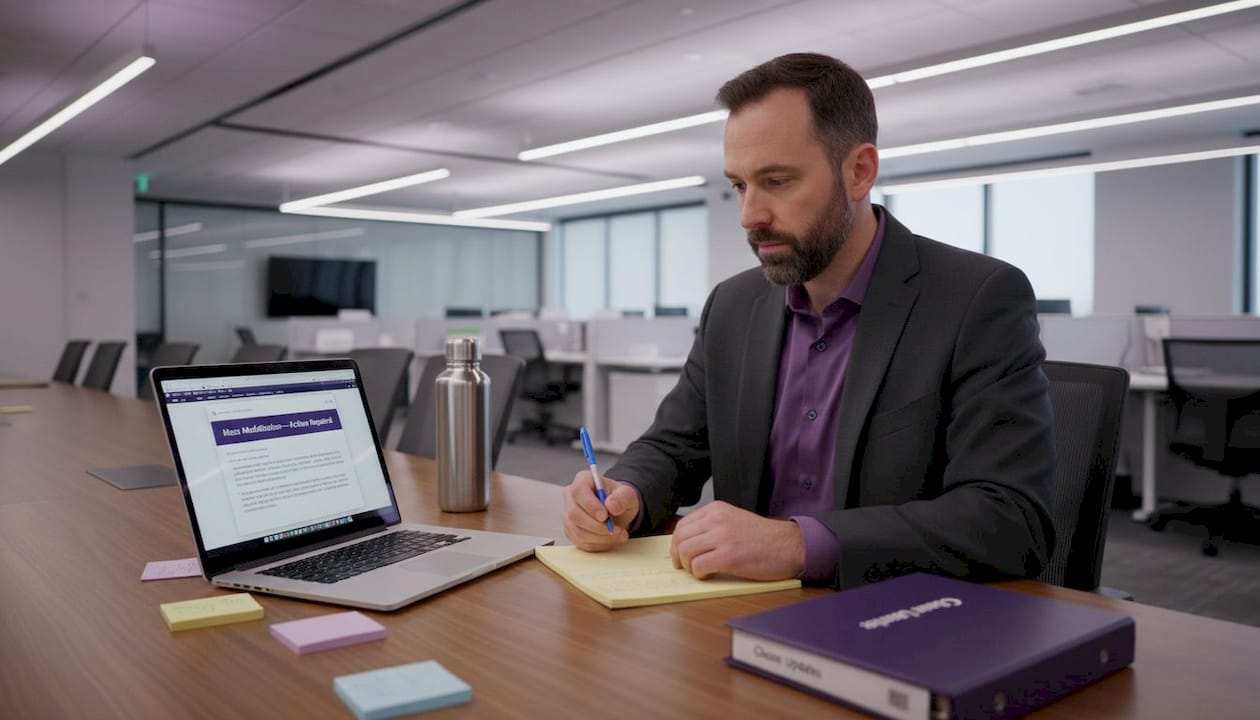
Missing the 90-day window to accept a mass modification can result in your contract being placed in a non-compliant status, which effectively removes you from active consideration for new task orders. GSA sends notifications through the eMod system, but it is your responsibility to monitor and respond.
Your pricelist on the GSA Vendor Support Center (VSC) must also stay current. If your commercial pricing changes, you may be required to pass those reductions to the government under the Price Reduction Clause (PRC). Failing to report price reductions proactively is one of the most common compliance errors and can result in audits, mandatory refunds, and contract termination.
Here is a comparison of key FAR clauses that GSA Schedule holders must actively monitor, based on the FAR provision and clause matrix:
| FAR Clause | Topic | Frequency of Review | SMB Risk Level |
|---|---|---|---|
| 52.204-23 | Kaspersky prohibition | At contract award and renewal | High |
| 52.204-28 | FASCSA supply chain security | Ongoing | High |
| 52.219-3 | HUBZone price preference | At each order | Medium |
| 52.222-54 | E-Verify employment eligibility | Ongoing | High |
| 52.232-29 | Financing terms | At modification | Medium |
| TAA compliance | Trade Agreements Act | Per product/service offered | Very High |
| CMMC requirements | Cybersecurity Maturity Model | Phased rollout, ongoing | High |
Key actions to stay ahead of clause compliance:
- Review your eMod inbox weekly for mass modification notices
- Update your VSC pricelist within 30 days of any commercial price change
- Audit your supply chain annually for TAA compliance on all products
- Verify E-Verify enrollment is active and up to date for all new hires
- Monitor CMMC guidance as requirements continue to evolve for IT and defense-related schedules
Staying current on your GSA Schedule contract checklist and understanding the nuances of changing contract pricing will help you avoid the most costly compliance errors in this category.
Minimum sales thresholds and performance requirements
Here is a compliance requirement that surprises many new GSA Schedule holders: you must actually sell a minimum amount through your contract or risk losing it. Small businesses must achieve minimum sales of $100K in the first five years and $125K every five years thereafter, or risk cancellation.
This requirement exists because GSA invests significant resources in awarding and administering contracts. A contract with zero or minimal sales activity is not serving its purpose. GSA actively reviews sales performance and will issue a notice of cancellation if you consistently fall below the threshold.
| Time Period | Minimum Sales Required | Consequence of Failure |
|---|---|---|
| First 5 years of contract | $100,000 cumulative | Contract cancellation |
| Every 5-year period after | $125,000 per period | Contract cancellation |
| Annual reporting | Sales reported via 72A system | Audit risk if unreported |
Steps to monitor and improve your GSA sales performance:
- Register on GSA Advantage! and keep your pricelist visible and updated
- Use the 72A Quarterly Sales Reporting system to track and submit your sales on time
- Actively market your GSA contract to federal buyers through targeted outreach
- Partner with prime contractors if direct agency sales are slow
- Attend GSA industry days and procurement conferences to build agency relationships
Understanding how growing with GSA Schedule works in practice gives you a roadmap for hitting these thresholds. And if you are still learning the fundamentals, the GSA contract success guide is a solid starting point.
Pro Tip: Use GSA’s eLibrary and Advantage! tools to research what similar vendors are selling and at what price points. If your sales are lagging, the problem is often pricing or visibility, not demand.
Summary comparison: Your compliance checklist for GSA Schedules
Compliance involves ongoing monitoring of SAM, certifications, pricelists, and prompt reporting of price reductions via eMod; failure triggers audits, refunds, and termination. Here is a consolidated view of everything covered so far:
| Requirement | Frequency | Consequence of Failure | SMB Risk |
|---|---|---|---|
| SAM.gov registration renewal | Annual | Contract suspension | Very High |
| SAM.gov information updates | As changes occur | Payment delays, audit | High |
| 8(a) certification review | Annual | Loss of set-aside eligibility | High |
| HUBZone recertification | Every 3 years | Loss of HUBZone status | High |
| WOSB/EDWOSB recertification | Annual | Loss of set-aside eligibility | High |
| Mass modification acceptance | Within 90 days | Non-compliant status | Very High |
| Pricelist updates (VSC) | As pricing changes | PRC violation, refunds | Very High |
| FAR clause compliance | Ongoing | Audit, termination | High |
| Minimum sales threshold | Every 5 years | Contract cancellation | High |
Recommended order of compliance actions for SMBs:
- Confirm your SAM.gov registration is active and accurate today
- Identify all certifications you hold and map their renewal dates
- Log into eMod and confirm no pending mass modifications require your signature
- Review your VSC pricelist for accuracy against your current commercial pricing
- Pull your 72A sales report and compare against your minimum threshold pace
- Schedule a quarterly compliance review on your calendar for the next 12 months
For a deeper look at the full picture, the federal contractor services overview is a helpful resource for understanding how these requirements fit into your broader federal contracting strategy.
Why pricing traps and supply chain clauses are the real SMB compliance hurdles
Most articles about GSA compliance focus on the administrative basics: renew your SAM.gov registration, keep your certifications current, respond to mass mods. That advice is correct. But it misses where small businesses actually get hurt.
In our experience working with SMBs across dozens of GSA Schedule categories, the two compliance areas that produce the most costly and unexpected consequences are price reduction compliance and supply chain security under TAA and CMMC requirements. Official GSA guidance emphasizes routine admin, while compliance experts consistently flag pricing traps and supply chain security as the top SMB risk areas.
Here is why. The Price Reduction Clause requires you to notify GSA whenever you lower your price to your “basis of award” customer, which is the commercial customer whose pricing was used to establish your GSA rates. Many small business owners do not track this relationship carefully. They offer a one-time discount to a commercial client, forget to report it, and months later face a government audit demanding refunds on all GSA orders placed during that period.
TAA compliance is equally tricky. If you sell products on your GSA Schedule, every item must be manufactured or substantially transformed in a TAA-designated country. The problem is that global supply chains shift. A product that was TAA-compliant when you were awarded your contract may no longer qualify if your supplier changes manufacturing locations. You are responsible for monitoring this, and GSA auditors do check.
CMMC, the Cybersecurity Maturity Model Certification, is still rolling out across defense-related schedules, but its reach is expanding. Small IT and professional services firms that assumed cybersecurity requirements only applied to Department of Defense prime contractors are now discovering they apply further down the supply chain than expected.
The uncomfortable truth is that routine admin tasks are visible and easy to schedule. Pricing traps and supply chain risks are invisible until they become expensive. Always review your pricing relationships and country-of-origin documentation before making any commercial pricing change or switching suppliers. And consult with a compliance expert before any significant pricing adjustment or supply chain restructuring.
Take the stress out of GSA contract compliance
Managing GSA Schedule compliance on top of running your business is genuinely demanding. Between SAM.gov renewals, certification timelines, mass modification deadlines, pricelist updates, and sales reporting, there are dozens of moving parts that require consistent attention. At GSA Schedule support services, we work specifically with small and medium-sized businesses to handle the compliance routines that put contracts at risk. From monitoring your certification renewal dates to reviewing your pricing structure for PRC exposure, our team keeps your contract clean and your pipeline open. You built your business. We help you protect your federal revenue stream so you can focus on delivering results to your agency clients.
Frequently asked questions
What is SAM.gov and why must I renew registration annually?
SAM.gov is the federal System for Award Management portal where all government vendors must register; annual renewal is required to maintain active eligibility for GSA Schedule contracts and receive federal payments.
Which certifications must small businesses regularly renew to keep GSA eligibility?
Certifications like 8(a), HUBZone, and WOSB require renewal at specified intervals ranging from annual reviews to every three years, and a lapse in any of them can disqualify you from set-aside opportunities on your GSA contract.
What are mass modifications and how quickly must I respond?
Mass modifications are government-wide contract updates that incorporate new clauses or terms across all active GSA Schedules; you must sign within 90 days of receiving the notice through the eMod system or your contract may be placed in non-compliant status.
How much must I sell on my GSA Schedule contract to keep it active?
You must reach at least $100K in sales within your first five contract years and $125K in every five-year period after that, or GSA may cancel your contract for insufficient sales activity.
Which federal clauses are most critical for GSA Schedule holders?
GSA MAS contracts incorporate numerous FAR clauses covering cybersecurity prohibitions, E-Verify employment verification, supply chain integrity, HUBZone pricing preferences, and financing terms, all of which require active monitoring throughout your contract period.
Recommended
- GSA Compliance: Don’t Get Lost | GSA Focus
- (Infographic) 25 Reasons GSA Contracts are Rejected
- Top 10 Interesting Compliance Risks for GSA Contract Holder
- Utilizing the Federal GSA Process in Your Business
- What is a contract-ready partnership? Guide for public sector IT