
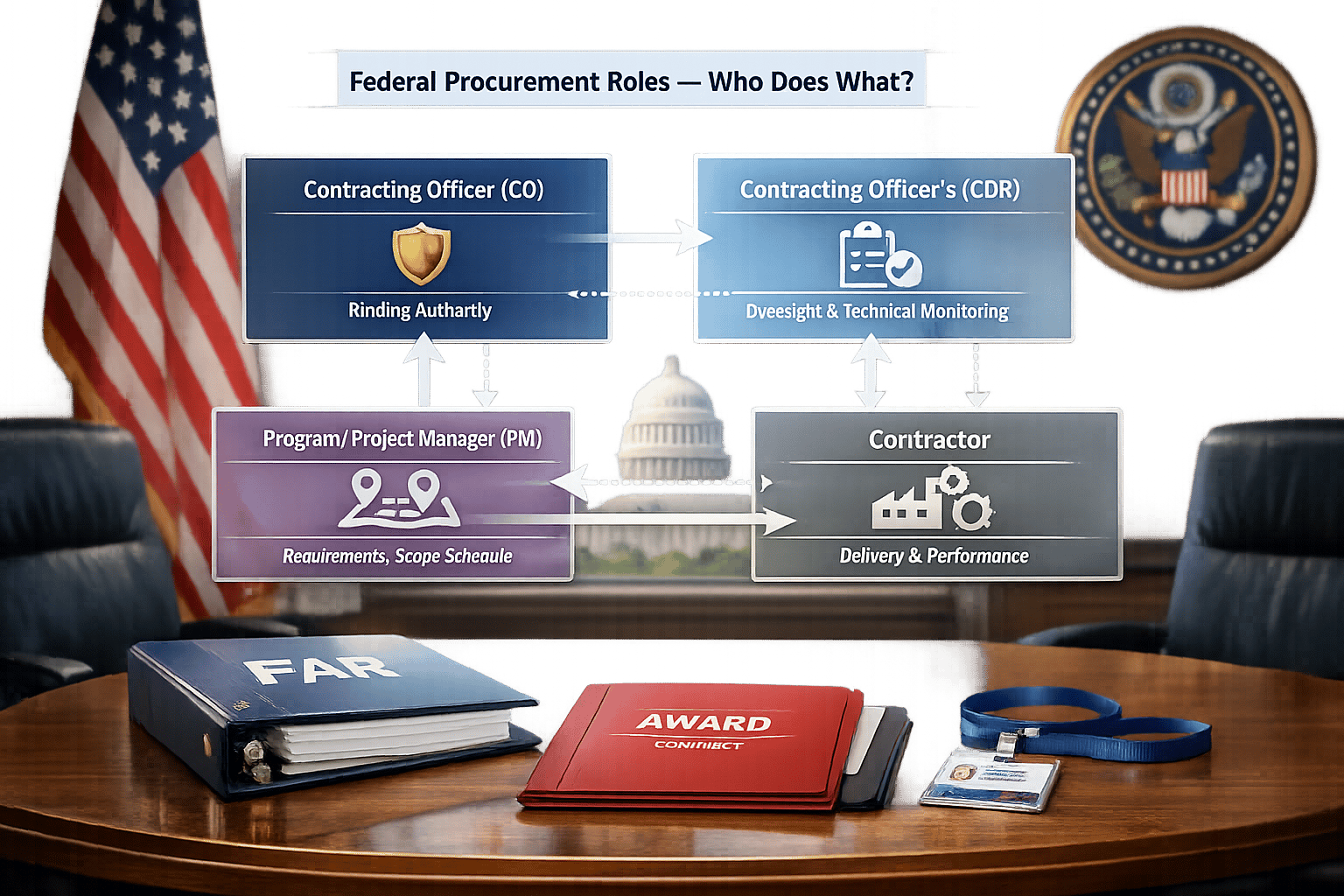
Federal procurement involves a structured process with defined roles, making it essential for businesses to understand who does what. Key players include:
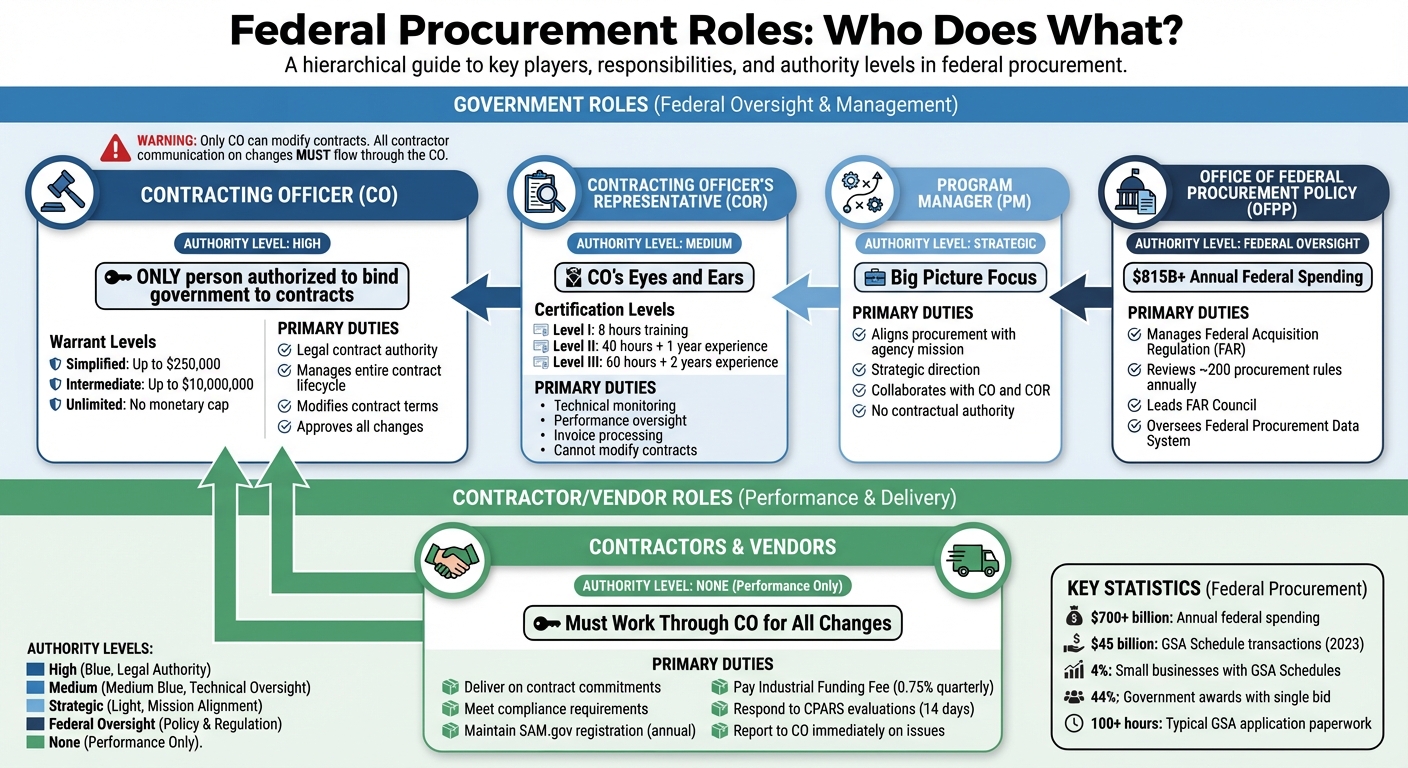
- Contracting Officer (CO): The only official authorized to legally bind the government to contracts. They oversee the entire contract lifecycle, from solicitation to termination, ensuring compliance with regulations.
- Contracting Officer’s Representative (COR): Acts as the CO’s technical monitor, ensuring contractors meet performance standards. CORs cannot modify contracts but play a critical role in oversight and reporting.
- Program Manager (PM): Focuses on aligning procurement with the agency’s mission. They provide strategic direction and collaborate with COs and CORs to ensure successful outcomes.
- Office of Federal Procurement Policy (OFPP): Shapes procurement policies at the federal level, oversees the FAR, and promotes efficiency across agencies.
- Contractors and Vendors: Deliver on contract commitments, ensure compliance with strict standards, and communicate effectively with federal personnel.
Understanding these roles helps businesses navigate the federal contracting landscape, avoid missteps, and communicate with the right decision-makers. With over $700 billion in annual federal spending, this knowledge is vital for securing opportunities, especially for small businesses benefiting from set-aside programs like HUBZone or 8(a). For those new to the system, expert support can simplify the process and save time.
Federal Procurement Roles and Responsibilities Guide
Acquisition 101: What is the Government Contracting Officer Thinking?
What Does the Contracting Officer (CO) Do?
The Contracting Officer (CO) is the only federal official authorized to legally commit the U.S. government to a contract. This authority is granted through a formal warrant – often Standard Form 1402 – issued by the agency head. The warrant outlines the specific scope and dollar limits of the CO’s authority. Any actions taken beyond these limits are not legally binding on the government.
“A contracting officer (CO) is the only individual authorized to bind the government to a contract.” – FAR 2.101
CO Authority and Duties
The CO plays a central role in managing the entire contract lifecycle, including solicitation, award, modification, and even termination. Their actions must comply with the Federal Acquisition Regulation (FAR), agency-specific supplements, and applicable procurement laws. As the government’s official decision-maker in contractual matters, their decisions carry significant legal weight.
COs operate under different warrant levels, which define their spending authority:
- Simplified: Up to $250,000
- Intermediate: Up to $10,000,000
- Unlimited: No monetary cap
To obtain a warrant, candidates must meet strict qualifications, such as earning certifications like the Federal Acquisition Certification in Contracting (FAC-C) or fulfilling the requirements outlined in the Defense Acquisition Workforce Improvement Act (DAWIA). Contractors should always confirm a CO’s warrant limits before proceeding with significant contract modifications to ensure the CO has the legal authority to approve the changes.
This authority is critical to acquisition planning, where COs work closely with program teams to ensure all procurement activities align with regulations and agency goals.
Planning Acquisitions
During the planning stage, COs collaborate with program teams to create effective acquisition strategies. They work with subject matter experts to define clear requirements, justify negotiation positions, and establish realistic timelines. By carefully selecting contract types and structures that meet agency objectives and comply with federal regulations, COs set the foundation for smooth contract execution. This proactive approach helps prevent complications during the award and administration phases.
What Does the Contracting Officer’s Representative (COR) Do?
The Contracting Officer’s Representative (COR) plays a crucial role as the Contracting Officer’s (CO) technical monitor during the execution of a contract. While the CO has the legal authority to bind the government to contracts, the COR ensures contractors deliver on their promises through day-to-day technical oversight. Federal agencies formally appoint CORs for construction contracts exceeding the micro-purchase threshold, cost-reimbursement contracts, and service contracts above the simplified acquisition threshold.
“The COR serves as the contracting officer’s ‘eyes and ears.’ They monitor contractor performance to ensure the contract’s articulated outcomes are being achieved.” – TTS Acquisition Division
Certification and Training
To carry out their responsibilities effectively, CORs must hold specific Federal Acquisition Certification for Contracting Officer’s Representatives (FAC-COR) credentials, tailored to the complexity of the contract:
- Level I: Requires 8 hours of training and is suited for low-risk contracts.
- Level II: Requires 40 hours of training and at least 1 year of experience for moderate to high-complexity contracts.
- Level III: Demands 60 hours of training and a minimum of 2 years of experience for major acquisitions.
These certifications are valid for 2 years, with annual ethics training required for renewal.
Monitoring Contractor Performance
One of the COR’s primary tasks is ensuring contractors meet their obligations under the contract terms. They rely on a Quality Assurance Surveillance Plan (QASP) to evaluate and document performance. This includes reviewing deliverables such as reports, data, and technical documentation to confirm they meet the required standards. CORs also process invoices to ensure payments align with completed work and that the government stays within its financial commitments.
If performance issues arise, the COR must promptly notify the CO, as only the CO has the authority to modify contract terms or initiate formal corrective actions. To support this process, CORs maintain a detailed record – known as the COR folder – of all interactions, deliverables, and performance metrics. This documentation is critical during contract close-out or in the event of disputes.
Bridging the Gap Between the CO and the Contractor
The COR serves as a vital link between the government and the contractor. They address technical questions, clarify requirements, and resolve minor issues before they escalate.
“Their reports provide the CO with the information needed for informed decisions.” – Alan McCain, Instructor, Graduate School USA
While the COR offers technical guidance and flags potential problems, they cannot obligate federal funds or make binding changes to the contract. These powers remain solely with the CO. By providing detailed and timely updates, the COR enables the CO to make informed decisions, ensuring smooth contract execution without overstepping their authority.
What Does the Program Manager (PM) Do?
The Program Manager (PM) plays a crucial role in ensuring that a program aligns with the agency’s mission and fulfills the sponsor’s needs. While the Contracting Officer (CO) and the Contracting Officer’s Representative (COR) focus on legal authority and day-to-day technical oversight, the PM takes charge of the overall program direction. Their primary focus is to ensure that the procurement delivers the capabilities necessary to advance the agency’s strategic goals.
“The PM is responsible for the big picture… Their focus is on achieving the strategic objectives and desired outcomes of the program that the contract supports.” – Alan McCain, Instructor, Graduate School USA
Aligning Procurement with Agency Goals
A Program Manager’s job starts with defining a clear vision and strategy that bridges the agency’s goals with the needs of the end user. During the planning phase, the PM works closely with the CO to shape the acquisition strategy and draft essential documents, such as Requests for Information (RFI) and Requests for Quotations (RFQ). This ensures that the procurement approach is modern, user-focused, and adaptable for future needs.
Beyond planning, the PM provides critical advice on technical constraints, including considerations like future maintenance costs and system compatibility. This foresight helps avoid long-term pitfalls, such as vendor lock-in. By maintaining this strategic oversight, the PM ensures that every procurement decision actively supports the agency’s mission.
The collaboration doesn’t stop there. The PM works hand-in-hand with contracting officials to put the plan into action, ensuring that the vision translates into concrete results.
Working with the CO and COR
The PM works closely with the CO to monitor contract progress and make key decisions, such as whether to extend option periods, modify contracts, or terminate them if necessary. Once a contract is awarded, the PM teams up with the COR to oversee vendor performance. This might involve technical reviews, evaluating deliverables, and ensuring the work meets the agency’s expectations.
In today’s procurement landscape, PMs often participate in agile-style meetings to provide continuous feedback and keep a close eye on performance.
“While the PM is focused on the program’s success, they rely on the CO’s contractual authority to implement the necessary actions to keep the project on track and aligned with its goals.” – Alan McCain, Instructor, Graduate School USA
Since the PM does not have the legal authority to sign contracts or commit funds, they must rely on the CO to execute formal actions. This partnership ensures that program needs are translated into proper contractual adjustments while adhering to federal procurement regulations.
What Does the Office of Federal Procurement Policy (OFPP) Do?
The Office of Federal Procurement Policy (OFPP) plays a vital role in shaping how the federal government approaches procurement. While agency-level procurement is managed by roles like the Contracting Officer (CO), Contracting Officer’s Representative (COR), and Program Manager (PM), the OFPP oversees procurement at the federal level. Established by Congress in 1974 and operating under the Office of Management and Budget (OMB), the OFPP ensures procurement policies, regulations, and procedures promote efficiency and effectiveness across federal agencies. This oversight is crucial, considering federal contract spending surpasses $815 billion annually. By maintaining a federal perspective, the OFPP helps standardize procurement practices across government agencies.
Each year, the OFPP reviews around 200 procurement rules to ensure compliance with federal laws and Administration priorities. As of October 2025, Kevin Rhodes serves as the 16th Senate-confirmed Administrator of the OFPP, acting as the Chief Policy Officer for all government contracts.
Creating and Enforcing Policies
One of the OFPP’s primary responsibilities is managing the Federal Acquisition Regulation (FAR). The FAR serves as the main rulebook for how federal agencies purchase goods and services. The OFPP oversees the FAR through its leadership of the Federal Acquisition Regulatory Council (FAR Council), which includes representatives from the Department of Defense (DOD), NASA, and the General Services Administration (GSA). This council reviews proposed FAR changes, evaluates agency-specific supplements, and can issue policy letters or revoke conflicting agency rules.
Currently, the OFPP is spearheading an ambitious project called the Revolutionary FAR Overhaul (RFO). This initiative seeks to simplify the FAR by focusing on its statutory foundations, rewriting it in plain language, and eliminating non-statutory rules. As described by Acquisition.gov:
“The goal is clear: faster acquisitions, greater competition, and better results.”
This project underscores the OFPP’s dedication to streamlining and modernizing federal procurement.
Providing Leadership and Direction
Beyond policy creation, the OFPP provides leadership across the federal acquisition landscape. It leads the Chief Acquisition Officers Council (CAOC), an interagency group focused on improving the federal acquisition system. The OFPP also manages the Federal Procurement Data System (FPDS), which provides real-time insights into acquisition performance. Additionally, the office oversees the Federal Acquisition Institute (FAI), responsible for training the acquisition workforce, and chairs the Cost Accounting Standards Board (CASB), which establishes cost standards for government contractors.
What Do Contractors and Vendors Do in Federal Procurement?
Federal procurement involves a partnership between government officials, who handle strategy and oversight, and contractors, who carry out the work while adhering to strict standards. While federal agencies manage the procurement process through roles like the Contracting Officer (CO), Contracting Officer’s Representative (COR), and Program Manager (PM), contractors are responsible for delivering on contract commitments. This role demands more than just completing tasks – it requires meeting detailed compliance rules, maintaining accurate documentation, and staying in constant communication with government personnel. For businesses aiming to enter this space, understanding these responsibilities is critical.
Meeting Compliance and Performance Requirements
Contractors are expected to follow all terms, conditions, and performance requirements outlined in government documents such as the Statement of Work (SOW), Statement of Objectives (SOO), or Performance Work Statement (PWS). Deliverables must meet exact specifications, and agencies often conduct inspections or testing before accepting the work.
An essential part of this process is maintaining an active registration on SAM.gov. Since all federal opportunities over $25,000 are posted there, this registration is a baseline requirement. Contractors must also renew their SAM.gov registration annually and keep up with certifications for small business programs like 8(a), HUBZone, or WOSB to remain eligible for set-aside contracts.
For businesses holding a GSA Schedule, additional duties come into play. For instance, they must pay the Industrial Funding Fee (IFF) – currently set at 0.75% of reported sales – within 30 days after each quarter ends. They’re also required to sign mass modifications within 90 days of receipt to stay compliant with GSA Schedule terms.
Safety is another key area. Contractors are solely responsible for meeting all health, safety, and regulatory standards during contract performance. As stated in 48 CFR 552.236-71:
“The Contractor shall be responsible for compliance with applicable codes, standards and regulations pertaining to the health and safety of personnel during performance of the contract.”
Additionally, contractors must have systems in place to detect and report kickbacks. Under 41 USC 57, any suspected violations must be reported in writing to the Inspector General or the Department of Justice.
Performance reviews are also a critical aspect of compliance. Contractors have 14 days to review and comment on CPARS evaluations (Contractor Performance Assessment Reporting System) before they are finalized. These evaluations play a significant role in future contract awards, so timely responses are essential.
| Responsibility Category | Key Action Required | Frequency/Deadline |
|---|---|---|
| Registration | Renew SAM.gov business registration | Annually |
| Financial | Pay Industrial Funding Fee (IFF) | Within 30 days of quarter end |
| Administrative | Sign mass modifications | Within 90 days of receipt |
| Performance | Review and comment on CPARS evaluation | Within 14 days of issuance |
By adhering to these stringent protocols, contractors ensure they operate within the defined framework of federal procurement.
Working Within Proper Boundaries with Federal Agencies
Beyond compliance, contractors must respect federal procedural boundaries. A clear understanding of agency roles is crucial, as only the Contracting Officer (CO) has the legal authority to modify contract terms. Any changes to the scope or cost of work must be approved by the CO – requests from the COR or other personnel should not be acted upon without verification.
Effective communication is another cornerstone of successful contracting. Contractors are required to notify the CO immediately if hazardous conditions or materials are discovered during performance. Similarly, if conflicts arise between different components of the work, contractors must halt work in the affected area and inform the CO. Proceeding without proper direction can leave contractors liable for additional costs or delays.
Ethical conduct is non-negotiable. Contractors are strictly prohibited from offering gifts or gratuities to government personnel to influence decisions. They must also avoid contingent fee arrangements, where fees are only paid if a contract is secured. Violations can lead to suspension or debarment, with the contractor’s name added to SAM.gov.
To protect sensitive information, contractors should clearly mark proprietary proposal data to prevent unauthorized disclosure. Using phrases like “Proprietary Information – See FAR 3.104” on every page of sensitive material helps safeguard the integrity of the source selection process.
For those new to federal contracting, the sheer volume of compliance requirements can seem daunting. GSA Focus provides specialized services to help small businesses navigate this landscape. Their offerings include document preparation, compliance checks, and negotiation support, streamlining the process and opening doors to federal opportunities. By simplifying these complex steps, they help businesses save time and focus on growth.
Agency Roles vs. Contractor Roles
This section breaks down the distinct responsibilities of agency officials and contractors, offering a clear side-by-side comparison to highlight their respective roles in federal procurement.
In federal procurement, decision-making authority and execution responsibilities are intentionally kept separate. Agency personnel oversee and guide, while contractors focus on delivering results. Recognizing these boundaries helps avoid confusion and ensures compliance with federal regulations.
The Contracting Officer (CO) holds the highest authority within this framework. With a formal “warrant” – granted only after rigorous training, education, and certification such as the Federal Acquisition Certification in Contracting (FAC-C) – the CO is the sole individual empowered to modify contract terms. Meanwhile, the Contracting Officer’s Representative (COR) supports the CO by providing oversight and technical direction within the existing contract’s scope. Acting as the CO’s “eyes and ears”, the COR monitors performance and flags potential issues early on.
Contractors, on the other hand, have no contractual authority. Their role is strictly performance-driven, adhering to the agreement’s terms without making unilateral changes. While they collaborate with agency personnel, their contribution is centered on execution rather than decision-making.
Side-by-Side Comparison of Responsibilities
| Responsibility Area | Federal Agency Roles (CO, COR, PM) | Contractor / Vendor Roles |
|---|---|---|
| Contractual Authority | High: The CO is the only person authorized to modify contract terms, conditions, or pricing. | None: Must comply with all terms; cannot alter scope or pricing. |
| Strategy & Vision | Lead: The PM outlines the product vision, acquisition strategy, and aligns goals. | Support: Executes the vision and provides subject matter expertise. |
| Work Execution | Oversight: Reviews deliverables, monitors progress, and accepts completed work. | Performer: Handles the actual work, such as development or service delivery. |
| Performance Monitoring | Evaluator: The COR uses Quality Assurance Surveillance Plans (QASP) to track contractor performance. | Subject: Meets performance and outcome requirements as per the contract. |
| Financial Management | Approval: Reviews invoices and ensures obligations are within budget limits. | Billing: Submits invoices and manages staffing and subcontractors. |
| Technical Direction | Direction: Provides guidance to ensure high-quality, maintainable deliverables. | Implementation: Follows technical direction to achieve project goals. |
Agency officials emphasize practices like open-source solutions and reusability to avoid vendor lock-in, while contractors focus on delivering outcomes that meet the agency’s expectations. This clear division of roles ensures both efficiency and compliance with federal procurement standards.
Key Takeaways
Understanding procurement roles is essential for winning government contracts. The Contracting Officer (CO) is the only person authorized to create, manage, or terminate contracts. Meanwhile, the Contracting Officer’s Representative (COR) oversees contract performance, and the Program Manager (PM) ensures procurement aligns with the agency’s broader objectives. Recognizing these distinctions helps you communicate effectively with the right officials and avoid costly compliance errors. These roles play a direct role in shaping success metrics for contracting.
In 2023, the GSA Schedule program handled $45 billion in transactions, yet only 4% of small businesses hold GSA Schedules. Even more eye-opening, about 44% of government awards receive just a single bid.
Josh Ladick, Founder of GSA Focus, highlights the challenges of the process:
“Getting into the GSA Program is complicated… complex and demanding.”
Some GSA applications require over 100 hours of paperwork. Professional assistance can significantly speed up the process, completing it 4–6 times faster. If your business qualifies for set-asides like HUBZone, 8(a), or SDVOSB, make sure to emphasize this to Contracting Officers, as they often have small business procurement goals to meet.
For small businesses pursuing federal contracts, expert support can be a game-changer. Services like those offered by GSA Focus provide comprehensive solutions, including document preparation, compliance checks, and negotiation support. With a 98% success rate and a refund guarantee, they help simplify the acquisition process and save you valuable time.
Understanding procurement roles and leveraging expert help can position your business to join the successful 4%.
FAQs
Who should I talk to first – the CO, COR, or PM?
Start by reaching out to the Contracting Officer (CO). This person oversees contract management, evaluates proposals, negotiates terms, and ensures everything aligns with regulations. For any procurement-related questions or processes, the CO is your go-to contact.
What should I do if a COR asks for work outside the contract?
If a Contracting Officer’s Representative (COR) asks for work beyond the scope of the contract, it’s essential to make it clear that such work cannot proceed without a formal contract modification. Always consult the Contracting Officer to confirm proper authorization and ensure the request complies with the existing agreement. This approach prevents unauthorized commitments and ensures all tasks remain consistent with the contract terms.
How can a small business use set-asides to win federal contracts?
Small businesses have a unique advantage when it comes to federal contracts thanks to set-asides. These opportunities are reserved specifically for smaller companies, giving them a chance to compete without being overshadowed by larger corporations. By limiting competition, set-asides help level the playing field.
Contracting officers can designate contracts as set-asides when at least two small businesses are capable of fulfilling the requirements at a reasonable price. Programs like the SBA Set-Aside and the 8(a) Business Development Program are designed to open doors for small businesses, providing access to federal contracts and increasing their revenue opportunities through targeted initiatives. These programs are a game-changer for small businesses looking to grow.
Related Blog Posts
- Key Roles in GSA Contracting Explained
- Role of Contracting Officers in GSA Contracts
- Roles in GSA Teaming Agreements Explained
- 5 Key Roles in Federal Acquisition Teams