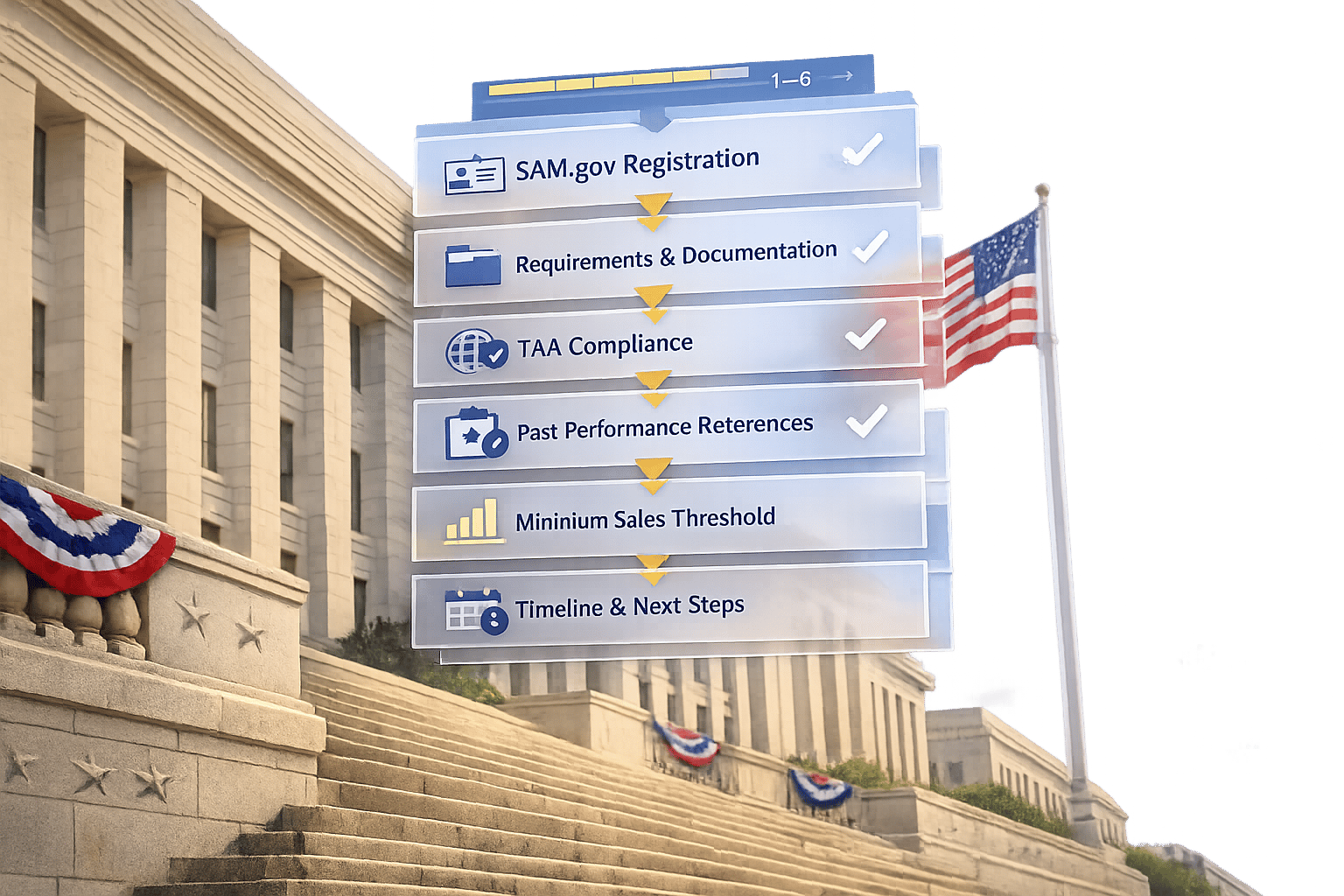
To qualify for a General Services Administration (GSA) Contract, your business must meet specific requirements. A GSA Contract allows businesses to sell directly to government agencies at pre-negotiated prices, streamlining procurement. Here’s a quick summary of what you need:
- Business Requirements: Operate for at least 2 years (or qualify under the Startup Springboard program), be U.S.-based, and show financial stability with two years of financial statements.
- Product/Service Criteria: Offer commercially available products or services, ensure compliance with the Trade Agreements Act (TAA), and match offerings to GSA Schedule categories and Special Item Numbers (SINs).
- Performance Proof: Provide evidence of $25,000+ in annual sales, customer references, and past project experience.
- Compliance: Register on SAM.gov, adhere to legal and ethical standards, and maintain proper documentation like financials, pricing disclosures, and technical proposals.
If you meet these qualifications, you’re ready to apply for a GSA Contract. The application process can take 3–6 months, so preparation is key. For businesses seeking guidance, professional services can simplify the process and improve success rates. Ready to explore this opportunity? Start by confirming your eligibility and gathering the necessary documentation.
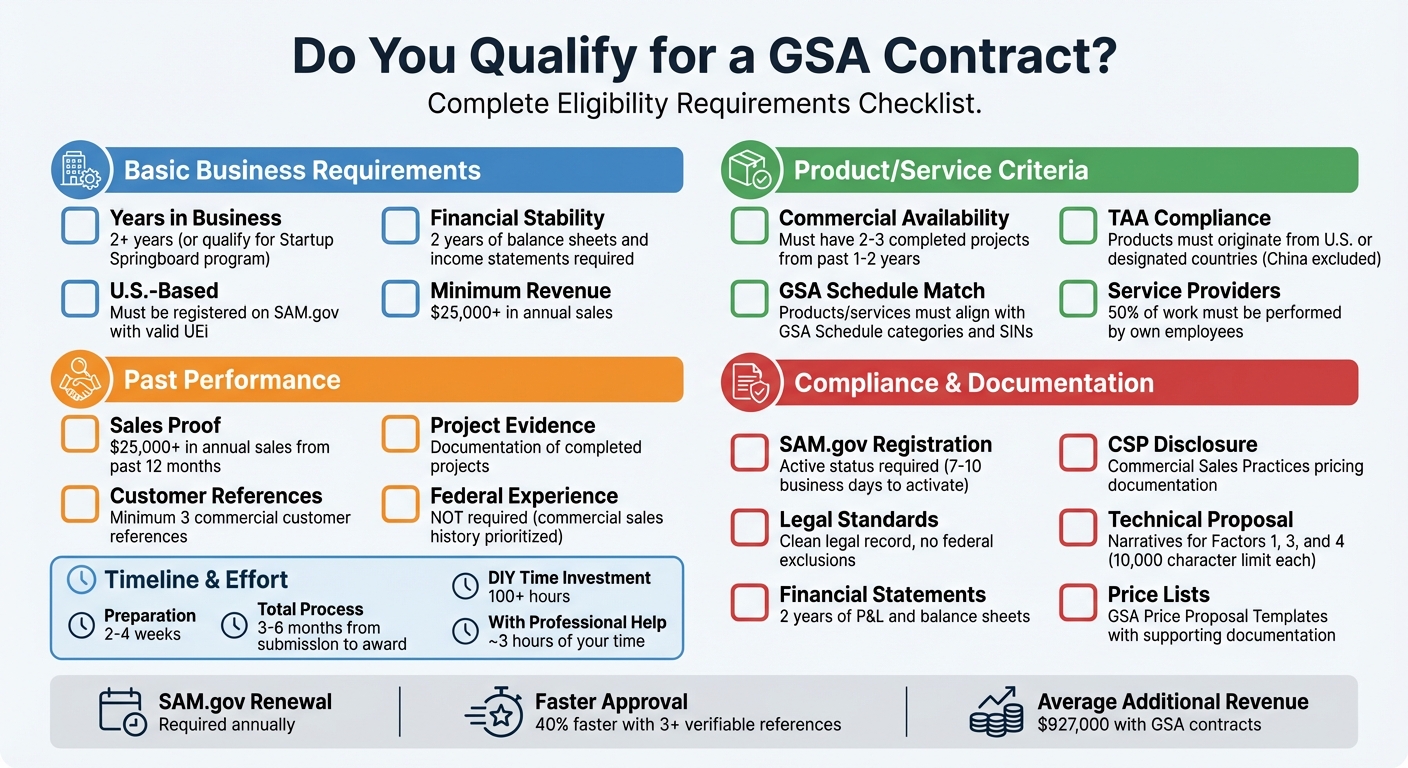
GSA Contract Eligibility Requirements Checklist
Is a GSA Schedule Right for Your Business?
Basic Business Requirements
To qualify for federal contracting, your business needs to meet three key criteria that establish its stability and legitimacy.
U.S.-Based Business Operations
Your company must be based in the United States and registered on SAM.gov with a valid UEI (Unique Entity Identifier). This registration is a non-negotiable step for accessing federal contracts and must be renewed every year to stay compliant. The GSA also underscores the importance of adhering to Executive Order 14005, which prioritizes domestic goods and services. Keep in mind, the SAM.gov registration process can take up to 10 business days to activate.
2 Years in Business
Typically, your business should have been operational for at least two years. However, if you’re newer, the Startup Springboard program may provide an alternative route. Stephanie Hagan notes:
This requirement can be waived for certain contractors (under any Large Category), provided they meet the requirements for the Springboard Program.
For those in the Information Technology field, the professional experience of your team can sometimes substitute for the two-year business operation requirement.
Financial Stability Requirements
You’ll need to submit balance sheets and income statements from the last two fiscal years. These documents should outline your assets, liabilities, equity, revenue, expenses, and net profit or loss. Even if your financial results show losses or debt, it doesn’t mean automatic disqualification. In such cases, you’ll need to provide a thorough explanation of the challenges and a plan to address them.
If your annual revenue falls below $150,000, you may also need to submit a letter explaining how you plan to meet the $25,000 minimum annual sales requirement. According to the Federal Acquisition Regulation:
A responsible prospective contractor must have adequate financial resources to perform the contract, or the ability to attain them.
Meeting these foundational requirements is crucial before moving forward in the eligibility process.
Product and Service Requirements
To sell through a GSA Schedule, your products or services must meet specific criteria beyond just proving your business credentials.
Commercial Availability
Your offerings need to already exist in the marketplace. To demonstrate this, provide documentation of 2–3 completed projects from the past 1–2 years. This serves as proof that your products or services are market-tested and viable. For service providers, at least 50% of the work must be performed by your own employees, ensuring you maintain control over quality and delivery standards. Additionally, your offerings must fit within the predefined GSA Schedule categories.
GSA Schedule Categories and SINs
Each product or service must correspond to a GSA Schedule and fall under a Special Item Number (SIN). You can use resources like GSA eLibrary or GSA Advantage! to find the SINs that match your offerings. If you’re reselling products you don’t manufacture, you’ll need a Letter of Supply from the manufacturer for each item. It’s wise to secure these documents early in the process to avoid delays.
Trade Agreements Act (TAA) Compliance
The TAA sets strict rules about where your products can originate. According to the Vendor Support Center:
The TAA limits the country of origin for products sold through your Schedule contract, in general, this means the following may be sold: 1. Articles that are wholly the growth, product, or manufacture of the U.S. or a designated country, or 2. Articles that are ‘substantially transformed’ in the U.S. or a designated country…
Products made entirely in China are not allowed. Your products must either be fully produced in the U.S. or a designated country, or undergo substantial transformation in one of these locations to qualify. To verify compliance, you’ll need to submit a Certificate of Compliance. The Vendor Support Center also recommends routinely checking the country of origin for your products, as manufacturers may change their production locations. Keep thorough records, such as invoices and purchase orders, to back up your compliance claims during audits.
Past Performance and Experience
Having products already in the marketplace is a strong indicator of your readiness for GSA contracts. GSA now places greater emphasis on your commercial track record instead of prior government contracting experience.
Proof of Commercial Sales
To meet GSA requirements, you’ll need to demonstrate sales activity from the past 12 months, with successful applicants typically showing $25,000 or more in annual sales. This sales threshold confirms that your products or services have genuine market demand and aren’t solely tailored for government use. To back this up, submit invoices or sales reports that clearly show transaction dates and totals. While you can redact sensitive information like specific pricing or customer names, it’s vital to retain key details such as total sales amounts, timeframes, and evidence of regular transactions. For specifics on the revenue threshold, consult the Basic Business Requirements.
Customer References
GSA also requires at least three customer references to verify the quality and performance of your offerings. These references should come from commercial clients, not government agencies, and should reflect work completed within the past 12 months. Aim for a diverse set of references – for instance, a mix of a large corporation, a small business, and a state or local entity – to highlight your success across multiple sectors. Be sure to provide full contact details, including names, phone numbers, and email addresses, for each reference. GSA often uses a Past Performance Questionnaire (PPQ) to assess customer satisfaction, so let your references know they might be contacted directly. Businesses providing three or more verifiable references tend to experience approval times that are 40% faster than those with fewer references.
Federal Contracting Experience
The good news? You don’t need prior federal contracting experience to qualify for a GSA Schedule. GSA prioritizes your commercial sales history and market presence. That said, if you do have federal contracting experience, it can strengthen your proposal. You may include optional reports from systems like the Past Performance Information Retrieval System (PPIRS) or the Contractor Performance Assessment Reporting System (CPARS), but these are not required for approval.
Regulatory and Compliance Requirements
Before the General Services Administration (GSA) approves your contract, you’ll need to meet specific regulatory standards. These ensure your business operates within legal parameters and is capable of managing the administrative demands of government contracting.
SAM.gov Registration
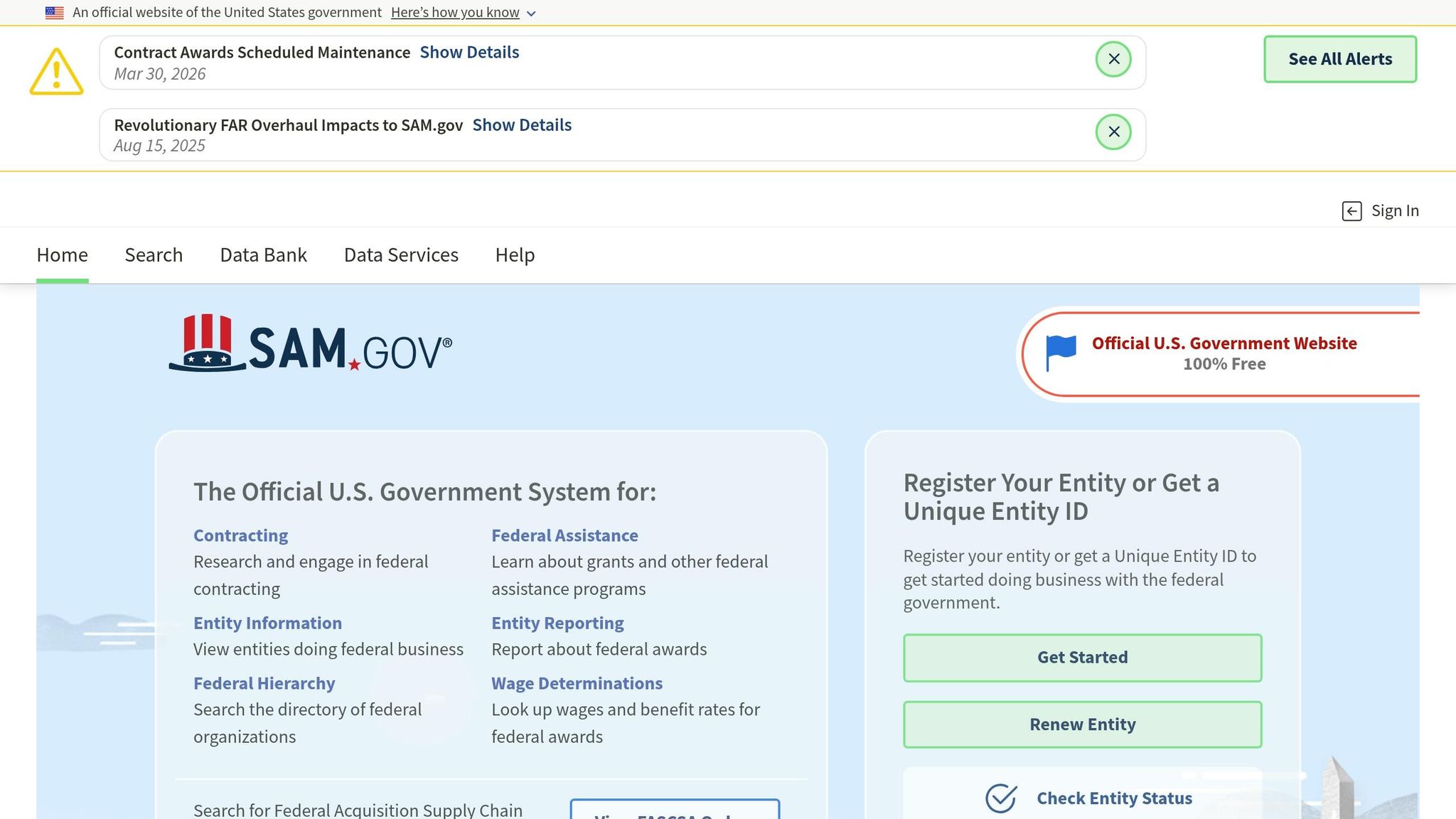
The Federal Acquisition Regulation (FAR) 4.1102 requires an active SAM.gov registration before contracting officers can award any contract, basic agreement, or blanket purchase agreement. To register, you’ll need your business’s legal details, including name, Employer Identification Number (EIN), state of incorporation, Unique Entity Identifier (UEI), and a physical street address (P.O. Boxes are not accepted).
Although SAM.gov typically activates registrations within 7–10 business days, external reviews can extend this to 10–15 calendar days. To avoid delays, it’s wise to begin the process at least 3–4 weeks before any contract bid deadlines. During registration, you’ll also complete certifications related to your business size, ownership, and regulatory compliance. This step is essential before moving on to other compliance requirements.
Legal and Ethical Standards
Meeting legal and ethical standards is just as important as registration. A clean legal record and compliance with labor laws and the Trade Agreements Act (TAA) are non-negotiable. During SAM.gov registration, you must disclose any criminal or tax felony history and confirm adherence to labor laws, including the Service Contract Act if you’re pursuing service-based contracts. SAM.gov also maintains a federal exclusions database – if your business is listed, you won’t qualify for federal contracts.
For GSA contracts, all products must comply with the TAA. This means they must be manufactured or "substantially transformed" in the U.S. or in a TAA-approved country. Violating clause 52.225-5 can lead to severe penalties, so it’s crucial to verify compliance before offering any products. Conduct regular audits of your supply chain, especially if there are changes in suppliers or manufacturing locations, to ensure ongoing compliance.
Required Documentation
When applying for a GSA Schedule, having all your documentation in order is a must. You’ll need to submit key materials through the eOffer system to confirm your qualifications and pricing. These documents not only showcase your compliance but also help speed up the review process.
Financial Statements
One of the primary requirements is submitting a Balance Sheet and Profit/Loss (Income) Statement covering the last two years. These reports can come directly from your accounting software – no need for CPA certification unless they’re already audited.
"The GSA asks for Balance Sheet and Profit/Loss Statement from the past 2 years. Reports generated from your accounting software work just fine, they do not need to be audited or ‘blessed’ by a CPA. The GSA will not accept Tax Returns."
- GSA Schedule Contract Services
If your financials show losses or trends that might raise questions, include a brief explanation to address any concerns about your business’s stability. For businesses with less than two years of operation, alternative financial documentation may be accepted.
Once your financials are ready, the next step is ensuring your pricing meets government standards.
Commercial Sales Practices Disclosures
The Commercial Sales Practices (CSP) disclosure helps demonstrate that your pricing is both fair and competitive. Essentially, you’ll need to disclose the best discount you offer to your commercial clients. This means any discount or deal that results in a price equal to or better than the one you propose for the government. This information must be accurate, up-to-date, and reflect conditions as of 14 days before submission.
You’ll complete the CSP disclosure in the eOffer system unless you’re opting into Transactional Data Reporting (TDR) for eligible SINs, which exempts you from CSP requirements. If your pricing practices differ across product lines, you can limit your disclosure to the models or product lines that make up more than 75% of historical sales for a specific SIN. Be prepared to explain any deviations from your pricing policies and outline the internal controls you have in place to maintain pricing consistency.
Technical Proposal and Price Lists
After addressing financials and pricing, shift your focus to the technical proposal and pricing documentation. For the technical proposal, you’ll need to submit narratives for Factors One, Three, and Four – these cover Corporate Experience, Quality Control, and Relevant Project Experience. Each narrative is limited to 10,000 characters and must be submitted directly in the eOffer system. Keep in mind, uploaded files for these factors will not be accepted, so prepare your text carefully before submission.
For the pricing portion, you’ll need to complete the GSA Price Proposal Templates, such as the FCP Product File or FCP Services Plus File. Alongside these, include a Pricing Terms document and supporting materials like invoices, catalogs, quote sheets, or contracts to validate every item listed on your price proposal. Make sure each document is clearly labeled to match your proposed offerings. If you’re submitting a CSP-1 disclosure, include a detailed Price Narrative explaining why your pricing is competitive and aligns with what you offer your most-favored customer.
Eligibility Self-Assessment Table
Before diving into the application process, take a moment to evaluate your business against the key requirements outlined below. This table consolidates the criteria discussed earlier, giving you a clear checklist to ensure your business is ready, compliant, and equipped to work with federal agencies.
| Eligibility Criteria | Requirement Detail | How to Assess/Verify |
|---|---|---|
| Years in Business | At least 2 years of active operation, unless exempt under Springboard IT. | Confirm your business formation date and review tax filings. |
| Financial Stability | Two years of profit and loss statements and balance sheets. | Check your financial records for the last two fiscal years. |
| SAM Registration | Active status on SAM.gov. | Log in to SAM.gov and confirm your registration is active. |
| TAA Compliance | Products must come from TAA-designated countries. | Obtain "Country of Origin" certificates from your suppliers. |
| Past Performance | 5–10 references and at least 2 completed projects per service category. | Prepare a list of contracts completed in the last two years. |
| Commercial Sales | Products or services must have been sold to the public previously. | Collect invoices or a commercial price list as proof of sales. |
| Pricing | Must align with market standards as "fair and reasonable." | Compare your GSA offer price with your standard commercial rates. |
| Integrity & Ethics | A clean record of business ethics. | Verify there are no active debarments or unresolved legal issues. |
If your business meets most of these criteria, you’re in a strong position to proceed. If not, take steps to address any gaps. For example, startups may benefit from the Springboard IT Program, while others might need to refine documentation or financial records.
For dealers or resellers, securing a formal Letter of Supply from your manufacturer is crucial. This document ensures product availability throughout the contract term. Tackling these requirements now will make your GSA Schedule application process much smoother.
Next Steps After Qualifying
Once you’ve confirmed that your business meets the eligibility requirements, it’s time to dive into the GSA Schedule application process. Start by ensuring your SAM.gov registration is up to date. Then, gather all the necessary documents, including financial statements, sales records, customer references, and pricing lists. This preparation stage generally takes around 2–4 weeks and lays the groundwork for a smoother submission process.
With your paperwork ready, the next step is to match your products or services to the appropriate GSA Schedule categories. This involves identifying the correct GSA Schedule categories and Special Item Numbers (SINs) that align with your offerings. To do this effectively, review the GSA Schedule catalog and study competitor listings within those categories to get a sense of pricing and positioning strategies. Without prior federal contracting experience, this step can be tricky for many.
The entire application process – from submission to receiving a contract award – typically spans 3–6 months. During this time, GSA will review your technical proposals, ensure regulatory compliance, and may negotiate pricing terms. If you’re handling this process on your own, expect to invest over 100 hours of work.
For businesses looking to save time and reduce stress, expert services can be a game-changer. GSA Focus, for example, provides a comprehensive service that takes care of about 95% of the paperwork. This reduces your active involvement to just around 3 hours. With over 18 years of experience and a 98% success rate, their team handles everything from document preparation to compliance checks and negotiation support. On average, their clients see an additional $927,000 in consistent revenue after securing GSA contracts.
"GSA Focus was crucial in helping us get our GSA contract quickly with no headaches, setting us on the path to some big wins."
- Deena T., Pacific Point
Whether you choose to tackle the process on your own or enlist professional help, start by organizing your documents and understanding your target GSA categories. From there, schedule a consultation to confirm your eligibility, map out a timeline, and decide on the best approach for your business.
FAQs
Can a startup still qualify for a GSA Contract?
Startups with less than two years of corporate experience can qualify for a GSA Contract, thanks to programs like Startup Springboard. This initiative allows newer businesses to use alternative documentation and experience criteria when submitting offers, simplifying the process and helping them meet eligibility standards.
What proof do I need if I don’t have $25,000 in annual sales yet?
If your annual sales fall below $25,000, you can still prove financial stability by providing profit and loss statements and balance sheets. Another way to strengthen your case is by meeting long-term sales goals, such as achieving $100,000 in revenue over five years. Additionally, showcasing project or fulfillment experience from the past one to two years can further demonstrate your reliability and eligibility.
How do I know my products are TAA compliant?
To meet TAA compliance requirements, your products need to be manufactured either in the United States or in a designated country. This means verifying the product’s country of origin and ensuring it aligns with the guidelines set by the Trade Agreements Act. Following these regulations is critical for securing GSA contracts and participating in federal procurement.
Related Blog Posts
- How To Qualify for a GSA Schedule
- 5 Key Requirements for GSA Schedule Eligibility
- GSA Contract Eligibility: Key Requirements
- 5 Steps to Meet GSA Prequalification Standards