
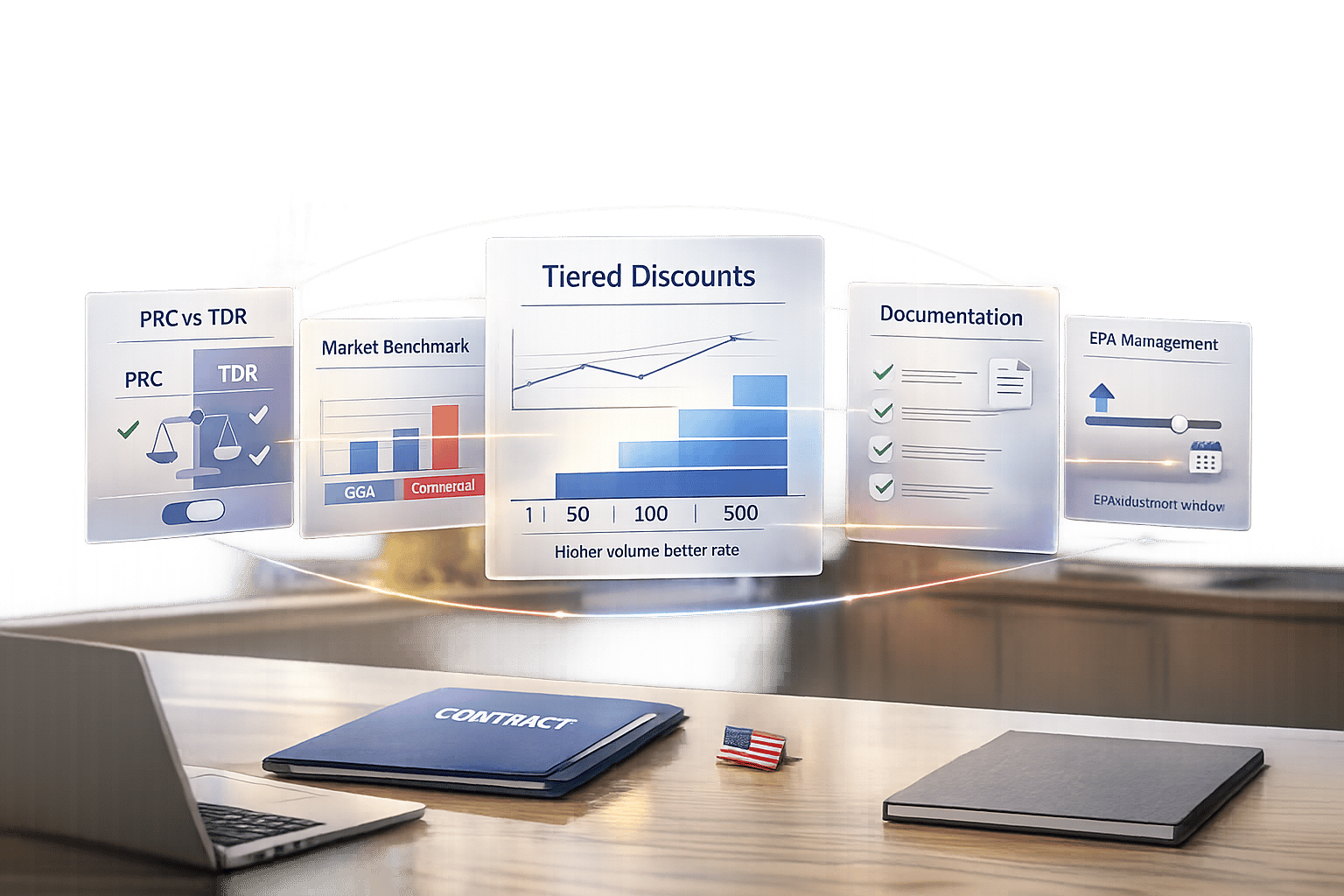
Pricing your GSA products correctly is critical for building a sustainable federal business. Missteps – like underpricing to win early contracts or overpricing beyond market norms – can hurt profitability and compliance. Here’s what you need to know:
- Balance is key: Competitive pricing helps win contracts, but it must also cover all costs (e.g., overhead, fringe benefits) and include a reasonable profit margin (5–10%).
- Compliance matters: GSA pricing must align with regulations, especially regarding the Price Reductions Clause (PRC) and Transactional Data Reporting (TDR).
- Market research is essential: Use tools like GSA Advantage and eBuy to benchmark competitors’ prices and set rates within a 10–15% market range.
- Plan for flexibility: Include tiered discounts, prompt payment incentives, and bundled offerings to encourage larger orders while maintaining profitability.
- Document everything: Keep thorough records of pricing data, discounts, and adjustments to stay audit-ready and ensure compliance over the contract’s lifecycle.
- Adjust pricing carefully: Use Economic Price Adjustments (EPA) and ceiling rate modifications to account for inflation and cost changes, following strict GSA guidelines.
With a strategic approach to pricing, your GSA Schedule can become a reliable revenue stream for up to 20 years. Proper planning, research, and documentation are the cornerstones of success.
GSA Pricing Strategy: Competitive Analysis for Sellers #shorts
Step 1: Set Your Pricing Baseline
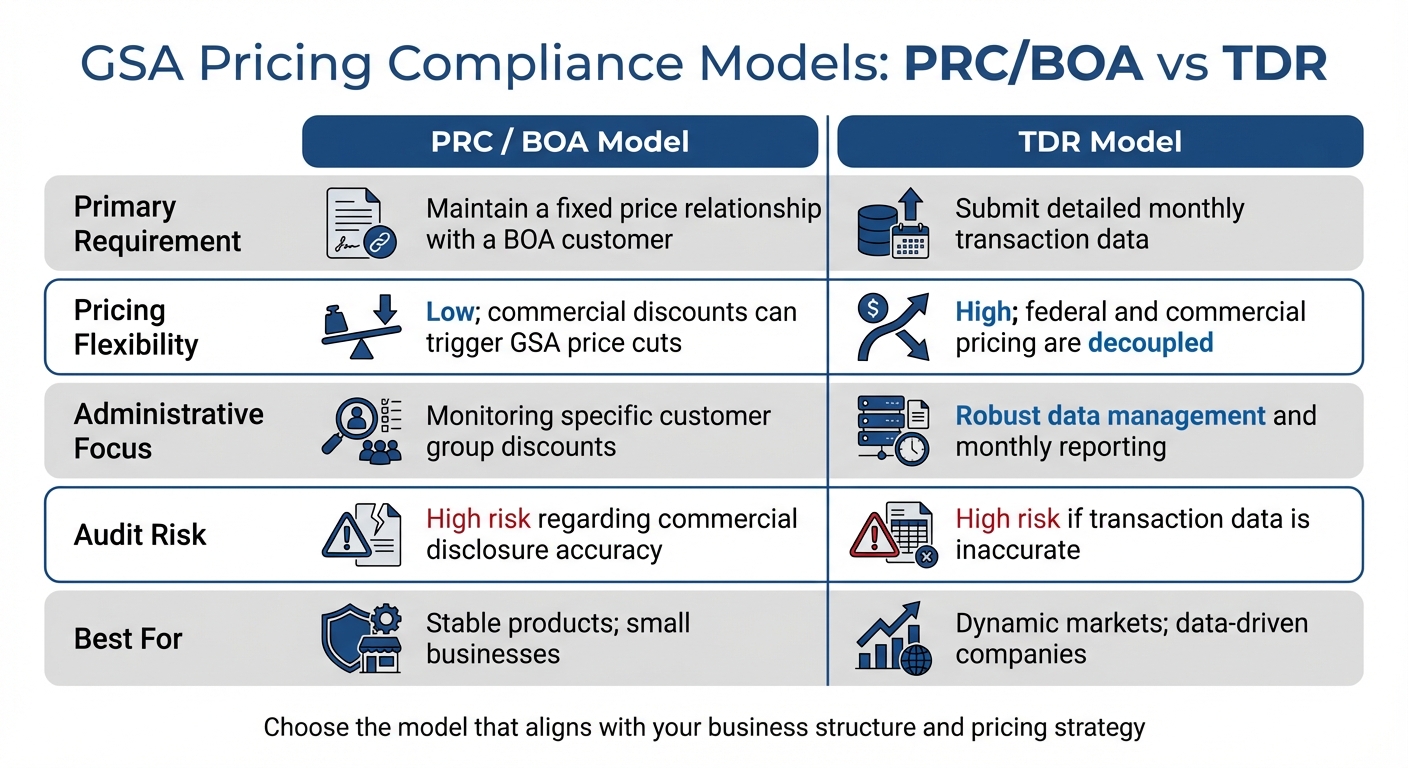
GSA Pricing Compliance Models: PRC vs TDR Comparison
To kick things off, establish a pricing baseline that aligns with your commercial pricing while meeting GSA compliance standards. This baseline becomes the foundation for all your pricing decisions throughout the contract’s lifecycle, helping you avoid costly mistakes. Once your baseline is set, the next step is to choose the right compliance model to guide your pricing strategy.
Choose Your Pricing Compliance Model
GSA offers two main compliance models for pricing, and selecting the right one is crucial for your contract’s success. Here’s a quick breakdown:
- Commercial Sales Practices (CSP) Model: This traditional model ties your GSA pricing to a specific Basis of Award (BOA) customer – essentially, the commercial customer receiving your best pricing. If you offer deeper discounts to your BOA customer, you’re required to match those discounts for GSA within 15 calendar days. While straightforward, this model requires constant monitoring and comes with a higher risk of audit issues related to discount accuracy.
- Transactional Data Reporting (TDR) Model: The newer TDR model offers more flexibility by removing the direct link between federal and commercial pricing. Instead of focusing on a single BOA customer, you provide detailed monthly transaction reports to GSA. This allows you to implement tiered or volume-based discounts (e.g., 1–10 units at $100, 11–50 units at $95) without automatically triggering GSA price adjustments when your commercial discounts change.
Here’s a side-by-side comparison of the two models:
| Feature | PRC / BOA Model | TDR Model |
|---|---|---|
| Primary Requirement | Maintain a fixed price relationship with a BOA customer | Submit detailed monthly transaction data |
| Pricing Flexibility | Low; commercial discounts can trigger GSA price cuts | High; federal and commercial pricing are decoupled |
| Administrative Focus | Monitoring specific customer group discounts | Robust data management and monthly reporting |
| Audit Risk | High risk regarding commercial disclosure accuracy | High risk if transaction data is inaccurate |
| Best For | Stable products; small businesses | Dynamic markets; data-driven companies |
Collect and Organize Your Commercial Pricing History
Once you’ve selected a compliance model, the next step is to gather and organize your commercial pricing data. This is essential to prove that your GSA pricing is both competitive and compliant. GSA requires evidence that your proposed prices are equal to or lower than what you charge commercial customers.
Start by compiling at least 24 months of commercial sales data, including invoices, price lists, and discount schedules. For instance, if your average discount for commercial customers is 15%, your GSA baseline should reflect a discount of 15% or better.
Your documentation package should include:
- Price Proposal Template (PPT): Lists all Special Item Numbers (SINs), unit prices, and discount structures.
- CSP-1 Form: Details your sales practices and identifies your BOA customer.
- Pricing Narrative: Explains your pricing strategy, including competitive analysis, warranties, and benchmark data from the GSA eLibrary.
For example, a vendor selling laptops might set a GSA baseline price of $1,080, based on a $1,200 commercial price with volume discounts. This baseline would be supported by invoices and competitor data sourced from the GSA eLibrary.
Before finalizing your baseline, perform a competitive analysis by researching what other GSA Schedule holders charge for similar products or services. Use tools like GSA Advantage and eLibrary to ensure your pricing is competitive while staying within industry norms – typically within a 10–15% range. Don’t forget to account for the 0.75% Industrial Funding Fee (IFF) and all fully burdened costs when setting your baseline.
Being audit-ready from the start is essential. Every price and discount you propose should be backed by solid documentation. Strong records not only ensure compliance but also set the stage for long-term pricing success.
Step 2: Create Competitive and Profitable Pricing
Once you’ve established your baseline, the next step is to set pricing that can win federal contracts without eating into your margins. Striking the right balance between staying competitive and maintaining profitability is crucial. After all, your GSA Schedule could last up to 20 years, and pricing decisions made today will impact whether it becomes a steady revenue stream or a financial strain.
Use Market Research to Shape Your Pricing
Tools like GSA Advantage and eBuy are your go-to resources for understanding what federal buyers are willing to pay. Start by searching for products or services similar to yours using your Special Item Numbers (SINs). Use keywords and categories to zero in on your competitors and analyze their pricing strategies. Look beyond base prices – pay attention to volume discounts, delivery times, warranty terms, and bundled offerings.
For instance, let’s say you’re selling office furniture. If competitors are pricing executive chairs between $450 and $520 per unit with 10–15% volume discounts, you might price yours at $480 but offer faster delivery or a longer warranty to justify being in the middle of the range. For services, use tools like the CALC tool to compare labor rates based on education, experience, and company size.
Beyond GSA Advantage and eBuy, platforms like the Federal Procurement Data System (FPDS) and Schedule Sales Query (SSQ+) can provide additional insights. Comparing base prices and volume discounts across these platforms helps ensure your pricing falls within the federal "fair and reasonable" range – typically within 10–15% of the market average. Equipped with this research, you can develop pricing strategies that encourage larger orders while safeguarding your profit margins.
Offer Tiered Discounts and Buyer Incentives
Tiered pricing is a proven way to encourage bulk purchases. For example, you could price 1–10 units at $100 each, 11–50 units at $95, and 51+ units at $90. This approach not only incentivizes agencies to consolidate their orders but could also increase your average order value by 20–30%.
Another effective tactic is offering prompt payment discounts. A 1–2% discount for payments made within 10 to 30 days can improve your cash flow while appealing to agencies with efficient procurement processes.
For products, consider bundling complementary items. For example, offering a printer with toner and installation for $1,800 instead of $2,000 when purchased separately simplifies the buying process and adds value. Just make sure all the bundled items are listed on your GSA contract to stay compliant.
However, keep in mind the Price Reduction Clause (PRC). If you offer a deeper discount to a commercial customer, you’re required to extend the same discount to GSA within 15 days. By structuring your tiered pricing carefully from the outset, you can protect your margins across all order sizes while staying compliant.
Avoid Common Pricing Mistakes
Pricing missteps can have long-term consequences. Underpricing might help you win contracts initially, but it locks you into rates that could be unprofitable over the 20-year lifespan of your GSA Schedule. For example, pricing an item at $90 when the market supports $110 could cost you significant profits over time.
On the flip side, overpricing – like setting rates 20% higher than competitors – can drastically lower your chances of winning contracts on platforms like eBuy, where the lowest "fair price" often wins. Vendors who overprice typically win only about 30% as many orders as those with more balanced pricing.
Instead of competing solely on price, focus on the overall value you provide. Highlight warranties, faster delivery, or superior customer support. Aiming for a 10–20% discount off your commercial list price is a good rule of thumb to maintain healthy margins while staying competitive.
Step 3: Update Pricing as Conditions Change
Pricing isn’t a “set it and forget it” situation – it needs to evolve as market dynamics, supplier costs, and inflation shift. To protect your profitability over time, you’ll need to adjust pricing when these factors change. Two tools can help you adapt: Economic Price Adjustments (EPA) and ceiling rate modifications. Knowing how to use these mechanisms effectively ensures your contract stays financially viable.
Using Economic Price Adjustments (EPA)
Economic Price Adjustments (EPAs) allow you to request price increases when inflation or market shifts impact your costs. However, GSA won’t approve these requests without strict adherence to the specific EPA clause in your contract. Simply pointing to rising costs won’t cut it – you need to tie your request directly to the terms outlined in your agreement.
There are three common EPA structures, each with its own rules:
- Commercial Price List: If your contract follows this method, you can only increase your GSA prices after raising your commercial catalog prices for your Most Favored Customer (MFC). For example, if you increase prices for your largest commercial client by 8%, you must maintain the same discount percentage for GSA prices.
- Market Indicators: Contracts tied to indices like the Consumer Price Index (CPI) or Producer Price Index (PPI) allow price adjustments based on those published rates.
- Fixed Escalation Caps: Some contracts include pre-negotiated annual escalation limits, often around 2.5%. These don’t require yearly justification but can’t be applied retroactively if you miss the adjustment window.
Before submitting an EPA request, confirm which clause governs your contract (e.g., GSAR 552.238-120, 552.216-70, or I-FSS-969). Each clause has its own documentation requirements and thresholds. For instance, under clause 552.216-70, the annual increase limit for services is typically 5%, while the Human Capital Category caps increases at 4%. For products, the allowable increase can go up to 10% under the same clause.
Be aware that EPA reviews now take 45–60+ days as of 2026 – significantly longer than the 21–30 days they took in the past. To stay ahead, request manufacturer price lists at least 30 days before they become effective, giving yourself enough time to navigate these extended timelines.
Once you’ve addressed EPA adjustments, your next task is to monitor ceiling rates and ensure compliance.
Track Ceiling Rates and Stay Compliant
After handling EPA adjustments, it’s critical to keep an eye on your ceiling rates – the maximum prices GSA has approved for your products or services. If your costs exceed these limits, you’ll need to submit a modification request before implementing any price increases. While GSA has occasionally relaxed some EPA restrictions to accommodate inflation – extensions remain in effect for certain categories through late 2024/2025 – most standard rules still apply.
A key challenge in 2026 is the increased scrutiny from Contracting Officers. Using the GSA 4P report, they now compare your requested price increases against others in your category. This can lead to "pricing deadlocks", where no price adjustments are approved until one contractor’s request sets the benchmark. To avoid delays, ensure your submission is backed by strong documentation, such as wage index data for services, commercial price lists for products, or relevant market data for index-based contracts.
If you need to lower prices temporarily, consider using a Temporary Price Reduction (TPR). Unlike permanent price cuts, TPRs take effect immediately and typically appear on GSA Advantage within 1–2 business days for FCP users. This gives you the flexibility to respond to short-term market shifts without locking in lower ceiling rates.
Step 4: Maintain Documentation for Pricing Reviews
After setting your baseline and adjusting your pricing, the next critical step is keeping thorough documentation. This ensures you’re always prepared for compliance checks and reviews. GSA emphasizes the importance of audit readiness, with periodic Contractor Assistance Visits (CAVs) for larger contractors or those with unusual sales patterns. Without well-organized records, you risk delays in modifications and potential non-compliance. Proper documentation connects your pricing strategy to future audits, ensuring you’re always ready for scrutiny.
Required Documents for Pricing Reviews
Your documentation should cover all aspects of your pricing strategy. Start with a presentation (PPT) that lists SINs, unit prices, and discount structures. The exact template will depend on your compliance model.
Additionally, you’ll need either a Commercial Price List (for product vendors) or a Market Rate Sheet (for service vendors). These documents establish your pricing baseline and help the Contracting Officer compare your commercial market prices with those offered to the government. To back up your baseline, include supporting materials like invoices, catalogs, and pricing data. A pricing narrative is also essential – it should explain your proposed prices and any differences between your commercial and GSA pricing.
For Economic Price Adjustment (EPA) requests, maintain year-by-year records that justify price increases. These could include cost increases, inflation data, or market trends. Under clause 552.216-70, your first EPA request is allowed 12 months after the contract award, with increases typically ranging from 4–10%, depending on your Schedule Large Category. Keep a record of price changes before and after any reductions, and ensure you notify your GSA contracting officer within 15 calendar days of any reductions. Failing to do so could result in contract termination. By maintaining these detailed records, you simplify pricing reviews and strengthen your compliance during audits.
How Documentation Supports Compliance
Comprehensive documentation is your shield against audit risks. It creates a clear record of how you established your baseline prices, determined discounts, and managed price changes over time. During audits, GSA requires you to provide evidence for every price and discount offered. Keeping systematic records – such as modification logs with submission dates, approvals, and supporting data – ensures you can quickly retrieve the necessary information for future price adjustments.
Organized documentation also demonstrates adherence to the Most Favored Customer principle, which requires that the government receives pricing no worse than your best commercial customer. By maintaining detailed records of all commercial sales, pricing changes, and their effective dates, you can easily prove compliance to GSA contracting officers. This level of preparedness not only protects your contract, which can last up to 20 years, but also ensures sustained profitability and smooth audit processes.
Conclusion
Key Takeaways for Small Businesses
Achieving long-term success in federal contracting requires finding the right balance between compliance, flexibility, and profitability. Start by choosing a pricing model that fits your business needs – whether the PRC model for stable commercial pricing or the TDR model for more dynamic pricing strategies.
Stay competitive by conducting regular market research with tools like GSA Advantage and CALC. Offering tiered discounts and other incentives can give you an edge in securing contracts, while adjusting pricing for inflation and cost changes ensures you remain adaptable.
Maintaining detailed, audit-ready records is crucial. These records not only help you navigate audits but also allow you to justify your pricing decisions to GSA contracting officers. With contracts potentially lasting up to 20 years, having an organized system from the start saves time and minimizes stress down the road.
By following these strategies, you can build a strong foundation for compliance, profitability, and growth – all while positioning your business for expert support when needed.
How GSA Focus Can Help
Federal contracting can feel overwhelming, especially for small businesses that are new to the process. That’s where GSA Focus comes in. They specialize in helping small businesses secure and manage GSA Schedule Contracts with a full-service approach that handles the heavy lifting for you.
With a 98% success rate and a refund guarantee, GSA Focus takes care of the complexities – like documentation, compliance, and negotiations – so you can focus on scaling your business. Their expertise in pricing models, EPA requests, and audit preparation ensures your pricing strategy aligns with GSA regulations while supporting your business goals.
Ready to explore federal contracting opportunities? Visit gsascheduleservices.com to see how GSA Focus can simplify the process and help your business thrive.
FAQs
Should I use PRC/BOA or TDR for my GSA pricing?
Deciding between PRC/BOA and TDR hinges on your contract specifics and the GSA’s evolving policies.
The PRC/BOA (Price Reductions Clause/Basis of Award) compares your pricing with that offered to a designated customer, requiring you to adjust prices if lower rates are provided elsewhere. On the other hand, TDR (Transactional Data Reporting), which will be mandatory by September 2025, focuses on submitting detailed sales data for compliance.
While PRC/BOA remains in use, shifting to TDR is crucial to meet updated GSA requirements and ensure long-term compliance.
How do I calculate a profitable GSA price after IFF and overhead?
To determine a profitable GSA price, you need to account for several key components. Start by including your fully burdened costs, which cover direct costs, indirect costs, and the Industrial Funding Fee (IFF). The IFF is usually 0.75% and must be added to your total costs. Next, factor in your desired profit margin and any overhead expenses.
It’s also crucial to ensure your pricing aligns with GSA rules. This means your rates should reflect fair pricing and remain consistent with what you offer to commercial customers. By following this method, you can achieve profitability while staying compliant with federal requirements.
When can I raise GSA prices, and what proof do I need for an EPA?
When your contract’s Economic Price Adjustment (EPA) clause permits it, you can adjust GSA prices – usually after 12 months from the contract award. To request an EPA, you’ll need to back it up with solid documentation. This might include a market analysis, sales data, or updated price lists. The key is to show that the price change aligns with market trends, inflation rates, or other factors specified in your EPA clause.
Related Blog Posts
- How to Analyze GSA Competitor Pricing
- How to Set GSA Prices for Federal Contracts
- 5 GSA Discounting Rules for Compliance
- Price Reasonableness in GSA Contracts: Basics