
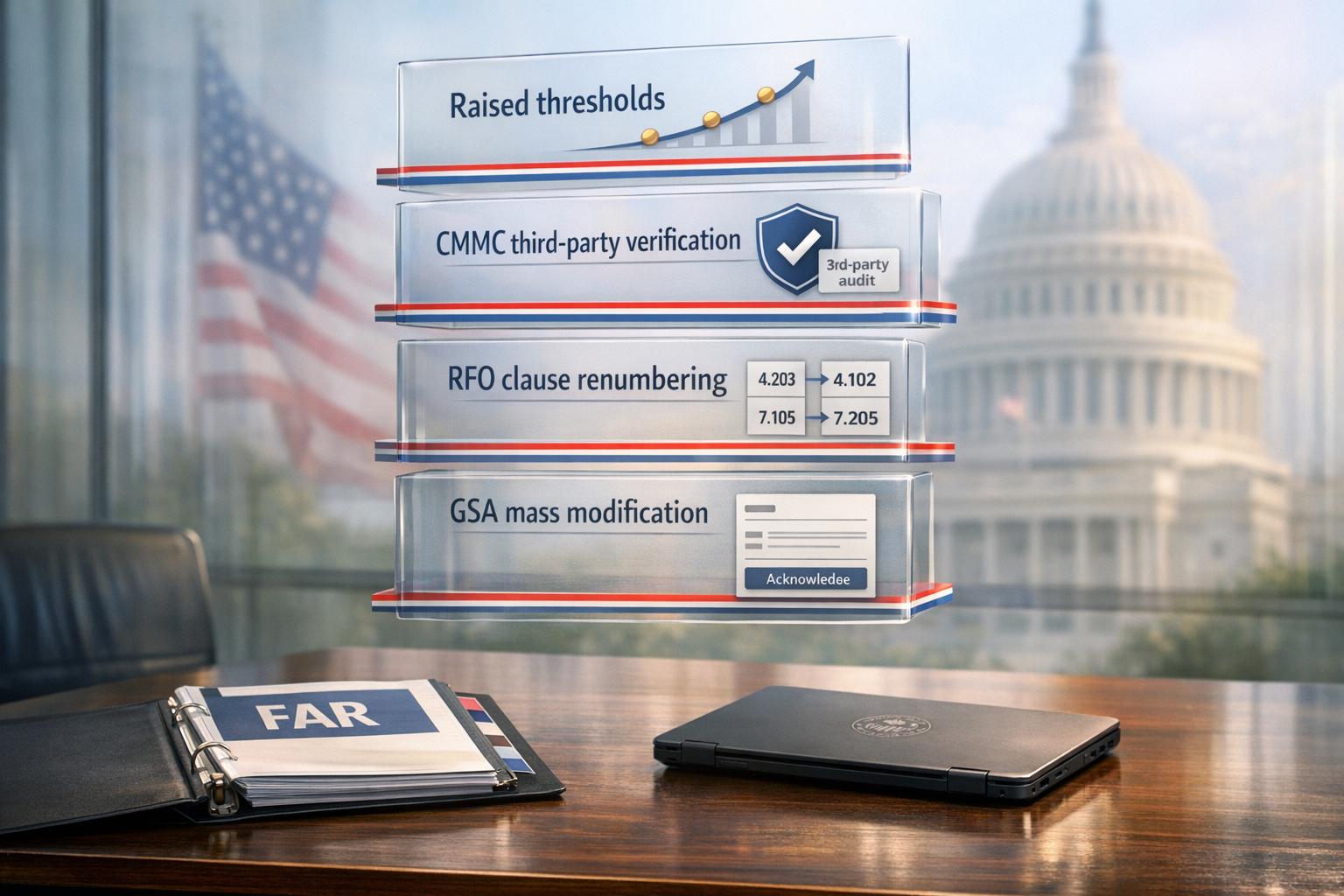
The Federal Acquisition Regulation (FAR) has undergone major updates that impact how government contractors secure and manage federal contracts. Key changes include:
- Revised thresholds: Certified cost data thresholds increased to $10 million, and Simplified Acquisition Threshold (SAT) rose to $350,000.
- Cybersecurity rules: The Cybersecurity Maturity Model Certification (CMMC) now requires third-party verification.
- Streamlined processes: The Revolutionary FAR Overhaul (RFO) simplified clauses, reorganized FAR Part 19, and eliminated outdated rules.
- Small business policies: Adjustments to the “Rule of Two” and new size status determination rules.
- New requirements: Contractors must accept Mass Modifications within 90 days and ensure compliance with updated terms.
These updates aim to modernize federal procurement, reduce administrative hurdles, and address cybersecurity risks. Contractors must act quickly to align their internal processes and ensure compliance with the new rules.
What Laws Drive FAR Changes
How Laws Become FAR Rules
Procurement regulations, including changes to the Federal Acquisition Regulation (FAR), are shaped by key legislative actions and the efforts of regulatory bodies. At the forefront is the Federal Acquisition Regulatory Council (FAR Council), which includes representatives from the General Services Administration (GSA), the Department of Defense (DoD), and NASA. This council is responsible for maintaining and updating the FAR. Meanwhile, the Office of Federal Procurement Policy (OFPP), part of the Office of Management and Budget (OMB), oversees the process and resolves disputes between agencies.
Normally, the rulemaking process adheres to the Administrative Procedure Act. This involves the FAR Council publishing a proposed rule in the Federal Register, allowing a 60-day public comment period, and then issuing a final rule. However, when Congress passes legislation like the National Defense Authorization Act (NDAA), it often imposes strict deadlines for implementation. This creates a need for quicker action.
To meet these deadlines, agencies frequently issue “class deviations” to implement changes immediately without waiting for the formal rulemaking process. For example, on December 19, 2025, the Department of War (formerly DoD) issued 31 class deviations to the Defense Federal Acquisition Regulation Supplement (DFARS), which went into effect on February 1, 2026. These deviations allow agencies to adapt quickly to legislative requirements, such as those outlined in the FY 2026 NDAA.
“Congress often paints only part of the solution in statute. Regulations must fill that gap, and sometimes regulations have to be written against a blank space left by Congress.” – Public Procurement International
This streamlined approach ensures that regulatory frameworks remain aligned with legislative changes, laying the groundwork for recent FAR updates.
Recent Laws That Changed the FAR
Recent legislation has significantly reshaped the FAR, reflecting the push for faster and more efficient procurement processes. The FY 2026 National Defense Authorization Act (Public Law 119-60), signed into law on December 18, 2025, is a major driver of these changes. This $900.6 billion defense bill introduced reforms through the Revolutionary FAR Overhaul and raised several acquisition thresholds. For instance:
- The Truth in Negotiations Act (TINA) threshold for certified cost or pricing data increased from $2 million to $10 million for defense contracts signed after June 30, 2026.
- The threshold for full Cost Accounting Standards (CAS) coverage doubled from $50 million to $100 million, while the per-contract CAS trigger rose from $2.5 million to $35 million.
Two key pieces of legislation – the Streamlining Procurement for Effective Execution and Delivery (SPEED) Act and the Fostering Reform and Government Efficiency in Defense (FoRGED) Act – provided the foundation for these reforms within the FY 2026 NDAA. Additionally, the BIOSECURE Act, included in the NDAA, established a ban on federal contracts with “biotechnology companies of concern”. Complementing these efforts, Executive Order 14275, titled “Restoring Common Sense to Federal Procurement”, aims to reduce regulatory burdens and accelerate federal purchasing.
| Threshold Type | Previous Amount | New Amount (Post-June 2026) |
|---|---|---|
| Certified Cost or Pricing Data (TINA) | $2 Million | $10 Million |
| Full CAS Coverage (Annual Awards) | $50 Million | $100 Million |
| CAS Per-Contract Trigger | $2.5 Million | $35 Million |
| Major System (RDT&E) | $115 Million | $275 Million |
| Noncompetitive Approval Threshold | $10 Million | $100 Million |
These updates highlight Congress’s efforts to simplify procurement, reduce barriers for businesses, and encourage commercial companies to engage with the government. The annual NDAA remains a pivotal tool for driving these reforms.
FY26 NDAA Acquisition Reform: What Changed, What Didn’t and What Comes Next
Major FAR Amendments and What They Mean for Contractors
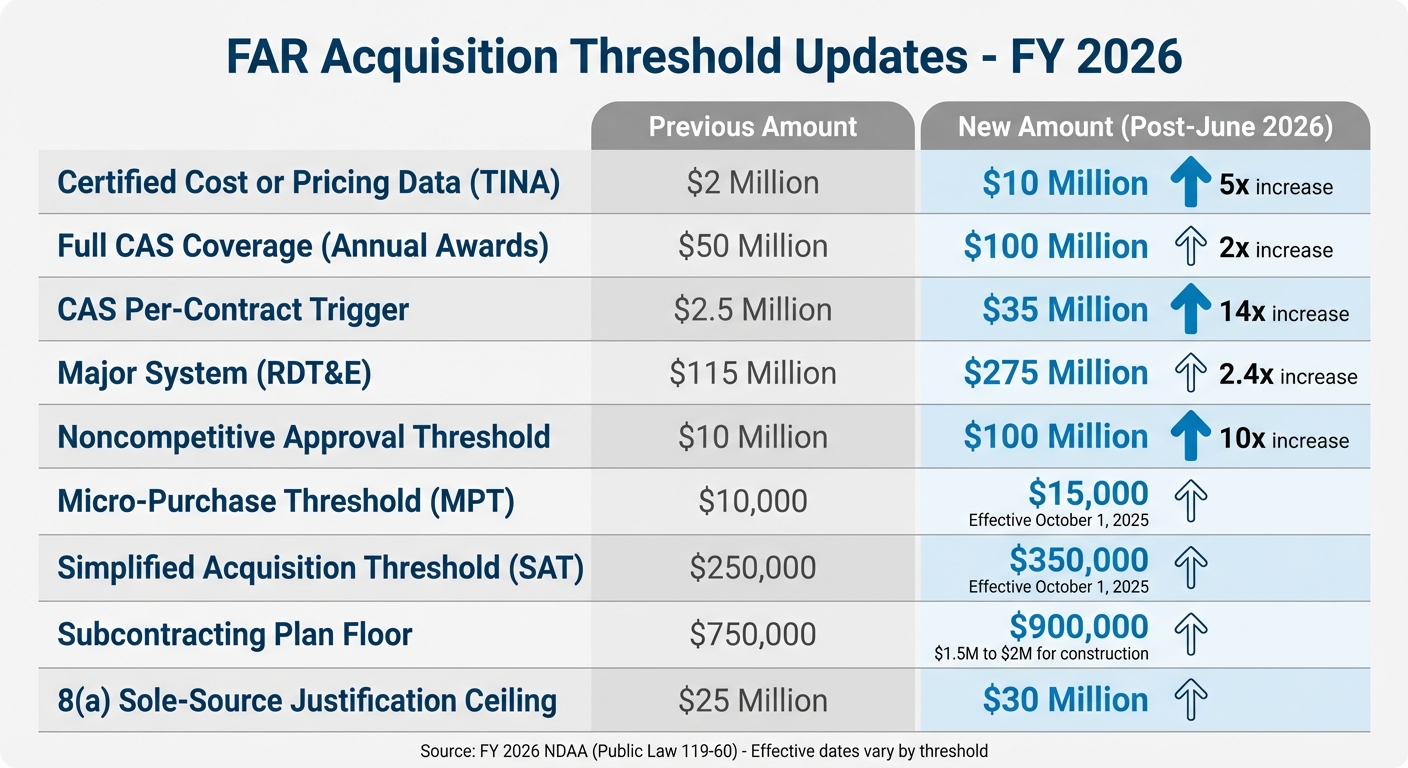
FAR Acquisition Threshold Changes 2026: Before and After Comparison
Recent updates to the Federal Acquisition Regulation (FAR) bring changes to acquisition thresholds, procurement processes, cybersecurity rules, and small business policies. These amendments reshape how contractors approach bidding, compliance, and contract awards.
Updated Acquisition Thresholds for Inflation
Starting October 1, 2025, the FAR Council has adjusted acquisition thresholds to reflect inflation, impacting procurement procedures. Here’s what’s changing:
- The Micro-Purchase Threshold (MPT) increased from $10,000 to $15,000, enabling agencies to make purchases without competitive quotes. This adjustment affects over 560,000 federal awards annually that previously fell under the old limit.
- The Simplified Acquisition Threshold (SAT) rose from $250,000 to $350,000, allowing more contracts to utilize FAR Part 13’s streamlined procedures. This change reduces formal proposal requirements and is expected to result in about 5,000 additional awards set aside for small businesses each year. For contracts between the MPT and SAT, these acquisitions are generally reserved for small businesses if at least two are anticipated to compete.
Other threshold updates include raising the subcontracting plan floor from $750,000 to $900,000 (and from $1.5 million to $2 million for construction) and increasing the 8(a) sole-source justification ceiling from $25 million to $30 million. These changes aim to preserve purchasing power while easing administrative burdens.
Revolutionary FAR Overhaul: Simplified Procedures
The Revolutionary FAR Overhaul (RFO) marks one of the most extensive rewrites of federal procurement regulations in decades. Phase 1, effective February 1, 2026, introduced 31 class deviations to the DFARS. Among the highlights:
- FAR Part 12 (Commercial Products/Services) was streamlined, reducing the number of provisions and clauses from 154 to 108.
- FAR Part 19 was reorganized around the acquisition lifecycle – Presolicitation, Evaluation and Award, and Postaward – to improve clarity for contractors working within small business programs.
Contractors must update proposal templates and compliance matrices to align with the new clause numbers introduced by the RFO. The General Services Administration (GSA) plans to integrate these changes into over 14,000 existing schedule contracts through a “Refresh” modification expected in November 2025. Contractors will have 90 days to accept the updated terms.
New Cybersecurity and Supply Chain Rules
In response to growing cyber threats, the Department of Defense (DoD) has introduced stricter cybersecurity requirements. The Cybersecurity Maturity Model Certification (CMMC) Program, effective December 16, 2024, replaces the previous “self-attestation” system with third-party or government-led verification. Under this program:
- Contractors must demonstrate compliance with security protocols for handling Federal Contract Information (FCI) and Controlled Unclassified Information (CUI).
- The Supplier Performance Risk System (SPRS) will monitor contractors’ cybersecurity compliance. Failure to maintain a passing score can result in ineligibility for new contracts, option exercises, or extensions.
“With this final rule, DoD establishes the Cybersecurity Maturity Model Certification (CMMC) Program in order to verify contractors have implemented required security measures necessary to safeguard Federal Contract Information (FCI) and Controlled Unclassified Information (CUI).” – Department of Defense
Prime contractors are also responsible for ensuring their subcontractors meet the required CMMC level before sharing sensitive data.
Changes to Domestic Preference and Small Business Policies
Recent amendments to FAR Part 19 have reshaped small business policies:
- The “Rule of Two” is no longer mandatory for individual orders under Multiple-Award Contracts (MACs). Contracting officers now have discretion to set aside orders, and these decisions are generally not subject to protest.
- Small business size status is now determined at the time of contract award and updated only for specific events, like novations or option exercises. This eliminates the need for repeated status updates for every individual order.
- For 8(a) program participants, contracting officers must prioritize competitive 8(a) acquisitions through SBA-approved government-wide vehicles before awarding sole-source contracts below competitive thresholds.
A new “loser pays” provision allows agencies to withhold up to 5% of payments from incumbent contractors who file and lose a GAO protest. This policy is designed to discourage frivolous protests and encourages contractors to carefully evaluate their protest strategies. Small businesses, in particular, should weigh the financial risks when challenging re-competes as incumbents.
What GSA Schedule Contractors Need to Know
FAR amendments don’t just tweak the rules – they directly update the terms of existing GSA Schedule contracts. As a contractor, it’s crucial to understand how these updates affect your agreements and what steps you need to take to stay compliant.
How FAR Changes Update GSA Schedule Terms
GSA incorporates FAR amendments into its schedules through Mass Modifications, commonly referred to as “Refreshes.” For instance, Refresh #30, issued on November 24, 2025, brought GSA Schedule contracts in line with the Revolutionary FAR Overhaul (RFO). This update revised 94 clauses, modernizing legacy provisions and adding RFO-specific terms. Contractors are required to accept these changes within a 90-day window.
Key updates in Refresh #30 include:
- Consolidation of security prohibitions, targeting entities like Kaspersky Lab and ByteDance.
- Removal of outdated requirements, such as the Professional Compensation Plan for services.
- Elimination of the 33.33% cap on Order-Level Materials (OLMs), while still ensuring OLMs are not the primary focus of an order.
- Removal of the Letter of Supply requirement for most categories, with exceptions for IT and Printing.
Once these updates are in place, contractors must ensure their internal systems and documentation reflect these changes to avoid compliance issues.
Meeting Compliance Requirements Under New FAR Rules
After accepting the updated contract terms, contractors must quickly align their internal processes with the new FAR requirements. This involves revising internal documentation, such as proposal templates, compliance matrices, and training materials, to reference the updated clause numbers. For example, basic safeguarding requirements have shifted from FAR 52.204-21 to FAR 52.240-93 under the RFO.
“MAS Refresh 30 is the RFO’s practical implementation for schedules: treat it as a compliance migration project, not just a reading assignment.” – Office Manager, Fed Contract Pros
To avoid last-minute stress, set internal deadlines to complete updates well before the 90-day acceptance period ends – aim for 60 days to stay ahead. Keep in mind that updates to SAM.gov may not reflect these changes until 2026, so focus on updating solicitation-level representations in the meantime. If your offerings include unmanned aircraft systems, make sure your catalog complies with the FASC prohibition effective December 22, 2025.
Getting Expert Help with FAR and GSA Updates
The scope of these changes can feel overwhelming, and many contractors find themselves unprepared. In fact, an estimated 90% of contractors were caught off guard by the RFO-aligned Refresh #30. Successfully navigating these updates requires precise alignment of your internal processes with the revised FAR terms.
This is where professional help can make all the difference. GSA Focus (https://gsascheduleservices.com) specializes in assisting small businesses with GSA Schedule transitions. Their services include updating documentation, aligning clause libraries with new requirements, and providing ongoing advisory support. With a track record of success and a refund guarantee, they help contractors minimize risks like missed deadlines or misinterpreted regulations.
For businesses managing multiple schedules or offering complex services, expert support is particularly important. While the FAR Overhaul Part Deviation Guide on acquisition.gov provides the exact language for new RFO clauses, experienced GSA consultants or legal counsel can help map old clause references to new ones and ensure your internal processes are fully aligned with the updated requirements.
Conclusion
The FAR overhaul is shaking up federal contracting, and businesses that don’t adapt quickly risk falling behind. With agencies rolling out draft revisions through class deviations, renumbering standard clauses, and increasing thresholds – like the TINA jump from $2 million to $10 million effective June 2026 – contractors need to act now to stay competitive.
The changes don’t stop there. New penalties and sunset clauses mean contractors must update compliance systems immediately. For GSA Schedule contractors, staying on top of Mass Modifications and ensuring internal systems are current is critical to keeping their contracts intact. Success hinges on staying informed and proactive.
From threshold adjustments to cybersecurity requirements, the FAR amendments demand expert navigation. Contractors need to cross-reference old clause numbers with the new ones and align their compliance documentation accordingly. This is where GSA Focus (https://gsascheduleservices.com) can help. With services like documentation updates, clause library alignment, and ongoing advisory support, they guide contractors through these changes with a proven 98% success rate.
FAQs
Which FAR changes apply to my existing contracts vs. new awards?
Changes to FAR Part 8 introduce updates like the mandatory use of Best-in-Class contracts and revised ordering procedures. These changes apply solely to new contract awards. Contracts already in place typically stay as they are, unless they are explicitly modified to incorporate these updates.
What do I need to do to pass CMMC under the new third-party verification model?
To meet the requirements of CMMC under the updated third-party verification model, contractors need to align with the CMMC 2.0 framework now included in the DFARS. Here’s what that involves:
- Understand the Framework: Familiarize yourself with the updated CMMC 2.0 structure and its levels.
- Implement Cybersecurity Controls: Put the necessary cybersecurity measures in place to meet the required level of compliance.
- Prepare for Third-Party Assessments: Get ready for external evaluations by ensuring your systems and processes align with the standards.
- Ensure Contract Compliance: Review and adhere to the finalized contract clauses tied to these cybersecurity requirements.
These steps are essential for meeting the Department of Defense’s updated cybersecurity standards, which take effect on November 10, 2025.
How do I map old FAR clause numbers to the new RFO clause structure?
To match old FAR clause numbers with the updated RFO structure, consult the revised FAR clause matrices and the guidance provided by the GSA and FAR Council. These tools clarify how the older clauses fit into the new framework. By reviewing the matrices, you can pinpoint the updated clause numbers or note any deviations. Be ready for changes through GSA’s MAS refresh and mass modifications, which will integrate these updates into existing contracts.
Related Blog Posts
- Regulatory Requirements for Federal Contracts
- How Procurement Threshold Changes Affect Small Businesses
- FAR Compliance Penalties: What Small Businesses Should Know
- FAR Compliance Basics for Small Businesses