
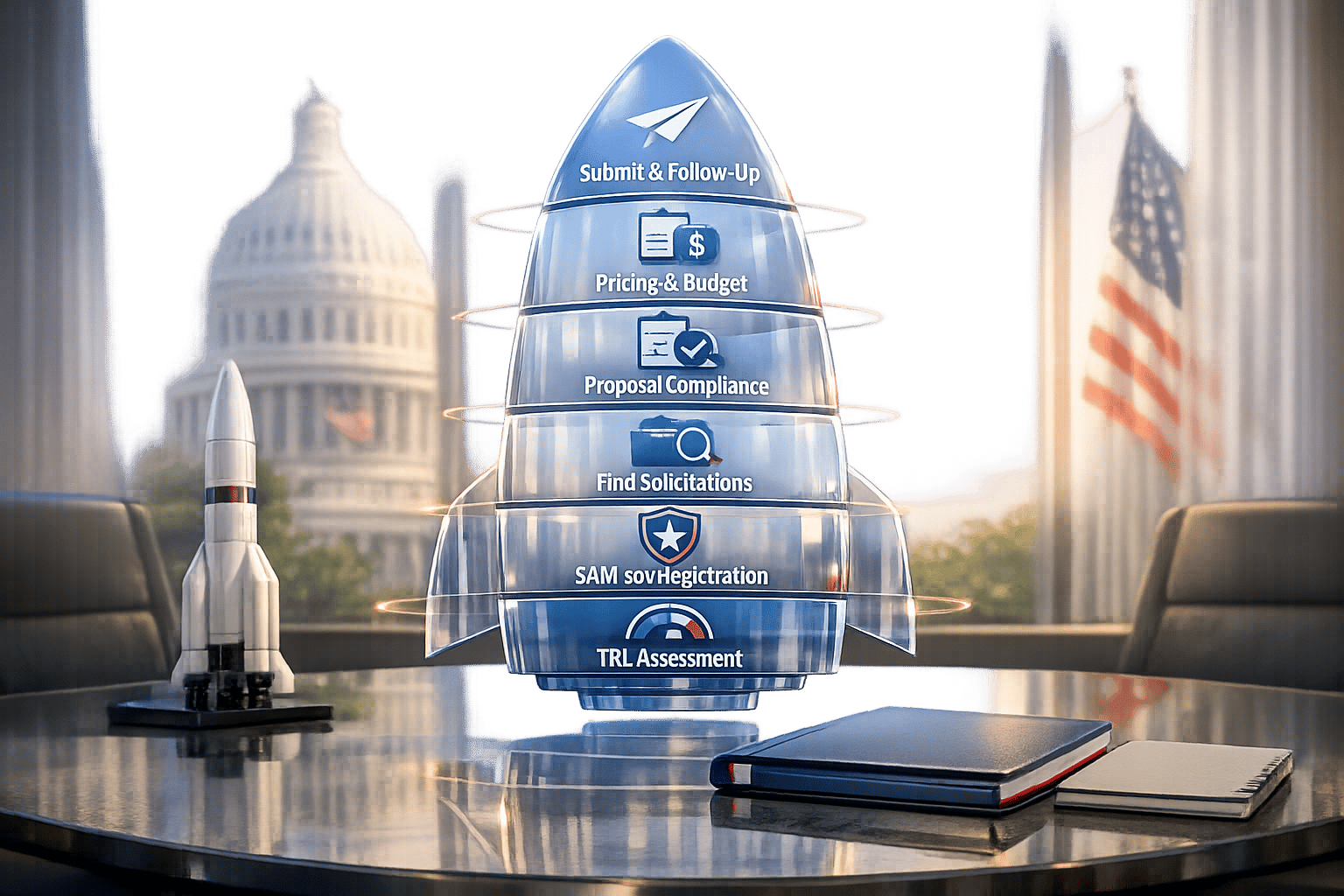
Federal contracts can transform your space tech business. With over $600 billion awarded annually, including significant allocations for small businesses, securing these contracts is a game-changer. Agencies like the U.S. Space Force and NASA are actively seeking innovative technologies, creating opportunities for companies specializing in AI, satellite cybersecurity, and prototyping.
Here’s a quick overview of the process:
- Understand Technology Readiness Levels (TRL): Gauge your tech’s maturity (TRL 1–9) to align with agency needs.
- Register on SAM.gov: Obtain a Unique Entity Identifier (UEI) and complete essential certifications.
- Find Opportunities: Use SAM.gov and NASA platforms to target relevant contracts early.
- Craft Winning Proposals: Follow strict guidelines to showcase your capabilities and compliance.
- Leverage Federal Programs: Apply for SBIR/STTR funding or explore Other Transactions Authority (OTA) agreements.
- Meet Compliance Standards: Ensure cybersecurity, financial, and regulatory requirements are met.
- Consider GSA Schedule Support: Streamline the contracting process with expert assistance.
Why this matters: Federal contracts offer multi-year stability and growth potential for space tech businesses. This guide simplifies the process into actionable steps to help you secure your share of this growing market.
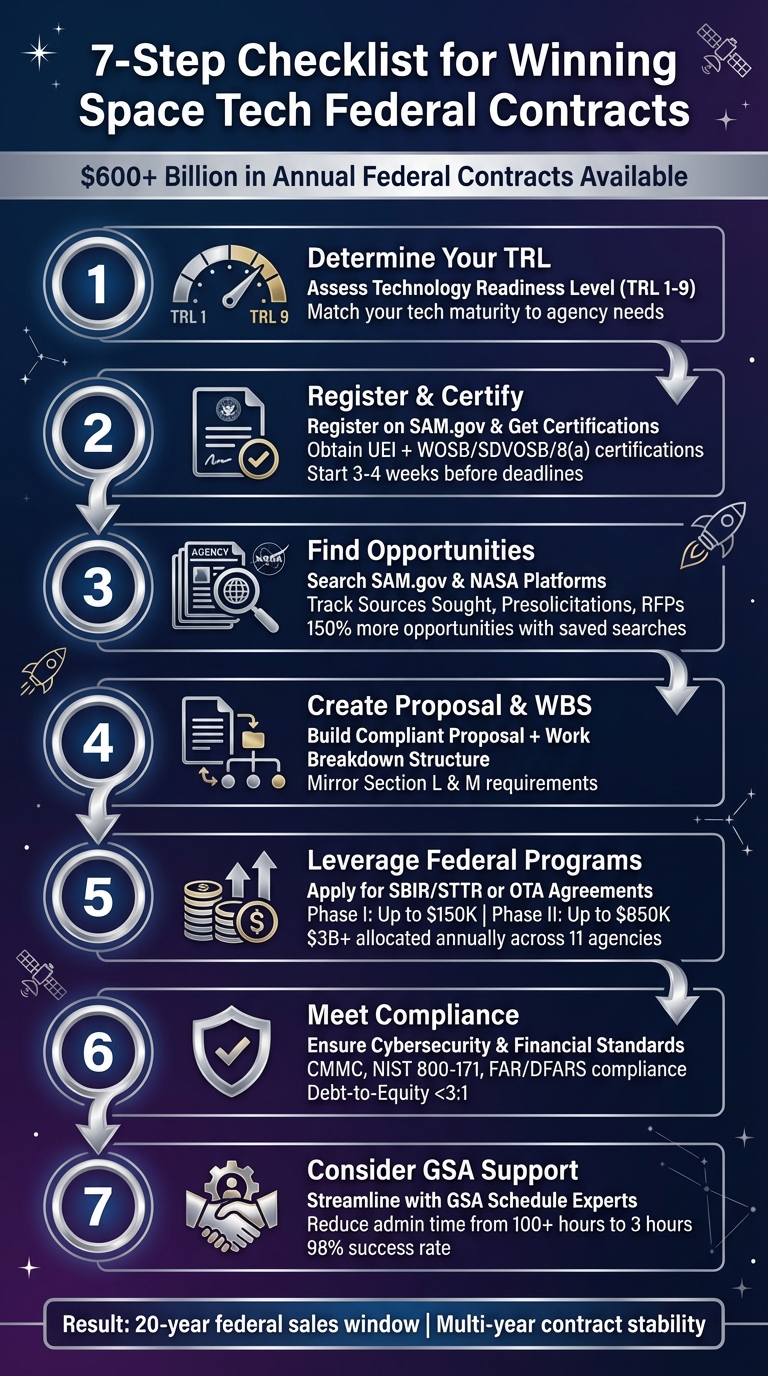
7-Step Process to Win Federal Space Tech Contracts
New Satellites In, Old Plans Out as Boeing Wins $2.8B Contract
Step 1: Determine Your Technology Readiness Level (TRL)
Before submitting a proposal, it’s important to understand where your technology stands in terms of maturity. Federal agencies rely on the Technology Readiness Level (TRL) system to evaluate whether your product or service aligns with their needs. This system, initially developed by NASA in the 1970s, has since become a standard measure across the Department of Defense (DoD) and other federal agencies.
The TRL framework creates a universal language for gauging technology readiness. As Marcin Kapuściński from TTMS explains:
TRLs provide a common language for assessing technology readiness.
Without this shared understanding, miscommunication can easily derail even the most promising proposals.
Knowing your current TRL is essential because different agencies focus on specific stages of maturity. For instance, DoD Research Labs often fund early-stage research (TRL 1–3), while the Army Rapid Capabilities Office seeks technologies that are closer to deployment (TRL 6–7).
To position your technology effectively, start by reviewing and understanding the TRL scale.
Learn the TRL Scale
The TRL scale ranges from 1 to 9, charting a technology’s progress from an initial concept to a fully operational system.
| TRL Level | Maturity Stage | What It Means |
|---|---|---|
| TRL 1–3 | Basic Research | Observing basic principles (TRL 1), identifying practical applications (TRL 2), and validating proof-of-concept in a lab (TRL 3) |
| TRL 4–6 | Applied R&D | Testing components in a lab (TRL 4), in a simulated environment (TRL 5), and demonstrating a prototype in a relevant environment (TRL 6) |
| TRL 7–9 | System Development | Showing a prototype in an operational environment (TRL 7), qualifying the system for flight (TRL 8), and proving it through successful missions (TRL 9) |
Understanding these levels helps pinpoint key challenges. One of the toughest transitions is moving from TRL 6 to TRL 7. In fact, advancing from TRL 5 to TRL 6 can cost significantly more than all the work done from TRL 1 to TRL 5 combined. This stage often involves shifting from controlled conditions to real-world operational environments.
It’s also important to note that commercial success doesn’t automatically qualify a product as TRL 9 for government use. As FedTrax clarifies:
In the eyes of the Government buyer, you are not at TRL 9 until your thing is gold plated for use in a production, Government program.
For example, even a well-established commercial product might only be considered TRL 7 or 8 until it meets federal standards, such as achieving full cyber compliance or obtaining an Authority to Operate.
Assess Your Current TRL
Once you’re familiar with the TRL scale, the next step is to accurately determine your technology’s current level. This requires gathering detailed evidence for each stage – like lab test results for TRL 4 or field trials with regulatory clearance for TRL 8. Keep in mind that your overall TRL is dictated by the lowest-performing component. For instance, if your technical performance is at TRL 6 but your manufacturing readiness is at TRL 3, your technology would be rated as TRL 3. If a solicitation requires TRL 6 and your technology is at TRL 3, you’ll need to focus on further development or seek other opportunities.
To avoid overestimating your readiness – such as mistaking a lab proof-of-concept (TRL 3) for a prototype (TRL 6) – consider having a third party with federal contracting expertise review your evidence. Be meticulous in documenting every detail, including test results, the testing environment (lab, simulated, or operational), and whether outcomes are reproducible.
A precise TRL assessment not only smooths the proposal process but also ensures your technology aligns with the expectations of the agency you’re targeting.
Step 2: Register and Certify Your Business
Once you’ve evaluated your space technology, the next step is to make your business eligible for federal contracts. Without proper registration and certifications, you can’t submit bids, win contracts, or even get paid – regardless of how advanced your technology might be.
The starting point for federal contracting is SAM.gov registration. This free process assigns your business a Unique Entity Identifier (UEI), a 12-character alphanumeric code that replaced the DUNS number in April 2022. The UEI acts as a permanent federal identifier, allowing contracting officers to search for businesses with specific capabilities, including those in space tech.
Certifications can also give your business a competitive edge. Programs like Woman-Owned Small Business (WOSB), HUBZone, Service-Disabled Veteran-Owned Small Business (SDVOSB), and 8(a) Business Development create "set-aside" contracts. These contracts limit competition to qualified small businesses, increasing your chances of success.
It’s smart to begin this process at least 3–4 weeks before any contract deadlines. This allows time for validation and resolves any documentation issues. Remember, SAM.gov registration is entirely free when done through the official government portal. Be wary of third-party services that charge unnecessary fees.
Register on SAM.gov
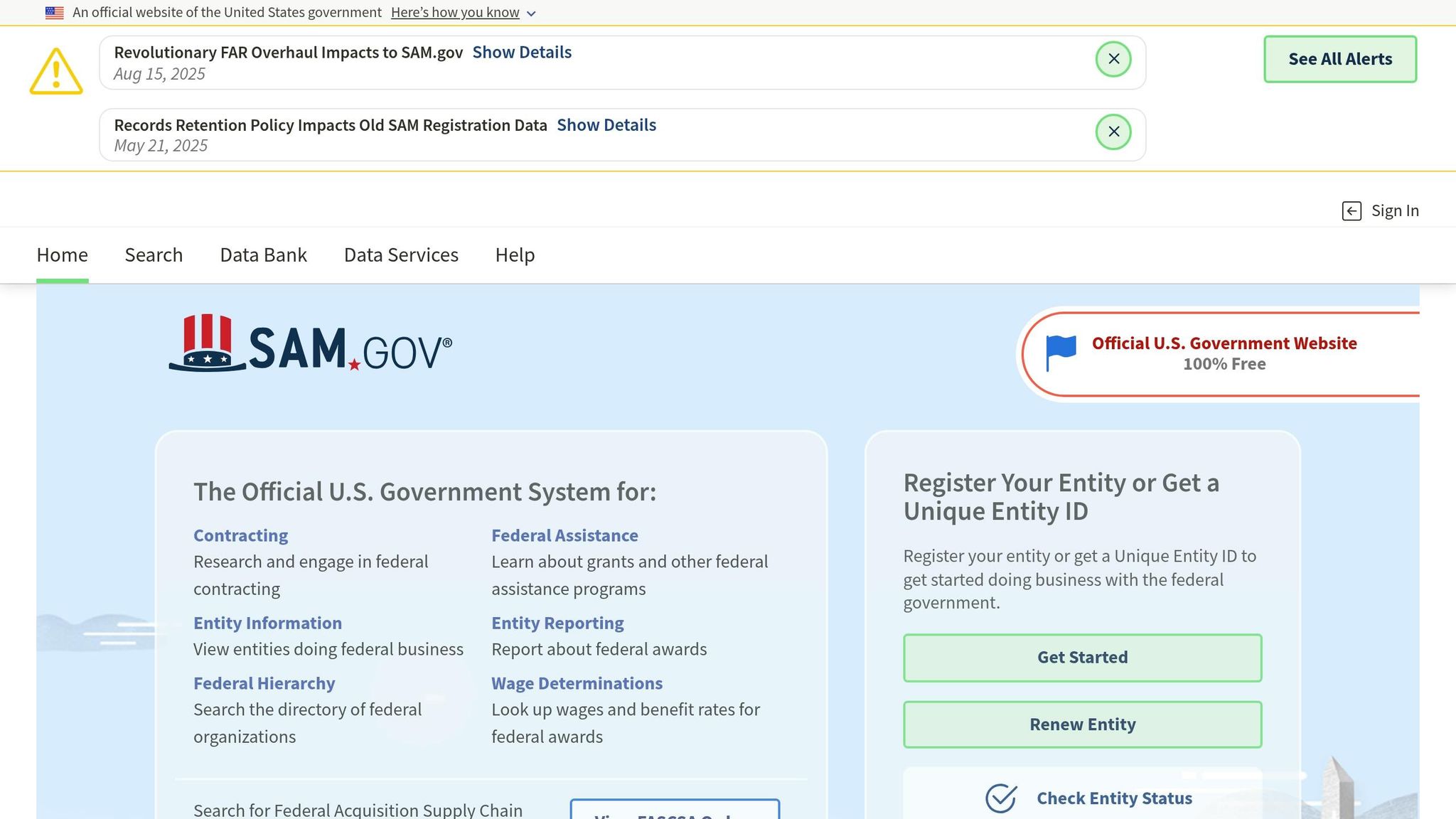
Start by creating a Login.gov account using a personal email and enabling multi-factor authentication. This account gives you access to SAM.gov’s registration system.
When registering, select "All Awards" as your purpose. Choosing "Financial Assistance Only" limits you to grants and loans, excluding you from federal contract opportunities in space technology.
The registration process requires detailed information across several categories:
| Category | Required Information |
|---|---|
| Legal Identity | Legal Business Name (as per IRS), EIN/TIN, Articles of Incorporation |
| Location | Physical Address (no P.O. Boxes), Congressional District |
| Financials | Electronic Funds Transfer (EFT) details (Routing & Account Numbers) |
| Operations | Primary NAICS Code, 12-month average employee count, Annual receipts |
| Points of Contact | Names, emails, and phone numbers for Government and Electronic Business POCs |
During registration, you’ll complete Assertions, where you define your goods and services using NAICS and Product Service Codes (PSC). This includes providing size metrics – like employee count and annual receipts – to determine if your business qualifies as "small". Your primary NAICS code is key here, as it sets the threshold for small business qualification in your industry.
You’ll also tackle Representations and Certifications (Reps & Certs), which confirm your compliance with Federal Acquisition Regulation (FAR) provisions. These answers are stored electronically and automatically included in your bids, eliminating the need for paper forms. Lastly, create a Marketing Partner Identification Number (MPIN) for secure access to other government systems.
If you’re a U.S.-based business, you’ll automatically receive a Commercial and Government Entity (CAGE) code during registration. This code is essential for security clearances and export controls – both critical for space technology contractors.
Get Relevant Certifications
Once your SAM.gov registration is complete, focus on certifications that align with your business profile. Apply for socioeconomic certifications through certify.sba.gov. Key programs include:
- 8(a) Business Development: For businesses owned by socially and economically disadvantaged individuals.
- WOSB/EDWOSB: For Woman-Owned or Economically Disadvantaged Woman-Owned Small Businesses.
- SDVOSB: For Service-Disabled Veteran-Owned Small Businesses.
- HUBZone: For businesses located in and employing individuals from historically underutilized zones.
If you’re working with the Department of Defense, you may also need Cybersecurity Maturity Model Certification (CMMC). Many DoD contracts specify the required CMMC level to protect sensitive data. Free tools like Project Spectrum can help you complete cybersecurity self-assessments, which are often a prerequisite for space tech contracts.
With the U.S. government awarding over $600 billion in contracts annually, proper registration and certifications can position your space technology business to secure a share of this lucrative market.
Step 3: Find Space Technology Contract Opportunities
Once your business is registered and certified, the next step is finding contract opportunities that align with your space technology expertise. The federal government posts all contract opportunities worth more than $25,000 on SAM.gov. However, navigating this platform can be challenging for many small businesses, especially when searching for space tech-specific contracts.
To narrow your search, use targeted NAICS codes like 336414 (Guided Missile and Space Vehicle Manufacturing) or 541715 (Research and Development in Physical, Engineering, and Life Sciences)[2,30]. Focus on agencies heavily involved in space, such as NASA, the Department of the Air Force (Space Force), and the Department of Defense.
Top contractors often engage early in the process, during the "pre-solicitation" phase, to influence requirements. Agencies use Sources Sought and Presolicitation notices to gauge market interest and refine their needs before issuing formal solicitations. Neil McDonnell, President of GovCon Chamber, emphasizes this point:
If a contract opportunity is listed in SAM.gov, you’re already too late… SAM.gov has so much more to offer than contract listings [such as] early-stage notices before solicitations are released.
To stay ahead, set up Saved Searches on SAM.gov with specific NAICS codes and enable daily email alerts. This automated system can uncover about 150% more qualified opportunities compared to manual keyword searches. Additionally, add your business to the Interested Vendors List for relevant solicitations, signaling your interest to prime contractors looking for subcontracting partners[23,25].
Search Contract Listings on SAM.gov
Understanding the different notice types on SAM.gov is critical to engaging at the right time. Here’s a quick breakdown:
- Sources Sought notices: These help agencies assess industry interest and capabilities. Submitting a capability statement here can put your business on their radar and potentially shape the final solicitation[2,28].
- Presolicitation notices: These offer early insight into upcoming requests for proposals (RFPs), giving you time to prepare teaming agreements or technical questions.
- Solicitations: These are formal requests requiring full proposals, including technical and cost details.
- Award Notices: These reveal contract winners, useful for identifying potential subcontracting opportunities or tracking future recompetes.
Check active solicitations at least twice a week for updates or amendments. Use the "Follow" feature on SAM.gov to receive automatic email alerts. Missing an amendment could disqualify your proposal[28,29].
Before submitting a bid, conduct a Requirements Gap Analysis (RGA) by scoring your capabilities (on a scale of 1–5) against each task in the Statement of Work (SOW). If your business can’t handle at least 60% of the work, consider partnering as a subcontractor rather than bidding as a prime contractor.
For agencies like NASA, which heavily invest in space technology, additional tracking is essential.
Track NASA Solicitations
NASA is a major player in space technology procurement, making it vital to monitor their opportunities closely. While NASA posts formal solicitations on SAM.gov, they also manage specialized awards, such as Cooperative Agreements and Funded Space Act Agreements, through the Federal Assistance domain.
For research and development contracts, check NSPIRES (NASA Solicitation and Proposal Integrated Review and Evaluation System). This platform offers general solicitations and peer review processes. NASA’s SBIR/STTR programs are also worth exploring. They release annual solicitations with a pre-release Q&A period and provide Phase I awards of up to $150,000 for feasibility studies (6 months) and Phase II awards of up to $850,000 for 24-month projects.
To get ahead, review NASA’s Office of Small Business Programs (OSBP) procurement forecasts. These forecasts can reveal upcoming space tech needs months before they appear on SAM.gov[26,32]. Additionally, the NASA SBIR/STTR "Firm Library" contains past award histories and sample documents, which can guide your proposal development.
If your business holds a GSA Schedule contract, explore GSA eBuy for exclusive Request for Quote (RFQ) opportunities. This platform accounts for over $39 billion annually in federal contracts[27,24]. Another resource is SBA SubNet, which lists subcontracting opportunities from prime contractors required to include small businesses in their plans.
Step 4: Create Your Proposal and Work Breakdown Structure (WBS)
Once you’ve identified the right federal opportunity, the next step is crafting a proposal that not only meets the required standards but also sets you apart from the competition. This involves developing a compliant proposal and a detailed Work Breakdown Structure (WBS) to show your ability to execute the project according to strict government requirements.
Write a Compliant Proposal
Federal proposals follow a specific format, and evaluators expect your submission to align with these guidelines. Your proposal should include several key sections:
- Administrative Section: Includes your SAM.gov registration, Unique Entity Identifier (UEI), financial records, and certifications.
- Technical Proposal: Highlights your Corporate Experience Narrative, Quality Control procedures, and the qualifications of your key personnel.
- Past Performance Section: Demonstrates your track record on similar projects.
- Pricing Section: Provides a detailed breakdown of costs.
- Compliance Section: Ensures all solicitation requirements are addressed.
The Technical Proposal is particularly critical. This section must showcase your ability to perform the work by including:
- A Corporate Experience Narrative that details your resources and the expertise of your team.
- A Quality Control Narrative explaining how you’ll manage internal reviews and subcontractor performance.
- Specific technical details that directly address the solicitation’s requirements.
To ensure your proposal is fully compliant, it should mirror Section L (Instructions to Offerors) and Section M (Evaluation Factors) of the solicitation. Using a compliance matrix can help you verify that you’ve addressed every requirement. As FedBiz Access emphasizes:
Compliance isn’t just about rules – it’s about credibility. A strong proposal proves you can follow instructions, meet deadlines, and deliver accurately.
Once your proposal is structured and compliant, the next step is to create a detailed WBS.
Build a Detailed WBS
A Work Breakdown Structure (WBS) is essential for breaking the project into manageable phases with clearly defined tasks, timelines, and costs. Federal agencies rely on this level of detail to evaluate whether your technical approach is realistic and whether your pricing aligns with the work proposed. Any inconsistencies between your WBS, technical proposal, and cost proposal can raise concerns during evaluation.
To build your WBS:
- Break the Statement of Work (SOW) into major project phases.
- Decompose each phase into specific tasks with measurable outcomes.
- Assign labor categories, estimated hours, and costs to each task.
This granular planning demonstrates that you’ve thought through every aspect of the project. Additionally, the Technical/Management Volume of your proposal should explain how you’ll manage risks, maintain quality, and track progress at each WBS level. A well-aligned WBS, combined with a strong narrative and accurate pricing, builds confidence in your ability to deliver.
Step 5: Use Federal Programs and Resources
After finalizing your proposal and Work Breakdown Structure (WBS), it’s time to tap into federal programs that can provide early-stage funding and flexible contracting options. The federal government offers a range of programs designed to support small businesses developing space technologies, offering funding that doesn’t require giving up equity and contracts tailored to smaller enterprises.
Apply for SBIR/STTR Programs
The Small Business Innovation Research (SBIR) and Small Business Technology Transfer (STTR) programs are two of the most prominent federal funding sources for small businesses working on innovative space technologies. Together, these programs allocate over $3 billion annually across 11 federal agencies, with NASA being one of the key participants.
To qualify for these programs, your business must meet specific criteria:
- Operate as a for-profit entity in the U.S.
- Have fewer than 500 employees.
- Be at least 51% owned and controlled by U.S. citizens or permanent residents.
For STTR, there’s an additional requirement: you must establish a formal partnership with a non-profit research institution, such as a university or a Federally Funded R&D Center.
The SBIR/STTR programs are structured in phases:
- Phase I: Focuses on feasibility studies. NASA awards for this phase can go up to $150,000 for a period of 6–12 months.
- Phase II: Supports research and development, including prototyping, with funding of up to $850,000 or more over 24 months.
- Phase III: Concentrates on commercialization but does not include SBIR/STTR funding.
Interestingly, most applicants are very small businesses with fewer than 10 employees, and the acceptance rate is typically between 15–20%.
Important Note: The SBIR/STTR programs are authorized only until September 30, 2025. Be sure to check the NASA SBIR/STTR website for the most up-to-date information.
The application process involves several steps, including registration with the SBIR Company Registry at SBIR.gov (to obtain an SBC Control ID) and NASA’s ProSAMS submission portal. Plan ahead – register weeks in advance and submit your application at least 24–48 hours before the 5:00 p.m. ET deadline. NASA’s ProSAMS system strictly enforces deadlines, and late submissions due to technical issues won’t be accepted.
NASA also provides additional support for Phase I awardees, including up to $6,500 in Technical and Business Assistance (TABA) funding. This helps with tasks like intellectual property strategy and market analysis. Some Phase I recipients are even invited to join NASA I-Corps, an entrepreneurial training program designed to refine commercialization strategies and validate product-market fit.
While SBIR/STTR programs are ideal for early-stage research, you might also want to explore more flexible contracting options like OTAs.
Learn About Other Transactions Authority (OTA)
Another option to consider is Other Transactions Authority (OTA) agreements, which offer a more streamlined alternative to traditional federal contracts. As Air Agency explains:
OTAs are flexible contracting mechanisms that expedite the federal procurement process, reducing traditional bureaucratic hurdles.
Unlike contracts governed by the Federal Acquisition Regulation (FAR), OTAs allow for quicker negotiations, more adaptable terms, and simplified compliance requirements. NASA manages OTA agreements through its Mission Directorates and the Space Technology Mission Directorate (STMD).
To increase your chances of securing OTA opportunities, consider joining industry consortia such as the National Security Innovation Network (NSIN) or the Consortium for Command, Control, Communications and Computer Technologies (C5). These memberships can help you stay informed about OTA opportunities and connect with key stakeholders in the industry.
Step 6: Meet Federal Compliance Requirements
After crafting your proposal, the next step is ensuring it meets federal compliance standards. This isn’t just about ticking boxes; it’s about adhering to strict regulatory frameworks, cybersecurity protocols, and detailed financial documentation that demonstrate your eligibility for federal contracts.
Align With Executive Order Space Priorities
Your proposals must reflect the current administration’s space policy goals. Executive Order 14369, titled "Ensuring American Space Superiority", signed on December 18, 2025, outlines the direction for federal space procurement through 2030.
Key objectives of this order include:
- Returning Americans to the moon by 2028.
- Establishing a permanent lunar outpost by 2030.
- Developing a commercial replacement for the International Space Station (ISS) by 2030.
- Attracting $50 billion in additional investment to U.S. space markets by 2028.
The order emphasizes a "commercial-first" approach to procurement. As Greenberg Traurig, LLP explains:
The EO instructs these agencies to adopt a first preference for commercial solutions and to rely more on streamlined instruments such as OTA arrangements and Space Act Agreements.
Agencies like NASA and the Department of Commerce now prioritize commercial solutions over traditional FAR-based contracts. To stand out, your proposal should clearly demonstrate how your technology supports these priorities – whether it’s advancing lunar exploration under the Artemis program, contributing to next-generation missile defense, or bolstering the National Initiative for American Space Nuclear Power.
When pursuing space contracts, familiarize yourself with the governing regulations, such as the Federal Acquisition Regulation (FAR), the Defense Federal Acquisition Regulation Supplement (DFARS), and the NASA FAR Supplement (NFS). Compliance with cybersecurity standards like NIST 800-171 and the Cybersecurity Maturity Model Certification (CMMC) is also mandatory.
For defense-related contracts, DFARS 252.204-7012 requires reporting cyber incidents to the Department of Defense within 72 hours. Additionally, DFARS 252.225-7049 and 252.225-7051 prohibit using certain foreign satellite and launch services.
Other compliance essentials include:
- Implementing a written code of business ethics and an internal control system, as required by FAR 52.203-13.
- Explicitly disclosing and marking pre-existing intellectual property (IP) in contracts to protect your rights. Failure to do so may grant the government broad rights to your technical data under DFARS 252.227-7013.
Failing to meet these requirements can lead to severe consequences, including suspension, debarment, or even legal liability.
Keep Accurate Financial and Cost Records
Federal contracts demand meticulous financial documentation and cost tracking. Separate government contract finances from your commercial accounts to ensure proper cost allocation. Agencies like the Defense Contract Audit Agency (DCAA) and the Defense Contract Management Agency (DCMA) will audit your records to verify compliance with performance and cost standards.
To meet federal evaluators’ expectations, you’ll need:
- Audited or verifiable Profit and Loss (P&L) statements and balance sheets for the past two fiscal years.
- At least three months of operating reserves.
- Evidence of six consecutive quarters of positive cash flow.
Pricing transparency is also critical. Provide at least six commercial invoices per product or service line to establish "fair and reasonable" pricing. Additionally, disclose your Commercial Sales Practices (CSP), including standard price lists, discount structures, and any special pricing offered to your "Most Favored Customers" (MFC).
| Financial Metric | Target Standard for Compliance |
|---|---|
| Debt-to-Equity Ratio | Below 3:1 |
| Cash Flow | 6+ consecutive quarters positive |
| Operating Reserves | 3 months of expenses |
| Tax Liabilities | Under 10% of total assets |
| Receivables Collection | Within 45 days |
| Minimum Sales | $100,000 within first 5 years |
For example, the General Services Administration (GSA) typically requires a debt-to-equity ratio under 3:1 for a favorable financial determination. Tax liabilities should remain under 10% of total assets, and receivables should be collected within 45 days to avoid signaling financial instability.
Stay proactive by maintaining an active SAM.gov registration and updating your Representations and Certifications (Reps & Certs) with each solicitation response. As the GovCon SkyNet Team advises:
Update your Reps & Certs every time you respond to a solicitation. Contracting officers verify these against your proposal, and outdated certifications can disqualify an otherwise winning bid.
Lastly, be prepared for additional requirements if you’re using Government-Wide Acquisition Contracts (GWACs), such as paying a contract access fee of 0.75% of sales.
Step 7: Work With GSA Schedule Experts
Once you’ve laid the groundwork with compliance and proposal preparation, enlisting specialized GSA Schedule support can significantly speed up your federal contracting efforts. Securing a GSA Schedule Contract often requires an additional 500–1,000 hours of work, which can strain your resources. For small space tech firms juggling Technology Readiness Level (TRL) advancements, NASA solicitations, and cybersecurity standards like CMMC, this administrative load can feel overwhelming. This is where expert assistance becomes invaluable.
How GSA Focus Eases Federal Contracting Challenges
GSA Focus provides a comprehensive, done-for-you service that simplifies the entire GSA Schedule acquisition process. Their team handles everything, from preparing required documentation – like your GSA Price List, Commercial Sales Practices disclosures, and Technical Proposals – to ensuring compliance with FAR and GSAR standards. For space tech companies, this means aligning your TRL-focused offerings and SBIR/STTR accomplishments with federal requirements to enhance competitiveness.
Through a secure online portal, GSA Focus allows you to upload around 12 key documents. From there, they take over, building your complete offer and managing interactions with contracting officers, including follow-ups. This streamlined process boasts a 98% success rate across more than 550 contracts, drastically reducing the time and effort required on your end.
But their support doesn’t stop at acquisition. GSA Focus also provides ongoing compliance services, such as certification reviews, contract clause management, and audit preparation. This ongoing guidance helps avoid common pitfalls that disqualify 30–40% of applications and ensures your contract remains active. With your contract in place, you’re well-positioned to tap into opportunities like the Space Force’s projected $3.39 billion FY2026 budget.
Setting the Stage for Long-Term Success
A GSA Schedule Contract offers a 20-year window for federal sales, perfectly aligning with the lengthy development cycles typical of space technology. These schedules account for 20–30% of federal IT and space-related procurements, giving you consistent access to federal buyers without having to start from scratch for every opportunity.
GSA Focus takes this access to the next level through its GSA Accelerator program. This includes a "Pipeline Sprint" that identifies bids within two weeks and a daily watchlist of curated opportunities from sources like GSA, SAM, and DIBBS. By leveraging these tools, companies can secure repeat business and strategically grow their federal market presence. For instance, aerospace firms using GSA Focus have reported securing over $10 million in follow-on contracts within just 18 months. One analysis even highlighted a 25% revenue increase thanks to streamlined access to Department of Defense (DoD) vehicles like FCSA for COMSATCOM requirements.
As GSA Focus puts it:
GSA Focus accelerates your access to a GSA Schedule 5x faster, with only 4 hours of your time in most cases. Our clients average +$927,000 to their bottom line.
Conclusion
Securing federal contracts in the space technology sector demands meticulous preparation and a strategic approach. From evaluating your Technology Readiness Level to registering on SAM.gov, crafting compliant proposals, and tapping into SBIR/STTR programs, each step lays the groundwork for success. Federal contracting isn’t a one-and-done effort – it’s an ongoing process of business development and growth.
Small businesses that engage early through "Sources Sought" notices, maintain up-to-date SAM.gov registrations, and use compliance matrices are better positioned to thrive in this expanding market. Every detail matters, and those who invest in these processes set themselves apart.
Partnering with GSA Focus can make this journey smoother. Their expertise reduces the administrative workload from over 100 hours to just 3 hours, enabling you to focus on advancing your technology. With a 98% success rate, they handle the complex documentation, compliance, and negotiations, so you can concentrate on driving innovation.
The federal space technology market is expanding, and agencies are eager to collaborate with forward-thinking partners. Activate automated SAM.gov alerts, keep your certifications current, and consider expert GSA Schedule support to accelerate your growth. Success in this field depends on viewing preparation and compliance not as hurdles, but as key advantages that open doors to long-term opportunities.
FAQs
What TRL is needed to compete for most space tech contracts?
To compete for the majority of space technology contracts, your technology generally needs to achieve TRL 6. This level indicates that the system or subsystem has been successfully demonstrated in a relevant environment, proving it’s ready for practical application.
How can I avoid disqualification on SAM.gov or in my proposal?
To stay in the running, make sure your SAM.gov registration is accurate and current. This includes verifying your addresses, banking information, and any other essential details. Pay close attention to completing all required documentation – every field matters. Stick to the specified formatting and submission guidelines, and double-check that your business information matches across all documents. If you’re unsure about any step, consulting a professional can help minimize mistakes and boost your chances of getting approved the first time.
Should I pursue SBIR/STTR, OTA, or a GSA Schedule first?
If you’re navigating federal contracting opportunities, a step-by-step approach can make all the difference. Here’s a roadmap to consider:
- SBIR/STTR Programs: These are ideal starting points for early-stage research and development. They provide funding to help you bring innovative ideas to life.
- OTA Agreements: Once you’ve advanced your projects, explore Other Transaction Authority (OTA) agreements. These are perfect for innovative initiatives, offering flexible terms that can adapt to unique project needs.
- GSA Schedule: When you’re ready for long-term federal contracting, securing a General Services Administration (GSA) Schedule simplifies procurement. It opens doors to the federal marketplace, making it easier for agencies to work with you.
Each step builds on the last, aligning with your goals and readiness for federal opportunities.
Related Blog Posts
- Ultimate Guide to Federal Buyer Relationships
- GSA Post-Award Checklist for Contractors
- Checklist for GSA Construction Contract Compliance
- 5 Steps to Meet GSA Prequalification Standards