

Looking to form a GSA Joint Venture (JV) and win federal contracts? Here’s what you need to know upfront:
- What is a GSA JV?
A GSA Joint Venture is a formal partnership where businesses combine resources to secure GSA Multiple Award Schedule (MAS) contracts. It operates as a separate legal entity with its own registration in SAM.gov, Unique Entity Identifier (UEI), and CAGE code. - Key Benefits:
- Small businesses can access set-aside contracts (e.g., 8(a), HUBZone, SDVOSB).
- The SBA Mentor-Protégé Program allows small businesses to partner with larger companies without violating size standards.
- The Startup Springboard program waives the two-year business history requirement for new ventures.
- Compliance Requirements:
- Register the JV in SAM.gov with its own UEI and CAGE code.
- Draft a joint venture agreement with specific provisions per SBA regulations (e.g., 13 CFR 125.8).
- Ensure the small business partner performs at least 40% of the work.
- Maintain financial transparency with a dedicated bank account and quarterly reporting.
- Limitations:
- Each JV can hold only one GSA Schedule contract.
- Partners are limited to three JV offers or awards.
- Post-Award Obligations:
- Renew SAM.gov registration annually.
- Report MAS sales quarterly and pay the Industrial Funding Fee (IFF).
- Notify GSA of any changes to the JV agreement.
Bottom Line: Follow federal guidelines carefully to avoid disqualification or contract issues. If you’re new to GSA contracting, consider expert assistance to streamline the process.
Now, let’s dive deeper into the steps, rules, and tips for forming a compliant GSA Joint Venture.
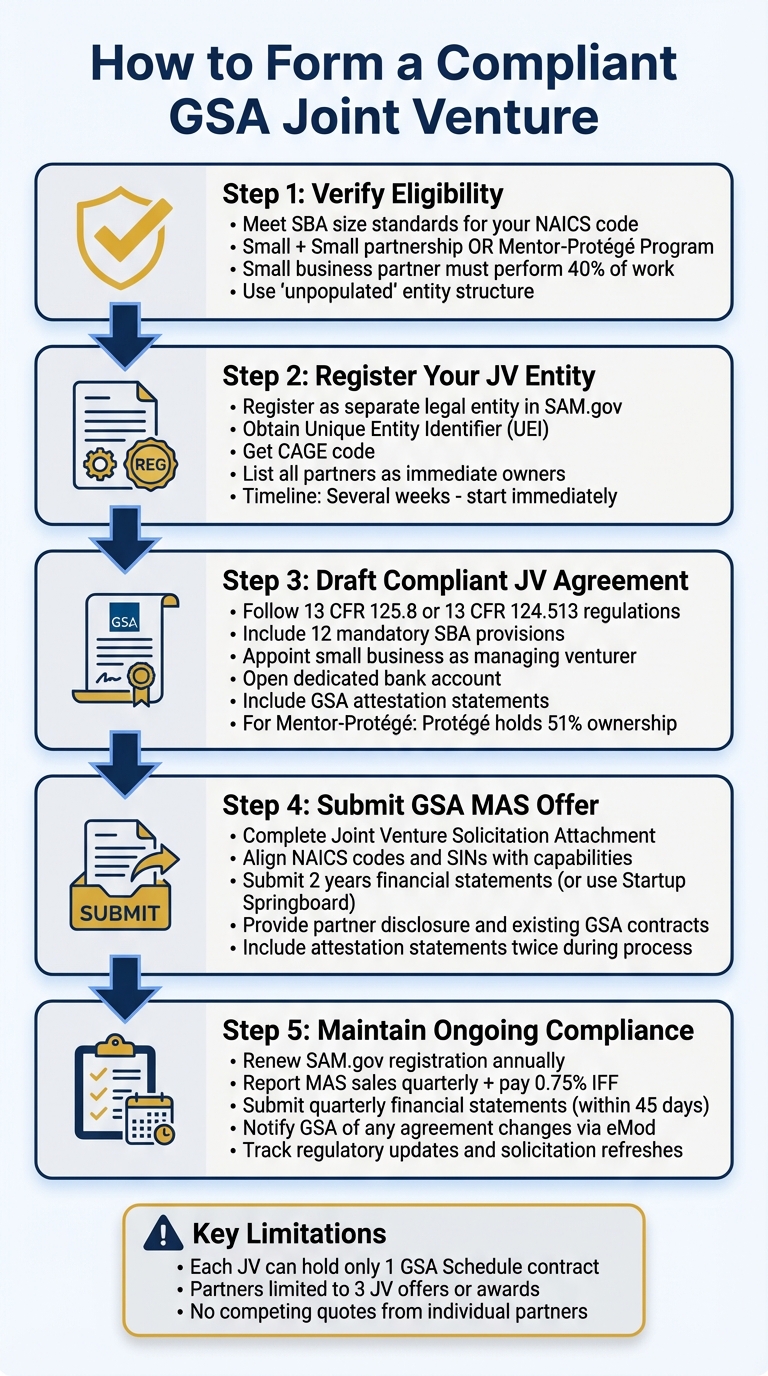
5-Step Process to Form a Compliant GSA Joint Venture
Joint Venture Eligibility Refresher on Requirements for Government Contractors
Who Can Form a GSA Joint Venture
To bid on small business set-asides and obtain a GSA Schedule contract, partnerships must meet specific federal criteria. Knowing these requirements is key to creating a compliant joint venture agreement and submitting a successful GSA MAS offer.
Meeting SBA Size Standards
The Small Business Administration (SBA) defines “small” businesses using industry-specific size standards, which are based on either average annual receipts or employee count under the NAICS code.
Typically, the SBA combines the revenue and employee numbers of joint venture partners unless exceptions apply. Here are two key exceptions where aggregation is not required:
- Small + Small Partnership: If all partners meet the “small” criteria under the applicable NAICS code, their individual revenues remain separate. For example, under SBA regulation 13 C.F.R. 125.8, two companies with annual receipts below a $10 million threshold can form a joint venture without combining their revenues.
- Mentor-Protégé Program: Partnerships between an approved mentor (which can be a larger business) and a small business protégé are exempt from affiliation rules, as long as the protégé qualifies as small for the specific contract.
According to the SBA: “A mentor and its protégé can joint venture as a small business for any small business contract, provided the protégé individually qualifies as small”.
It’s important to note that the small business partner must handle at least 40% of the work performed by the joint venture itself. Additionally, for small business set-asides, the joint venture must be an “unpopulated” entity – meaning it cannot employ staff for contract work, though administrative employees are allowed.
Registering in SAM.gov and Getting a UEI
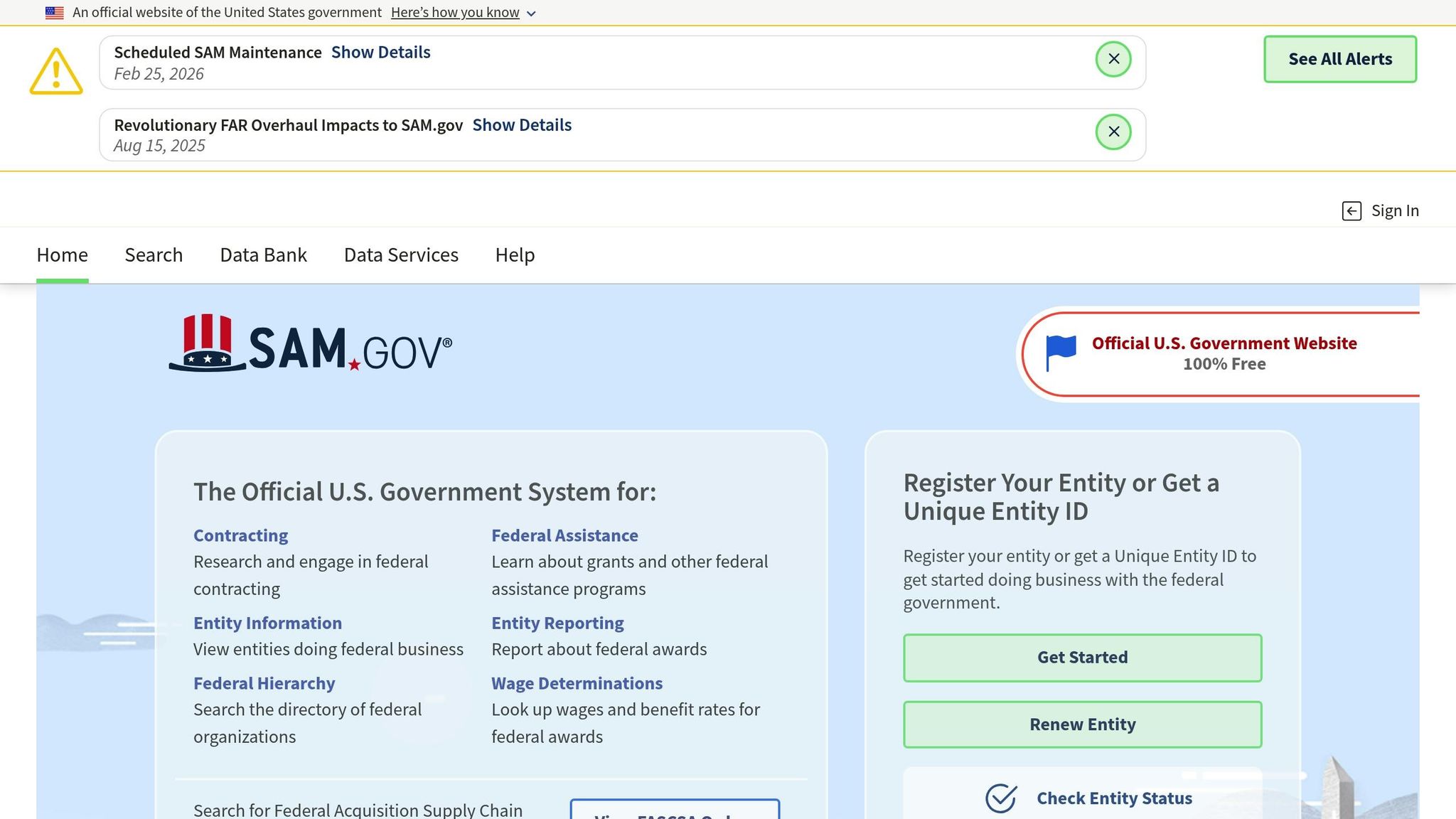
Your joint venture must be registered as a distinct legal entity in the System for Award Management (SAM.gov). This process includes obtaining a Unique Entity Identifier (UEI), which replaced the DUNS number system in April 2022.
The SBA emphasizes: “The joint venture must be separately identified with its own name and have both a Unique Entity Identifier (UEI) and a Commercial And Government Entity (CAGE) code in the federal government’s System for Award Management at SAM.gov”.
To avoid delays, register your joint venture in SAM.gov immediately after finalizing your agreement. SAM registration can take several weeks, and without it, you cannot bid on government contracts or secure a GSA Schedule award. During registration, identify the entity type as a “joint venture” and list all partners as the immediate owners. Be prepared to provide each partner’s UEI, CAGE code, and TIN.
Once your joint venture’s legal identity is confirmed, you can move forward with meeting GSA Schedule contract requirements.
GSA Schedule Contract Limits for Partners
After establishing your joint venture, remember that it must hold its own GSA Schedule contract, even if individual partners already have their own. For a GSA Multiple Award Schedule (MAS) offer, the joint venture itself must apply for and secure a separate contract.
When submitting your GSA MAS offer, disclose any existing GSA Schedule contracts or pending offers held by your partners, either individually or with other ventures. Transparency is critical here – failure to provide this information can lead to your offer being denied or your contract being canceled after approval.
Writing a Compliant Joint Venture Agreement
Drafting a joint venture agreement that aligns with federal standards is a critical step for ensuring compliance and setting your GSA venture up for success. Once your joint venture is registered, it’s essential to create a written agreement that meets both SBA and GSA regulatory guidelines. This document needs to go beyond the basics of a standard partnership agreement, incorporating specific provisions outlined in federal regulations like 13 CFR 125.8 for small business ventures and 13 CFR 124.513 for 8(a) Program participants.
Using generic templates is a risky move. These agreements must be customized to meet stringent federal requirements. Overlooking even one mandatory provision could lead to disqualification or trigger a size protest.
Required Agreement Components
The SBA mandates 12 provisions to be included in joint venture agreements. These ensure transparency, proper management, and equitable work and profit distribution.
One of the key elements is the management structure. The agreement must appoint a small business partner (or the protégé in a mentor-protégé setup) as the managing venturer. Additionally, a Responsible Manager – an employee of the managing venturer – must be named to oversee contract performance.
Financial controls are another essential aspect. A separate bank account in the joint venture’s name is required for all contract-related transactions. To maintain accountability, withdrawals should require the consent of all partners.
The agreement should also address profit distribution and resource allocation. Profits must be distributed based on the work performed, and all resources contributed by each partner – such as equipment, facilities, and labor – should be listed along with their values.
Record-keeping and reporting are equally important. Administrative and accounting records should be maintained at the managing venturer’s office, with final records retained after the contract ends. The SBA requires quarterly financial statements to be submitted within 45 days of each quarter’s end, and a final profit and loss statement must be provided within 90 days after the contract concludes.
| Requirement Category | Mandatory Provision (per 13 CFR 124.513 / 125.8) |
|---|---|
| Management | Appoint a small business managing venturer and a Responsible Manager. |
| Financials | Open a dedicated bank account requiring all partners’ signatures. |
| Profits | Allocate profits based on the proportion of work completed. |
| Resources | List all resources with their associated values. |
| Reporting | Submit quarterly financial statements and a final P&L statement. |
| Workshare | Ensure the protégé or small business performs at least 40% of the total work. |
For ventures under the SBA Mentor-Protégé Program, additional requirements apply.
Mentor-Protégé Program Requirements
Joint ventures operating under the SBA Mentor-Protégé Program must designate the protégé as the managing venturer. The protégé is required to perform at least 40% of the work, and this work must be substantive, not just administrative.
If the joint venture is structured as a separate legal entity, the protégé must hold at least 51% ownership of the entity. For ventures participating in the 8(a) Program, the SBA must approve the joint venture agreement before the contract is awarded.
To solidify compliance, attestation statements play a crucial role.
Including GSA Attestation Statements
GSA MAS templates require specific attestation statements to be included in your joint venture agreement. These certifications affirm your commitment to adhering to SBA regulations throughout the contract.
Partners must provide these certifications twice: first, when submitting the initial offer, and again before being identified as the apparent successful offeror. These statements typically confirm compliance with 13 CFR 125.8 or 13 CFR 124.513, the managing venturer’s responsibility for at least 40% of the work, and that profit distribution aligns with the work performed.
As stated in 13 CFR 128.402(e): “The certified VOSB or SDVOSB partner to the joint venture must submit a certification to the contracting officer and SBA… stating… The parties have entered into a joint venture agreement that fully complies with [regulations]”.
Failing to include these attestations – or failing to perform according to them – can lead to size protests, contract cancellations, or even government suspension and debarment. Make sure your agreement explicitly references the applicable regulations and mirrors the required language from GSA’s certifications.
Submitting Your GSA MAS Offer
Once your agreement is finalized and your registration is confirmed, the next step is submitting your GSA Multiple Award Schedule (MAS) offer. Before diving in, make sure your joint venture is separately registered in SAM.gov with a valid UEI, CAGE code, and a clear listing of all partners.
Completing the Joint Venture Attachment
As part of GSA Refresh 16, you’ll need to fill out the mandatory Joint Venture (JV) Solicitation Attachment. This document requires detailed information about all partners and includes important attestation statements. If your joint venture is part of the SBA Mentor-Protégé Program, don’t forget to complete Appendix B of the attachment and attach your SBA-approved Mentor-Protégé Agreement.
In your Price Proposal Template (PPT), the “Vendor Name” column should clearly indicate which partner is responsible for providing each product or service. For unpopulated joint ventures, each partner must propose appropriate labor categories. Additionally, include a cover letter that names the joint venture and its partners, along with any existing GSA Contract numbers held by individual partners. Be sure to submit financial statements for the past two years, along with required documents like Commercial Sales Practices (CSP) and Professional Compensation Plans.
Once the attachment is complete, double-check that your NAICS codes and SINs are correctly aligned with your joint venture’s capabilities.
Aligning NAICS Codes and SINs
Accurate trade classifications are critical for a compliant submission. Ensure the NAICS codes and Special Item Numbers (SINs) you choose accurately reflect your joint venture’s capabilities. For the protégé partner, it’s essential to qualify as “small” under the relevant NAICS code. Carefully review the GSA SIN table to identify any unique requirements, such as technical certifications or specific project experience, for each subcategory.
The protégé partner must submit at least one project experience narrative for the SINs being offered, along with a customer reference or CPAR. If your joint venture doesn’t have two years of corporate experience, consider leveraging the Startup Springboard program. This allows you to use key personnel’s management and project experience to meet SIN-specific requirements.
Avoiding Competing Quotes
GSA enforces strict rules to prevent competing quotes. If your joint venture submits a quote for a GSA MAS order or BPA, individual partners cannot submit separate quotes for the same requirement using their own GSA MAS contracts or through any other joint venture.
Additionally, if the same two companies form multiple joint venture entities, only one of those joint ventures can hold a GSA Schedule. To avoid compliance issues, establish clear communication protocols between partners to ensure no competing quotes are submitted. Maintaining these practices will help you stay aligned with GSA regulations and foster smooth federal engagements.
Staying Compliant After Award
Securing a GSA Schedule award is just the beginning. To protect your joint venture’s federal contracting status, staying on top of ongoing compliance obligations is crucial.
Annual Size Recertification
Renewing your SAM.gov registration every year is a must. As GSA.gov explains, “You must renew your business registration on SAM.gov annually. If any of your business details change prior to the annual renewal, update your information immediately”. For joint ventures participating in small business programs, this means keeping certifications – like those for the SBA Mentor-Protégé Program, 8(a) Business Development, HUBZone, or Veteran-owned programs – up to date in line with each program’s specific requirements.
Additionally, your joint venture must report MAS sales quarterly and pay the Industrial Funding Fee (IFF), which is 0.75% of reported sales. Payments are due within 30 calendar days after the quarter ends or monthly if you’re part of the Transactional Data Reporting program.
And don’t forget: any changes to your joint venture’s structure need to be reported promptly to avoid compliance issues.
Reporting Agreement Changes to GSA
If your joint venture’s structure or agreement changes, you must notify GSA through the eMod system. Submit a “Revise Terms and Conditions” modification and update your JV Solicitation Attachment and Authorized FSS price list. For modifications involving new products or services offered by a specific partner, separate requests – such as “Add Products” or “Add Service Offerings” – are required. Once submitted, GSA reviews these updates and typically issues a bilateral contract modification to formally incorporate the changes into your MAS contract.
Additionally, GSA periodically issues mass modifications that apply to all contractors. These must be signed within 90 days of receipt, or your contract could be at risk. Staying proactive with these updates is key to avoiding compliance setbacks.
Tracking Regulatory Updates
Federal contracting rules are always changing, so keeping up with the latest MAS Solicitation Refreshes is essential. For example, joint ventures awarded contracts before Refresh 16 had to retroactively submit JV Solicitation Attachments to align with updated GSA policies.
Other areas to monitor include Service Contract Labor Standards (SCLS) Wage Determinations, which can impact labor pricing, and Economic Price Adjustment (EPA) clauses. Current EPA guidelines set ceiling limits for price increases at 4% for the Human Capital Category, 5% for Professional Services and Travel, and 10% for other large categories. You’re allowed up to three price increases in a 12-month period, but requests must be spaced at least 30 days apart.
To stay compliant, maintain an active Vendor Support Center account and ensure your company price list is current, including all required joint venture disclosures. Regularly reviewing solicitation refreshes and policy updates will help your joint venture navigate the evolving federal landscape with confidence.
Conclusion
Working within the framework of a compliant GSA joint venture requires careful attention to federal requirements at every step. Start by registering your joint venture as a separate entity on SAM.gov, ensuring it has a unique UEI and CAGE code. Then, draft an agreement that aligns with SBA standards, keeping in mind that the protégé partner must handle at least 40% of the work. Remember, each partner is capped at participating in three GSA Schedule JV contracts.
Here’s a key challenge to consider:
Fortunately, the Startup Springboard program offers a significant advantage, allowing joint ventures to skip the traditional two-year business history requirement. While this can streamline the process, maintaining compliance after securing the award is equally important. Annual recertifications and timely updates on agreement changes are critical to staying on track.
Given the intricate nature of GSA Schedules, having expert support can make a world of difference. GSA Focus offers a full-service solution specifically designed to help small businesses manage the complexities of acquiring and maintaining GSA Schedule Contracts. Their services cover everything from document preparation and compliance checks to negotiation support, helping you save time and effort while navigating federal contracting requirements.
Whether you’re building a Mentor-Protégé joint venture or forming a standard partnership, success in the federal marketplace depends on thorough preparation and consistent diligence. Partnering with experts like GSA Focus can help ensure your joint venture is not only compliant but also well-positioned for long-term growth.
FAQs
Do we need a new UEI and CAGE code for the JV?
Yes, a GSA joint venture (JV) does need its own UEI (Unique Entity Identifier) and CAGE code. According to GSA Refresh 16, a JV is considered a separate legal entity, distinct from its individual member companies. This means it must have its own registration in the System for Award Management (SAM). To register the JV in SAM, you’ll need to create a new account, which confirms the requirement for these unique identifiers.
What does “unpopulated JV” mean in practice?
An “unpopulated JV” refers to a joint venture established as a distinct legal entity that doesn’t have its own workforce to carry out tasks. Instead, it serves as a framework allowing its members to collaborate as the prime contractor. Each member contributes by completing assigned tasks using their own employees.
How do JV partners avoid submitting competing quotes?
Joint venture partners can sidestep the issue of competing quotes by laying out clear roles, responsibilities, and scopes of work in their agreement. Careful planning is key – when tasks are well-aligned, overlap becomes a non-issue. On top of that, partners should work together to submit one unified proposal that showcases their combined strengths and meets federal guidelines. Open communication and sticking to the agreed terms are crucial to avoiding conflicts or duplicate submissions.
Related Blog Posts
- How GSA Joint Ventures Work
- Ultimate Guide to Teaming Agreements for Small Businesses
- 5 Steps to Meet GSA Prequalification Standards
- Checklist for Successful Federal Joint Ventures