

Looking to tap into federal funding for public transportation projects? The Federal Transit Administration (FTA) offers over $20 billion annually to support transit systems across the U.S. Here’s what you need to know:
- What is the FTA? A division of the U.S. Department of Transportation, established in 1964, focused on funding and improving public transportation.
- Why FTA Grants Matter: They fund everything from new buses and rail systems to maintenance and safety upgrades.
- Types of Grants:
- Formula Grants: Predictable annual funding based on population and transit data (e.g., Section 5307 for urban areas).
- Discretionary Grants: Competitive funding for specific projects like zero-emission buses or major infrastructure development (e.g., Capital Investment Grants).
- Eligibility: Open to public agencies, local governments, tribes, and nonprofits involved in transit.
- How to Apply: Start with registration on SAM.gov, include projects in local/state plans, and meet environmental and funding match requirements.
Whether you’re a contractor, small business, or transit agency, FTA grants provide opportunities to contribute to public transit growth. Read on for a step-by-step guide to securing funding and maximizing your impact.
Capital Investment Grants Program – Small Starts Presentation 2021
FTA Formula Grant Programs
Formula grants provide consistent, annual funding based on specific statutory formulas. These formulas factor in elements like population size, service levels, and the condition of transit infrastructure to determine funding allocations. Two key programs – Section 5307 and Section 5337 – contribute billions of dollars annually to support public transit systems. Let’s take a closer look at how these programs work.
Urbanized Area Formula Grants (Section 5307)
Section 5307 is the primary funding mechanism for public transit systems in urbanized areas, defined as regions with populations of 50,000 or more. In FY 2026, this program is expected to receive $6.943 billion in funding. For areas with populations over 200,000, funds are distributed directly to eligible public agencies. In smaller urbanized areas (50,000–200,000 residents), state Governors are responsible for allocating the funds.
The program supports a wide range of transit-related activities. Eligible uses include capital projects such as replacing buses, overhauling vehicles, purchasing security equipment, and constructing facilities. It also funds planning efforts like engineering design and technical studies. Notably, preventive maintenance is categorized as a capital expense. Federal cost-sharing varies: capital projects typically receive 80% federal funding, while operating assistance for smaller agencies is capped at 50%. Operating assistance is generally restricted to smaller urbanized areas or agencies operating 100 or fewer vehicles during peak service.
Additionally, agencies in urbanized areas with populations of 200,000 or more must allocate at least 0.75% of their Section 5307 funds to safety-related projects. Federal cost shares can reach 85% for vehicle purchases and 90% for projects related to ADA compliance or Clean Air Act requirements. Funds remain available for use in the year they are appropriated and for five additional years, giving agencies flexibility in managing their projects.
Fixed Guideway Capital Investment Grants (Section 5337)
Section 5337 is dedicated to maintaining and rehabilitating high-intensity transit systems, ensuring that aging infrastructure remains safe and operational. Unlike programs designed for new capital investments, Section 5337 focuses on preserving existing assets. This includes rail lines, subways, light rail, commuter rail, trolleys, ferries, and bus rapid transit systems.
The program addresses a vital need by funding the replacement, rehabilitation, and modernization of aging transit infrastructure. Agencies seeking major capital funding under other programs, such as Section 5309, must demonstrate progress toward meeting transit asset management performance targets. This makes Section 5337 funding a critical component for maintaining eligibility.
As of November 2025, the Federal Transit Administration (FTA) consolidated guidance for Section 5337 with Section 5307 and the bus component of Section 5339 into a single circular (C 9050.1A). This update simplifies compliance for transit agencies managing multiple formula grants.
FTA Discretionary Grant Programs
Discretionary grants stand apart from formula grants by being competitive in nature. These programs aim to address specific objectives like upgrading bus fleets, cutting emissions, and constructing major transit infrastructure. The competition is fierce – just look at the numbers. In FY 2024, the Low-No Program received 214 eligible applications totaling $4.7 billion in requests, but only 62 projects were funded. Similarly, the Bus Program had 263 applications seeking $4.4 billion, with just 55 projects receiving awards.
For those projects that are selected, the rewards are substantial. In November 2025, the FTA allocated nearly $2 billion across 165 projects in 45 states and the District of Columbia through the Grants for Buses and Bus Facilities and Low or No Emission programs. Grant amounts vary widely; for FY 2024, Low-No grants ranged from $1,215,776 to $99,499,531, while Bus Program grants spanned $131,168 to $26,880,000. These grants focus on modernization, environmental responsibility, and capital renewal – areas we’ll explore more deeply in the sections below.
Grants for Buses and Bus Facilities Program
The Grants for Buses and Bus Facilities Program (Section 5339(b)) is designed to replace aging buses, rehabilitate vehicles, acquire new equipment, and upgrade facilities. It supports fixed-route bus services, ensuring agencies can provide dependable transportation for their communities.
For FY 2026, this program is backed by $412 million through the Bipartisan Infrastructure Law. Typically, the federal share covers 80% of project costs, but this can rise to 85% for buses meeting Clean Air Act or ADA standards [15, 19]. Additionally, at least 15% of these funds are earmarked for rural projects. This creates opportunities for small businesses specializing in fleet services or equipment to participate in federal transit initiatives.
"The Low-No Program and Bus Program goals are to enhance safety and renew our transit systems through the deployment of modern buses and associated equipment and facilities."
- Federal Transit Administration
Low or No Emission Grant Program (Low-No)
The Low or No Emission Grant Program (Section 5339(c)) focuses on environmental goals by funding low- and zero-emission transit buses. This includes vehicles like hydrogen fuel-cell and battery-electric buses, as well as the infrastructure needed to support them – charging stations, refueling facilities, and more.
In FY 2026, funding for the Low-No Program reaches $1,128 million. The federal share for eligible projects can go as high as 90% for equipment and facilities tied to low- or zero-emission buses [15, 19]. Of this funding, at least 25% is reserved for low-emission projects that are not zero-emission, such as hybrid-electric, CNG, or propane vehicles [15, 16].
Applicants pursuing zero-emission projects must meet additional requirements. These include submitting a Zero-Emission Fleet Transition Plan that outlines fleet acquisition, infrastructure needs, and cost estimates. Additionally, 5% of the federal award must be allocated to workforce development and training to prepare staff for maintaining and operating new technologies [15, 16]. Agencies can also apply to both the Low-No and Bus Programs for the same project, increasing their chances of receiving funding.
Capital Investment Grants (CIG) Program
The Capital Investment Grants (CIG) Program (Section 5309) is the primary federal funding source for large-scale transit infrastructure projects. It supports major endeavors like heavy rail, commuter rail, light rail, streetcars, and bus rapid transit (BRT) systems. Unlike the bus-focused programs, CIG involves a detailed, multi-year evaluation process.
With up to $4.6 billion authorized annually (pending Congressional appropriations), the program is divided into three categories: New Starts, Small Starts, and Core Capacity.
- New Starts projects are for initiatives with total costs of $400 million or more, or those seeking at least $150 million in CIG funding.
- Small Starts projects are for smaller-scale efforts costing less than $400 million and requesting under $150 million in CIG funds.
- Core Capacity projects address existing transit corridors expected to reach capacity within 10 years. These projects must increase capacity by at least 10% [3, 20].
"Federal transit law requires transit agencies seeking CIG funding to complete a series of steps over several years."
- Federal Transit Administration
The CIG process includes distinct phases like Project Development and Engineering. Projects are rated on a 5-point scale, and only those achieving at least a "Medium" rating are eligible for funding. While the maximum CIG share is typically 60%, total federal contributions can reach 80% when combined with other FTA programs. Given the extended timeline and rigorous evaluation, CIG funding is best suited for agencies with long-term plans for transformative transit infrastructure. Up next, we’ll dive into the eligibility requirements and application process to help you make the most of these funding opportunities.
Eligibility and Application Process
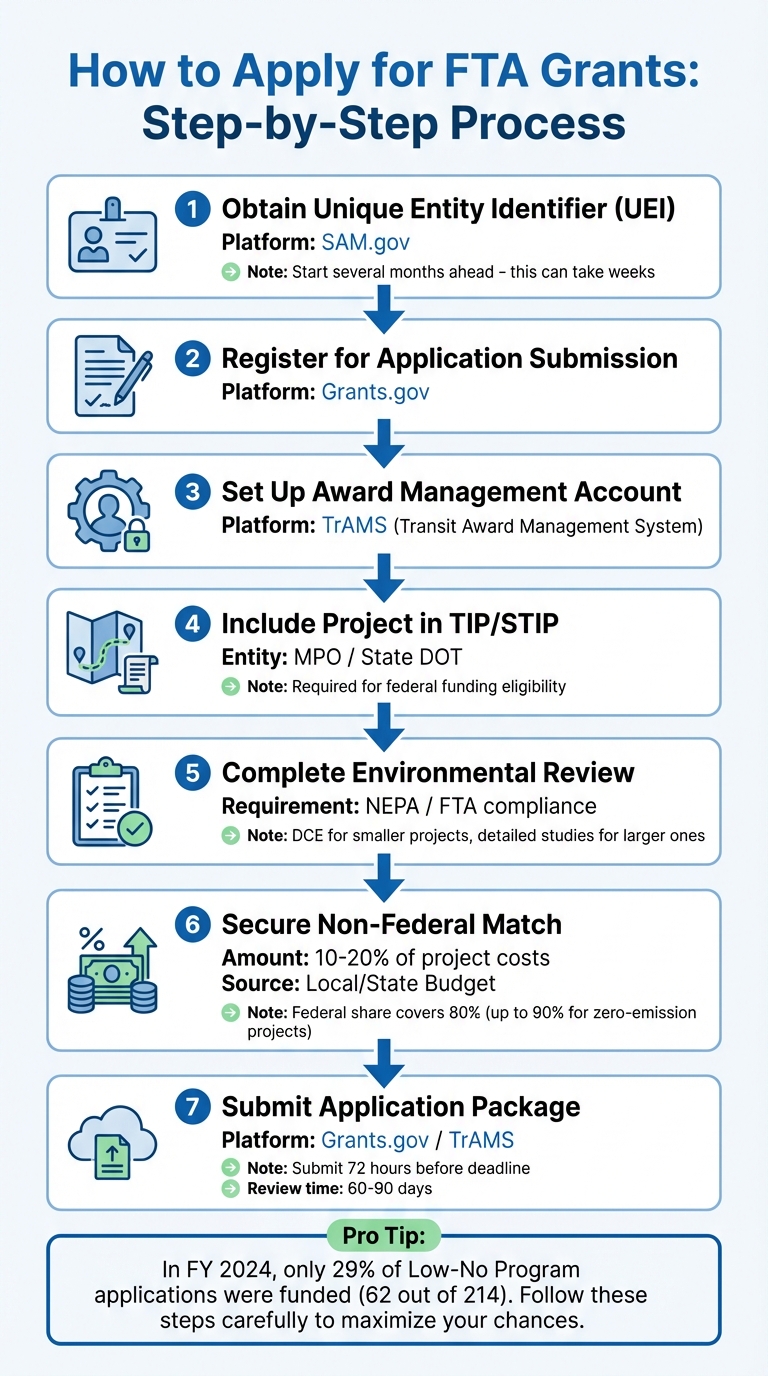
7-Step FTA Grant Application Process for Transit Agencies
Understanding the eligibility criteria and application steps is key to securing funding from the Federal Transit Administration (FTA).
Who Can Apply for FTA Grants?
Eligible applicants typically include states (including U.S. territories and Washington, D.C.), local government entities, designated recipients, and federally recognized Indian tribes. Private non-profit organizations involved in public transportation can also participate as subrecipients for certain programs, such as the Grants for Buses and Bus Facilities Program and the Section 5310 program, which supports seniors and individuals with disabilities.
There’s a clear distinction between rural and urban programs. Rural programs under Section 5311 are aimed at areas with populations under 50,000. These projects must be submitted by the state, either individually or as part of a consolidated application, except for those proposed by Indian tribes. Meanwhile, urban programs under Section 5307 provide formula grants specifically for urbanized areas.
Applicants must demonstrate they have the legal, financial, and technical capacity to manage federal funds. Additionally, they need to be registered in the Transit Award Management System (TrAMS) and have a valid Unique Entity Identifier (UEI) from SAM.gov. For the FY 2025 Bus Program, no single grant recipient can receive more than 10% of the total available funding.
How to Apply: Step-by-Step
The application process starts with registering at SAM.gov to obtain a Unique Entity Identifier (UEI). Since this step can take weeks, it’s wise to begin several months ahead. Your project must also be included in the Metropolitan Transportation Improvement Program (TIP) and the State Transportation Improvement Program (STIP) to qualify for federal funding. Additionally, compliance with the National Environmental Policy Act (NEPA) is required. Smaller projects may need a Documented Categorical Exclusion (DCE), while larger ones could require more detailed environmental studies.
FTA grants generally require a non-federal match of 10–20%, with the federal share covering 80% of costs. This share increases to 85% for transit buses that comply with the Clean Air Act or ADA standards and up to 90% for equipment and facilities tied to low- or zero-emission buses.
| Step | Action | Platform/Entity |
|---|---|---|
| 1 | Obtain Unique Entity Identifier (UEI) | SAM.gov |
| 2 | Register for Application Submission | Grants.gov |
| 3 | Set Up Award Management Account | TrAMS |
| 4 | Include Project in TIP/STIP | MPO / State DOT |
| 5 | Complete Environmental Review | NEPA / FTA |
| 6 | Secure Non-Federal Match (10-20%) | Local/State Budget |
| 7 | Submit Application Package | Grants.gov / TrAMS |
After submission, the FTA typically takes 60 to 90 days to review applications. The Department of Labor (DOL) also evaluates applications to ensure compliance with transit employee protective arrangements. Following these steps carefully ensures your application meets FTA standards and increases your chances of a successful review.
Tips for a Successful Application
To stand out in a competitive process, attention to detail is critical. For example, in FY 2024, the Low-No Program received 214 eligible applications requesting $4.7 billion, but only 62 projects (around 29%) were funded.
- Submit early: Aim to file your application at least 72 hours before the deadline to address any errors on Grants.gov.
- Use current forms: Always use the latest digital forms provided for the application year. Avoid scanning or using outdated versions, as these can lead to technical issues.
- Name your partners: Clearly identify vehicle manufacturers and consultants to meet competitive procurement requirements under 49 U.S.C. 5325(a). Failing to do so could delay your project with additional procurement processes.
- Prepare for zero-emission projects: If your project involves zero-emission vehicles, your Zero-Emission Fleet Transition Plan must include all six statutory components required by 49 U.S.C. 5339(c)(24)(D). Allocate 5% of your federal funding request for workforce development unless a smaller amount is justified. If your project temporarily exceeds spare ratio guidelines during the transition, consult your FTA Regional Office early for guidance.
To improve your chances, review past funding awards on program pages to understand the types of projects that have been approved. For capital projects, prepare a Benefit-Cost Analysis (BCA) to quantify the anticipated benefits of your investment. Coordination with your Metropolitan Planning Organization (MPO) is also essential to align your project across finance, procurement, and planning departments.
Finally, remember that all grant recipients must sign annual Certifications and Assurances to remain eligible for funding. Section 5307 recipients undergo Triennial Reviews, while Section 5311 recipients face State Management Reviews. Since FTA grants are reimbursable, your agency must have the cash flow to cover costs upfront before seeking reimbursement.
Using FTA Grants with GSA Schedules
GSA Schedules in FTA Projects
Transit agencies rely on GSA Schedules to make the most of their FTA grants, offering a streamlined way to procure pre-negotiated goods and services without enduring lengthy procurement processes. With the FTA allocating over $20 billion annually to public transit, this approach provides a wealth of opportunities for vendors listed on GSA Schedules. By simplifying procurement, GSA Schedules align seamlessly with the fiscal guidelines of FTA grants.
In fiscal year 2024, small businesses saw impressive results, securing $18.2 billion in sales through the GSA Schedule. They dominated several key sectors, accounting for 76% of sales in Transportation and Logistics Services and 61% in Industrial Products and Facilities. On average, small businesses generated nearly $1.5 million in annual sales.
One standout feature of GSA Schedules is Cooperative Purchasing, which allows state and local entities – the main beneficiaries of FTA grants – to purchase directly from GSA contractors for eligible categories. This approach not only saves time but also ensures compliance with federal pricing standards. Transit agencies often prefer GSA Schedule holders because the standardized procurement process and pre-verified pricing make transactions efficient and straightforward.
For small businesses, subcontracting on FTA projects can open doors to federal contracting. Prime contractors frequently need small business subcontracting plans, creating opportunities for smaller vendors. Certified businesses, such as those with 8(a), HUBZone, WOSB, or SDVOSB certifications, can access set-aside contracts. Additionally, HUBZone-certified businesses benefit from a 10% price evaluation preference in open contract competitions.
How GSA Focus Can Help
While GSA Schedules offer clear benefits, navigating the process of acquiring a contract can be daunting. Securing a GSA Schedule typically takes three to six months and requires handling complex documentation, financial disclosures, and compliance measures. That’s where GSA Focus steps in, offering a full-service solution tailored to small businesses. Their services include document preparation, compliance management, and negotiation support, all designed to simplify the process. With a 98% success rate and a refund guarantee, GSA Focus minimizes the workload for business owners.
Beyond contract acquisition, GSA Focus helps businesses maintain compliance, handling tasks like the 0.75% Industrial Funding Fee on all sales and ensuring the minimum sales requirement of $25,000 within the first two years is met. They also provide marketing and advisory support to help businesses avoid a common pitfall – about 60% of GSA Schedule holders fail to generate revenue.
With GSA Schedule contracts lasting up to 20 years, they offer a stable foundation for businesses looking to tap into recurring FTA-funded projects. For small businesses eager to break into the expanding public transit market, combining expertise in FTA grants with access to GSA Schedules creates a solid pathway to federal contracting success.
Conclusion
Benefits of FTA Grants
Every year, $20 billion in Federal Transit Administration (FTA) grants is directed toward improving transit systems. These funds cover everything from replacing outdated vehicles and upgrading facilities to implementing cutting-edge safety measures like bus automation. Programs such as the Low or No Emission Grant Program also play a pivotal role in supporting the shift to electric buses and building charging infrastructure, helping communities across the country work toward cleaner energy goals.
For small businesses, these grants open doors to the expansive federal marketplace. Transit agencies rely on contractors for a wide range of needs – construction, vehicle manufacturing, tech solutions, and even integrated fare payment systems. Whether partnering directly, subcontracting, or supplying goods and services to transit agencies, small businesses can find opportunities that blend infrastructure development with economic growth.
Next Steps for Small Businesses
To take full advantage of these funding opportunities, small businesses should start by ensuring they meet the necessary registration requirements on SAM.gov and TrAMS, as outlined in the Eligibility and Application Process section. Regularly check Grants.gov for new opportunities and review FTA circulars to understand the specifics of each program. Keep in mind that most competitive grants require a 10% to 20% non-federal match, so it’s wise to organize your financial records early.
Combining FTA grants with a GSA Schedule can further enhance your chances of securing federal contracts. Transit agencies often favor GSA Schedule holders for their streamlined procurement process and standardized pricing. Companies like GSA Focus can guide you through the process, offering services like document preparation, compliance management, and negotiation support.
To get started, identify your NAICS codes, connect with your local APEX Accelerator, and consider professional assistance to simplify documentation. With the right preparation and resources, small businesses can tap into the growing public transit market and seize opportunities that align with their expertise.
FAQs
What is the difference between FTA formula grants and discretionary grants?
Formula grants from the Federal Transit Administration (FTA) are distributed automatically using specific criteria like population size, transit ridership, or other predefined factors. These grants aren’t competitive, meaning eligible recipients – such as state or local transit agencies – receive funding without needing to compete for it.
Discretionary grants, however, are a different story. These are competitive and require applicants to submit comprehensive proposals. The funding decision depends on the quality of the application and how well it aligns with the program’s specific goals and priorities. Applying for discretionary grants usually demands more effort, including detailed documentation and preparation, to stand out in the competitive process.
How can small businesses take advantage of FTA grant programs?
Small businesses in the public transit sector have a unique opportunity to tap into funding through Federal Transit Administration (FTA) grant programs. These programs provide financial support for acquiring equipment, improving infrastructure, and launching forward-thinking projects. Grants come in two types: competitive grants, which are awarded based on the project’s merit and readiness, and formula grants, which distribute funds according to statutory formulas.
Two standout programs include the Low or No-Emission Grant Program and the Capital Investment Grants (CIG) program. These grants can help small businesses offset costs for items like low-emission vehicles, charging stations, or large-scale construction projects. For instance, the CIG program allocates up to $4.6 billion annually to support capital projects such as rail systems or bus rapid transit networks, making it a significant resource for businesses aiming to expand or modernize.
To further assist, the FTA provides free tools like the Grant Applicant Toolkit and Technical Assistance Centers. These resources are designed to help small businesses navigate the complexities of eligibility, application processes, and compliance requirements. By utilizing these programs and tools, small transit providers can secure the funding they need to grow while contributing to a more sustainable and accessible public transit system nationwide.
What are the key steps to apply for an FTA grant?
To apply for an FTA grant, here’s what you need to do:
- Identify the right funding opportunity: The FTA publishes available grants through a Notice of Funding Availability (NOFA). This notice outlines eligibility criteria, deadlines, and application requirements. Review it thoroughly to confirm your project aligns with the grant’s purpose.
- Register and prepare your application: Start by setting up an account on Grants.gov, the official platform for federal grant submissions. You’ll also need to complete registrations like SAM and DUNS (if required). Gather all necessary materials, including project descriptions, cost estimates, and ridership data, to ensure your application is complete.
- Submit your application: Upload your finalized application on Grants.gov before the deadline. After submission, the FTA’s Transit Award Management System (TrAMS) will handle award notifications and post-award processes. Make sure your organization has a TrAMS account to track updates and fulfill reporting obligations.
By staying organized and following these steps, you’ll navigate the application process more efficiently and position your transit project for success.
Related Blog Posts
- GSA Award Process Explained
- Types of Federal Procurement Methods Explained
- 5 Steps to Meet GSA Prequalification Standards
- Ultimate Guide To GSA Contracting Results