

A GSA Schedule Contract is a long-term agreement with the U.S. General Services Administration, offering businesses direct access to federal buyers without lengthy bidding processes. These contracts, lasting up to 20 years, are pre-negotiated for pricing and terms, making them a reliable way to sell to government agencies.
Key Takeaways:
- Eligibility: Your business must be at least 2 years old (or qualify under the Startup Springboard program), financially stable, and compliant with federal regulations like the Trade Agreements Act (TAA).
- SAM.gov Registration: Register your business on SAM.gov to obtain a Unique Entity Identifier (UEI) and select the right NAICS codes and SINs for your offerings.
- Documentation: Prepare financial records, capability statements, past performance reports, and compliance certifications.
- Pricing Strategy: Offer "fair and reasonable" pricing, adhering to GSA’s guidelines like the Most Favored Customer rule or Transactional Data Reporting.
- Application Process: Submit your proposal via the eOffer system, ensuring accuracy and completeness to avoid rejection.
The process can take 6-18 months, but programs like FASt Lane can expedite approval for IT-related businesses. Once approved, you’ll access exclusive government contracts, opening doors to consistent revenue streams.
Tip: Thorough preparation is essential – only 15% of applications are approved on the first attempt.
How To Apply For GSA Schedule? – CountyOffice.org
Getting Ready for the GSA Application
Taking the right steps before submitting your application for the GSA Schedule can save you a lot of time and frustration. Missing key details could set you back by weeks – or even months.
Register with SAM.gov and Get Your UEI
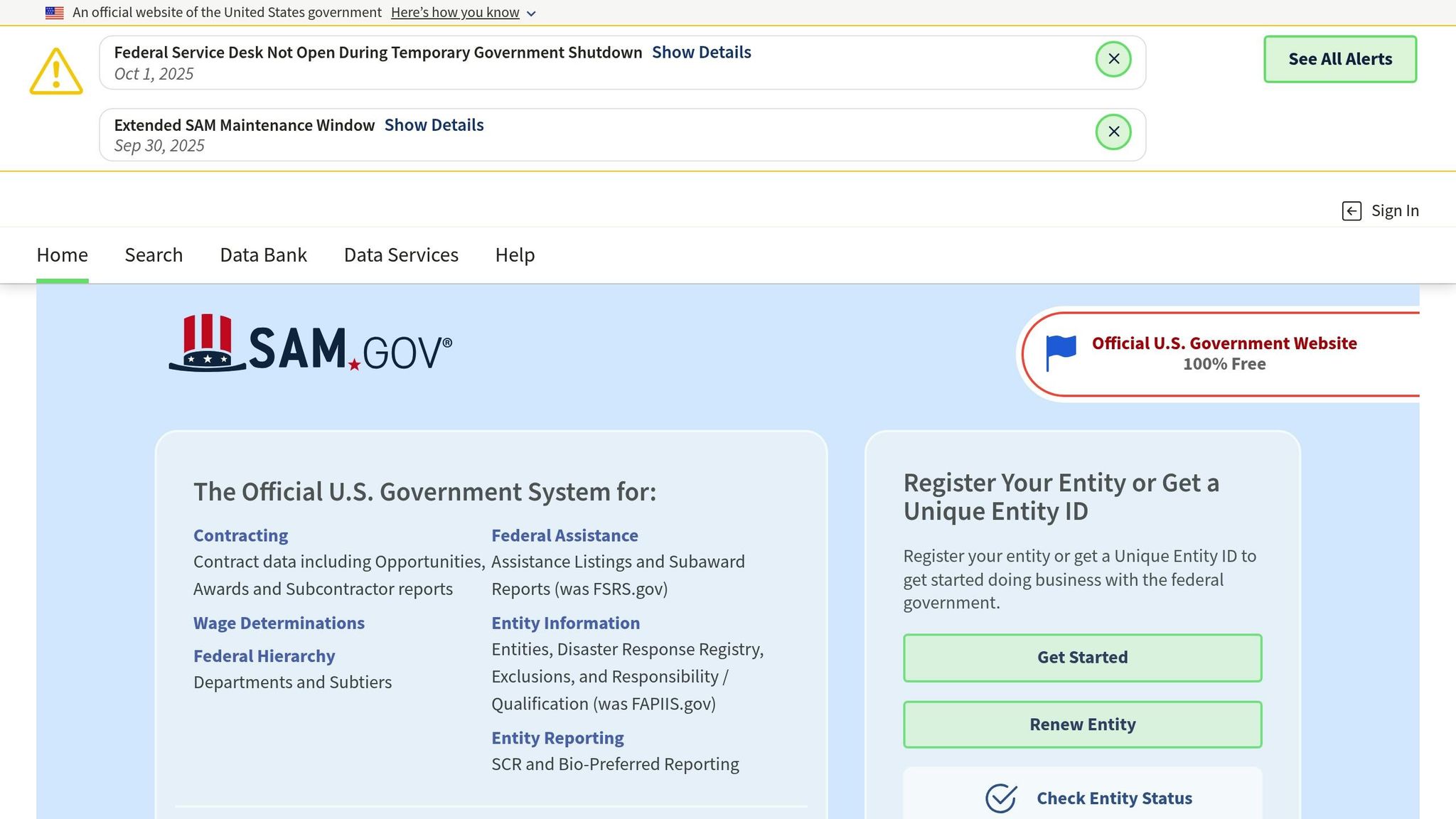
Your first stop is SAM.gov. This is where you’ll register for federal contracting and get your Unique Entity Identifier (UEI) – a 12-character alphanumeric code that replaced the DUNS system in April 2022.
Here’s how to get started:
- Set up a Login.gov account for your Entity Administrator.
- Log in to SAM.gov, click "Get Started", and then select "Create New Entity" from your workspace.
- Follow the prompts, choosing "I want to do business directly with the U.S. federal government" and selecting "All Awards" if you plan to bid on contracts.
You’ll need to have your legal business name, physical address, Taxpayer Identification Number, and bank account details ready. Make sure all the information matches official records exactly.
The registration process involves several steps, including filling out Core Data, Assertions, Representations and Certifications, and Points of Contact. You can save your progress and return later if necessary. Once submitted, SAM.gov will validate your information, including checks with the IRS and CAGE code verification. Keep in mind this process can take 10-15 business days.
Also, remember that your SAM.gov registration needs to be renewed every year. While your UEI doesn’t expire, your registration does. After registration, ensure your business is classified correctly by selecting the appropriate NAICS codes and SINs that align with your services.
Choose Your NAICS Codes and SINs
Picking the right North American Industry Classification System (NAICS) codes and Special Item Numbers (SINs) is a crucial step. NAICS codes are six-digit identifiers that define your business type and industry. On the other hand, SINs are specific to GSA and categorize the products and services offered under the Multiple Award Schedule program.
"The biggest difference between NAICS Codes and SINs is that SINs are specific to GSA. NAICS Codes are used by any business, not just GSA Schedule holders."
- Peri Costic, Proposal Writer, Winvale
The GSA Schedule is divided into 12 Large Categories and 315 SINs. Out of more than 1,000 NAICS codes, about 300 are represented on the contract. To apply for a specific SIN, you must ensure its corresponding NAICS code is active in your SAM.gov account.
Use tools like the U.S. Census Bureau’s NAICS lookup and GSA’s NAICS–SIN Crosswalk to match your business activities to the right categories.
"The NAICS–SIN Crosswalk is a structured mapping tool that connects North American Industry Classification System codes with GSA Special Item Numbers. It plays a crucial role in the General Services Administration’s Multiple Award Schedule program by linking the federal industry classification system with the contracting categories used by GSA to organize its offerings."
- Price Reporter Glossary
Be selective when choosing SINs. Only include those directly related to the products or services you plan to offer.
"It’s important to only select SINs for products or services you actually intend to offer on the GSA – don’t add SINs simply because they relate to your business."
- Peri Costic, Proposal Writer, Winvale
Business Documentation Checklist
Once your registration and classifications are in place, it’s time to gather the documentation needed to support your GSA application. These documents are essential for demonstrating compliance, technical capabilities, and pricing strategies.
Administrative Documentation:
- Two years of financial statements, including balance sheets and profit & loss statements.
- An accounting system that can separate government contracts from commercial work.
- Completed Past Performance Questionnaires, along with customer references and testimonials.
Technical Documentation:
- A one- to two-page Capability Statement outlining your core competencies and relevant experience.
- Resumes of key personnel, especially for service-based SINs, highlighting qualifications and certifications.
Pricing Documentation:
- A Price Proposal Template aligned with Commercial Sales Practices and your commercial price list.
- A clear explanation of your pricing methodology, supported by market benchmarks.
Compliance Documentation:
- Completion of GSA’s "Pathways to Success" and "Readiness Assessment" courses from the Vendor Education Center.
- Letters of Supply from manufacturers if you’re a reseller, using GSA’s templates.
Consistency is key. Make sure all your profiles, documents, and pricing materials align across the board. Use the latest templates and clauses from SAM.gov, and don’t hesitate to consult professionals with GSA compliance expertise if you’re unsure.
Creating Your GSA Proposal
Now that you’ve gathered your documentation, it’s time to assemble your GSA proposal. This involves combining your administrative records, technical capabilities, and pricing plan into a cohesive package. Each piece is crucial in proving your business is equipped to handle federal contracts.
Required Administrative Documents
Administrative documents serve as evidence of your business’s legitimacy, financial health, and readiness to take on contracts.
- Financial Records: Submit two full fiscal years of financial documentation, including balance sheets and profit-and-loss statements. While audited records are preferred, small businesses can provide internal reports. If your company has faced losses or negative equity, include an explanation or a plan to address these issues.
- Authorization and Supply Letters: Provide an Agent Authorization Letter that designates who can communicate with GSA on your behalf, signed by someone with the authority to bind your company. For product-based businesses, also include a Letter of Supply from the manufacturer using GSA’s template.
- Organizational Documents: Include an organizational chart showing lines of authority, your employee handbook, and an overtime policy statement. If you’re a product company, add a production points statement detailing where your products are manufactured.
- Compliance Statements: Product sellers need to submit a Trade Agreements Act (TAA) compliance statement to confirm their products meet manufacturing requirements. Depending on your offerings, compliance with Section 508 Standards may also be necessary.
Technical Proposal Requirements
Your technical proposal showcases your operational expertise and reliability. GSA evaluates this section based on four equally weighted factors: Executive Summary and Program Management, Recruitment and Retention of Workers/Training, Past Performance, and Insurance.
"The technical section is an opportunity to demonstrate your experience and capability in providing the products or services you are offering on your GSA proposal. Successful offers leverage this section to give a strong impression of their expertise and competitive edge over other entities in the space." – Jen Camp, Proposal Writer, Winvale
- Corporate Experience and Quality Control: Highlight your company’s relevant experience, organizational structure, and quality control processes. Include key projects – especially government contracts – and emphasize your team’s expertise. Discuss how you maintain high standards across multiple projects.
- Past Performance: Submit either a Past Performance Evaluation Report or three CPARs to show a track record of successful project delivery.
- Past Project Narratives (for service providers): Provide one narrative for each Special Item Number (SIN). These should detail the work performed, methods used, regulatory compliance, and how the project aligns with your proposed offerings.
- Insurance Requirements: Include proof of Workers’ Compensation and General Liability insurance (minimum $500,000) through a current Certificate of Insurance that complies with Clause 52.228-5.
Keep in mind that Factors One, Three, and Four must fit within a 10,000-character limit in eOffer (uploaded documents are not accepted). The entire technical proposal should not exceed 15 pages.
Pricing and Commercial Sales Practices
Your pricing strategy is the final piece of your proposal, demonstrating that your rates are competitive while remaining fair. GSA Schedule contracts involve a one-time price negotiation to secure reasonable pricing for your products or services.
For service-based businesses, you’ll also need to include a Professional Compensation Plan. This outlines salary and fringe benefit policies for employees working under the contract.
"We’ll be there with you, on-call, as your authorized negotiator, to make sure you get the prices your Small Business deserves." – GSA Focus
Pricing negotiations can be tricky, but having experienced support can make the process smoother. With a well-prepared proposal, you’ll not only meet GSA’s requirements but also position your business for success in the federal marketplace.
Submitting Your GSA Application
To submit your proposal to the GSA, you’ll need to use their official platform. This involves navigating the eOffer system, understanding the review and negotiation stages, and ensuring every document is accurate and complete. This step is critical – over half of applications are rejected due to incomplete or incorrect documentation.
How to Use the eOffer System
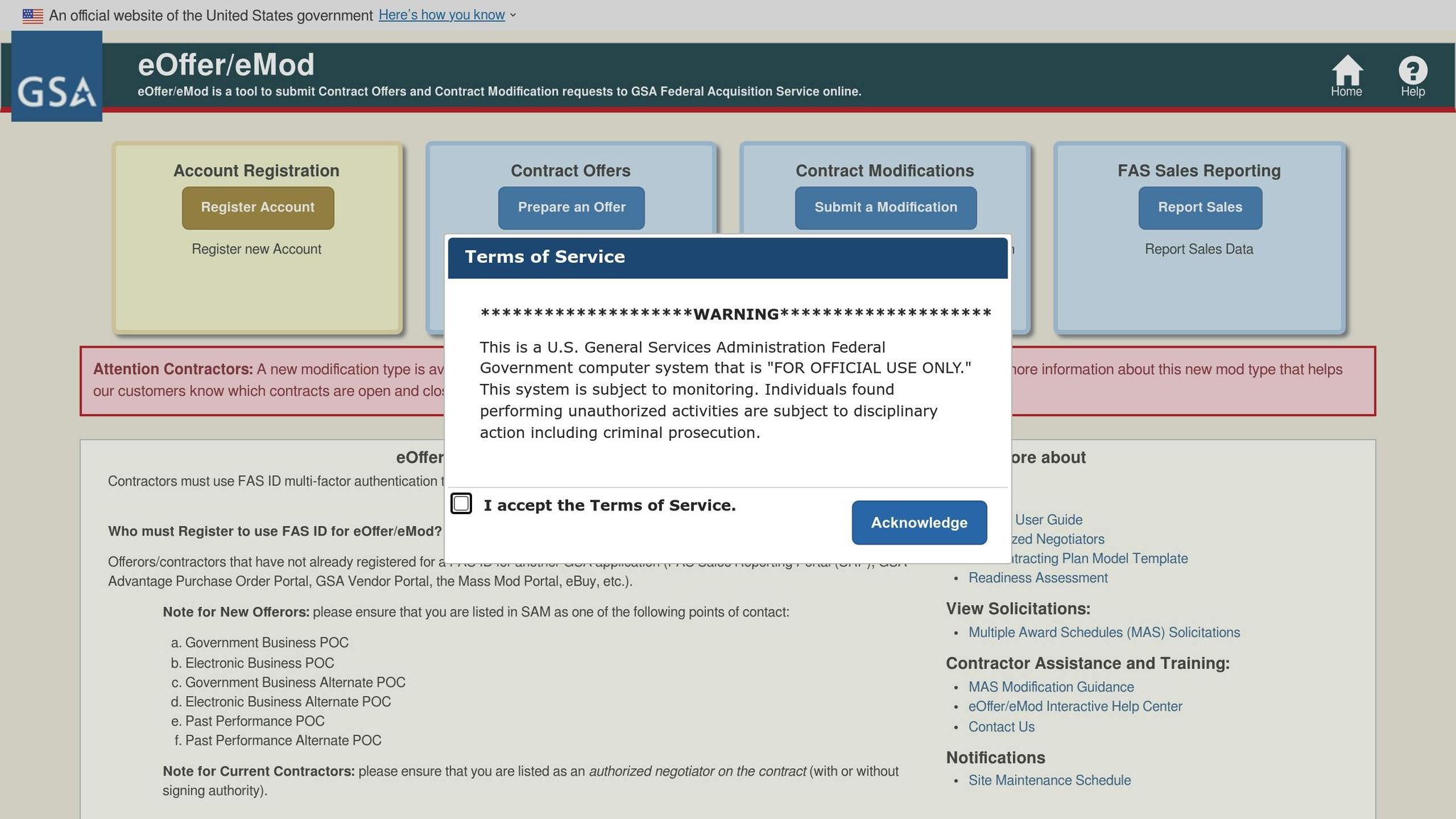
Start by creating an eOffer account. Follow the system’s instructions carefully to upload all required documents exactly as specified. Once your materials are submitted, your application will enter a structured review process.
Review and Negotiation Process
After submission, your application is assigned to a Contracting Specialist (CS) and a Contracting Officer (CO) for review. The process is divided into several phases, each with its own timeline and focus:
| Review Phase | Typical Duration | Key Activities |
|---|---|---|
| Preliminary Review | 1–2 months | Initial check for compliance |
| Financial Review | 1–3 months | Evaluation of financial stability |
| Price Negotiation | 2–4 months | Discussion to establish fair pricing |
| Final Processing | 2–3 months | Contract finalization and approval |
Throughout these phases, the GSA ensures your proposal meets their standards.
During the clarifications phase, the CS may flag ambiguities or compliance issues and request updates. Common requests include verifying your Special Item Number (SIN) scope to match your offerings and providing additional pricing documentation, such as invoices or market research.
According to the GSA Schedule Timeline: Step-by-Step Guide, "The GSA review process includes preliminary review, financial review, and determining ‘fair and reasonable’ pricing and negotiation. After submission, a contracting professional will review your offer, clarify any questions or issues, correct errors, and negotiate pricing if necessary".
Price negotiations are a key part of the process. The CS and CO will discuss terms like base pricing, quantity discounts, prompt payment discounts, and Economic Price Adjustment (EPA) mechanisms. It’s wise to hold back your most competitive pricing initially, as GSA is required to negotiate for better terms.
Respond quickly to all GSA inquiries and ask for clarification if needed. These phases are essential for ensuring your application meets compliance requirements.
Compliance and Common Mistakes to Avoid
Compliance issues are the most common reason for application rejection. Before submitting, double-check every aspect of your proposal for accuracy and completeness.
- Financial Documentation: Ensure your financial statements cover the required two-year period. Any inconsistencies with other submitted documents can lead to additional scrutiny.
- Product Compliance: For product-based offerings, verify that your Trade Agreements Act (TAA) compliance statements accurately reflect your manufacturing sources. Providing incorrect information can result in immediate rejection.
- Pricing Accuracy: GSA limits annual price increases to 10% per category item unless justified. Make sure your pricing documentation supports your proposed rates and discounts.
- Proposal Consistency: Misaligned sections, incomplete forms, and missing signatures are common errors. Use a checklist to ensure all documents are complete.
One frequent mistake is selecting the wrong SINs. Double-check that the SINs you choose align with your products or services. Misaligned SINs can lead to scope restrictions or outright rejection.
GSA reviewers prioritize consistency across all documents. Your technical capabilities, past performance, and proposed offerings should collectively show that your company is well-prepared to serve federal clients.
If this process feels overwhelming, consider working with GSA Focus. Their team takes on the heavy lifting, managing the compliance challenges while requiring just a few hours of your time to complete the application.
Next Steps After Your Application
Submitting your GSA Schedule application is just one step in the process. What happens next – and how you handle it – can make all the difference in maximizing this federal contracting opportunity.
What to Expect After Submission
The review process for GSA Schedule applications can take anywhere from 6 to 18 months. However, if your offer falls under the GSA Information Technology Category (ITC) and qualifies for the FASt Lane program, your timeline could be cut in half, with awards possible in just 3 to 6 months. Knowing these timelines helps you plan your next steps effectively.
Keep in mind that GSA enforces strict standards. For example, price increases are capped at 10% per category item annually unless you can provide specific justification. While it’s important to submit competitive pricing in your application, be prepared for negotiations during the review process.
A practical tip: consider submitting a streamlined offer that focuses on your core products or services. This can simplify your submission and potentially speed up the review. On the other hand, if your offer includes an extensive product catalog, expect a longer review period.
Once awarded, ongoing compliance is non-negotiable. Familiarize yourself with key requirements like the Price Reduction Rule, sales data reporting, and Industrial Funding Fee (IFF) obligations. Understanding these rules now will make managing your contract smoother later.
Simplify the Process with GSA Focus
Navigating the GSA Schedule process can be overwhelming, but professional support can make it manageable. That’s where GSA Focus comes in. Their full-service approach simplifies the journey for small businesses, handling everything from document preparation to compliance and negotiations.
Working with a GSA consultant can shrink your timeline by 30% to 50%. GSA Focus brings expertise to every step of the process, ensuring your application meets all requirements while minimizing your involvement. With a 98% success rate, they’re well-versed in avoiding common pitfalls and securing favorable outcomes.
Once your contract is awarded, the opportunities begin immediately. As a GSA Schedule holder, you’ll gain access to exclusive, high-value federal bids with minimal competition – often delivered straight to your inbox. Platforms like GSA eBuy and GSA Advantage make these opportunities easy to explore.
"The GSA Program delivers High-Value, Low-Competition Bids, sent by email, for 20 Years."
– GSA Focus
But GSA Focus doesn’t stop at securing your contract. They also offer ongoing maintenance and marketing services tailored to federal buyers. These services help ensure your products and services stand out to the agencies actively seeking them.
Federal contracting offers incredible potential, but success depends on both securing approval and managing your contract strategically. With GSA Focus handling the complexities, you can concentrate on delivering your products and services while reaping the benefits of this lucrative opportunity.
FAQs
What are the main reasons GSA Schedule applications get rejected, and how can I avoid them?
GSA Schedule applications frequently hit roadblocks for several reasons: choosing the wrong SIN (Special Item Number), submitting incomplete or incorrect documentation, pricing that isn’t competitive, poor financial records, or a lack of proven past performance. Other common missteps include not meeting registration requirements, misinterpreting the application guidelines, or providing outdated information.
To steer clear of these issues, start by thoroughly reviewing all application requirements. Make sure your SIN selection matches your products or services, and confirm your pricing is in line with market expectations. Carefully check that every piece of documentation is accurate, complete, and current before submitting. A well-prepared application can make a world of difference in achieving approval.
What is the FASt Lane program, and how does it speed up the GSA Schedule process for IT businesses?
The FASt Lane program is tailored for IT-focused businesses aiming to secure GSA Schedule contracts in a fraction of the usual time. With a goal of processing new offers in as little as 45 days – much quicker than the standard timeline – it also ensures faster communication with GSA contracting officers throughout the process.
This program is a game-changer for IT companies needing to respond swiftly to federal contracting opportunities. By simplifying and accelerating the application process, FASt Lane enables businesses to access federal market opportunities without unnecessary delays, keeping them ready to meet government demands efficiently.
What compliance requirements must I follow after obtaining a GSA Schedule contract?
Once you’ve landed a GSA Schedule contract, the next big task is making sure you stay compliant – this is non-negotiable if you want to keep your contract active and continue tapping into federal opportunities. Here are some key areas to stay on top of:
- Keep your contract details current: This includes updating your business information, pricing, and product or service offerings as needed.
- Follow the agreed pricing and discount terms: Stick to the pricing structure and discount policies outlined in your contract.
- Submit required reports on time: This includes critical filings like the Contract Sales Report (CSR) and Industrial Funding Fee (IFF) payments.
It’s a good idea to routinely review GSA regulations and double-check that your business practices align with their compliance standards. Staying on top of these requirements is essential – not just for smooth contract renewals, but also to avoid penalties or non-compliance headaches.
Related Blog Posts
- How to Read GSA Solicitation Documents
- Ultimate Guide to GSA Proposal Documents
- 5 Steps to Meet GSA Prequalification Standards
- Understanding the Basics of a GSA Schedule Contract