
Federal contracting offers small businesses immense opportunities, but navigating this space requires thorough research. In 2023, agencies awarded over $850 million daily through GSA contracts, yet many businesses struggle to start. The good news? The federal government provides free tools to simplify market research, helping you analyze spending trends, explore contract opportunities, and benchmark pricing.
Here’s a quick overview of the top tools:
- USAspending.gov: Analyze federal spending trends.
- SAM.gov: Find contract opportunities and review awards.
- GSA eLibrary: Study competitors and pricing benchmarks.
- Market Research as a Service (MRAS): Gain insights from RFI responses.
- Dynamic Small Business Search (DSBS): Locate teaming opportunities.
- Data.gov: Access datasets for broader market insights.
These tools, when used together, help answer key questions like:
- Which agencies buy your services?
- What are competitors charging?
- Where are the best opportunities?
For small businesses, combining these resources creates a clear path to enter and succeed in the federal market. Let’s explore how each tool works and how you can use them effectively.
Market Research In Government Contracting: Who Buys What I Sell? (Live Demo)
USAspending.gov: Federal Spending Data
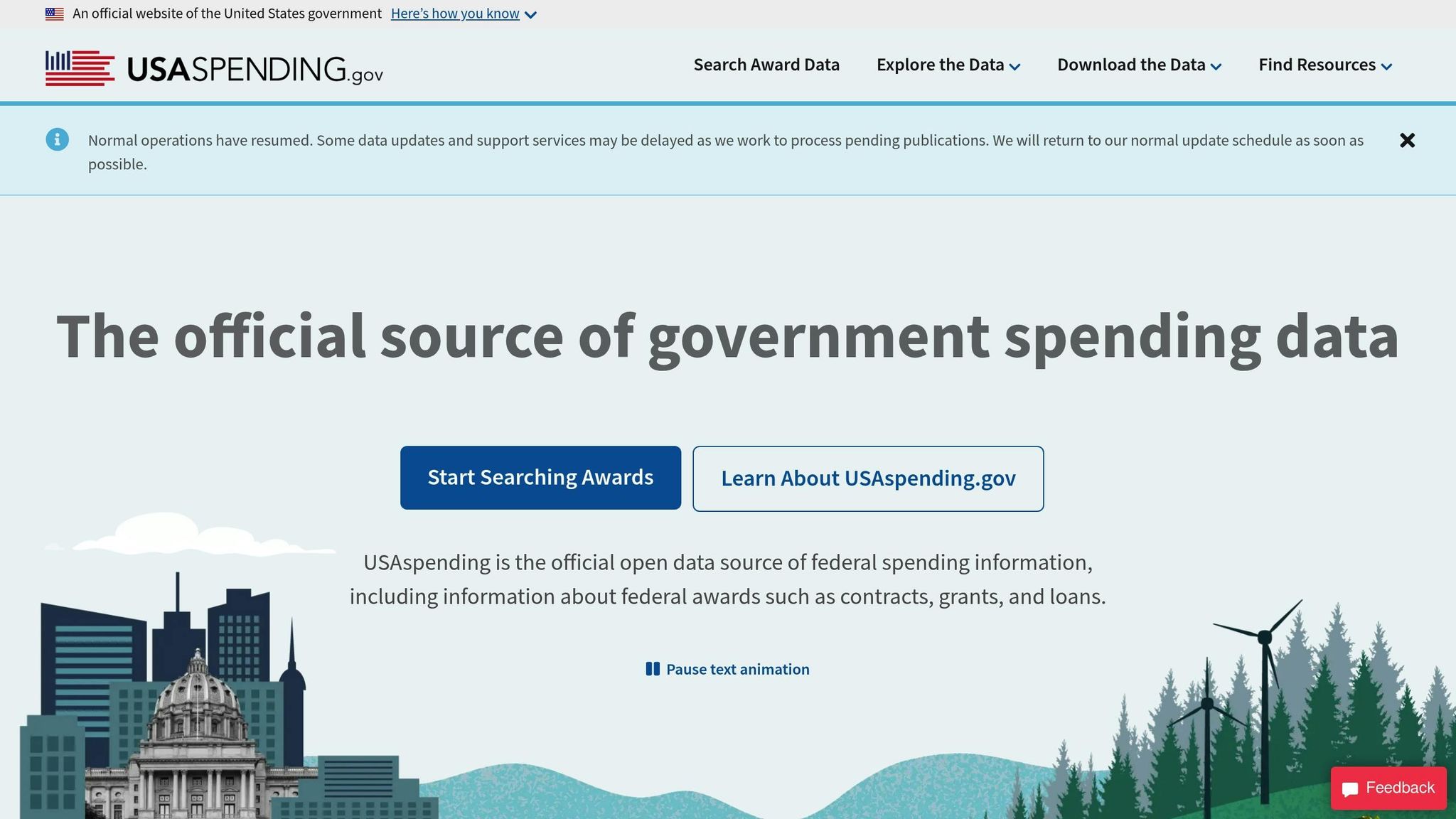
USAspending.gov is a go-to resource for anyone looking to access federal spending data at no cost. As the official portal for tracking how federal funds are allocated through contracts, grants, and awards, it offers small businesses a chance to identify spending patterns and trends. This information serves as a starting point for analyzing federal market opportunities.
Overview of USAspending.gov
The platform organizes federal spending into easy-to-navigate categories, making it straightforward to examine procurement trends. By breaking down spending data systematically, the site allows users to uncover patterns that could point to potential market opportunities within the federal landscape.
Strengths and Limitations
One of USAspending.gov’s biggest advantages is that it’s both official and free, providing a reliable snapshot of federal spending. However, it’s important to note that the data reflects past spending rather than real-time activity. For businesses eyeing active contracting opportunities, combining this historical data with up-to-date market research is crucial. Still, small businesses can use these insights to gain a clearer picture of federal spending habits and refine their market strategies accordingly.
SAM.gov: Contract Opportunities and Research
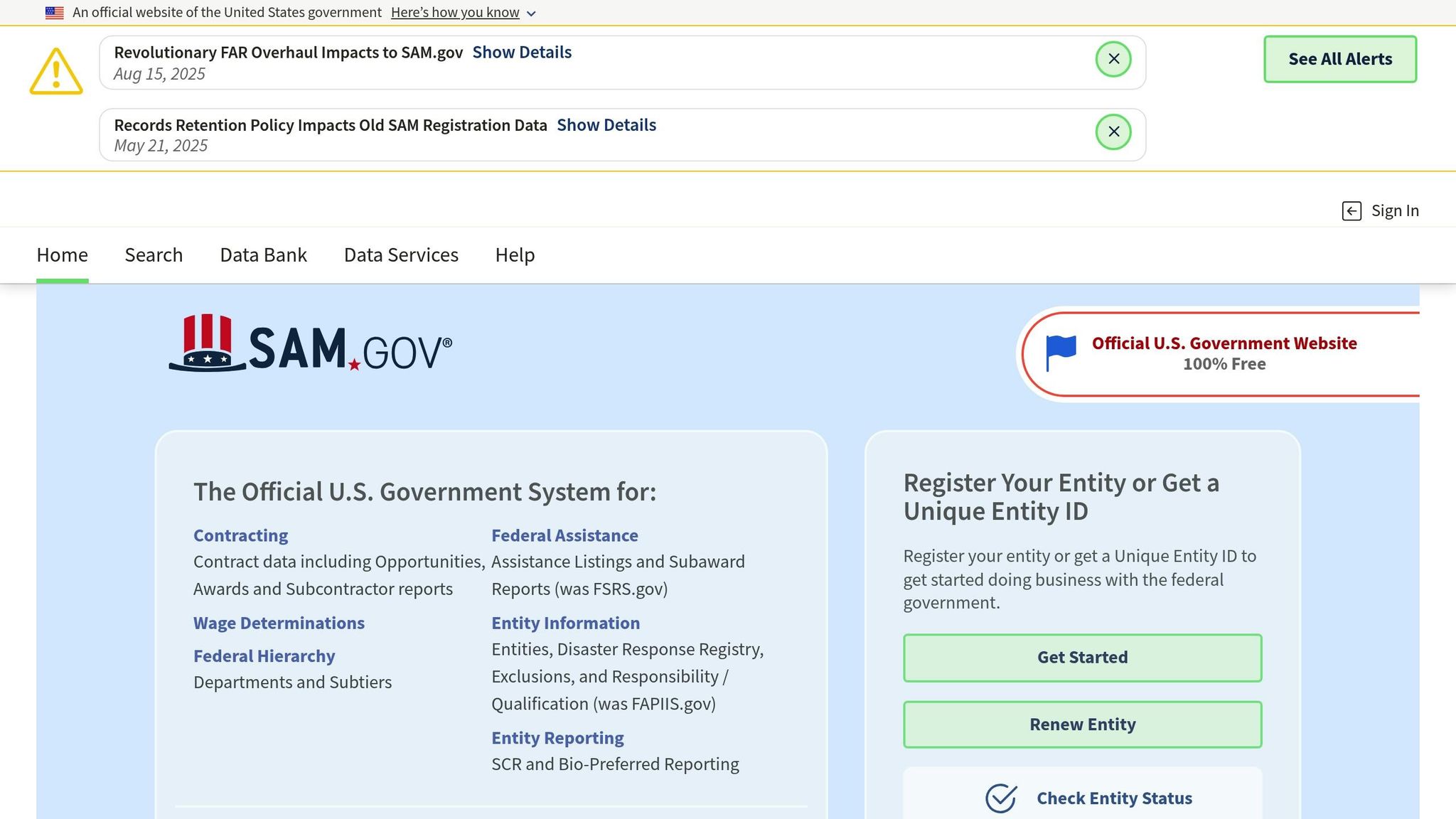
SAM.gov serves as the official system of the U.S. Government where small businesses can register or obtain a Unique Entity ID to access federal contract opportunities, awards, and subcontractor reports. This platform acts as a centralized hub, complementing other research tools by offering a broad view of federal contracting activities.
How to Use SAM.gov for Market Research
Once registered, businesses can dive into federal contracting data directly on SAM.gov. The platform provides official details about contract opportunities, awarded contracts, and subcontractor relationships. However, SAM.gov is primarily a data repository and lacks advanced market research tools, such as detailed filtering options. This means users often need to manually sift through the data to uncover actionable insights. For a more complete market view, combining SAM.gov data with information from USAspending.gov can be helpful.
Pros and Cons of SAM.gov
| Advantages | Potential Limitations |
|---|---|
| Free access to federal contracting data | Lacks advanced filtering options for in-depth market research |
| Authoritative source for official data | Requires manual analysis to identify market trends |
| Centralized platform for contract opportunities, awards, and subcontractor reports |
As the official federal contracting platform, SAM.gov ensures small businesses have access to a wealth of opportunities and related data. While analyzing the information may take additional time and effort, the platform’s comprehensive database provides a reliable starting point for market research.
GSA eLibrary and Market Research as a Service (MRAS)
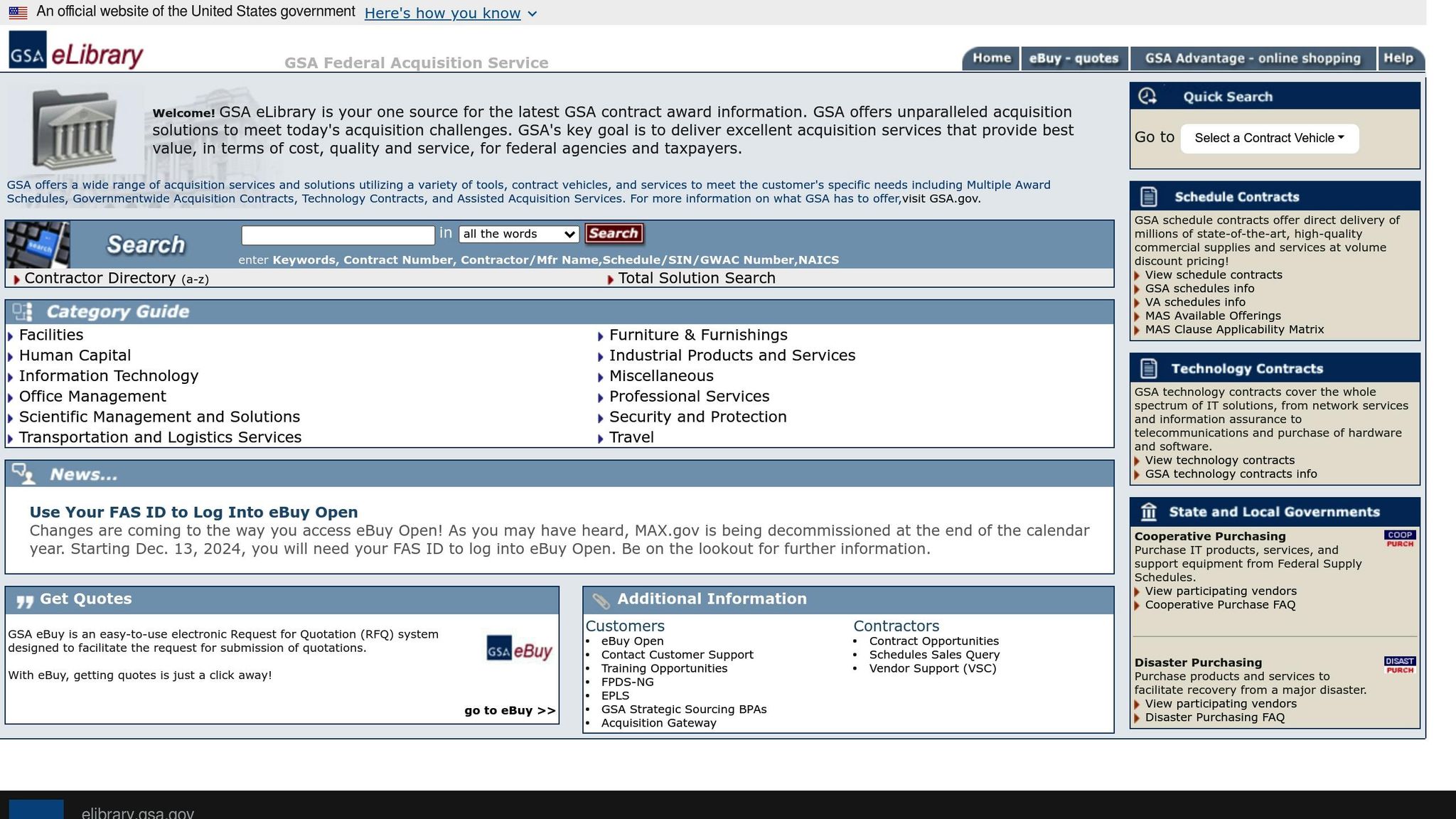
Drawing from the foundational data found on USAspending.gov and SAM.gov, GSA eLibrary and Market Research as a Service (MRAS) provide small businesses with targeted insights for pricing strategies and competitive positioning in the federal market.
GSA eLibrary: A Tool for Competitor Analysis and Pricing Insights
Small businesses can tap into GSA eLibrary to access detailed information about active GSA Schedule contracts. This tool is invaluable for analyzing competitors, conducting pricing studies, and reviewing Special Item Number (SIN) details. The database includes key information such as:
- Contract holder details
- SINs
- Labor categories
- Published rates
For example, businesses can search by SIN to compare hourly rates and contract terms for similar services. By focusing on specific data points – like contract holder names, awarded SINs, labor categories, published rates, contract dates, and socioeconomic designations – small businesses can benchmark their offerings against at least three to five competitors. This approach helps them set realistic, defensible pricing that aligns with federal expectations while steering clear of common mistakes like overpricing or underpricing.
However, it’s important to note that eLibrary reflects only contract-level rates, which may vary based on factors like project complexity or volume. For a broader perspective, supplementing eLibrary research with tools like SAM.gov can provide additional context.
Market Research as a Service: Adding Depth to Federal Insights
Market Research as a Service (MRAS) is a free program by GSA designed for federal, state, and local agencies. It provides market research that complies with FAR Part 10, offering detailed reports based on vendor responses to Requests for Information (RFIs) and sources-sought notices. These reports often include:
- Capability summaries
- Pricing ranges
- Socioeconomic breakdowns
- Suggested acquisition strategies
Agencies initiate MRAS by submitting RFIs or sources-sought questionnaires, which GSA then distributes to relevant vendors. Over time, MRAS has produced thousands of reports across various categories under the Multiple Award Schedules, with some projects completed in as little as two weeks, depending on their complexity.
For small businesses, MRAS represents a strategic opportunity to increase visibility. By responding to RFIs and sources-sought notices with detailed information – such as capabilities, past performance, relevant SINs, and socioeconomic status – vendors can position themselves as strong contenders for future contracts. For instance, a small business specializing in cloud migration services might highlight its federal project experience, certifications like FedRAMP or ISO, and typical pricing models to stand out in agency assessments.
Additionally, MRAS enables agencies to discover emerging technologies and solutions beyond well-established vendors. Reports generated through MRAS often include insights into vendor counts, socioeconomic categories, and trends in capabilities, helping agencies shape their acquisition strategies.
Comparing GSA eLibrary and MRAS
Here’s a quick breakdown of how these tools differ and complement each other:
| Aspect | GSA eLibrary | Market Research as a Service (MRAS) |
|---|---|---|
| Primary User | Contracting officers, program offices, vendors, and public researchers | Federal, state, and local agencies (vendors benefit indirectly) |
| Main Purpose | A static reference showing vendors with GSA/VA Schedules and their offerings | Dynamic, project-specific research on vendor capabilities, pricing ranges, and competition |
| Data Type | Awarded contracts, SINs, vendor details, links to pricing, and socioeconomic flags | Aggregated RFI responses, capability summaries, socioeconomic data, and acquisition strategies |
| How Small Businesses Use It | Competitor analysis, pricing benchmarks, and identifying teaming opportunities | Responding to RFIs, shaping agency requirements, and supporting small-business strategies |
| Cost | Free, publicly accessible | Free for agencies; vendors participate at no cost, aside from effort to respond |
Maximizing Insights with GSA eLibrary and MRAS
By combining the static data from GSA eLibrary with the dynamic, agency-driven insights from MRAS, small businesses can fine-tune their proposals and pricing strategies. These tools also enhance visibility in agency assessments, creating a well-rounded approach to federal market research. Together, they form a powerful foundation for navigating the competitive landscape of federal contracting.
Small Business and Industry Data Sources
Federal tools like USAspending.gov and SAM.gov are excellent starting points for small businesses diving into market research. But to get a broader understanding of industry trends and market dynamics, there are additional resources that can provide even deeper insights. Platforms like Data.gov and tools from the Department of Commerce offer critical data to help businesses stay informed and spot emerging opportunities.
Exploring Data.gov and Commerce Resources
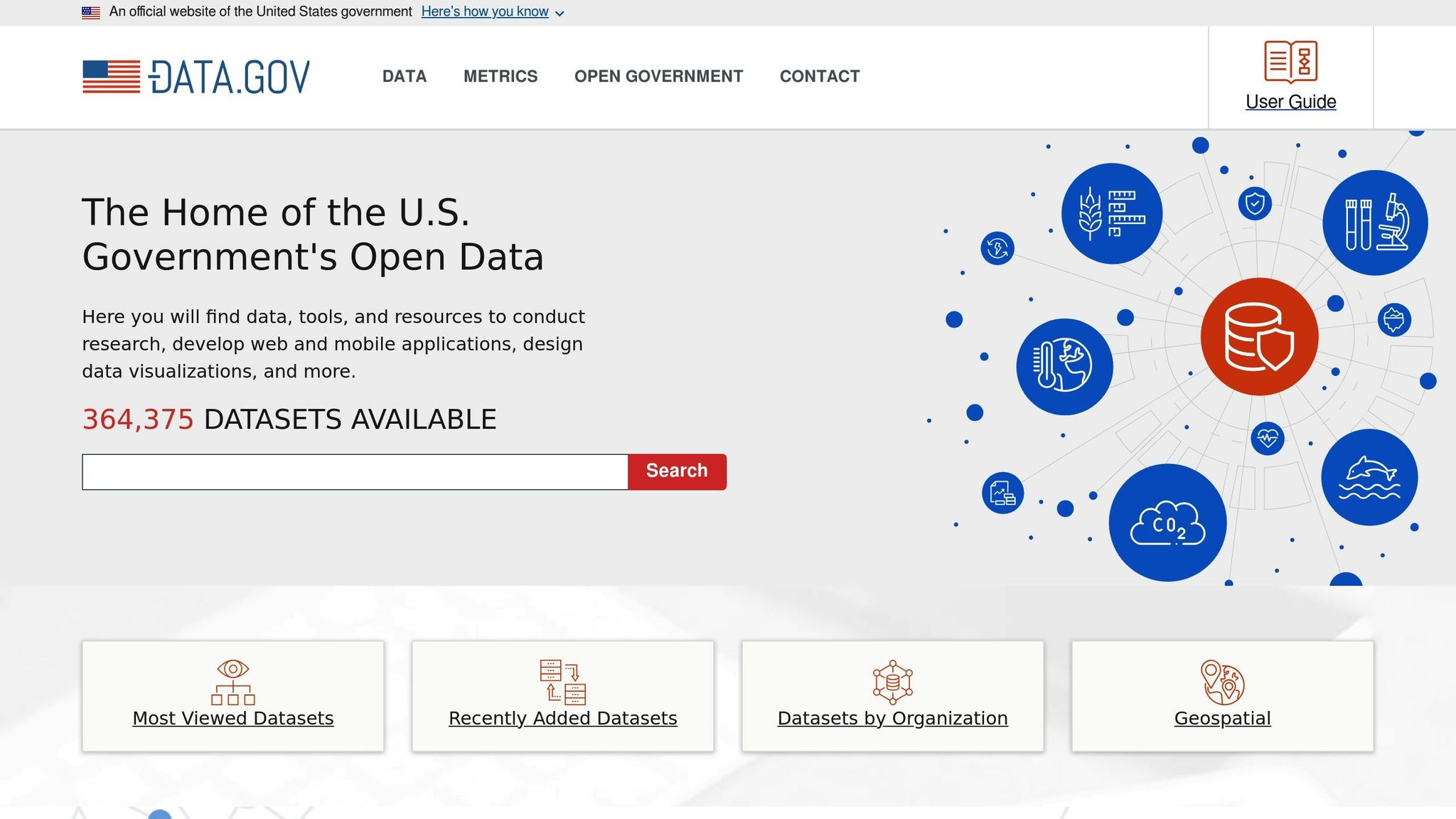
Data.gov serves as the main hub for open government data in the U.S., offering access to an impressive 364,375 datasets. To make navigation easier, the platform organizes information into categories like "Most Viewed Datasets", "Recently Added Datasets", and "Datasets by Organization." This structure helps businesses quickly find the data that’s most relevant to their industries.
But Data.gov isn’t just a storage space for numbers and charts – it’s a tool for decision-making. The platform enables small businesses to uncover trends in federal spending and demographic changes, both of which can directly impact contracting opportunities. By tapping into this treasure trove of information, businesses can make smarter, data-driven decisions.
On top of that, economic data from the Department of Commerce provides insights into market size, growth patterns, and regional demand. When combined with federal spending data, these resources give small businesses a more complete picture of the market landscape. This blend of information allows for a strategic approach to federal market research, offering a clearer path for planning and growth.
Practical Workflows for Small Businesses
Leveraging free federal tools can provide small businesses with valuable insights for navigating the federal marketplace. By combining these public resources, businesses can identify spending patterns, active contract opportunities, and competitive pricing, helping them establish a strong position in this space.
Combining Tools for Smarter Research
To get the most out of federal tools, it’s essential to use them in a coordinated way. Here’s how you can streamline your research process:
Start by exploring USAspending.gov to analyze federal spending data. This will help you identify which agencies are most active in your industry, giving you a clear starting point to focus your efforts.
Once you know which agencies to target, move to SAM.gov. Set up tailored saved searches to monitor contract opportunities. This tool provides a wealth of information, including contract awards, opportunities, subcontractor reports, and details about the federal hierarchy.
For pricing validation, turn to GSA eLibrary. Compare contract pricing data here with spending trends from USAspending.gov to better understand competitive rates in your field.
To analyze competitors, combine SAM.gov’s entity search with spending data from USAspending.gov. This will reveal key players in your industry, their contract histories, and the types of agreements agencies prefer.
If you’re looking for teaming partners, use DSBS (Dynamic Small Business Search). This tool, along with resources like Data.gov and commerce industry tools, can offer broader insights into regional demand, industry growth trends, and federal spending forecasts. These insights are especially useful for planning market expansion.
Tool Combinations for Business Goals
The table below pairs specific business objectives with the most effective tool combinations, making it easier to align your research with your goals:
| Business Goal | Primary Tools | Expected Output |
|---|---|---|
| Identify target agencies with consistent spending | USAspending.gov → SAM.gov | A focused list of agencies with historical spending and procurement trends |
| Find active contract opportunities | SAM.gov (tailored saved searches) | Alerts with solicitation details, deadlines, and key contacts |
| Validate pricing strategy | GSA eLibrary → USAspending.gov | Competitive pricing ranges and contract value insights |
| Research competitors | SAM.gov (entity search) → USAspending.gov | Profiles showing contract histories, award patterns, and agency preferences |
| Understand market size and trends | Data.gov → Commerce industry tools → USAspending.gov | Insights into growth rates, regional demand, and federal spending forecasts |
| Find teaming partners | DSBS → SAM.gov | A list of small businesses with relevant capabilities and past performance data |
| Track subcontracting opportunities | SAM.gov (subcontractor reports) → USAspending.gov | Data on prime contractors with active subcontracting plans and trends |
These workflows highlight how free federal tools can be combined to achieve a variety of research goals. Whether you’re new to federal contracting or looking to expand your reach, these resources allow you to gather critical insights without the need for costly subscriptions.
Where GSA Focus Fits into Federal Market Research
Free federal research tools like USAspending.gov, SAM.gov, and GSA eLibrary are great for uncovering patterns and trends. But turning that raw data into a successful GSA Schedule proposal? That’s where specialized expertise comes in – and that’s exactly what GSA Focus offers.
Let’s say your IT services company spots cloud migration opportunities at the VA using USAspending.gov and GSA eLibrary. GSA Focus steps in to help you translate those insights into a compliant, competitive proposal that aligns with proven spending patterns and meets every GSA requirement. Their expertise bridges the gap between identifying opportunities and crafting a winning offer.
The GSA Schedule process is no walk in the park. It demands precision, compliance, and detailed proposals. Here’s where GSA Focus shines: they handle 95% of the paperwork, cutting down over 100 hours of work for small businesses and requiring just 3 hours of your direct input. Their full-service approach covers everything from document preparation and compliance checks to negotiating with GSA contracting officers and managing contract modifications and renewals.
If your business holds certifications like 8(a), SDVOSB, or WOSB, GSA Focus knows how to leverage those credentials to strengthen your proposal. They highlight your certifications, optimize pricing, and showcase your past performance to make your bid stand out.
Compliance can be a major hurdle, but GSA Focus helps you clear it with ease. They perform detailed pre-proposal assessments to flag potential issues, whether it’s financials, past performance, or organizational structure. This proactive review reduces risks like protests, audits, or proposal denials, giving you peace of mind.
Here’s what sets them apart: GSA Focus completes the process 4–6 times faster than a DIY approach, boasts a 98% success rate, and even offers a refund guarantee. For small businesses, that’s a game-changer. On average, their clients see an additional $927,000 in consistent revenue after securing a GSA Schedule.
Steven P. of BMNT Inc. shared his experience:
"The results speak for themselves – we’ve seen our GSA sales grow exponentially year after year. We highly recommend GSA Focus."
But their support doesn’t stop once your GSA Schedule is awarded. GSA Focus tracks agency spending and RFQs, offering tailored advice on which opportunities to pursue. They use the same federal tools to pinpoint which agencies are investing in your SINs and which RFQs align with your capabilities. By analyzing win probabilities, contract sizes, and strategic fit, they help you refine your capture strategies and maximize your success.
Interested in seeing how GSA Focus can help you navigate federal contracting? Visit https://gsascheduleservices.com to schedule a free consultation. You’ll get an expert assessment of your GSA eligibility and learn more about their full-service support options.
Conclusion
Federal market research tools offer invaluable resources for small businesses aiming to enter the world of government contracting. Platforms like USAspending.gov, SAM.gov, GSA eLibrary, DSBS, and Data.gov provide a wealth of information, from federal spending data and contract opportunities to pricing benchmarks and industry trends. These tools help answer key questions such as: Which agencies are purchasing what you sell? How much are they spending? Who is securing these contracts?
Consider this: In fiscal year 2023, the federal government awarded $731 billion in prime contracts, with $178 billion directed toward small businesses. These numbers highlight the immense potential for small businesses to thrive in this space – if they can identify demand and target the right markets. However, turning this data into successful contracts is no small feat.
While these tools reveal trends and opportunities, the next step – crafting compliant, competitive proposals – requires a different level of expertise. Navigating the GSA Schedule process is particularly challenging. It demands meticulous documentation, strict adherence to federal regulations, strategic pricing, and skilled negotiation. For many small businesses, the hurdle isn’t their capability but the lack of specialized knowledge in federal contracting.
That’s where GSA Focus steps in. By leveraging data from platforms like USAspending.gov, SAM.gov, and GSA eLibrary, they transform your research into a tailored strategy for securing a GSA Schedule. Handling everything from complex documentation to compliance and negotiations, their streamlined approach reduces your workload significantly. With a process that’s up to four to six times faster and a 98% success rate, GSA Focus ensures you’re not just navigating the system – you’re positioned to win.
FAQs
What are the best ways for small businesses to use free federal tools to succeed in the federal marketplace?
Small businesses have access to a variety of free federal tools that offer crucial insights for navigating the federal marketplace. These tools can provide data on contract opportunities, agency spending patterns, and competitor activities – valuable information that can help businesses identify leads and fine-tune their strategies.
Using these resources, small businesses can gain a clearer understanding of federal procurement processes, ensure they meet regulatory requirements, and improve their competitive positioning. Regularly exploring these tools and aligning their features with your business objectives can open doors to new opportunities and make the journey into federal contracting much smoother.
What challenges do small businesses face when using platforms like USAspending.gov and SAM.gov for federal market research, and how can they address them?
Small businesses often face hurdles when trying to make sense of the massive amount of data available on platforms like USAspending.gov and SAM.gov. The sheer volume of information can feel overwhelming, and sifting through it to find what’s relevant can be a daunting task. On top of that, the complex language and tricky navigation of these platforms can leave business owners feeling frustrated and short on time.
One way to tackle these obstacles is to start with a clear plan. Define your research goals – whether it’s focusing on a specific agency or zeroing in on a particular type of contract. Most platforms come with search filters, and using them wisely can help you cut through the noise and get to the information that matters. Another helpful step is to get comfortable with common federal contracting terms and resources. This can make understanding the data much less intimidating. If you’re still feeling stuck, reaching out to experts for guidance can be a game-changer, helping you navigate the process more efficiently while ensuring you meet federal requirements.
How does GSA Focus help businesses move from market research to securing GSA Schedule contracts?
GSA Focus takes the hassle out of securing GSA Schedule contracts with their all-inclusive, hands-on service. They manage everything from preparing the necessary documents to ensuring full compliance with federal regulations and even offering negotiation support. This streamlined approach helps businesses move seamlessly from market research to landing federal contracting opportunities.
By leveraging their expertise, small businesses can save time and energy, concentrating on growth while tapping into the profitable federal marketplace.
Related Blog Posts
- How to Track Federal Sales with GSA Tools
- 5 Tools for GSA Competitor Research
- 5 Steps for GSA Market Research
- Top Platforms for Federal Market Insights