

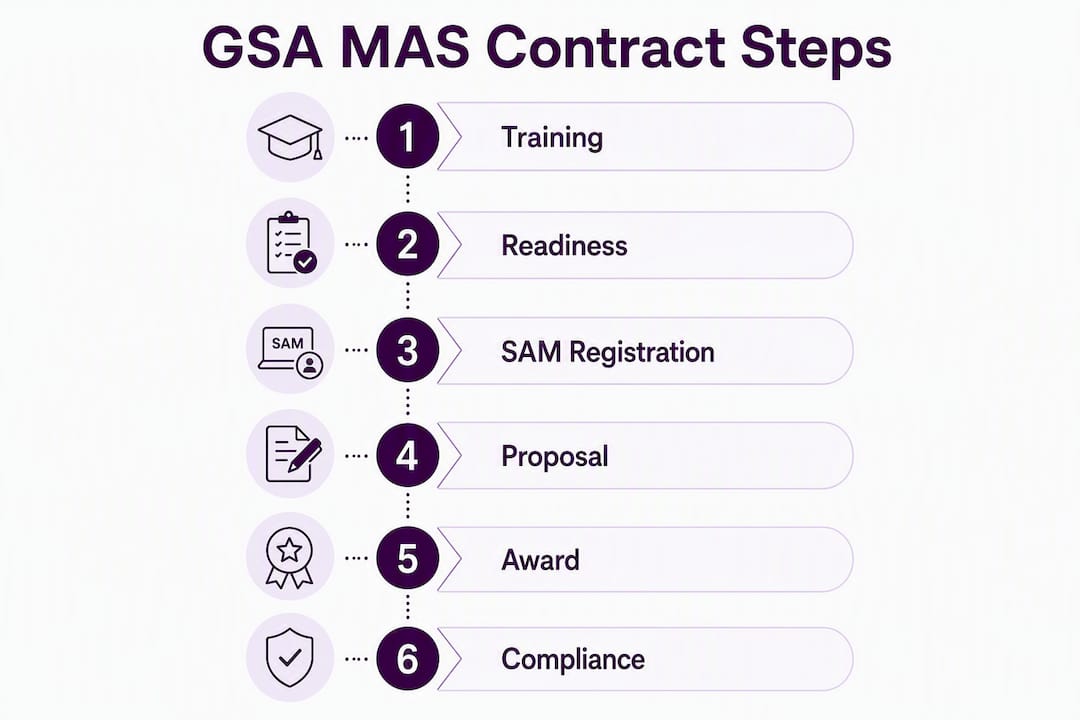
Texas small and medium businesses can get a GSA Multiple Award Schedule (MAS) contract — what many call “texas state contracts” in the federal procurement sense — provided they meet eligibility requirements and complete three mandatory pre-submission steps. First, finish the Pathways to Success training, which runs 3–4 hours and must be completed within 12 months of your offer submission, then acknowledge completion inside GSA eOffer. Second, complete a readiness assessment. Third, register on SAM.gov and obtain your Unique Entity Identifier (UEI). Most businesses generally need to have established a stable financial record and operating history. Newer firms may qualify through the Startup Springboard program instead.
Pro Tip: Start the Pathways to Success training before you touch any other paperwork. The acknowledgement clock starts from completion, so finishing it early gives you the full 12-month window to prepare a strong offer.
Table of Contents
- How do you stay eligible after winning a GSA Schedule?
- Gsascheduleservices helps Texas SMBs win and manage GSA MAS contracts
- Key Takeaways
- What most Texas SMBs underestimate about GSA contracts
- Authoritative sources for your GSA MAS research
- FAQ
How do you stay eligible after winning a GSA Schedule?
Winning the contract is the start, not the finish. Post-award compliance is where many Texas SMBs get caught off guard.

Quarterly sales reporting is mandatory — including quarters where you recorded zero sales. Late filings after the 30th day following each quarter are recorded and can hurt your contractor performance assessment. You also owe the Industrial Funding Fee (IFF) on every sale, remitted alongside your sales reports. Miss it consistently and you risk contract cancellation.
Business changes trigger reporting obligations too. If your company changes ownership, restructures, or crosses a small-business size threshold, you must notify your Contracting Officer and file a contract modification promptly. Keeping your LLC in good standing and corporate documents current is not optional — it directly affects your eligibility status.
Expect at least two Contractor Assistance Visits (CAVs) during a five-year contract term. An Industrial Operations Analyst will verify TAA compliance, check your supplier list, review your current price list, and confirm your scope matches your awarded SINs. Firms that treat CAVs as surprise audits rather than scheduled reviews tend to scramble. Keep a documented TAA compliance process and an updated Statement of Work at all times.
Gsascheduleservices helps Texas SMBs win and manage GSA MAS contracts
Gsascheduleservices handles the full application cycle for Texas SMBs: readiness assessments, three-volume eOffer preparation, pricing template completion, NAICS/SIN mapping, Letters of Supply, TAA verification, and negotiation support. Post-award, the team manages quarterly sales reporting, IFF remittance, contract modifications, Contractor Team Arrangements, and CAV preparation.
Engagement options include project-based application support, monthly retainers for post-award administration, and DIY toolkits with consulting add-ons for firms that want to stay hands-on. If you lack two years of clean financials, have no assigned contract manager, or have no federal marketing plan, those are clear signals that DIY carries real risk.
Schedule a discovery call to get a readiness assessment and a realistic timeline for your specific situation.
Key Takeaways
A GSA MAS contract requires completing Pathways training, a readiness assessment, SAM.gov registration, and a three-volume eOffer before award — then sustained compliance work every quarter after.
| Point | Details |
|---|---|
| Pathways training is mandatory | Complete the 3–4 hour training within 12 months of submission and acknowledge it in GSA eOffer. |
| Open solicitation, no deadline | The MAS solicitation is continuous — submit when your documents are complete, not rushed. |
| Post-award work is ongoing | Quarterly sales reports, IFF remittance, and CAVs are required for the contract’s full term. |
| Award does not equal sales | Active marketing, eBuy responses, and RFQ engagement drive actual revenue after award. |
| Gsascheduleservices | Covers readiness assessment through post-award compliance for Texas SMBs pursuing a GSA Schedule. |
What most Texas SMBs underestimate about GSA contracts
The applications I see fail most often share the same three problems: pricing that doesn’t reconcile with commercial invoices, missing or incomplete Commercial Sales Practices (CSP) data, and Letters of Supply that either don’t exist or name suppliers not covered under TAA. Each one gets an offer returned — sometimes months into the review cycle.
The post-award burden surprises people even more. Reporting zero-sales quarters feels pointless until you miss one and it shows up in your performance record. Modifications for scope changes, price updates, and SIN additions pile up fast for growing firms. And CAVs, while not adversarial, require documentation most small businesses don’t maintain by default.
The business case for structured help is straightforward: a three-volume MAS proposal done well typically takes 6–12 months from first draft to award. Firms that rush incomplete financials or inconsistent CSP data restart that clock. Expert support shortens the cycle and eliminates the most common rejection triggers before submission.
Authoritative sources for your GSA MAS research
| Resource | What it answers |
|---|---|
| Pathways to Success (GSA) | Mandatory pre-submission training and MAS program overview |
| Roadmap to get a MAS contract | Step-by-step application process and eLibrary SIN research |
| Find opportunities (GSA) | Eligibility basics, Startup Springboard, and marketing requirements |
| Steps to Success (GSA) | Post-award obligations: sales reporting, IFF, CAVs, modifications |
| Requirements after getting a MAS contract | Compliance checklist for active Schedule holders |
| LegalClarity: GSA proposal preparation | Three-volume structure, CSP requirements, and realistic timelines |
- SAM.gov — register your business and obtain your UEI before any other step.
- GSA eLibrary — search MAS categories, SIN descriptions, and awarded contracts to map your offerings before writing your proposal.
- GSA eOffer — the submission portal where you acknowledge Pathways training and upload all three proposal volumes.
FAQ
What is a GSA MAS contract for Texas businesses?
A GSA Multiple Award Schedule (MAS) contract is a federal procurement vehicle that lets Texas SMBs sell products and services directly to U.S. government agencies at pre-negotiated prices. It is not a state of Texas contract.
How long does it take to get a GSA Schedule?
A well-prepared proposal typically takes 6–12 months from first draft to award, depending on documentation quality and GSA review volume.
What happens if I miss a quarterly sales report?
Late filings after the 30th day following each quarter are recorded and can negatively affect your contractor performance assessment, and repeated failures risk contract cancellation.
Can a newer Texas business qualify for a GSA Schedule?
Yes. The Startup Springboard program offers an alternative path for businesses that cannot yet demonstrate two years of operating history.
When should I hire help for my GSA application?
If you lack two years of clean financials, have no federal marketing plan, or cannot assign an internal contract manager, professional support from a firm like Gsascheduleservices reduces the risk of rejection and rework.
Recommended
- How does the GSA Schedule (GSA MAS) Work?
- Government procurement strategies that help SMBs win GSA bids
- GSA Contracts for Dummies
- Why do Agencies use GSA Contracts?