

Creating a technical proposal for federal contracts can be overwhelming, but understanding the key requirements can simplify the process. Here’s what you need to know upfront:
- Purpose: A technical proposal demonstrates your company’s ability to meet contract requirements through expertise, experience, and resources.
- Key Sections: Include a company overview, past performance references, quality control methods, and technical capabilities.
- Formatting Rules: Follow strict guidelines – double-spacing, 12-point font, 1-inch margins, and page limits.
- Certifications: Stay current in SAM.gov and include required certifications like SDVOSB or HUBZone.
- Submission Process: Use the GSA eOffer platform, ensuring all documents are accurate and complete.
Success Tip: Avoid restating requirements – explain how your company will meet them. Clear, well-organized submissions increase your chances of winning contracts.
Let’s break it down further.
The Winning Government Proposal Format in Federal Contracting
What to Include in Your Technical Proposal
Your technical proposal is your chance to showcase how your company is prepared to meet the contract’s requirements. By clearly presenting your capabilities, experience, and quality assurance approach, you can make a strong case for why you’re the right choice. Here’s what to include.
Company Overview and Capability Statement
Start with the basics: your company name, address, and organization type (profit, nonprofit, educational, or small business). If your company qualifies for government set-asides – like 8(a), Service-Disabled Veteran-Owned Small Business (SDVOSB), HUBZone, or Economically Disadvantaged Women-Owned Small Business (EDWOSB) – make sure to highlight this prominently, as it can influence your evaluation.
Next, list your relevant NAICS codes and Product Service Codes (PSC) to clearly define your core competencies. Provide details about your facilities, equipment, and any unique resources that support the contract objectives. If your company is newer, emphasize the relevant experience of your key personnel. Additionally, identify any proprietary information and explain how your approach aligns with the agency’s mission and goals.
Past Performance References
Once you’ve established your company’s profile, focus on showcasing your track record. Government evaluations of past performance often hinge on five key factors: technical quality, cost control, timeliness, management/business relations, and small business subcontracting. Your references should address each of these areas.
Include examples of past or current contracts – whether federal, state, local, or private – that are similar to the work you’re bidding on. Use performance data from the past three years, or six years if you’re in construction or architect-engineering. The Contractor Performance Assessment Reporting System (CPARS) is a vital resource for this information.
If challenges arose during previous projects, be transparent. Outline the specific corrective actions you took to address them. If your company lacks extensive experience, you can reference the relevant work of key personnel or subcontractors who have handled similar requirements. Additionally, highlight any achievements in meeting or surpassing small business subcontracting goals.
Quality Control and Technical Capabilities
Building on your experience, explain your approach to quality control and technical execution. Tailor your quality control measures to match the complexity of your product or service. For straightforward items, simple inspections at the time of acceptance may be enough. However, for more complex or critical items – where failure could impact safety or mission success – you’ll need to demonstrate compliance with higher-level standards like ISO 9001, ASQ/ANSI E4, ASME NQA-1, or SAE AS9100.
As stated in the Federal Acquisition Regulation (FAR 46.201):
"The type and extent of contract quality requirements needed depends on the particular acquisition and may range from inspection at time of acceptance to a requirement for the contractor’s implementation of a comprehensive program for controlling quality."
Outline your methods, the level of effort, and the results you aim to achieve. Include detailed qualifications and biographical information for key personnel who will play a critical role in meeting the contract’s objectives. For IT-related contracts, address specific technical requirements, such as IPv6 compliance and adherence to GSA IT Security Procedural Guides. If relevant, demonstrate that your products or services are well-established in the commercial market or have been successfully delivered under similar contracts in the past.
Formatting and Presentation Standards
When it comes to government proposals, clear and organized formatting isn’t just helpful – it’s mandatory. According to the Commerce Acquisition Regulations, "To aid in evaluation, the proposal shall be concise and well-presented, indexed (cross-indexed as appropriate), and logically assembled". Even a well-thought-out technical approach can lose its impact if buried under poor formatting. Adhering to these standards ensures your proposal is easy to navigate and evaluate.
Here’s what’s required: your technical proposal must be double-spaced, use one-inch margins, and be printed on one side of standard 8.5″ x 11″ paper in a professional 12-point font. Additionally, every page should include your company name, the date of your offer, and the solicitation number, along with sequential page numbers for easy reference.
Page limits are strictly enforced. The regulations are clear: "Any pages in excess of [the limit] will be disregarded, and will not be included in the proposal evaluation. Failure of the offeror to comply with the page limitations… shall not constitute grounds for a protest". However, resumes and corporate experience documents are typically excluded from these limits.
To make your proposal even more evaluator-friendly, organize it with the following structure:
- Table of Contents: Provide a roadmap to your document.
- List of Tables and Figures: Make it easy to locate visual aids.
- Technical Summary: Offer a concise overview of your approach.
- Main Proposal Body: Address all evaluation factors and subfactors outlined in Section M of the solicitation.
- Exceptions and Deviations: Note any areas where your proposal diverges from the solicitation requirements.
One critical guideline: keep pricing information out of your technical volume. Regulations state, "In order that the technical proposal may be evaluated strictly on the merit of the material submitted, no contractual price information is to be included in Volume II". While you can describe the type and quantity of labor and materials, any associated costs must be confined to a separate price volume. Mixing technical details with pricing can result in disqualification, so keep these two elements distinct.
Required Documents and Certifications
To ensure your submission is processed smoothly, it’s essential to gather and organize all necessary documents and certifications. Missing even a single required document can delay the evaluation process or lead to disqualification. Here’s what government evaluators typically expect:
Your submission should be divided into three volumes:
- Volume I: Business documents, including the Proposal Form (commonly Standard Form 33 or SF 1449), required representations and certifications, and justifications for any noncompetitive subcontracts.
- Volume II: Technical materials, such as your approach, resumes of key personnel, past performance data, and corporate experience documentation.
- Volume III: Pricing details, which should include cost breakdowns, agreements on indirect rates with federal agencies (or detailed cost element data if approved rates are unavailable), and copies of consultant and subcontract agreements.
Certifications for Eligibility
Certifications play a critical role in verifying your eligibility for contract opportunities. To stay eligible, make sure your representations and certifications are current in the System for Award Management (SAM) and updated annually. For set-aside contracts, specific certifications may be required, such as Women-Owned Small Business (WOSB) or HUBZone certifications. Starting January 1, 2024, Service-Disabled Veteran-Owned Small Businesses (SDVOSBs) must be officially certified by the Small Business Administration (SBA) in SAM. Self-representation will no longer meet the eligibility requirements for SDVOSB programs.
GSA Schedule Proposals
For General Services Administration (GSA) Schedule proposals, you’ll need to submit two years of financial statements, including balance sheets and income statements. While audited statements are preferred, tax returns are explicitly not accepted. Additionally, you must complete the "Pathways to Success" training and the "Readiness Assessment for Prospective Offerors" within one year of your submission. If you’re working with a consultant, include a signed Agent Authorization Letter. For resellers who don’t manufacture products, a Letter of Supply is required for IT and Printing/Photographic categories.
Compliance Documents
Compliance documentation is equally important. For IT procurements, you must provide evidence of IPv6 compliance and adherence to Section 508 accessibility standards. You’ll also need to certify compliance with the Buy American Act by identifying whether each end product is domestic or foreign. Additionally, confirm that you are not debarred or suspended and that you are current on federal taxes. These certifications are mandatory before any contract can be awarded.
Thorough and accurate documentation not only strengthens your technical proposal but also ensures alignment with the government’s evaluation criteria, giving you the best chance for success.
How to Submit Your Proposal Through GSA eOffer
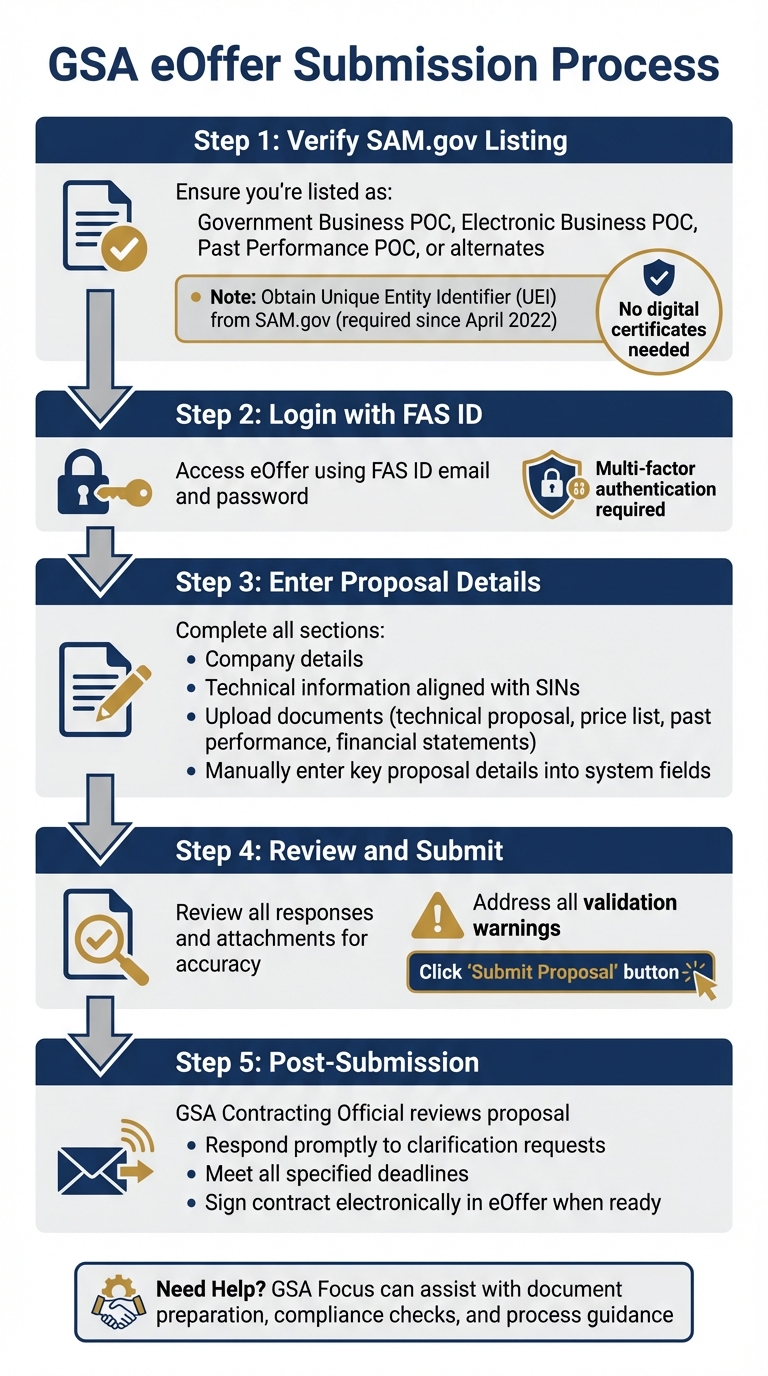
Technical Proposal Submission Process for Federal Contracts
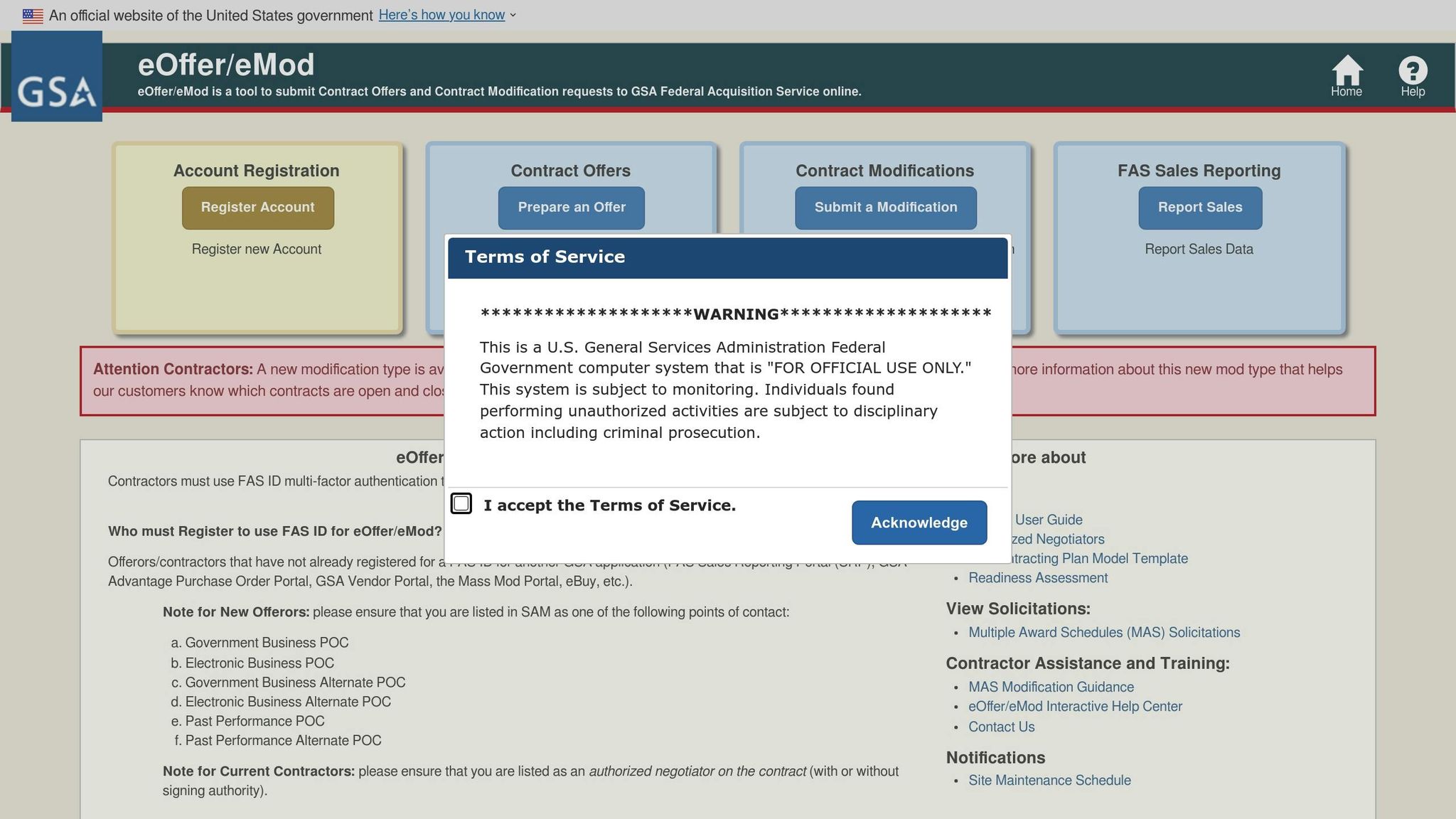
Submitting a proposal via the GSA eOffer platform involves several precise steps. The system is structured to simplify the process, but ensuring everything is done correctly is essential to avoid delays.
Verify Your SAM.gov Listing
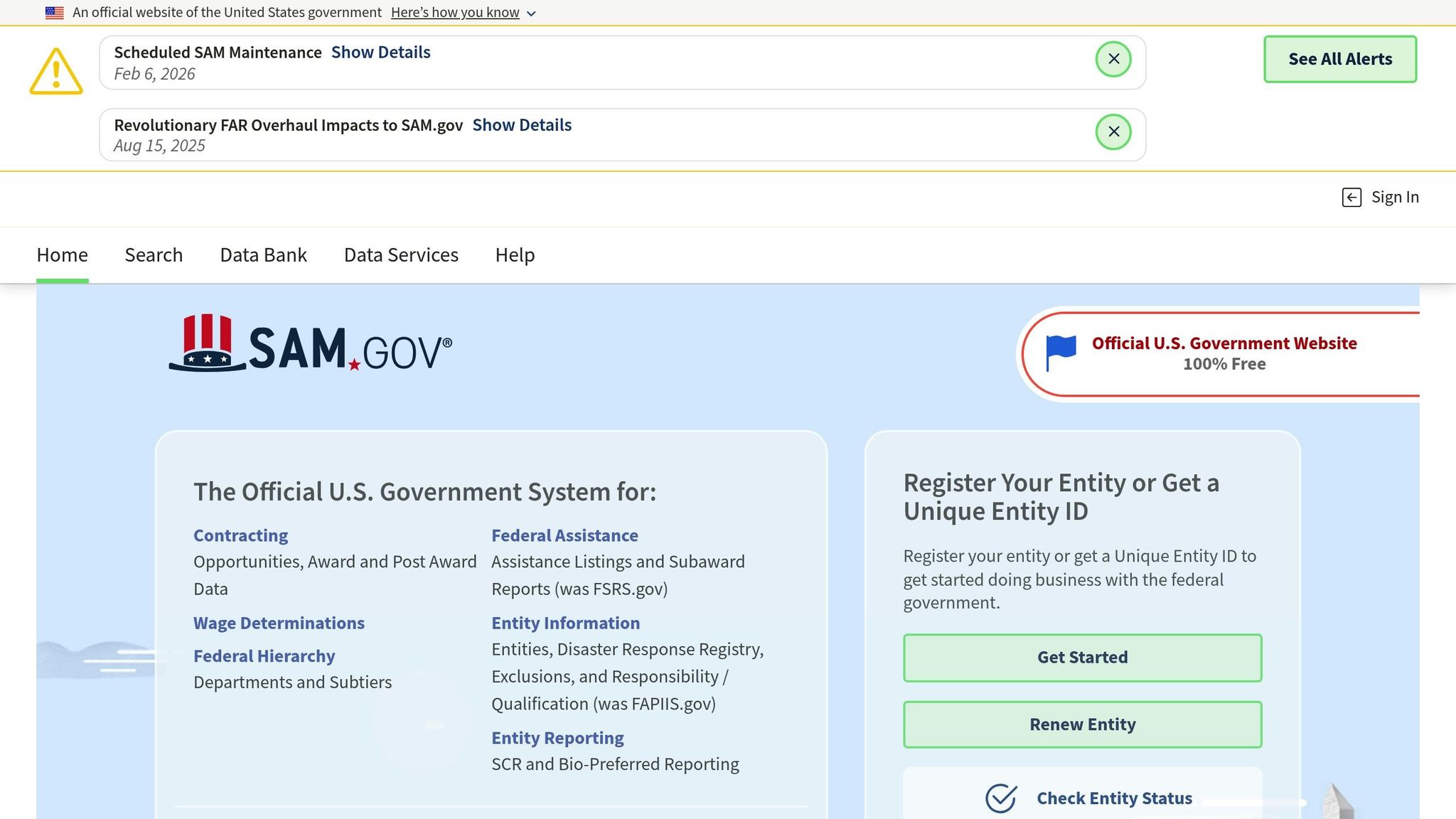
Before starting, make sure you’re listed in SAM.gov as one of the following: Government Business POC, Electronic Business POC, Past Performance POC, or their alternates. This is a crucial first step because your FAS ID credentials won’t work without the proper authorization. Since April 2022, you’ll also need to obtain your Unique Entity Identifier (UEI) from SAM.gov to access the platform. The good news? Digital certificates are no longer required. Instead, the system relies on FAS ID credentials with multi-factor authentication for secure access [25, 26].
Logging In and Entering Proposal Details
Once your SAM.gov listing is verified, log into eOffer using your FAS ID email and password. The platform will guide you through several sections where you’ll:
- Enter your company details
- Align technical information with your Special Item Numbers (SINs)
- Upload essential documents, such as your technical proposal, price list, past performance narratives, and financial statements [24, 25]
Additionally, some key details from your proposal must be manually entered into specific fields within the eOffer system.
Review and Submit
Before submitting, carefully review all your responses and attachments for accuracy. Address any validation warnings that appear to avoid potential issues. Once you’re confident everything is complete, click the "Submit Proposal" button to send your proposal electronically to the GSA Contracting Office [24, 25].
After Submission
After submission, a GSA Contracting Official will review your proposal. They may reach out for further clarifications or to negotiate terms [24, 25]. Be sure to respond promptly to any requests within the specified deadlines. When the contract is ready, the Contracting Official will prepare a package for you to sign electronically within the eOffer platform, finalizing the agreement [24, 25].
Need Help?
If navigating the eOffer process feels overwhelming, consider reaching out to experts like GSA Focus. They can assist with document preparation, compliance checks, and guiding you through every step of the process. Following these steps carefully can greatly enhance your chances of submitting a strong, successful proposal for government contracting.
Conclusion
Putting together a technical proposal for a government contract is no small task – it requires sharp attention to detail and thorough preparation. Agencies evaluate proposals based on key areas like your technical approach, past performance, and quality control. Overlooking even one of these aspects could mean disqualification. Simply restating the requirements without explaining how you’ll meet them won’t cut it.
The process is strict for a reason. Formatting mistakes, exceeding page limits, or missing deadlines can sink your chances. Everything matters, from font size and margins to how you organize your document. Straying from the guidelines can raise red flags about your ability to perform.
For small businesses navigating these challenges, professional help can make all the difference. GSA Focus offers a comprehensive service tailored to meet these rigorous standards. For $7,400, they handle everything – document preparation, compliance checks, and even negotiation support. With over 12 years of experience and the ability to manage 150–200 contracts annually, they’ve helped clients secure billions in federal contracts.
There are no shortcuts in government contracting, but with careful preparation and the right support, your proposal can shine and set your business up for success in the federal marketplace.
FAQs
What makes a technical proposal stand out to evaluators?
A strong technical proposal grabs attention by offering a clear and organized technical approach, emphasizing relevant past achievements, showcasing qualified key team members, and outlining a detailed management plan that aligns with the agency’s goals. Highlighting these aspects effectively can make your proposal resonate more with evaluators.
What counts toward the page limit in a federal technical proposal?
When preparing federal technical proposals, page limits usually pertain to particular sections outlined in the solicitation. Typically, a "page" refers to one side of an 8.5" x 11" sheet, formatted with at least 1-inch margins and a font size of 12 points or larger. It’s crucial to carefully review the solicitation to confirm the exact specifications.
What can get my proposal rejected in GSA eOffer?
Proposals submitted through GSA eOffer often face rejection due to a handful of recurring errors. These include simple administrative oversights like an expired SAM registration or discrepancies between DUNS and EIN information. Another common pitfall is submitting outdated or incomplete documents, which can immediately derail the process.
Pricing inconsistencies or failing to adequately explain net losses are also frequent reasons for rejection. Beyond these, proposals often fall short when past work doesn’t align with GSA’s requirements, or when specific qualifications are not met. Paying close attention to these details and conducting a thorough review can significantly reduce the chances of rejection.
Related Blog Posts
- GSA Proposal Formatting Checklist
- Ultimate Guide to GSA Proposal Documents
- Federal Proposal Deadlines: Key Rules
- How To Write a Technical Proposal