
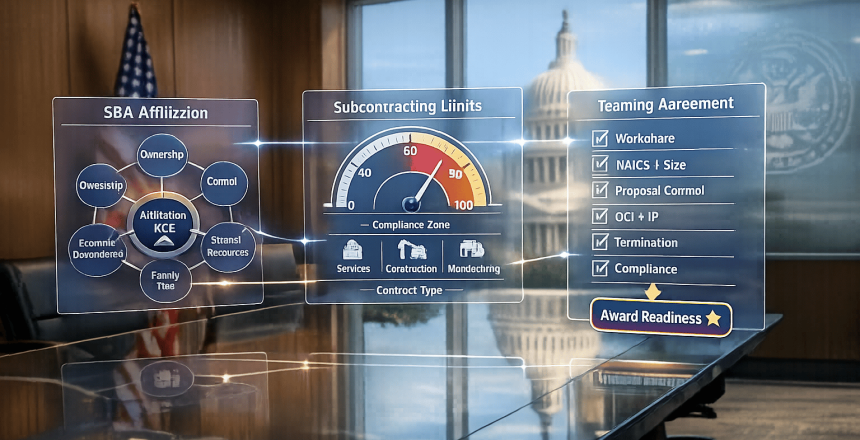
Set-aside contracts are a cornerstone of federal procurement, channeling billions to small businesses annually. In FY2025 alone, over $178 billion (26.5% of federal prime contract dollars) were awarded through these contracts. While teaming arrangements like joint ventures and prime-subcontractor partnerships help small businesses compete for these opportunities, they come with challenges that demand attention.
Key issues include:
- SBA Affiliation Rules: Partnerships with larger entities or dependence on specific subcontractors can disqualify eligibility.
- Subcontracting Limits: Strict rules like the 50% self-performance requirement for services ensure small businesses don’t act as intermediaries.
- Teaming Agreements: Poorly defined agreements often lead to disputes over work shares, compliance, and intellectual property.
- Joint Venture Complexities: Legal structures, control disputes, and compliance with regulations like CMMC 2.0 add layers of difficulty.
To succeed, small businesses must:
- Partner with firms sharing the same small business status.
- Document clear work shares and compliance responsibilities.
- Avoid over-reliance on subcontractors to meet performance requirements.
- Draft precise and enforceable teaming agreements to prevent disputes.
How to Draft Teaming Agreements that Win Government Contracts
SBA Affiliation Rules and Their Impact
Navigating SBA affiliation rules can feel like walking a tightrope for small businesses aiming to secure set-aside contracts. The SBA determines your company’s size by combining the size metrics – like revenue or employee count – of all affiliates, whether domestic or international. As Crowell & Moring put it:
"In determining a concern’s size, SBA counts the receipts, employees, or other measure of size of the concern whose size is at issue and all of its affiliates (domestic and foreign)".
In simpler terms, even if your company qualifies as small on its own, partnering with the wrong entity could push you over the size limit, making you ineligible for set-aside opportunities.
Affiliation occurs when one business controls another, or when a third party has control over both. The SBA evaluates the "totality of the circumstances" to determine affiliation, which means they look at the overall relationship rather than a single factor. Control can take different forms – affirmative (like owning a majority of the board seats) or negative (such as a minority shareholder having veto power over key decisions). Ward & Berry clarify:
"Negative controls… include instances where the entity may not have the power to make decisions but does have the power to prevent actions".
This framework is essential to understand before diving into specific violations and ways to steer clear of them.
What Happens When You Violate Affiliation Rules
The consequences of violating SBA affiliation rules are serious. If the SBA finds that your company is affiliated with another and your combined size exceeds the standard for the relevant NAICS code, you’ll be labeled "other than small." This disqualification removes your eligibility for small business set-aside programs like 8(a), HUBZone, WOSB, and SDVOSB.
One common pitfall is the Ostensible Subcontractor Rule. If a subcontractor handles the "primary and vital requirements" of a contract or if your business is "unusually reliant" on them, the SBA considers the subcontractor a joint venturer, creating an affiliation. Other triggers include:
- Earning 70% or more of your revenue from a single company over the past three fiscal years (economic dependence presumption).
- Sharing management, staff, or office space with another business.
- Repeatedly subcontracting to the same firms.
- Having overlapping financial or operational arrangements.
Understanding these triggers can help you avoid costly missteps.
How to Avoid Affiliation Problems
Fortunately, there are steps you can take to stay compliant with SBA rules while teaming for set-aside contracts:
- Work with similarly situated subcontractors: Partner with businesses that share your small business program status and meet the size standards for the NAICS code in question. This helps you sidestep the Ostensible Subcontractor Rule.
- Diversify your revenue sources: If you cross the 70% revenue threshold with one client, provide evidence that your business isn’t economically dependent on them.
- Review operating agreements: Remove clauses that grant minority owners "negative control", which could allow them to block everyday business decisions.
- Maintain operational independence: Avoid sharing employees, equipment, or office space with other firms.
- Monitor joint venture activity: Ensure all members qualify as small under the NAICS code and limit the joint venture to three contract awards within two years to retain the affiliation exclusion.
Lastly, businesses owned by Indian Tribes, Alaska Native Corporations, Native Hawaiian Organizations, or Community Development Corporations often benefit from exemptions to affiliation rules, particularly when it comes to contractual relationships or economic dependence involving sister entities.
Meeting Limitations on Subcontracting Requirements
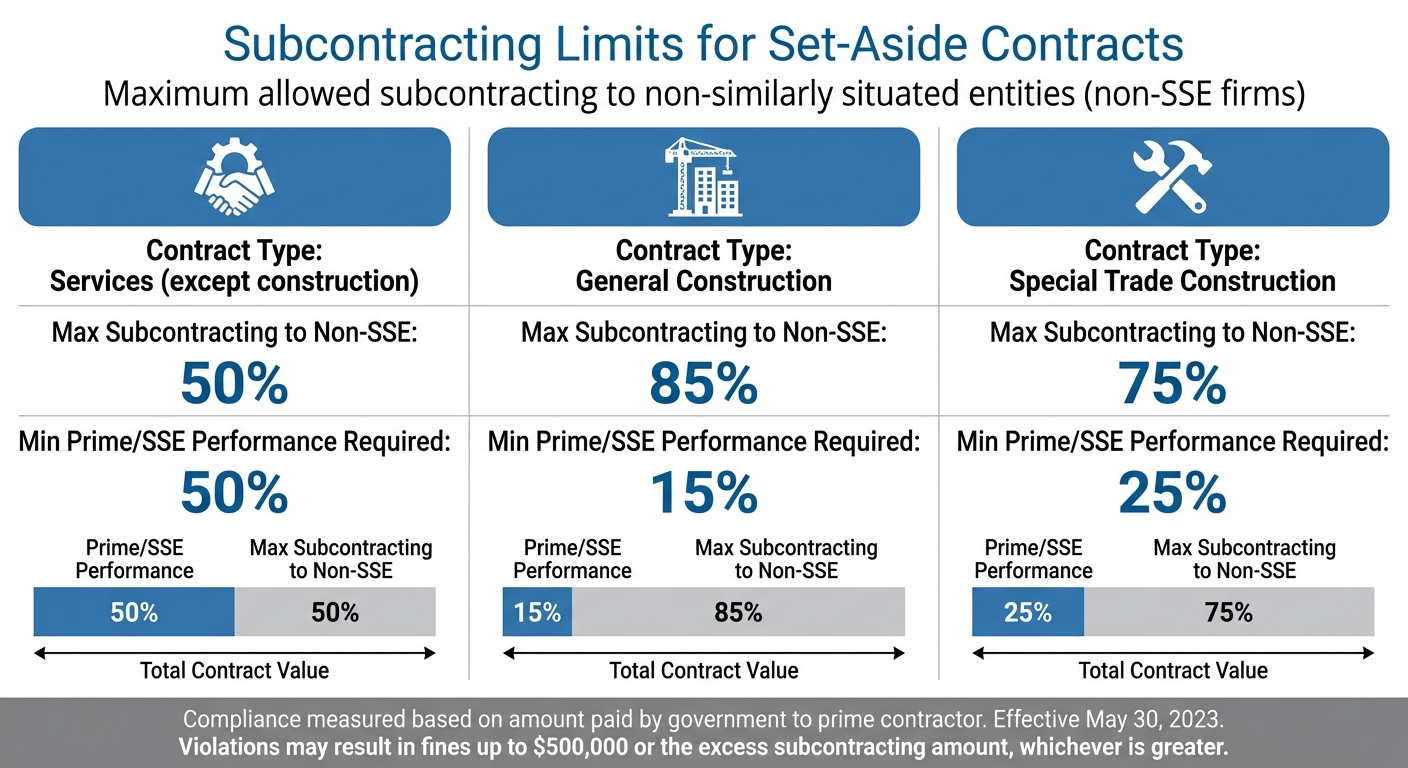
Federal Set-Aside Contract Subcontracting Limits by Contract Type
Once you’ve tackled affiliation issues, the next hurdle for small businesses vying for set-aside contracts is adhering to strict subcontracting limits. The government wants to ensure small businesses aren’t just acting as intermediaries funneling work to larger firms. To enforce this, the SBA has outlined subcontracting restrictions under 13 C.F.R. § 125.6.
Starting May 30, 2023, failing to meet these limits can have serious consequences. Contracting officers won’t give you a "satisfactory" or higher past performance rating unless you can prove there were circumstances beyond your control. Poor ratings can jeopardize your chances for future contracts. Even worse, violations come with hefty fines – whichever is greater: $500,000 or the amount spent on subcontracting beyond the allowed threshold.
What the Subcontracting Limitations Require
The rules vary depending on the type of contract. Here’s a breakdown:
- For service contracts (excluding construction), you can’t subcontract more than 50% of the amount paid by the government to firms that don’t qualify as similarly situated entities (SSEs).
- For general construction contracts, the limit is 85%.
- For special trade construction contracts, it’s 75%.
What counts as an SSE? It’s a firm with the same small business program status that qualified you for the contract. For example, if you’re a Woman-Owned Small Business (WOSB) awarded a WOSB set-aside contract, subcontracting to another certified WOSB won’t count against your 50% limit.
| Contract Type | Max Subcontracting to Non-SSE Firms | Min Prime/SSE Performance |
|---|---|---|
| Services (except construction) | 50% of amount paid by government | 50% |
| General Construction | 85% of amount paid by government | 15% |
| Special Trade Construction | 75% of amount paid by government | 25% |
It’s important to note that compliance is measured based on the amount paid by the government to you as the prime contractor – not based on the "cost of performance" as in the past. For total or partial set-aside contracts, compliance is assessed over the base term and each option period. For orders under full and open contracts, compliance is measured per order.
How to Stay Compliant with Subcontracting Rules
To avoid compliance pitfalls, careful planning is essential. Maria Panichelli, Partner at Cohen Seglias, offers this advice:
"Small business prime contractors should include in every teaming agreement (and resulting subcontract) the percentages (by number) and the specific scopes of work (by description) that will be performed by the small business prime contractor".
Here are some actionable steps to ensure compliance:
- Verify SSE Status: Before naming a subcontractor as an SSE, confirm their status on SAM.gov or the Dynamic Small Business Search (DSBS). This is especially critical for HUBZone, WOSB, and EDWOSB statuses, which require SBA certification rather than self-certification.
- Include Protective Clauses: Add clauses in your subcontracts requiring subcontractors to notify you immediately if their size or socioeconomic status changes. If they lose their certification, they no longer qualify as an SSE.
- Retain Managerial Control: Make sure your small business maintains control over the project and completes the "vital components" of the work. This helps avoid triggering the Ostensible Subcontractor Rule, which penalizes over-reliance on subcontractors.
- Document Mitigating Factors: If unforeseen issues – like labor shortages, government-directed changes, or a subcontractor losing their SSE status – affect your compliance, document these circumstances. This record can protect you from negative past performance ratings.
Writing Clear and Effective Teaming Agreements
After meeting subcontracting limits, the next step is to formalize your arrangements with a well-structured teaming agreement. Many contractors rely on informal agreements that provide little protection in the event of disputes. The Cabrillo Club Editorial Team explains it clearly:
"The companies that win consistently in federal contracting are not necessarily the largest or most technically capable. They are the ones that build the right teams, formalize those teams with airtight agreements, and execute as a cohesive unit."
Think of a teaming agreement as your pre-award roadmap. It lays out responsibilities, payment terms, and dispute protocols. However, poorly crafted agreements, often viewed by courts as "agreements to agree", can leave you without legal recourse when conflicts arise. A strong agreement can mean the difference between a successful partnership and one that falls apart mid-contract.
Problems with Vague Teaming Agreements
One of the biggest issues with teaming agreements is unclear task allocation. For example, vague commitments like "Partner B will provide cybersecurity support" can lead to reduced or eliminated work shares later on. Without specifics such as percentages, dollar amounts, or defined Contract Line Item Numbers (CLINs), it’s tough to hold partners accountable.
Overly broad exclusivity clauses can also cause problems. Agreements that bind partners to exclusive relationships across entire agencies or markets, rather than specific solicitations, limit your ability to pursue other opportunities. Worse, these clauses often have no expiration date if no proposal is submitted, leaving you tied up indefinitely.
Additionally, poorly written agreements may violate SBA affiliation rules under 13 CFR 121.103, which could jeopardize your small business status. Missing compliance flow-downs from the prime contract is another risk. For example, DFARS 252.204-7012 requires contractors to report cyber incidents to the Department of Defense within 72 hours. Without clear roles for handling Controlled Unclassified Information (CUI) and compliance responsibilities, you risk serious penalties.
Finally, vague clauses on intellectual property (IP) can lead to disputes over proprietary data shared during the proposal phase. Without clear definitions, ownership of critical IP can become a contentious issue.
How to Draft Better Teaming Agreements
Avoid these pitfalls by following these strategies to strengthen your teaming agreements.
- Quantify work share: Use specific percentages or dollar amounts and define tasks by CLINs to avoid disputes later. For SBA mentor-protégé joint ventures, ensure the protégé performs at least 40% of the work.
- Negotiate subcontract terms upfront: Include rate structures, payment schedules, and flow-down requirements in the teaming agreement. Waiting until after the award gives the prime contractor all the leverage.
- Limit exclusivity clauses: Tie exclusivity to specific solicitations or programs, not entire agencies. Add "sunset" clauses that end exclusivity if no proposal is submitted within a set timeframe, such as 90 days after the solicitation closes.
- Address cybersecurity responsibilities: Clearly define secure collaboration tools, data boundaries, and incident response protocols. Subcontractors should notify the prime within 24 hours to meet the 72-hour reporting requirement.
- Include a cure period for terminations: A 30-day written notice with an opportunity to correct issues before termination protects both parties from abrupt exits. Specify dispute resolution methods, like binding arbitration, and the governing jurisdiction to avoid public litigation.
- Clarify intellectual property ownership: Define ownership for background IP (pre-existing), proposal IP (developed during the bid), and performance IP (created during the contract). This avoids conflicts over who owns what once the work is complete.
Joint Venture Challenges and Solutions
Joint ventures can be incredibly rewarding, especially for set-asides, but they come with their own set of hurdles. Unlike subcontracting, where there’s a clear prime-sub relationship, forming a joint venture means creating an entirely new legal entity. This involves shared management, risks, and rewards, along with requirements like a formal operating agreement, a unique EIN, and separate accounting systems. The process is far more time-intensive than subcontracting, often taking weeks or even months to finalize, compared to the quicker turnaround of subcontracting agreements.
Typical Problems in Joint Ventures
One of the most common stumbling blocks is the "three-in-two" rule. The SBA restricts mentor-protégé joint ventures to three contract awards within a two-year period. After that, the protégé must prove its ability to compete independently. This essentially gives your partnership an expiration date, so planning for the future from the outset is critical.
Control disputes between partners can also derail joint ventures. For example, mentor-protégé agreements require the protégé to handle at least 40% of the work. Without clearly defined percentages tied to specific CLINs (Contract Line Item Numbers), the minority partner might find themselves sidelined.
Another significant risk is joint-and-several liability, which makes both partners equally responsible for any mistakes, including cybersecurity breaches. Under DFARS 252.204-7012, any cyber incidents involving Controlled Unclassified Information (CUI) must be reported to the Department of Defense within 72 hours. If one partner fails to act, both are held accountable.
Administrative requirements can also become a roadblock. JVs without dedicated employees need to submit detailed professional compensation plans and overtime policies for each member. Mentor-protégé JVs face additional hurdles, such as providing project experience for at least one Special Item Number (SIN) and securing a customer reference to prove technical capability. Missing these steps can lead to delays or even disqualification.
How to Build Successful Joint Ventures
To set your joint venture up for success, start by thoroughly vetting potential partners. Check their compliance maturity, including their readiness for CMMC, whether they have a DCAA-approved accounting system, and if they hold necessary facility clearances. Assess their "bench strength" to ensure their key personnel aren’t stretched thin with other commitments. Conduct an Organizational Conflict of Interest (OCI) review early to avoid any disqualifications due to conflicting contracts.
Establish the JV’s legal identity early. Register it as a separate entity with its own Unique Entity Identifier (UEI) and CAGE code before pursuing federal contracts. For newer JVs (under two years old), be prepared to submit financial statements for each member to meet administrative requirements. Keep in mind that Contracting Specialists often evaluate JV rates independently and may request additional discounts.
Your operating agreement should be as detailed as possible. Define how CUI will flow between partners before the contract begins, and specify which partner is responsible for maintaining security boundaries and reporting incidents. To meet the federal 72-hour reporting requirement for cyber incidents, require partners to notify the lead JV member within 24 hours of discovering a potential breach. Additionally, include clear terms for exiting the JV, both before and after contract award, and outline how CUI will be destroyed or returned if the partnership dissolves. Make sure the JV Agreement explicitly addresses performance expectations under the proposed contract to ensure compliance.
Getting Expert Help to Overcome Teaming Challenges
Why Professional Guidance Helps
Navigating teaming arrangements for set-asides can feel like walking a tightrope. The rules are intricate, the stakes are high, and even small missteps can lead to major setbacks. That’s where expert guidance comes in – it helps prevent affiliation violations, ensures subcontracting compliance, and strengthens teaming agreements.
Here’s what the numbers say: expert advice can boost win rates by 30–50% while slashing affiliation protests from 25% to under 5%, according to GAO data from FY2022–2024. In FY2023 alone, 20% of set-asides were voided due to affiliation violations. By thoroughly reviewing affiliation rules, subcontracting limits, and team structures, experts help reduce these risks significantly.
This kind of support isn’t just helpful – it’s essential if you want to stay competitive and compliant.
How Full-Service Providers Simplify the Process
Full-service providers, such as GSA Focus, take the heavy lifting off your plate. They handle everything from drafting teaming agreements and joint venture documents to securing compliance certifications. By ensuring all paperwork aligns with SBA rules, they cut down on errors and reduce document preparation time from months to just weeks.
But that’s not all. GSA Focus also offers guidance on profit splits, workshare clarity, and dispute resolution clauses – key elements that simplify access to lucrative GWACs like OASIS or Alliant 2. These contracts open doors to over $100 billion in annual set-aside opportunities. With a 98% success rate and built-in compliance checks, working with experts doesn’t just make the process easier – it turns your bid into a winning one.
Conclusion
Teaming for set-asides can open doors to valuable federal contracting opportunities, but navigating the complexities requires careful attention to compliance and strategic planning. Even minor missteps – like overlooking SBA affiliation rules or subcontracting limitations – can jeopardize your efforts.
The key to success lies in detailed planning and clear documentation. Ambiguities in work shares, overly broad exclusivity clauses, or missing termination terms can lead to operational headaches and legal risks. To avoid these issues, make sure to define work shares precisely – using specific percentages or dollar amounts – and limit exclusivity to clearly identified opportunities with reasonable timeframes. Including comprehensive dispute resolution procedures also strengthens your teaming agreements. By addressing these details upfront, you create a strong foundation for your partnership.
Compliance is non-negotiable, especially when it comes to SBA rules, flow-down requirements, and protecting intellectual property. Tackling flow-down provisions early ensures that key prime contract terms carry over seamlessly into subcontracts. At the same time, non-disclosure agreements safeguard your competitive edge by protecting sensitive information. Expert guidance plays a crucial role here – whether it’s avoiding affiliation pitfalls, drafting airtight agreements, or ensuring compliance throughout the contract lifecycle. Partnering with professionals, like the team at GSA Focus, can help you handle document preparation, compliance checks, and negotiations, freeing you to focus on delivering outstanding results to federal agencies.
FAQs
How can I team without triggering SBA affiliation?
To steer clear of triggering SBA affiliation, it’s crucial to structure teaming arrangements with care. The key is ensuring the small business maintains its independence and adheres to SBA rules. This means the small business should have full control over its performance and decision-making processes.
A detailed agreement that clearly outlines roles and responsibilities is essential. Be mindful of common missteps like overlapping ownership, shared management, or financial entanglements, as these can raise red flags. With thoughtful preparation and the right legal guidance, you can stay compliant and protect your small business status.
What counts as a similarly situated entity (SSE)?
A similarly situated entity (SSE) refers to a business that shares comparable characteristics with the primary contractor, such as size, expertise, and qualifications. These entities play a key role in evaluating team structures and ensuring that teaming arrangements meet necessary compliance standards.
Which teaming agreement terms prevent disputes?
Clear communication about roles, responsibilities, and performance expectations is critical in teaming agreements to avoid potential conflicts. By outlining a detailed scope of work, compliance requirements, and provisions for resolving disputes, you can significantly reduce the chances of misunderstandings or disagreements.
Related Blog Posts
- Ultimate Guide to Teaming Agreements for Small Businesses
- Best Practices for Small Business Teaming Success
- Teaming vs. Subcontracting: Compliance Differences
- Best Practices for Federal Teaming Success