
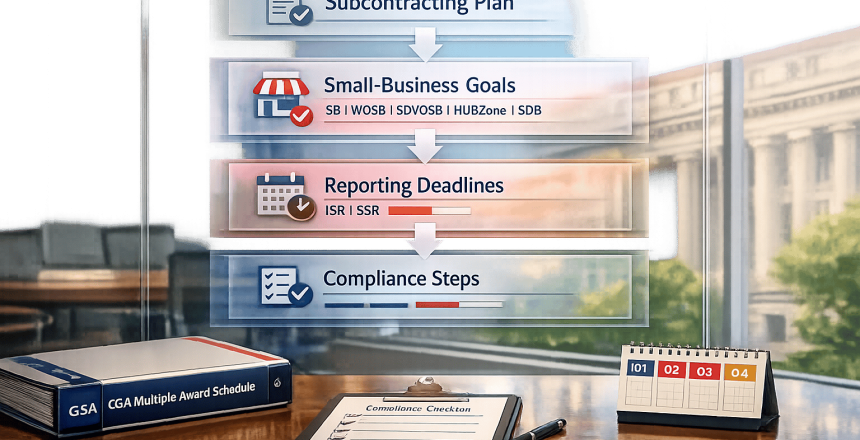
Selling to the government? GSA Schedules simplify the process, but understanding subcontracting rules is critical for compliance and success. Here’s what you need to know:
- Who it applies to: Other Than Small Business (OTSB) prime contractors must follow these rules when contracts exceed specific dollar thresholds. Small businesses are exempt but can benefit by partnering with compliant primes.
- Subcontracting plans: OTSBs can choose between Commercial Plans (covering all operations) or Individual Plans (specific to a contract). Both require setting spending goals for six small business categories.
- Reporting deadlines: Timely submissions are essential. Reports (ISRs and SSRs) must now be filed through SAM.gov, with key deadlines being April 30 and October 30.
- Compliance matters: Failing to meet small business goals or missing deadlines can hurt your federal contracting opportunities. Use tools like SAM.gov and SBA’s SubNet to stay on track.
Bottom line: Knowing these rules helps prime contractors maintain compliance and small businesses seize growth opportunities in federal contracting.
Doing Business with GSA – Subcontracting
How Subcontracting Plans Work
Commercial vs Individual Subcontracting Plans: Key Differences for GSA Schedules
Commercial Plans vs. Individual Plans
When it comes to subcontracting plans, OTSB contractors have two options: Commercial Subcontracting Plans or Individual Subcontracting Plans.
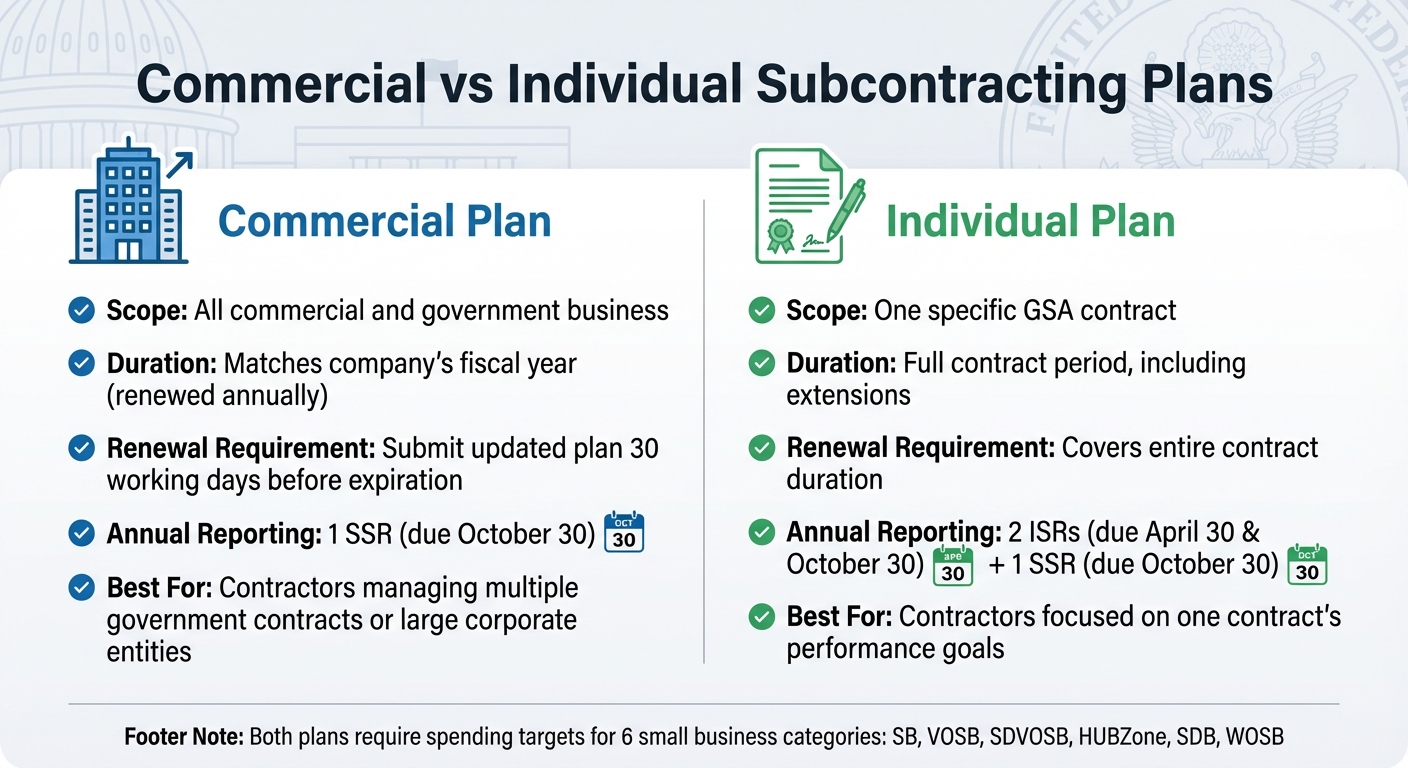
A Commercial Subcontracting Plan covers all of a contractor’s commercial and government operations across federal agencies. This plan aligns with the company’s fiscal year, requiring annual renewal. Contractors must submit the updated plan at least 30 working days before the previous plan expires. Reporting is streamlined, with just one Summary Subcontract Report (SSR) due each year on October 30.
"The commercial subcontracting plan includes planned subcontracting for both commercial and government business, not just a single agency like GSA".
On the other hand, an Individual Subcontracting Plan applies to a specific GSA contract, covering the entire duration of that contract, including any option years. Reporting is more frequent, requiring two Individual Subcontracting Reports (ISRs) – one for October 1 to March 31 (due April 30) and another for April 1 to September 30 (due October 30) – plus one SSR, also due on October 30.
Here’s a quick comparison of the two plans:
| Feature | Commercial Plan | Individual Plan |
|---|---|---|
| Scope | All commercial and government business | One specific GSA contract |
| Duration | Matches the company’s fiscal year (renewed annually) | Full contract period, including extensions |
| Annual Reporting | One SSR (due October 30) | Two ISRs (due April 30 & October 30) and one SSR (due October 30) |
| Best For | Contractors managing multiple government contracts or large corporate entities | Contractors focused on one contract’s performance goals |
Once you’ve chosen the right plan for your business, the next step is ensuring it meets all the required elements.
Required Parts of a Subcontracting Plan
Regardless of the type of plan you select, it must comply with federal guidelines for subcontracting goals and reporting.
Every subcontracting plan must establish spending targets for six small business categories: Small Business (SB), Veteran-Owned Small Business (VOSB), Service-Disabled Veteran-Owned Small Business (SDVOSB), HUBZone, Small Disadvantaged Business (SDB), and Women-Owned Small Business (WOSB). These targets should be realistic, based on your total planned subcontracting dollars, and approved by the Contracting Officer as evidence of your "best faith efforts" to meet or exceed the minimum requirements.
Plans should also estimate the total subcontracting spend for the coverage period and outline your strategy for identifying potential subcontractors. This might include resources like SAM.gov, veteran service organizations, or trade associations.
Compliance and Reporting Duties
Once a compliant subcontracting plan is in place, keeping up with classification and reporting responsibilities is essential to stay aligned with federal requirements.
How to Classify Subcontractors
Getting subcontractor classifications right is key to meeting small business goals and steering clear of compliance problems. Classification determines which socio-economic category a subcontractor belongs to – such as Small Business (SB), Veteran-Owned Small Business (VOSB), Service-Disabled Veteran-Owned Small Business (SDVOSB), HUBZone, Small Disadvantaged Business (SDB), or Women-Owned Small Business (WOSB).
The first step is to verify the subcontractor’s self-certified status on SAM.gov, your go-to resource for this information. If a subcontractor lacks a SAM.gov record, you can rely on self-certification forms or consult the SBA’s Dynamic Small Business Search tool for confirmation. Be sure to review the subcontractor’s primary NAICS code, as it determines size standards and should accurately reflect the industry that constitutes most of their business.
Retain all documentation – SAM.gov certifications, self-certification forms, and relevant correspondence – as proof for audits. Once subcontractors are properly classified, your focus should shift to accurate and timely reporting.
When to Submit Reports
Reporting timelines depend on the type of plan you have, and missing deadlines can negatively impact your CPARS ratings. For Individual Plans, submit ISRs by April 30 (covering October–March) and October 30 (covering April–September). Additionally, all plans require an SSR submission by October 30. If you hold a Commercial Plan, ensure you submit revised plans 30 working days before the plan’s expiration to maintain uninterrupted coverage.
Heads up: Starting February 20, 2026, the Electronic Subcontracting Reporting System (eSRS.gov) will no longer be in use. From that date forward, all subcontracting reports must be filed through SAM.gov. Make sure your SAM.gov account is set up correctly for Subcontracting Plan Reporting access.
Sticking to these deadlines is critical for maintaining strong CPARS ratings and avoiding any non-compliance records in FAPIIS (Federal Awardee Performance and Integrity Information System), which could hurt your chances for future federal contracts. Keep in regular contact with your Administrative Contracting Officer (ACO) to discuss the status of your reports, as they review your submissions and issue CPARS assessments.
Solutions to Common Compliance Problems
When it comes to federal contracting, staying on top of compliance is non-negotiable. Even with a well-crafted subcontracting plan, challenges can crop up. Addressing these issues head-on not only helps you remain compliant but also safeguards your reputation as a reliable contractor.
Late or Missing Reports
Missing a reporting deadline can put your compliance status at risk. To avoid this, set up automated reminders well in advance of deadlines and assign a team member to handle reporting, with a backup person in place for added security. If a report is overdue, submit it immediately and notify your contracting officer. Be sure to explain the delay and outline the steps you’re taking to prevent future issues. These small but critical actions can make a big difference in maintaining compliance.
Poor Record-Keeping
Good record-keeping is the backbone of compliance, especially during audits. Keep detailed records for each subcontracting relationship, including UEI numbers, vendor addresses, primary NAICS codes, product or service lines, and small business designations. Organize these records by NAICS codes or industry categories for easier reporting. Double-check all subcontracting data against official government databases to ensure accuracy. If you’re unsure about documentation standards, your local OSDBU Technical Advisor can provide valuable guidance.
Missing Small Business Goals
Even with a compliant subcontracting plan, meeting small business targets can be tricky. Falling short doesn’t automatically mean non-compliance, but you must show good-faith efforts. Document every outreach effort, review successful strategies in GSA’s Subcontracting Directory, and stay updated on opportunities through SBA’s SubNet. If shortfalls persist, it might be time to reassess your targets. Were they too ambitious? Discuss potential adjustments with your contracting officer during the next review cycle. Regularly monitoring and tweaking your approach demonstrates your commitment to meeting federal compliance standards.
Practical Subcontracting Tips
Building Good Subcontractor Relationships
Creating strong connections with prime contractors starts with choosing the right partners. A great resource to begin with is the GSA Subcontracting Directory, which lists prime contractors – mainly Other Than Small Businesses (OTSBs) – that have submitted subcontracting reports in the latest fiscal year. This shows their dedication to meeting small business subcontracting goals and staying compliant with federal requirements.
Before reaching out, take the time to do your homework. Use tools like FPDS.gov or USAspending.gov to verify a potential partner’s UEI or company name, ensuring they have active prime contracts and a solid performance history. Narrow your search by NAICS codes, keywords, or geographic areas to find contractors whose projects match your expertise.
Once you’ve identified promising prospects, focus on clear communication and delivering top-notch work. Prime contractors depend on reliable subcontractors to meet their goals across categories like SDB, WOSB, HUBZone, VOSB, and SDVOSB. If you’re unsure about how to engage or explore collaboration models like Joint Ventures or Contractor Team Arrangements, reach out to your local GSA OSDBU Technical Advisor for guidance.
And remember, keeping a close eye on compliance is just as important as building the relationship.
Tools for Tracking Compliance
Effective tools make tracking compliance smoother and more manageable. Use SAM.gov’s Subcontracting Plan Reporting tool to submit required ISRs and SSRs. Since all subcontracting reports are now centralized on SAM.gov, this ensures you’re aligned with current federal reporting standards. Make sure to meet all reporting deadlines.
At the start of every subcontractor relationship, verify their size status and socio-economic categories on SAM.gov. Since size standards can change yearly, this step should be a regular part of your process. If a subcontractor doesn’t have an active SAM.gov record, keep internal vendor self-certification forms as documentation for any future compliance audits.
For new opportunities, check the SBA’s Subcontracting Network (SubNet) frequently. Additionally, use GSA eLibrary to confirm a prime contractor’s current GSA Schedule status and the products or services they’re authorized to offer. These tools can help you stay informed and maintain compliance while building valuable partnerships.
Conclusion
Subcontracting compliance under GSA Schedules plays a crucial role in building a strong federal contracting business. Prime contractors with federal contracts exceeding certain dollar thresholds are required to establish small business subcontracting plans, as outlined in FAR 52.219-9. These plans set percentage goals across six small business categories, ensuring inclusivity and accountability in federal contracting efforts. By meeting these requirements, contractors secure their listing in GSA’s Subcontracting Directory, which highlights firms with up-to-date compliance reports.
For small businesses, understanding these rules opens doors to federal contracts through partnerships with established prime contractors. Companies like Amazon Web Services, Inc. (UEI: NQEWN6C1LSU5), Accenture Federal Services LLC (UEI: C47BNA8GM833), and 3M Company (UEI: YLQMY5SGNE55) maintain their positions in the GSA Subcontracting Directory by adhering to reporting obligations. This compliance not only strengthens their standing but also makes them valuable partners for small businesses looking to break into the federal market.
Whether you’re a prime contractor focused on meticulous record-keeping or a small business eager to seize subcontracting opportunities, consistent compliance is the foundation of federal contracting success. Tools like GSA’s Subcontracting Directory, SBA’s SubNet, FPDS.gov, and GSA eLibrary provide essential resources to research potential partners, verify contract histories, and identify opportunities that align with your expertise. Staying informed and meeting reporting requirements ensures a competitive edge in the federal marketplace.
FAQs
Do I need a subcontracting plan for my GSA Schedule contract?
If your GSA Schedule contract exceeds $750,000, you are required to have a subcontracting plan. This is a federal mandate designed to ensure compliance with regulations while encouraging small businesses to participate in government contracting opportunities.
Which plan should I choose: Commercial or Individual?
If you’re a small business, the Commercial plan might be your best bet. Subcontracting plans are usually necessary only for larger businesses that meet certain thresholds. On the other hand, the Individual plan works well for sole practitioners or smaller entities that don’t have to worry about subcontracting requirements. Keep in mind that small businesses often operate under a distinct set of rules when it comes to GSA Schedule contracts.
What happens if I miss a report or fall short of my goals?
Missing a report or falling short of your goals under a GSA subcontracting plan can lead to serious consequences. These might include financial penalties, jeopardizing your contract, and harming your professional reputation. It’s crucial to stay on top of reporting and meet your goals to steer clear of these risks.
Related Blog Posts
- Why Subcontracting Plans Matter for GSA Contracts
- GSA Subcontracting Plans: Key Requirements
- Why Subcontracting Reports Matter for GSA Contracts
- How GSA Subcontracting Rules Impact Partnerships