

Socioeconomic status in GSA contracting is a formal legal classification that determines whether a business qualifies for preferential federal procurement programs. This is not the sociological measure of individual income, education, or social standing you encounter in academic research. The GSA version of socioeconomic status defines eligibility for set-aside contracts, statutory goals, and priority access to billions in federal spending. Understanding what is socioeconomic status GSA means in practice is the first step to competing effectively in the federal marketplace.
What is socioeconomic status in GSA contracting?
Socioeconomic status in government contracting is a legally defined business eligibility concept, not a measure of social class. The General Services Administration and the Small Business Administration use specific ownership, size, and demographic criteria to assign businesses to recognized categories. These categories then unlock access to set-aside contracts, sole-source awards, and agency spending goals that would otherwise be unavailable.
The distinction matters because the phrase “socioeconomic status” carries very different weight depending on context. In sociology, it measures an individual’s relative position in society based on income, education, and occupation. In federal procurement, it is a binary determination: your business either qualifies for a category or it does not. There is no spectrum, no partial credit, and no gray area.

The GSA uses these classifications to fulfill a congressional mandate. Federal agencies must prioritize contracting with small businesses and specific subgroups to meet statutory goals. The government awarded over $117 billion to small businesses in FY2024. That figure reflects how seriously agencies treat these classifications when making purchasing decisions.
What are the official socioeconomic categories recognized by GSA?
The GSA and SBA recognize several distinct socioeconomic categories, each with its own ownership requirements, size standards, and contracting goals. Here is how the major categories compare:
| Category | Ownership Requirement | Key Contracting Goal |
|---|---|---|
| Small Business (SB) | U.S. citizen, meets SBA size standards | 23% of all prime contract dollars |
| Service-Disabled Veteran-Owned Small Business (SDVOSB) | 51% owned by service-disabled veterans | 3% of prime contract dollars |
| Women-Owned Small Business (WOSB) | 51% owned by women | 5% of prime contract dollars |
| HUBZone Small Business | Located and staffed in Historically Underutilized Business Zones | 3% of prime contract dollars |
| Small Disadvantaged Business (SDB) | 51% owned by socially and economically disadvantaged individuals | 15% of prime contract dollars |
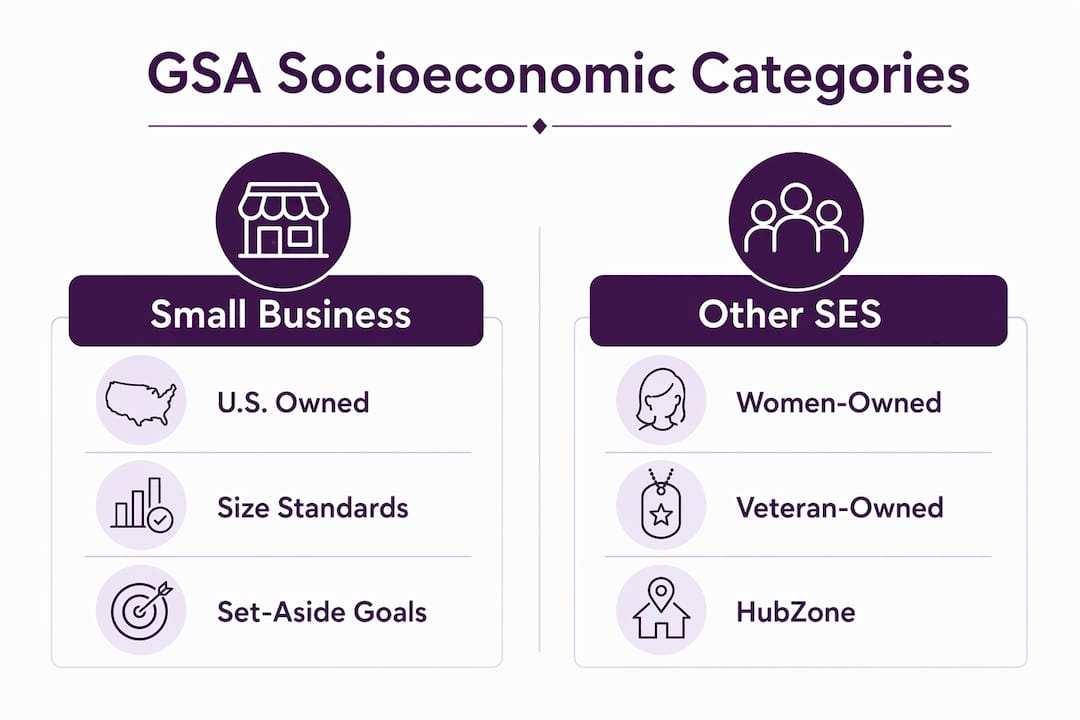
Each socioeconomic category has unique ownership and eligibility requirements, plus statutory goals established by Congress. Meeting the ownership threshold is necessary but not sufficient. You also need to meet the applicable SBA size standard for your primary NAICS code.
A few critical details for each category:
- SDVOSB: The veteran must control daily operations and hold the highest officer position. VA verification through the Veteran Small Business Certification program is required.
- WOSB: The woman owner must be a U.S. citizen and control management decisions. Some industries require the firm to qualify as an Economically Disadvantaged WOSB (EDWOSB).
- HUBZone: At least 35% of employees must reside in a designated HUBZone area. The principal office must also be located there.
- SDB: Certification goes through the SBA’s 8(a) Business Development program for the most common pathway.
You can learn more about qualifying for a GSA schedule and how these categories affect your eligibility before you apply.
How do federal regulations govern socioeconomic status certifications?
Certification for each socioeconomic category is not self-reported. GSA set-aside contracts require formal certification through the SBA’s online platform, with protest procedures and certifications governed by specific parts of the Code of Federal Regulations. The regulatory framework is precise and category-specific.
Key regulatory references by category:
- SDVOSB protests: Governed by 13 C.F.R. Part 128.500
- WOSB protests: Governed by 13 C.F.R. Part 127.600
- SDB protests: Governed by 13 C.F.R. Part 124.1002
- HUBZone protests: Governed by 13 C.F.R. Parts 126.800 through 126.805
Certification and protest procedures vary by category and are codified in federal regulations. This means a competitor can formally challenge your eligibility, and the SBA will adjudicate the protest. Losing a protest can cost you a contract award.
One of the most significant recent regulatory changes involves Multiple Award Contracts (MACs). FAR updates from 2025 require contractors to rerepresent their size and socioeconomic status for orders under MACs. This rerepresentation rule ensures that orders only go to firms that still meet NAICS and socioeconomic eligibility at the time the order is placed. A business that qualified as a small business when it won the base contract may no longer qualify years later when a task order is issued.
NAICS code accuracy is also critical. Your socioeconomic status eligibility is tied to the size standard for the specific NAICS code assigned to each contract or order. A firm that qualifies as small under one NAICS code may not qualify under another.
Pro Tip: Set a calendar reminder to review your SAM.gov registration and SBA certifications every six months. Regulations change, size standards update, and your own business growth can affect your eligibility without any formal notice from the government.
What is the practical significance of socioeconomic status for government contractors?
Socioeconomic status directly controls which contracts you can compete for. Agencies use set-asides to restrict competition to firms within a specific category. If you do not hold the right certification, you cannot bid. This is the most direct financial impact of socioeconomic status in federal procurement.
The dollar amounts at stake are substantial. The government-wide small business prime contract goal is at least 23% of all federal prime contract dollars annually. Sub-goals for SDVOSB, WOSB, HUBZone, and SDB firms create additional layers of targeted spending. Agencies that fall short of these goals face scrutiny from the SBA and Congress.
Here is how agencies use these goals in practice:
- Contracting officers review their agency’s socioeconomic scorecard before issuing solicitations.
- If an agency is behind on its WOSB goal, it will prioritize WOSB set-asides for upcoming awards.
- Program managers use GSA Advantage search tools to filter vendors by socioeconomic category using business indicator codes.
- Agencies can sole-source contracts to SDVOSB or 8(a) firms under specific dollar thresholds without full competition.
- SES-certified vendors appear in agency procurement databases with flags that make them easier to find and select.
Government agencies use SES as a tool to fulfill mission-driven procurement goals, reduce procurement risk, and support mandated socioeconomic contracting targets. From the agency’s perspective, buying from a certified SES vendor is a compliance win. That creates a genuine purchasing preference you can exploit if you hold the right certifications.
Pro Tip: If you hold a GSA Schedule contract, check whether your socioeconomic categories are correctly reflected in GSA Advantage. Errors in your business indicator codes can make you invisible to contracting officers filtering by category.
Understanding how to grow your small business through a GSA Schedule becomes significantly more tractable once you know which socioeconomic categories apply to your firm.
What are the common challenges in maintaining socioeconomic status?
Maintaining socioeconomic status is an ongoing compliance obligation, not a one-time achievement. Failure to maintain accurate SES status and rerepresent when required can lead to exclusion from order awards even if you were originally qualified on the base contract. That is a hard outcome to recover from mid-performance.
The most common challenges contractors face:
- Rerepresentation deadlines: Under the 2025 FAR rule, contractors must rerepresent status when the contracting officer requests it for a specific order. Missing this window can disqualify you from that order.
- Business growth crossing size thresholds: Revenue or employee growth can push you out of the small business size standard for your NAICS code. You may not notice until a protest is filed.
- Ownership changes: Selling equity, adding partners, or restructuring can invalidate your SDVOSB, WOSB, or SDB certification if the qualifying owner’s control falls below 51%.
- HUBZone employee residency drift: If employees move out of the HUBZone area, your 35% residency requirement can slip without any intentional action on your part.
Each SES category requires tailored documentation and periodic renewal through SBA portals, with strict protest mechanisms to challenge eligibility. Treat your certifications like professional licenses. They expire, they require renewal, and competitors can challenge them.
The best practice is to assign a specific person in your organization to own certification compliance. That person should track renewal dates, monitor NAICS code size standard updates, and flag any business changes that could affect eligibility. For WOSB certification specifics, the WOSB certification process is a useful reference for what documentation the SBA requires.
Key takeaways
Socioeconomic status in GSA contracting is a legal business classification that controls access to set-aside contracts, sole-source awards, and billions in targeted federal spending.
| Point | Details |
|---|---|
| SES is a legal classification | GSA socioeconomic status determines contract eligibility, not social standing or income level. |
| Five major categories exist | SDVOSB, WOSB, HUBZone, SDB, and general small business each carry distinct ownership rules and goals. |
| Rerepresentation is now required | 2025 FAR rules require contractors to reconfirm SES eligibility for each MAC task order issued. |
| Agencies actively use SES filters | GSA Advantage lets contracting officers search and prioritize vendors by socioeconomic category. |
| Compliance is ongoing | Ownership changes, growth, and employee moves can all invalidate your certification without warning. |
Why most contractors underestimate their SES advantage
Most contractors I work with treat socioeconomic status as a checkbox they completed during registration. They certified once, updated SAM.gov, and moved on. That approach leaves money on the table every single year.
Here is what I have seen repeatedly: agencies are under real pressure to hit their socioeconomic contracting goals. When a contracting officer is behind on their WOSB or SDVOSB numbers in the third quarter, they are actively looking for certified vendors to award work to. If your certifications are current and visible in GSA Advantage, you become the path of least resistance for that officer. If your certifications lapsed or your business indicator codes are wrong, you are invisible.
The contractors who win disproportionately in the federal market are not always the most technically capable. They are the ones who keep their SES credentials current, understand which NAICS codes apply to each opportunity, and show up correctly in agency procurement systems. That is a process discipline problem, not a capability problem. And it is entirely solvable.
The 2025 FAR rerepresentation rules changed the game for MAC holders. Contractors who do not understand that they must rerepresent at the order level will lose awards they should have won. That is not a hypothetical risk. It is happening right now to firms that have not updated their compliance processes.
My honest advice: treat your socioeconomic certifications as a revenue-generating asset that requires active management. Review your status quarterly. Know your renewal dates. Understand the size standards for every NAICS code you use. The firms that do this consistently outperform those that do not.
— Josh
How Gsascheduleservices can help you identify and use your SES status
Gsascheduleservices works with small and medium-sized businesses to identify which socioeconomic categories apply to their firm, document those credentials correctly, and position them for maximum visibility in federal procurement. The team handles the regulatory complexity so you can focus on winning contracts. Whether you are pursuing your first GSA Schedule or trying to maintain compliance under the 2025 FAR rerepresentation rules, Gsascheduleservices provides the guidance to keep your certifications current and your pipeline active. Start with a GSA schedule discovery session to understand exactly where your business stands and which socioeconomic categories could open new contract opportunities for you.
FAQ
What does socioeconomic status mean in GSA contracting?
Socioeconomic status in GSA contracting is a formal legal classification that determines whether a business qualifies for set-aside contracts and preferential federal procurement programs. It is based on ownership, size, and demographic criteria, not on individual income or social standing.
What are the main GSA socioeconomic categories?
The main categories are Small Business, Service-Disabled Veteran-Owned Small Business (SDVOSB), Women-Owned Small Business (WOSB), HUBZone Small Business, and Small Disadvantaged Business (SDB). Each has distinct ownership requirements and a separate statutory contracting goal.
How do i get certified for a GSA socioeconomic category?
Certification is completed through the SBA’s online platform, with specific CFR regulations governing each category. Protest procedures allow competitors to challenge your eligibility, so accurate documentation is critical from the start.
What happens if i lose my socioeconomic status mid-contract?
Under 2025 FAR rerepresentation rules, losing your status can disqualify you from receiving task orders under a Multiple Award Contract even if you were originally eligible. Contractors must rerepresent their size and socioeconomic status at the order level when requested.
How does socioeconomic status affect my chances of winning federal contracts?
Agencies use GSA Advantage and other procurement tools to filter vendors by socioeconomic category when they need to meet statutory goals. Holding a current, accurate certification makes your firm a priority target for contracting officers working to hit their socioeconomic spending targets.
Recommended
- Government Contract Opportunities 2026: SME Guide
- GSA Contract Eligibility Criteria – Quick Guide
- GSA Contract Eligibility Criteria – Quick Guide
- Performance Metrics for GSA Contracts: 2026 Guide