

Hook: CPARS evaluations can make or break your chances of securing future federal contracts.
Value Summary: The Contractor Performance Assessment Reporting System (CPARS) is the government’s tool for evaluating contractor performance on contracts over $150,000. These evaluations influence future contract awards and remain visible for up to six years. If you receive a negative rating, you have 14 days to respond before it’s made public. Acting quickly and professionally is essential to protect your reputation.
Quick Overview:
- What to Do:
- Register for CPARS notifications.
- Review evaluations carefully for errors.
- Respond with fact-based, professional comments.
- Request higher-level reviews if needed.
- Ratings Matter: Categories like quality, schedule, cost control, and management are scored on a five-point scale from Exceptional to Unsatisfactory.
- Key Deadlines: Submit your initial response within 14 days. Evaluations are finalized within 60 days and stay on record for years.
Bridge: Below, we’ll guide you step-by-step on how to respond to CPARS evaluations effectively, avoid common mistakes, and secure your future contracting opportunities.
Understanding the CPARS Evaluation Process
How Federal Agencies Conduct CPARS Evaluations
Federal agencies follow a structured approach to document contractor performance. The Federal Procurement Data System (FPDS) automatically flags contracts for evaluation based on specific thresholds: contracts over $150,000, construction contracts over $750,000, and architect-engineering contracts around $35,000.
The evaluation process begins with the Assessing Official, who drafts the initial rating and narrative. This draft is then reviewed for accuracy by the Rating Official. Contractors are notified to review and comment on the draft evaluation before it is finalized.
Performance is evaluated across six key categories:
- Quality: How well the work met the contract’s requirements.
- Schedule: Adherence to deadlines.
- Cost Control: Effective cost management and forecasting (for cost-reimbursement contracts).
- Management: Collaboration and customer satisfaction.
- Small Business Subcontracting: Meeting participation goals.
- Regulatory Compliance: Following legal and contractual obligations.
The Federal Acquisition Regulation highlights the importance of past performance, stating that it is "relevant information, for future source selection purposes, regarding a contractor’s actions under previously awarded contracts or orders". This underscores how critical CPARS evaluations are for securing future contracts.
CPARS Rating Categories
Each performance category is rated on a five-point scale:
- Exceptional: Requirements were met and often exceeded, with only minor issues that were resolved effectively.
- Very Good: Requirements were met, some were exceeded, and minor problems were handled well.
- Satisfactory: Requirements were met, and any minor issues were appropriately addressed.
Lower ratings, however, can have serious consequences:
- Marginal: Indicates unmet requirements with limited corrective actions.
- Unsatisfactory: Reflects that most requirements were not met, with little or no recovery likely.
An Unsatisfactory rating requires the government to document "multiple significant events in each category that the contractor had trouble overcoming and state how it impacted the Government". Importantly, contractors cannot receive a rating lower than Satisfactory solely for not exceeding contract requirements. This ensures evaluations focus on meeting – not surpassing – contractual obligations.
The 60-Day Response Window
Contractors have 60 days to respond to evaluations, but the first 14 days are critical. After 14 days, the evaluation is publicly posted, making it immediately visible to government officials across all agencies. Once posted, other agencies will only see the government’s narrative unless the contractor has submitted their comments.
The evaluation process should be completed within 120 days after the evaluation period ends. If you disagree with any ratings, it’s essential to act quickly. Request a meeting with the contracting agency within 7 days of receiving the report and submit formal comments within the initial 14-day window.
Finalized evaluations remain accessible to government officials for three years after contract completion – or six years for construction and architect-engineering projects. With past performance disputes playing a role in 10 protest decisions at the Court of Federal Claims and 38 at the Government Accountability Office in 2024, addressing evaluations promptly and effectively is crucial for protecting your record and securing future opportunities. This timeline is your foundation for crafting a strong, professional response.
How to Respond to CPARS Evaluations
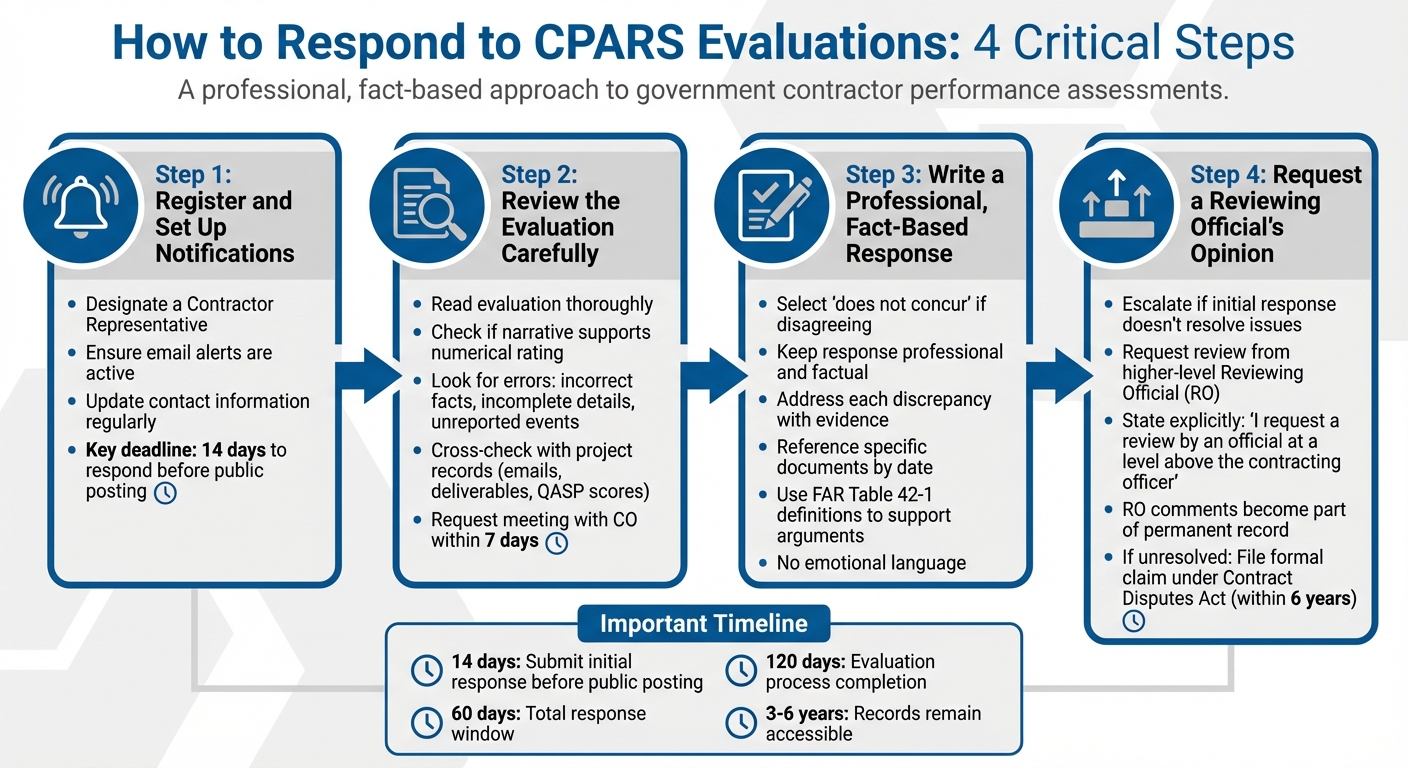
4-Step Process for Responding to CPARS Evaluations
Step 1: Register and Set Up Notifications
Start by designating a Contractor Representative with up-to-date contact details and ensure email alerts are active. The clock starts ticking as soon as you receive a CPARS notification, and you only have 14 days to respond. If the alerts go to someone unavailable or no longer with the company, you could miss this critical window. Make it a habit to update your contact information in CPARS whenever there are personnel changes.
Once notifications are in place, promptly review the evaluation details to avoid delays.
Step 2: Review the Evaluation Carefully
Take the time to read the evaluation thoroughly. Pay close attention to how the narrative supports each numerical rating. According to regulations, the narrative must justify the assigned score. If the comments are vague or don’t match the rating, you have grounds to challenge them.
Look for errors such as incorrect facts, incomplete details, or references to events that never occurred. Cross-check the evaluation with your project records – emails, deliverables, and Quality Assurance Surveillance Plan (QASP) scores are especially useful here. If the government mentions a deficiency that was never brought to your attention during the contract period, document this as a valid reason to dispute the rating.
It’s also a good idea to request a meeting with the Contracting Officer or program office within seven days of receiving the evaluation. This step ensures clarity before drafting your response.
Step 3: Write a Professional, Fact-Based Response
If you disagree with the evaluation, select "does not concur" in the CPARS system. Be cautious – choosing "concur" might imply you accept the evaluation, even if you include critical comments. Keep your response professional and grounded in facts. Avoid emotional language, as a well-reasoned argument is more likely to gain traction with the contracting officer and other reviewers.
Address each discrepancy you identified during your review. Since CPARS doesn’t allow file attachments, summarize your evidence and directly reference specific documents. For instance, you might write: "Refer to Email from CO dated 03/15/2025 confirming government-caused delay". Use the FAR Table 42‑1 definitions to argue your case, particularly if the narrative does not justify the assigned rating. For ratings like "Marginal" or "Unsatisfactory", the government is required to detail significant events and their impact. If they haven’t done so, highlight this omission.
Back up your points with specific documentation and data wherever possible. Stay professional and focused throughout your response.
Step 4: Request a Reviewing Official’s Opinion
If your initial response doesn’t resolve the issues, you can escalate by requesting a review from a higher-level Reviewing Official (RO). The RO provides an impartial perspective and can either modify or affirm the evaluation. While they won’t change the original narrative, their comments become part of the permanent record.
In your written request, explicitly state, "I request a review by an official at a level above the contracting officer". The RO’s input is valuable for future source selection boards and shows that you’ve used every available option to address the evaluation. If the internal review process still doesn’t resolve the matter and the evaluation has a major impact on your business, you have the option to file a formal claim under the Contract Disputes Act within six years.
Managing CPARS Evaluations Effectively
Keep Detailed Documentation
Strong documentation is the backbone of a well-prepared CPARS response. To ensure you’re ready for anything, maintain a thorough record of all project milestones, including emails, deliverables, meeting minutes, and QASP scores. Pay close attention to the six primary CPARS categories: Quality, Schedule, Cost Control, Management, Regulatory Compliance, and Small Business Subcontracting.
It’s not just about tracking your successes – document external challenges too. Whether it’s delays caused by the government, scope changes, or third-party issues, these records can provide important context if your performance metrics are impacted by factors beyond your control. Remember, CPARS reports stay on record for up to six years after the contract ends. Without the ability to attach files to your CPARS response, having a well-organized reference library of documents (cited by date or reference number) is essential for protecting your reputation long after the project wraps up.
By staying on top of documentation, you’ll be better equipped to address any issues that arise during the contract period.
Address Issues During the Contract Period
Proactively managing potential problems during the contract period can save you from headaches later. Engage with evaluators early on to identify any concerns before the evaluation is drafted. As noted by Miller & Chevalier:
A challenge can also be raised if the agency failed to notify the contractor during performance of the deficiency that led to the unfavorable rating.
Keep communication open and professional throughout the project. If issues arise, document them immediately, along with the corrective actions you take. This not only demonstrates proactive management but also helps avoid "Marginal" or "Unsatisfactory" ratings. Toward the end of the contract, schedule meetings with the evaluation team to review findings and clear up any misunderstandings before the report is finalized. A project that resolves issues promptly can still achieve "Exceptional" or "Very Good" ratings.
Once issues are under control, the focus should shift to consistently tracking and improving performance metrics.
Track and Improve Performance Metrics
Start strong by meeting with the COR within the first two weeks of contract award. Use this time to align on what "Exceptional" or "Very Good" performance looks like for your project. These defined metrics will directly shape your CPARS evaluation ratings. To stay on track, implement internal scorecards to measure key data points like on-time delivery rates, defect or rework percentages, response times to government inquiries, and the stability of key personnel.
Regular reviews with the COR are critical. Analyze past CPARS records to spot recurring challenges and adjust your action plan accordingly. For example, if your management ratings consistently hover at "Satisfactory", develop a focused strategy to close that gap. Training Project Managers on the CPARS process is another way to ensure alignment – consider linking part of their performance reviews to the contract’s CPARS results:
An up-front mutual understanding of expectations, followed by consistent communications, can help avoid surprises.
Common Mistakes in CPARS Responses
Avoiding missteps in CPARS responses is crucial for protecting your reputation and securing future contracts. Below, we break down some frequent errors and offer practical advice to help you navigate the process effectively.
Missing the Response Deadline
You have 60 days to submit a final response, but the clock starts ticking long before that. After just 14 days, the evaluation becomes visible to federal source selection officials. Missing this window means any negative ratings are made public, potentially harming your chances for years to come.
"If the contractor fails to respond, the evaluation is automatically posted… and can be viewed by agencies immediately." – Anne Marie Tavella, Attorney, Davis Wright Tremaine LLP
To avoid this, designate someone on your team to monitor CPARS notifications and act quickly. Aim to request a meeting with the agency within the first 7 days of receiving the evaluation. This gives you a chance to present your case before the evaluation is finalized and publicly accessible – an important step, as these records can impact your standing for up to 6 years.
Using Emotional or Defensive Language
Letting emotions drive your response is a common mistake that can backfire. Remember, your rebuttal becomes part of the official record and will be reviewed by future agencies. A defensive or confrontational tone can harm your credibility and relationships with evaluators.
"When submitting comments or rebutting statements, contractors should avoid the urge of going on the attack! It makes more sense to strike an objective and professional tone." – Schoonover Law Firm
Approach the evaluation analytically. Focus on the specific issues raised, whether related to work quality, timeliness, or management. When drafting your response, keep two audiences in mind: the current agency’s Reviewing Official and future Source Selection Officials. Maintain a professional and fact-based tone. As attorney John Mattox notes:
"Facts, coupled with persuasive argument, will garner more points with the contracting officer and the reviewing official." – John Mattox, Attorney, Schoonover & Moriarty LLC
Not Including Supporting Evidence
A strong CPARS response isn’t just about stating your disagreement – it’s about backing it up with evidence. Your rebuttal should clearly demonstrate why the evaluation is inaccurate or unfair. Reference specific contract requirements, use the rating definitions in FAR 42.1503 Table 42-1, and include documented proof.
"A convincing rebuttal should not just voice disagreement, but needs to show that the evaluation is unfair or inaccurate." – Dorn C. McGrath III and Ken M. Kanzawa, Attorneys, American Bar Association
For instance, if you receive an "Unsatisfactory" rating, challenge it by showing the agency failed to meet the FAR standard of citing "multiple significant events". Use precise documentation, such as dates or reference numbers, to support your case. Additionally, check the "does not concur" box to trigger a higher-level review. Skipping this step may result in unintentional agreement with negative ratings, forfeiting your chance for an independent review.
Conclusion
How Effective CPARS Responses Help Your Business
CPARS evaluations are crucial for securing future federal contracts. As Miller & Chevalier points out, "CPARS evaluations can be the difference between winning and losing new contracts, which means contractors should put a premium on making sure their CPARS-entered ratings and narratives are objective and warranted". The importance of these evaluations is underscored by recent trends – in 2024 alone, numerous past performance disputes were brought before the Court of Federal Claims and the Government Accountability Office.
Your response to a CPARS evaluation plays a key role in safeguarding your reputation. These evaluations remain accessible for three to six years, depending on the type of contract. Even if your rating isn’t revised, a well-prepared rebuttal can shape how future evaluators interpret your performance. Acting promptly within the 14-day window ensures your perspective is included before unfavorable ratings are finalized and shared across federal agencies.
Federal contract awards are often decided by fine margins, and CPARS evaluations can tip the scales. As attorneys Dorn C. McGrath III and Ken M. Kanzawa emphasize, "Competitions for federal contracts can be close, and awards can turn on even a single CPARS evaluation". A professional, fact-driven response, crafted using the steps outlined in this guide, ensures your side of the story is represented for future evaluators who might otherwise rely solely on the agency’s account.
If you’ve refined your CPARS response, seeking expert support can further enhance your federal contracting prospects.
How GSA Focus Can Help

Managing CPARS evaluations effectively requires expertise and strict attention to deadlines. GSA Focus offers specialized assistance to small businesses navigating GSA Schedule Contracts and the federal contracting process. With a 98% success rate, they bring years of experience in compliance and contract management. Their team helps businesses stay on top of evaluations, craft timely responses, and maintain a strong performance record.
GSA Focus’s done-for-you approach handles everything – from setting up notifications to documenting performance – so you can focus on growing your business. By protecting your reputation and ensuring your evaluations reflect your capabilities, they help open doors to future contracting opportunities.
FAQs
What should I do first if I get a negative CPARS rating?
If you get a negative CPARS rating, the first step is to carefully review the evaluation details. You have 14 days to respond, so use this time wisely. Submit comments, rebuttals, or any additional information that might correct errors or address specific concerns. Keep your response clear, factual, and focused – this increases the likelihood that your input will be taken seriously during the review process.
How do I cite proof in CPARS if I can’t upload attachments?
If you’re unable to upload attachments in CPARS, make sure your evaluation comments include detailed and objective supporting narratives. Use clear descriptions and back up your performance assessments with factual data or specific observations. Remember, CPARS evaluations depend on thorough, well-documented narratives instead of relying on external files.
When should I request a higher-level CPARS review?
If you think your CPARS evaluation is unfair or doesn’t reflect your performance accurately, it’s important to take action quickly. You usually have 14 days from the notification to request a higher-level review. This gives you a chance to seek informal or formal reconsideration and possibly work toward a revised rating. Acting swiftly increases the likelihood that your concerns will be heard and resolved.
Related Blog Posts
- Ultimate Guide to Marketing with Past Performance
- What Is CPARS in Federal Contracts?
- 5 Tips to Improve CPARS Ratings
- What is GSA Past Performance Evaluation?