
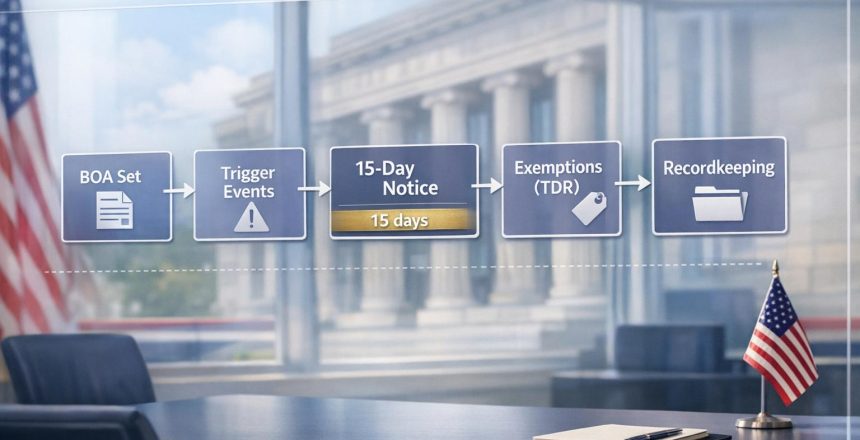
The Price Reductions Clause (PRC) ensures fair pricing in GSA Multiple Award Schedule (MAS) contracts by requiring contractors to match discounts offered to their Basis of Award (BOA) customers. This clause is critical for maintaining compliance and avoiding penalties, such as refunds, contract termination, or suspension. Here’s what you need to know:
- How It Works: If discounts or price changes for BOA customers disrupt the agreed pricing relationship, contractors must extend the same reductions to the government within 15 calendar days.
- Compliance Risks: Violations can lead to retroactive pricing adjustments, fines, or penalties under the False Claims Act.
- Exceptions: Sales to federal agencies, high-volume sales exceeding the maximum order threshold, and administrative errors are exempt. Contractors under Transactional Data Reporting (TDR), mandatory since September 30, 2025, are also exempt from PRC requirements.
- Record-Keeping: Detailed documentation of pricing, discounts, and BOA relationships is essential for audits and compliance.
To stay compliant, define your BOA customer, document pricing relationships, monitor changes, and report reductions promptly. Non-compliance can have serious financial consequences, so maintaining accurate records and timely reporting is key.
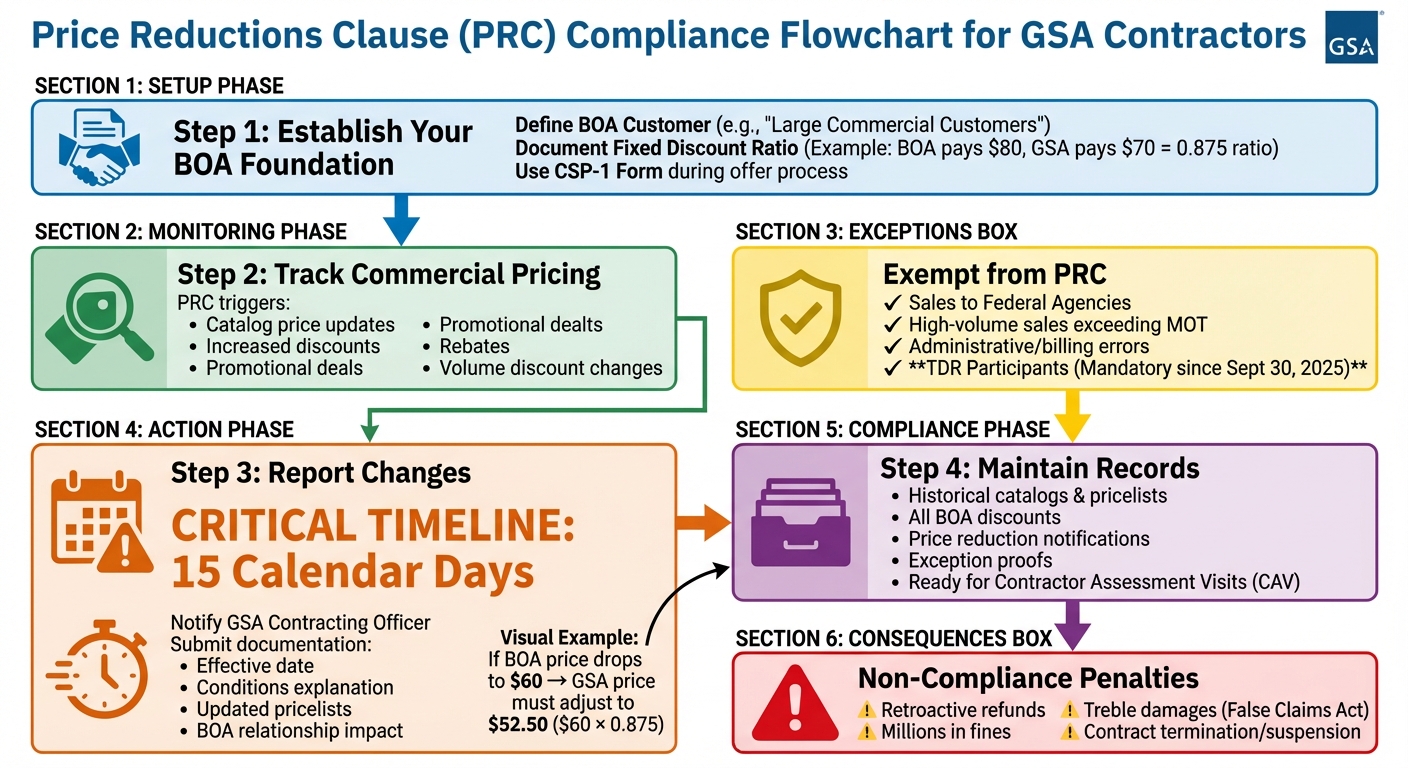
Price Reductions Clause Compliance Process for GSA Contractors
Setting Up the Basis of Award (BOA)
Defining the Basis of Award Customer
Defining your Basis of Award (BOA) is a key step during initial negotiations. Before the contract is awarded, you and the Contracting Officer must agree on this benchmark, which serves as the foundation for pricing decisions.
"Before award of a contract, the Contracting Officer and the Offeror will agree upon the customer (or category of customers) which will be the basis of award, and the Government’s price or discount relationship to the identified customer (or category of customers)."
– GSAM 552.238-81
Typically, contractors opt for a broad customer category – like "Large Commercial Customers" or "Standard Commercial Customers" – rather than pinpointing a single company. This choice is disclosed using the Commercial Sales Practices (CSP-1) form during the offer process. Once selected, your BOA price relationship must be documented to maintain the agreed discount ratio.
Documenting the BOA Price Relationship
After identifying your BOA, the next step is to establish and document the fixed discount relationship between the prices your BOA customer pays and what the government pays. This relationship is expressed as a consistent mathematical ratio that remains unchanged throughout the contract. For example, if your BOA customer pays $80 and the GSA price is $70, the ratio is 0.875 ($70 ÷ $80). If the BOA price later drops to $60, your GSA price must adjust to $52.50 ($60 × 0.875) to maintain the same relationship.
To ensure compliance, keep detailed records, including sales data, BOA contracts, pricing policies, and calculations of the discount ratio. Using a comparison matrix can help you monitor pricing details and spot any potential issues early.
Additionally, integrating your CRM system can streamline this process. By logging BOA discounts and flagging transactions that could disrupt the pricing ratio, you can proactively manage compliance. This approach also helps your commercial sales team stay within established pricing boundaries.
What Triggers the Price Reductions Clause
Common PRC Trigger Scenarios
The Price Reductions Clause (PRC) kicks in when changes affect the discount ratio outlined in your Basis of Award (BOA). These changes can include catalog price updates, increased discounts, promotional deals (like free shipping or extended warranties), undisclosed rebates, temporary price cuts, or modifications to volume discount structures.
"Any change in the Contractor’s commercial pricing or discount arrangement applicable to the identified customer (or category of customers) which disturbs this relationship shall constitute a price reduction."
– GSAM 552.238-81
Even a one-time discount offered to a BOA customer could potentially lower your GSA pricing – whether temporarily or permanently. This highlights the need to educate your commercial sales team about PRC risks. A discount aimed at securing a large commercial account could inadvertently put your federal contract compliance at risk. Keeping a close eye on these scenarios is essential for maintaining the internal controls established during your BOA documentation process. However, there are specific exceptions where pricing changes don’t trigger the clause.
Exceptions to PRC Triggers
Not every commercial price adjustment activates the PRC. Here are the key exceptions:
- Sales to Federal Agencies: These are not subject to PRC requirements, nor are sales to eligible GSA MAS users as defined in GSAR 552.238-113.
- High-Volume Sales: Commercial sales under firm, fixed-price contracts that exceed your contract’s maximum order threshold (MOT) are exempt.
- Administrative Errors: Verifiable billing or quote errors don’t trigger the clause, as long as you can provide clear documentation proving it was an administrative mistake rather than a standard pricing adjustment.
The most notable exception applies to contractors participating in Transactional Data Reporting (TDR). Since September 30, 2025, TDR has been mandatory for all Multiple Award Schedule contractors. As a result, PRC requirements no longer apply to these participants. Instead of tracking BOA relationships, TDR participants submit monthly transactional data, simplifying compliance.
How to Notify the GSA of Price Reductions
Reporting Price Changes within 15 Days
When a price reduction occurs, it’s crucial to act quickly. The clock starts ticking immediately – the General Services Administration (GSA) requires you to notify your assigned GSA Contracting Officer within 15 calendar days of the price reduction’s effective date.
"The Contractor shall notify the Contracting Officer of any price reduction subject to this clause as soon as possible, but not later than 15 calendar days after its effective date."
– GSAR 552.238-81(f)
This 15-day reporting period is tied to the date the reduced pricing becomes effective for your Basis of Award (BOA) customer – not the date you realize the price change or decide to report it. Missing this deadline could lead to retroactive pricing adjustments and refunds. To avoid such issues, consider using automated tracking tools in your CRM to flag BOA discounts as soon as they occur, ensuring you meet the reporting requirement.
Once you’ve notified the GSA within the required timeframe, the next step is to provide thorough and accurate documentation.
Preparing Documentation for Notifications
Timely reporting is only part of the process – your notification to the GSA Contracting Officer must include detailed and precise documentation. Start by specifying the effective date of the price reduction and the period it covers. The government is entitled to the same pricing terms as your commercial customer for the duration of the reduction.
"The Contractor’s report shall include an explanation of the conditions under which the reductions were made."
– GSAR 552.238-81(b)
Your report should also explain the conditions behind the price reduction, including how it affects your BOA relationship and the corresponding GSA price adjustment. To support your notification, include documents like updated commercial catalogs, pricelists, or schedules. If the price change stems from an administrative error, provide evidence to confirm it was a billing mistake rather than a standard pricing adjustment.
After submitting the required information, the GSA will initiate a formal contract modification to reflect the updated pricing. Proper documentation not only ensures compliance but also helps maintain a strong relationship with the GSA.
Maintaining PRC Compliance Records
Tracking Commercial Pricing Changes
To stay compliant with the Price Reductions Clause (PRC), keeping a close eye on commercial pricing is essential. This means maintaining up-to-date and historical versions of all commercial catalogs, pricelists, and market rate sheets. Both current and past pricing documents play a role in ensuring accuracy.
It’s also crucial to systematically document every sale and discount offered to BOA (Basis of Award) customers. This includes special promotions, volume discounts, and any other price adjustments. Pay particular attention to "special" discounts provided to commercial customers, as these could permanently impact the GSA discount if not properly documented as exceptions – such as orders exceeding the maximum order threshold. Collaboration between accounting and sales teams is key to ensuring all GSA-related sales and pricing changes are meticulously recorded.
Additionally, internal pricing policies, discount protocols, and staff training procedures should be thoroughly documented. Regularly reviewing these systems ensures they capture all potential PRC triggers. Having detailed records in place not only simplifies audits but also allows for quick verification during Contractor Assessment Visits.
Retention of Records for Audits
GSA audits, known as Contractor Assessment Visits (CAV), are conducted to verify the value negotiated in your contract. During these assessments, you’ll need to present documentation that supports your BOA relationship, justifies exceptions, and provides notification records. This includes keeping all price reduction notifications alongside corresponding evidence, such as proofs for exempt transactions like billing error corrections, invoices for federal agencies, or firm-fixed-price contracts exceeding the maximum order threshold. Without proper documentation, GSA may reclassify transactions, potentially leading to required price adjustments.
For those transitioning to Transactional Data Reporting (TDR) – mandatory for all Multiple Award Schedule contractors by September 30, 2025 – the focus shifts from BOA tracking to detailed monthly sales data. This means recording critical details like contract numbers, order IDs, part numbers, quantities, and transaction prices. Using automated accounting or ERP systems can help ensure accuracy and reduce the risk of manual errors.
Non-compliance with the PRC can lead to severe consequences, including fines amounting to millions of dollars and treble damages. If a PRC trigger is discovered late, you will be required to refund overcharges retroactively to the date when the reduced pricing was first offered to your BOA customer. Proper record-keeping is your best defense against these costly penalties.
Government Contracting – Understanding the GSA Price Reduction Clause – Win Federal Contracts
Conclusion
Check this list to make sure you’re meeting every PRC requirement.
To comply with the PRC, you need to establish and maintain a steady BOA pricing relationship and pass along any BOA discount to the government within 15 days. Here’s how to stay on track: clearly define your BOA customer, document the pricing ratio, keep an eye on commercial pricing changes, and report any price reductions to your Contracting Officer without delay.
The stakes are high. Violations can lead to millions in refunds, contract termination, or even treble damages under the False Claims Act. The ~$50 billion GSA contract market shows just how serious this can be. Patrick Morgans, Manager at Winvale, puts it plainly:
"If you report GSA sales quarterly, the Price Reductions Clause does apply and can cost your company significantly if you do not comply with it".
Detailed documentation is your best defense during audits. Keep track of every BOA discount and pricing adjustment, and ensure your sales and accounting teams are aligned to capture all changes and maintain historical pricelists.
For contractors using TDR (required starting September 30, 2025), the PRC no longer applies. Instead, monthly transactional data reporting simplifies compliance. Regardless of whether you fall under PRC or TDR, solid documentation and timely reporting are essential. Use this checklist to navigate GSA contract management with confidence.
FAQs
How do I choose the right BOA customer category?
To choose the right BOA (Basis of Award) customer category, focus on identifying the customer or group of customers whose pricing and discounts will act as the standard during contract discussions. This approach helps ensure compliance with the Price Reductions Clause, which mandates that if there are changes in your commercial pricing or discounts, you must inform the government and adjust your prices accordingly.
What counts as a PRC-triggering discount vs an exception?
A PRC-triggering discount refers to any price reduction or improved terms offered to your Basis of Award (BOA) customer that must be reported and might lead to changes in your contract. On the other hand, an exception is a price reduction – whether temporary or permanent – that does not need to be reported or result in contract adjustments.
What proof should I keep for audits and CAVs?
To stay prepared for audits and Contractor Assistance Visits (CAVs), it’s crucial to keep detailed records. This includes sales data, pricing history, and compliance reports. These documents play a key role in showing that you’re meeting the requirements of the Price Reductions Clause and other GSA obligations.
Related Blog Posts
- 5 GSA Discounting Rules for Compliance
- What Is GSA Most Favored Customer Pricing?
- GSA Price Reductions Clause Explained
- How Pricing Impacts GSA Sales Revenue