

If you’re pursuing a GSA Schedule Contract, your product documentation must meet strict compliance standards. Missing requirements or deadlines can lead to delays, lost revenue, or even contract termination. Here’s what you need to know:
- Key Steps: Register on SAM.gov, ensure Trade Agreements Act (TAA) compliance, and provide financial stability documents.
- Required Documents: Letter of Supply (if you’re not the manufacturer), Price Proposal Template (PPT), and supporting pricing documentation.
- Compliance Standards: Adhere to Section 508 accessibility rules, confirm products meet commercial availability standards, and ensure all items align with procurement regulations.
- Platforms: Use tools like the FAS Catalog Platform (FCP), eMod, and Vendor Support Center (VSC) to validate and submit your files.
- Common Pitfalls: Avoid errors like exceeding the 40-character limit for part numbers, offering better discounts to non-government customers, or failing to monitor product origin for TAA compliance.
Quick Overview of Submission Process:
- Gather Key Documents: Ensure all required files are complete and accurate.
- Meet Deadlines: Submit your GSA Advantage! catalog within 30 days of contract award.
- Stay Compliant: Regularly review product sources and maintain $100,000 in MAS sales every five years.
Pro Tip: Follow GSA’s "New Offeror Checklist" to ensure nothing is missed. Proper preparation ensures faster approvals and better visibility on GSA platforms.
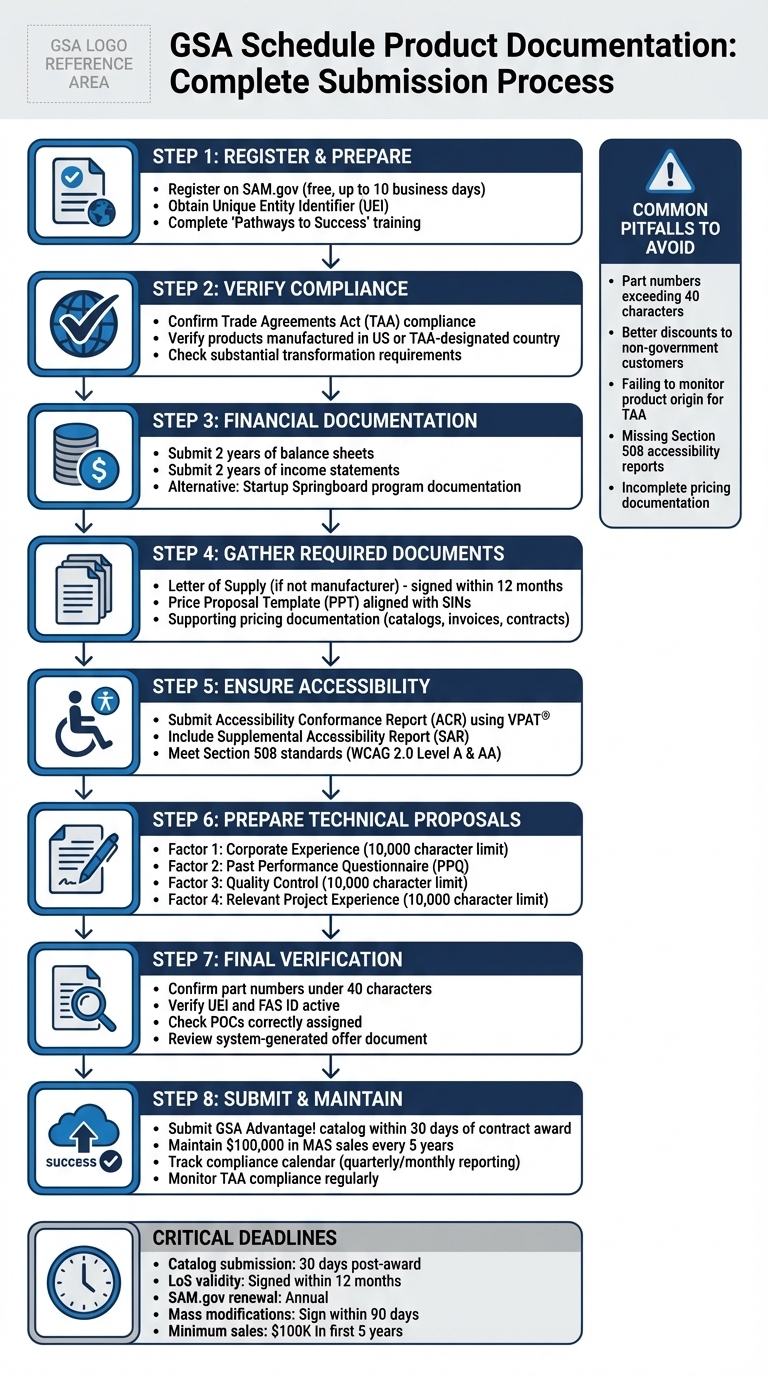
GSA Schedule Product Documentation Submission Process: 8-Step Compliance Checklist
The Product File & Error Remediation in FCP – MAS Vendor Training
Prerequisites for GSA Product Documentation
To participate in the GSA Schedule program and submit compliant product offers, you must complete three key steps: registering on SAM.gov, ensuring Trade Agreements Act (TAA) compliance, and providing financial verification. Here’s a closer look at each requirement.
SAM.gov Registration and System Requirements
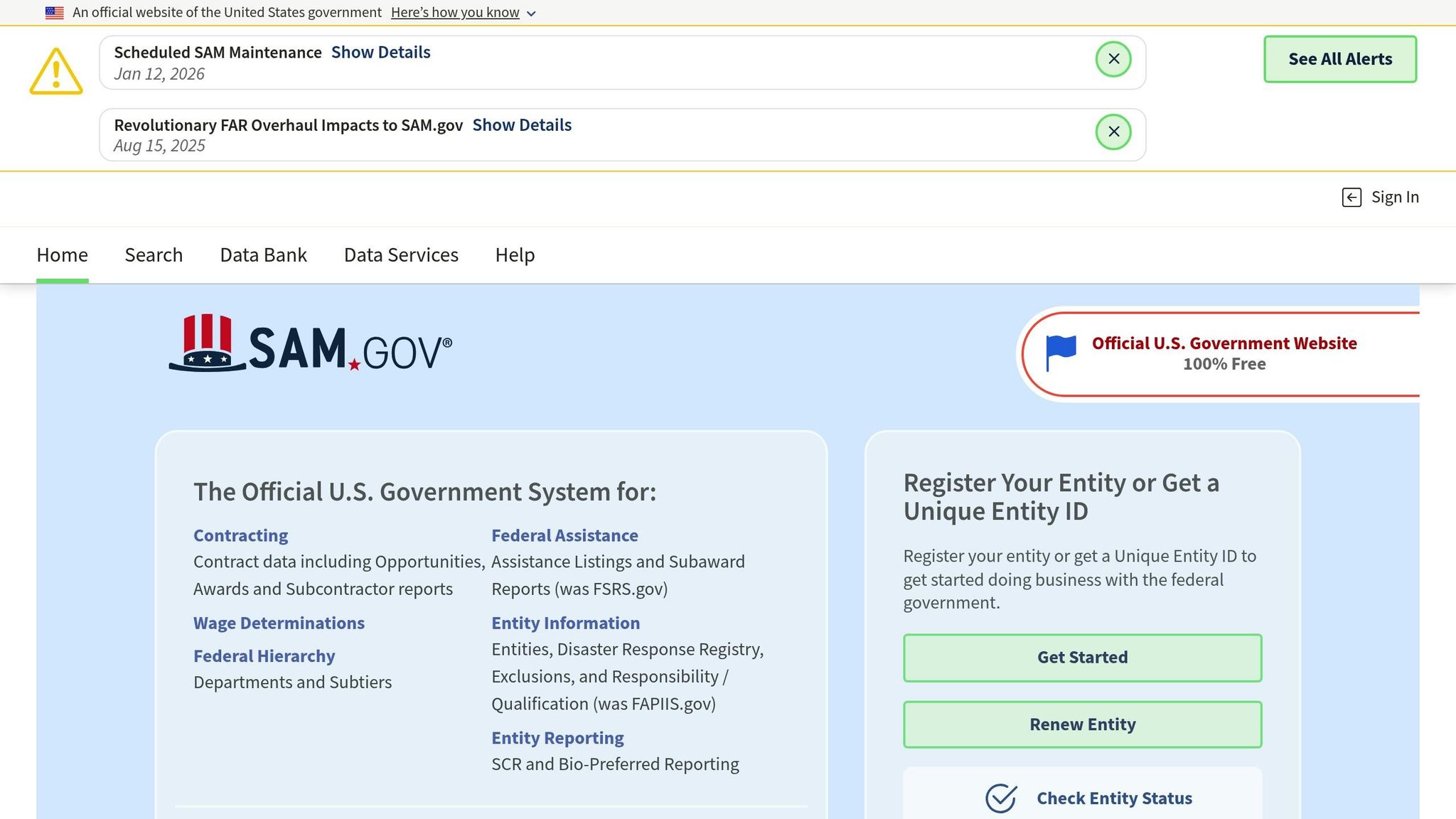
An active SAM.gov registration is essential for accessing GSA eOffer/eMod and submitting proposals. The process is free and begins by creating an account through Login.gov, which provides secure authentication. Before starting, gather your Taxpayer Identification Number (TIN), CAGE/NCAGE codes, NAICS codes, and banking details for Electronic Funds Transfer (EFT). Once registered, you’ll receive a Unique Entity Identifier (UEI), which replaced the DUNS number in April 2022.
The registration process can take up to 10 business days to validate, and it requires annual renewal to maintain eligibility for federal awards. Make sure your designated Points of Contact (POCs) are correctly listed to access your FAS ID. Additionally, complete the mandatory "Pathways to Success" training on the Vendor Support Center to familiarize yourself with GSA-specific offer submission requirements.
Trade Agreements Act (TAA) Compliance Certification
Products listed on a GSA Schedule must be manufactured or substantially transformed in the United States or a TAA-designated country. "Substantial transformation" refers to a product undergoing a significant change, resulting in a new article with a distinct name, character, or use compared to its original components. Verify the manufacturing location of each product against the current list of TAA-designated countries, as outlined in FAR clause 52.225-5.
Financial Statements to Demonstrate Stability
To prove financial stability, you’ll need to submit two years of balance sheets and income statements. If you’re a new company, you might still qualify under the Startup Springboard program. In this case, you can provide alternative documentation, such as credit reports or detailed information about the management team’s experience and the expertise of key professionals.
Required Documents for GSA Product Offers
Now that you’ve handled registration, TAA compliance, and financial documentation, it’s time to focus on gathering the essential documents needed to back up your product offer. These materials confirm your authority to sell specific products, outline your pricing structure, and demonstrate that your prices are fair and reasonable.
Letter of Supply
If you’re not the manufacturer, you’ll need a Letter of Supply (LoS) from each authorized supplier. This document confirms your authorization to distribute specific products under your GSA Schedule. The LoS must follow the GSA’s required template (Attachment 2), be printed on the supplier’s official letterhead, and include signatures from both your company and the supplier. Additionally, it must be signed and dated within 12 months of your submission date.
Before requesting a LoS, check if the manufacturer is registered in the Verified Products Portal (VPP). If they are, you won’t need an individual LoS. For manufacturers not listed in the VPP, provide two copies of the LoS for each one.
Price Proposal Template (PPT)
The Price Proposal Template (PPT) is crucial for structuring your product pricing and aligning it with your Special Item Numbers (SINs). Standard templates include the FCP Product File and the FCP Services Plus File. However, some SINs may require a specialized version. Use the SIN look-up table to confirm if your SIN needs a unique template instead of the standard ones. Be sure to include accurate data to validate your proposed pricing.
Supporting Pricing Documentation
To justify your prices as fair and reasonable, you’ll need to provide supporting documents. These can include published catalogs, price lists, commercial invoices, existing contracts, or quote sheets. Clearly label each document to match it with the corresponding product. Additionally, include two printed and dated copies of your current price list or catalog. If your proposed pricing differs from what you offer your most-favored customer, include a written explanation detailing the reasons for the difference.
For resellers, submit any commercial supplier agreements or End User License Agreements (EULAs) in an editable format. Ensure these documents have non-compliant federal clauses removed and include manufacturer approval signatures.
GSA Product Compliance Standards
Once you’ve gathered the necessary documents, the next step is ensuring your products meet federal compliance standards. This is a crucial requirement for finalizing your GSA product offer. Your products must comply with guidelines for accessibility, commercial availability, and procurement regulations.
Section 508 Accessibility Standards
Every piece of Information and Communication Technology (ICT) sold through GSA must be accessible to individuals with physical, sensory, or cognitive disabilities. This includes everything from software and hardware to digital content like PDFs and websites. The Revised 508 Standards align with WCAG 2.0 Level A and AA as their technical benchmarks.
To prove compliance, you’ll need to submit an Accessibility Conformance Report (ACR) using the latest VPAT® provided by ITIC. Additionally, include a Supplemental Accessibility Report (SAR) that outlines testing methods, accessibility features, and installation instructions for off-the-shelf products.
“Section 508 requirements should be included from the beginning of the ICT procurement lifecycle process and continue through the development and testing lifecycle processes.” – Section508.gov
If your product doesn’t fully meet these standards, you’ll need to document how it compares to market alternatives and describe alternative ways for users to access the information. It’s also important to re-test your products after updates to ensure continued compliance.
Once accessibility standards are addressed, focus on meeting commercial availability and regulatory requirements.
Full Product Offerings Requirement
In addition to compliance documentation, your product lineup must be commercially viable. This means offering a range of products that align with your awarded SINs and are available to the general public at established catalog or market prices. GSA does not permit contracts for custom or non-commercial items.
Keep your GSA catalog up to date with approved product changes. To maintain your Schedule, you must generate at least $100,000 in GSA Multiple Award Schedule (MAS) sales within the first five years and every subsequent five-year period.
Ensure your offerings exclude products from prohibited foreign entities or non-compliant manufacturers. All items must meet Trade Agreements Act (TAA) standards. Regularly review product origins, as manufacturers may relocate production, potentially making a previously compliant product non-compliant.
Best Practices for Preparing GSA Product Documents
Getting your GSA product documents in order is crucial for avoiding delays and ensuring a smooth submission process. The key is knowing which documents are required and catching potential errors before they cause problems.
Organizing Required vs. Optional Documents
Once you’ve gathered your documents, the next step is sorting them into mandatory and optional categories. The type of catalog offering you need depends on your SIN (Special Item Number): Product File, Services Plus File, or the legacy PPT. Start by registering with the GSA Vendor Support Center (VSC) – trying to log into FCP or eBuy without this step will lead to system errors. Preparing your Product Files and Terms & Conditions in parallel can save time while waiting for Seller Profile approval.
Here’s a quick breakdown of required and optional documents:
| Document Name | Mandatory for Products | Supporting Evidence Needed |
|---|---|---|
| Seller Profile | Yes | Order requirements and point-of-contact details |
| Product File | Yes | Manufacturer part numbers and names |
| Terms & Conditions (T&C) File | Yes | Contract terms (pricing excluded if using Product File) |
| Universal Product Codes (UPC) | Yes (when available) | Manufacturer-provided UPC data |
| IPv6 Compliance Statement | Yes (for IT products) | Proof of IPv4/IPv6 network capability |
| Product Photos | Optional | ZIP file with filenames matching the Product File |
| Product Samples | Optional | Needed only for "or equal" offers at the CO’s discretion |
While photos are optional, they’re highly recommended. GSA Advantage allows customers to filter results to show only products with images. If you include photos, submit them in a ZIP file and ensure the filenames match the references in your Product File exactly. Keep in mind that electronic catalog files must be submitted to GSA Advantage no later than 30 days after your contract is awarded.
Avoiding Common Compliance Mistakes
Once your documents are organized, focus on avoiding common compliance errors. For instance, manufacturer part numbers should not exceed 40 characters. Double-check these before uploading – any mistakes will require deleting and re-adding the part numbers.
Pricing compliance is another area where contractors often stumble. Offering better discounts to a "Basis of Award" customer without extending the same to the government violates the Price Reduction Clause. To stay compliant, track GSA sales separately from your commercial sales and ensure the correct IFF (Industrial Funding Fee) payments of 0.75% of MAS sales.
"Many contractors only start thinking seriously about compliance after something goes wrong. A late report, a pricing question on an awarded contract that violates the Price Reduction Clause, or an unexpected audit notice is often what brings compliance into focus." – Michael Perch, CEO, Road Map Consulting
Staying compliant with the Trade Agreements Act (TAA) is equally critical. All products must be manufactured or "substantially transformed" in the U.S. or a designated country. Regularly monitor your product sources to ensure ongoing TAA compliance.
"Some companies may not keep a close eye on whether a product or its component has a manufacturer change and that can get them in trouble. We suggest you have a system in place to routinely monitor this." – Daniel Lopez, Lead Consultant, Winvale
Other key compliance tips include:
- Report only GSA contract-related sales; including open market items can lead to IFF overpayments.
- Use a compliance calendar to track reporting deadlines (quarterly or monthly), SAM.gov renewal dates (annually), and contract anniversaries.
- Sign mass modifications within 90 days of receipt.
- Maintain at least $100,000 in MAS sales within the first five years to avoid contract cancellation.
Final Submission Checklist for GSA Documents
Before submitting your offer package, double-check that all components are accurate and complete. The eOffer platform generates your final contract document upon submission, and errors at this stage can lead to delays or even require a resubmission. To avoid these issues, download the official "New Offeror Checklist" (XLSX) from GSA and use the category-specific tabs to confirm you’ve included all required documents. Afterward, review your technical proposals and supporting documents to finalize your submission.
Technical Proposals and Past Performance
Your technical proposal must address four distinct factors. For Factors One (Corporate Experience), Three (Quality Control), and Four (Relevant Project Experience), you’ll need to create narratives directly in eOffer. Each narrative has a 10,000-character limit, so drafting these in a word processor first can help you stay within the limit. Keep in mind that GSA does not review separately uploaded documents for these factors.
For Factor Two (Past Performance), you must attach a completed Past Performance Questionnaire (PPQ). If your customer reference plans to submit the PPQ directly to the GSA Contracting Officer, include a letter in your submission stating that this request has been made. Accuracy and thoroughness in this section are critical to ensuring your submission is successful.
Once your technical narratives are complete, double-check that your pricing documentation complies with all requirements.
Verification of Pricelists and Supporting Documents
Your Price Proposal Template must be backed by documentation that validates each line item. Clearly label each pricing document to correspond with the relevant product, making it easier for the Contracting Officer to verify pricing accuracy. Additionally, confirm that your SAM.gov registration is active with a valid UEI and that your FAS ID is enabled for multi-factor authentication. Failure to meet these requirements could result in your submission being rejected. Also, ensure that the individual submitting the offer is listed as a Government Business POC, Electronic Business POC, or Past Performance POC.
| Verification Step | Action Required |
|---|---|
| Administrative | Confirm UEI (SAM) is active and POCs are correctly assigned |
| Training | Complete "Pathways to Success" and "Readiness Assessment" |
| Technical/Pricing | Upload pricelists and all required artifacts per the MAS solicitation |
| Final Review | Check the system-generated offer document for accuracy |
| Authentication | Verify FAS ID is active for multi-factor authentication |
Conclusion
Creating GSA-compliant product documents requires careful attention to detail and strict adherence to guidelines. Failing to meet these standards can lead to hefty penalties and payment delays, which no business wants to face. Considering that GSA Schedules can last up to 20 years, staying compliant isn’t just a one-time task – it’s an ongoing responsibility that protects both your contract and your company’s reputation. With over a million customers visiting GSA Advantage! each week, having accurate and well-prepared product listings is key to maintaining visibility and driving sales.
To ensure your submission is flawless, review every piece of documentation thoroughly. This includes everything from registration details to technical narratives. Your package should feature essential components like a fully completed Letter of Supply, a validated Price Proposal Template, supporting pricing documents, and technical narratives that align with evaluation criteria. Missing or incorrect documentation can result in delays or even audits by the GSA Office of Inspector General.
For businesses looking to simplify this process, GSA Focus offers expert assistance tailored to small businesses. They provide a full-service solution, managing everything from document preparation to compliance checks and negotiation support. To stay ahead, consider integrating compliance into your regular operations by conducting internal audits, maintaining a compliance calendar for key deadlines, and tracking GSA sales separately from your commercial ones. These steps can help position your business for long-term success in the federal marketplace.
FAQs
What is the Trade Agreements Act (TAA) and why does it matter for GSA compliance?
The Trade Agreements Act (TAA), established in 1979, plays a key role in regulating the products purchased by the U.S. government. Its main purpose? Ensuring that these products are either made in the United States or come from countries with approved trade agreements. But what does it mean for a product to be TAA-compliant? Here’s the breakdown:
- It must be fully manufactured in the U.S. or in a designated TAA-approved country.
- Alternatively, it can be substantially transformed in the U.S. or an approved country into a new product with a distinct name, character, or purpose.
Why TAA Compliance Matters
For businesses working under GSA Schedule contracts, TAA compliance isn’t optional – it’s essential. Products that don’t meet TAA standards cannot be listed on GSA Advantage or sold through these contracts. Non-compliance can lead to serious consequences, such as:
- Termination of contracts
- Financial penalties
- Potential legal investigations
To steer clear of these risks, businesses must maintain meticulous supply chain records and regularly verify the origin of their products.
Help for Small Businesses
Navigating TAA requirements can feel overwhelming, especially for smaller companies. That’s where GSA Focus comes in. They offer tailored support, including assistance with TAA documentation and ongoing compliance monitoring. By simplifying the process, GSA Focus helps businesses stay compliant and focus on their growth.
How can I make sure my products comply with Section 508 accessibility standards?
To make sure your products meet Section 508 accessibility standards, start by following the official guidelines for creating accessible documents. Use resources like authoring and testing checklists to assess Word and PDF files. Incorporate universal design principles to ensure your content works for everyone, regardless of ability. Pay special attention to making documents easy to navigate, compatible with screen readers, and accessible to individuals with disabilities. Staying up-to-date with changes to Section 508 standards is also key to maintaining compliance.
What mistakes should I avoid when preparing GSA product documents?
When putting together GSA product documents, steering clear of common pitfalls can save both time and frustration. Some frequent errors include leaving out required forms, miscalculating or improperly formatting price lists, and submitting incomplete or inconsistent product descriptions that don’t align with GSA standards. Contractors also often run into trouble by providing outdated company information, incorrect SAM registration details, or files in unsupported formats, such as anything other than PDFs or Excel files.
Another area where mistakes happen is in meeting GSA-specific requirements. For instance, product titles need to be clear, at least three words long, and under 40 characters. Additionally, high-quality product photos are crucial for many SINs to reduce buyer confusion. Ignoring the latest GSA amendments or submitting incomplete subcontracting plans can also lead to delays in the approval process.
To make things easier and avoid these roadblocks, enlisting the help of experts like GSA Focus can be a smart move. They can assist in ensuring your documentation is accurate, compliant, and ready to go on the first try.
Related Blog Posts
- GSA Proposal Formatting Checklist
- Ultimate Guide to GSA Proposal Documents
- Checklist for GSA Construction Contract Compliance
- Top GSA Certification Requirements Explained