
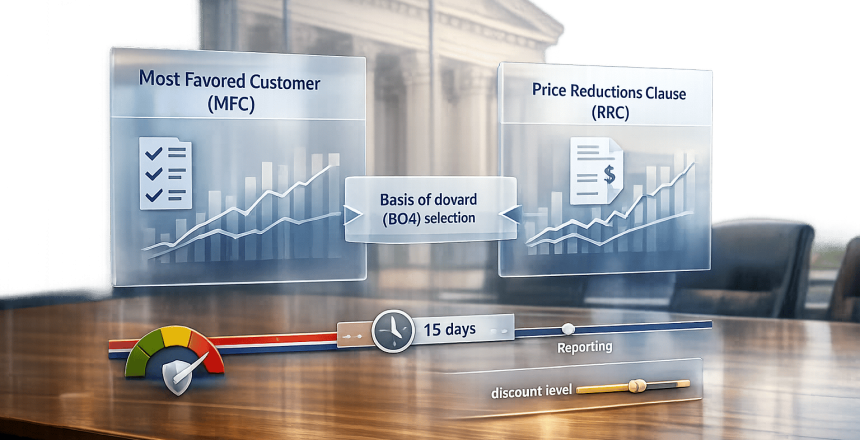
The Most Favored Customer (MFC) and Price Reductions Clause (PRC) are two critical pricing rules for businesses selling to the federal government through GSA Schedule contracts. The MFC clause ensures the government receives pricing equal to or better than your best commercial customer, while the PRC enforces this pricing relationship throughout the contract term.
Key Takeaways:
- MFC Clause: Sets the initial pricing by requiring disclosure of your best commercial discounts. The government uses this to secure competitive rates.
- PRC Clause: Maintains fairness by mandating price adjustments if better discounts are offered to your designated Basis of Award (BOA) customer.
- Compliance Risks: Non-compliance can result in penalties, refunds, or legal action under the False Claims Act.
- Best Practices: Monitor BOA pricing, notify GSA of changes within 15 days, and train teams to avoid unintentional violations.
Understanding and managing these clauses is essential to avoid costly compliance issues while maintaining competitive pricing. For businesses navigating federal contracts, staying informed and organized is key.
What is the Most Favored Customer (MFC) Clause?
Definition and Purpose
The Most Favored Customer (MFC) Clause is a pricing rule designed to ensure the federal government gets pricing that’s just as good as – or better than – what you offer your top commercial clients. According to the General Services Administration Acquisition Manual (GSAM) 538.270(a), "The Government will seek to obtain the offeror’s best price (the best price given to the most favored customer)".
Here’s how it works: if you give your lowest prices to certain commercial customers, you’re obligated to extend the same pricing to the government. To make this happen, vendors must disclose their best discounts across various customer categories, such as dealers, distributors, educational institutions, state and local governments, OEMs, and end users. This transparency allows the GSA to confirm that government pricing remains competitive.
Unlike the private sector, where discounts often come with strings attached – like minimum purchase commitments or multi-year contracts – the MFC clause bypasses those conditions. The government gets access to your best pricing without guaranteeing any specific purchase volume or long-term agreements. This distinction sets the stage for how the clause impacts pricing and compliance, particularly when identifying your Basis of Award (BOA) customer.
Identifying the Basis of Award Customer
To comply with the MFC clause, it’s crucial to identify your Basis of Award (BOA) customer. This customer category serves as the benchmark for your government pricing and plays a key role in your compliance with the Price Reductions Clause.
During GSA Schedule negotiations, contracting officers will work with you to determine this BOA customer. Typically, the GSA advocates for the customer category receiving your largest discounts – such as OEMs or wholesalers – to serve as the BOA. However, many vendors aim to designate end users as their BOA, as this group more closely reflects the way the government procures goods: purchasing finished products directly rather than in bulk for resale.
As Christopher Griesedieck, Jr. and Dismas Locaria from Venable LLP explain, "Usually, GSA’s goal is for the company’s MFC to be the BOA (i.e., MAS customers receiving pricing that is the same as or better than that received by the company’s customer(s) that receives its best pricing)". The choice of BOA customer directly impacts your pricing strategy and compliance workload, making it a critical decision during contract negotiations. Whether the BOA is based on OEMs, wholesalers, or end users, this designation shapes your pricing flexibility and obligations throughout the contract.
What is the Price Reductions Clause (PRC)?
Definition and Enforcement
The Price Reductions Clause (PRC), identified as GSAR 552.238-75, is the enforcement tool for the Most Favored Customer (MFC) clause. While the MFC clause determines your initial pricing at the time of the contract award, the PRC ensures that this pricing advantage remains intact throughout the contract’s duration.
Here’s how it works: the PRC requires you to maintain a specific discount relationship – the percentage difference between the price you offer the government and the price you give your Basis of Award (BOA) customer. If you lower prices for your BOA customer after the contract is awarded, you must also reduce your GSA contract price by the same percentage. For instance, if your BOA customer gets a 2% price reduction, you’re obligated to modify your GSA pricing by 2% as well to maintain the agreed discount structure.
As Kevin Lancaster, CEO of Winvale, puts it:
"The PRC requires GSA contractors to disclose any changes to discounting policies to Basis of Award (BOA) customers…"
However, the PRC doesn’t apply to all sales. It excludes transactions that exceed your contract’s maximum order threshold, direct sales to other federal agencies, or temporary discounts lasting 30 days or more – provided those discounts are also extended to the GSA.
Non-compliance with the PRC can lead to hefty penalties. A notable example occurred in 2000 when Gateway, Inc. paid $9 million to settle allegations of failing to provide required price reductions between 1994 and 1997. Under the False Claims Act, the government can recover up to three times the damages incurred, plus penalties of up to $10,000 per claim for intentional violations.
To enforce these rules, the PRC includes strict notification timelines for pricing adjustments.
Notification Requirements
The PRC requires contractors to act quickly: you must notify your GSA Contracting Officer and submit a price reduction modification within 15 calendar days of offering a better discount to your BOA customer. This means any change in your commercial pricing triggers an immediate obligation to inform the GSA.
Carl Dickson, Founder of CapturePlanning.com, explains:
"The PRC states that if you violate the contractually agreed upon pricing/discount relationship by offering a (better) discount to your MFC, you have invoked the PRC. This means from the date that the violation took place, you will owe the government a discount proportionately equal to that given the MFC".
Compliance is closely monitored through Contractor Assistance Visits (CAVs) and audits by the Office of Inspector General (OIG). If unreported price reductions are discovered, the government will demand retroactive refunds for the difference, along with possible civil and criminal penalties. To avoid such risks, it’s essential to designate staff for tracking sales, implement pre-sale review processes, and ensure smooth communication between your commercial sales and GSA contract management teams.
Government Contracting – Understanding the GSA Price Reduction Clause – Win Federal Contracts
Key Differences Between MFC and PRC
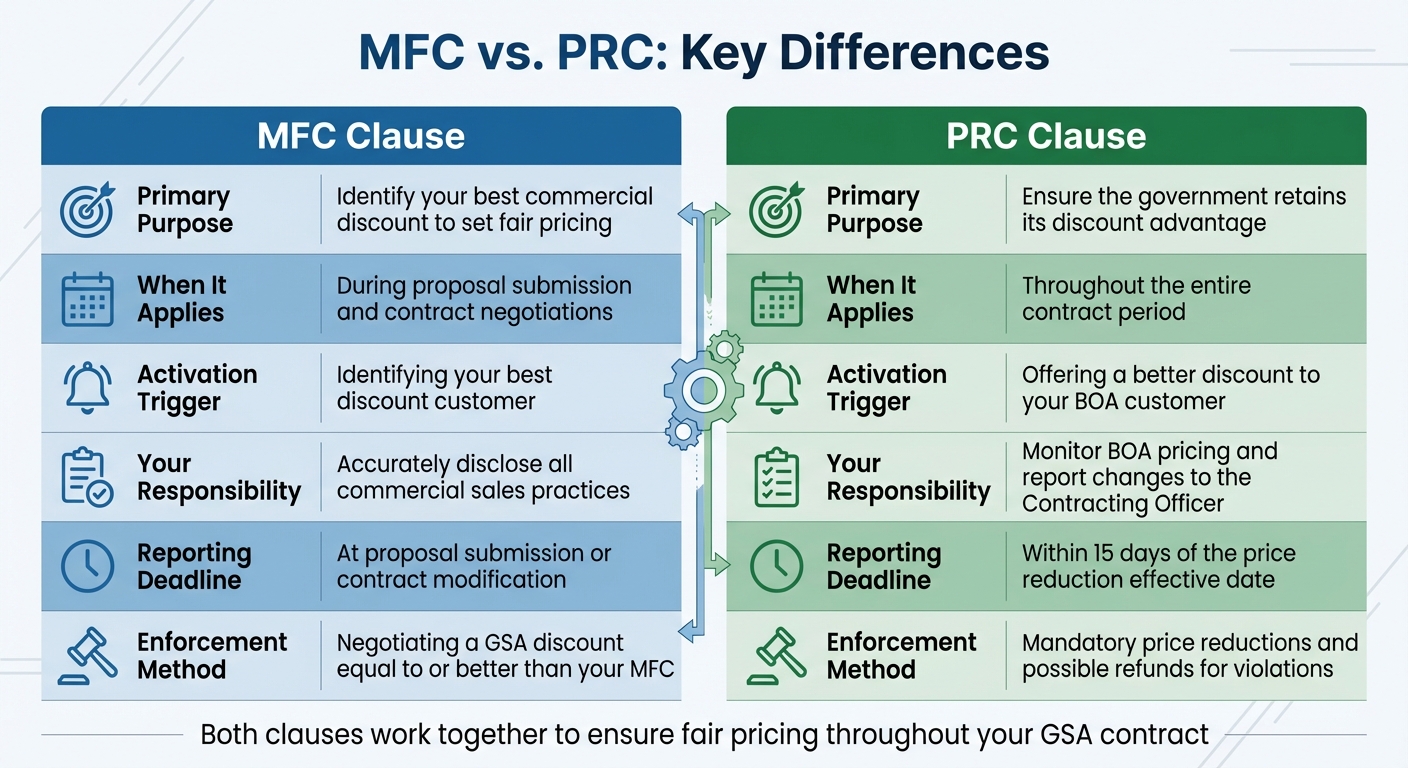
MFC vs PRC Clause Comparison for GSA Contracts
The Most Favored Customer (MFC) clause and the Price Reductions Clause (PRC) may seem closely related, but they serve distinct purposes in managing pricing compliance under your GSA contract. Here’s a closer look at how they differ and why both are critical.
The MFC clause comes into play during contract negotiations. It requires you to disclose your commercial sales practices and identify your Basis of Award (BOA) customer. This helps establish your initial pricing by ensuring it aligns with your best commercial discount. On the other hand, the PRC governs pricing after the contract is awarded. It ensures that if you offer a better discount to your BOA customer, you must extend the same benefit to the government within 15 days.
Another key difference lies in timing. The MFC is a one-time requirement during the proposal and negotiation phase, while the PRC requires ongoing monitoring and compliance throughout the life of the contract.
Comparison Table
| Feature | Most Favored Customer (MFC) | Price Reductions Clause (PRC) |
|---|---|---|
| Primary Purpose | Identify your best commercial discount to set fair pricing | Ensure the government retains its discount advantage |
| When It Applies | During proposal submission and contract negotiations | Throughout the entire contract period |
| Activation Trigger | Identifying your best discount customer | Offering a better discount to your BOA customer |
| Your Responsibility | Accurately disclose all commercial sales practices | Monitor BOA pricing and report changes to the Contracting Officer |
| Reporting Deadline | At proposal submission or contract modification | Within 15 days of the price reduction effective date |
| Enforcement Method | Negotiating a GSA discount equal to or better than your MFC | Mandatory price reductions and possible refunds for violations |
These differences highlight the unique roles of the MFC and PRC in pricing compliance. Together, they ensure fair pricing during negotiations and maintain that fairness throughout the contract term. By understanding these distinctions, contractors can better navigate their compliance responsibilities.
How MFC and PRC Work Together in GSA Contracts
How the Clauses Interact
These two clauses function as a team to ensure competitive pricing stays intact throughout the duration of your contract.
When negotiating a contract, the Most Favored Customer (MFC) clause requires vendors to reveal their commercial discounting practices across various customer types – like OEMs, dealers, and end users. The government uses this data to secure a discount that matches or surpasses the discount given to the designated Basis of Award (BOA) customer. This creates a "discount delta", which is the percentage difference between the BOA customer’s discount and the government’s discount.
Once the contract is active, the Price Reductions Clause (PRC) ensures this discount delta is upheld. For instance, if your BOA customer’s discount increases by 2%, you are required to lower the government’s price by the same 2% within 15 days. Kevin Lancaster, CEO of Winvale, explains:
"According to the PRC, a discount delta is established between the BOA customer and GSA. This discount delta must be maintained at all times, so if the prices that you offer to your BOA customer decrease by 2%, you will need to submit a price reduction modification within 15 days to decrease your GSA offered prices by 2%."
This dynamic underscores the importance of maintaining vigilant pricing practices to stay compliant.
Why Vendors Need to Understand Both Clauses
For vendors, fully understanding these clauses is not just about compliance – it’s about avoiding significant risks. Missteps can lead to severe consequences, including mandatory price reductions on future GSA orders, government refund demands, penalties, or even liability under the False Claims Act. As Christopher Griesedieck, Jr. and Dismas Locaria from Venable LLP explain:
"A single salesperson’s decision to provide a one-time discount to the commercial BOA customer or customers could arguably trigger millions of dollars in price reductions on future MAS orders."
This makes it crucial for your sales, accounting, and contract teams to understand how commercial discounting decisions directly impact your GSA contract responsibilities. Without this knowledge, even minor errors could snowball into costly compliance issues that outweigh the benefits of a single sale.
Compliance Requirements and Best Practices
To maintain compliance after implementing the pricing adjustments mentioned earlier, businesses must focus on rigorous internal controls and consistent monitoring.
Monitoring and Documentation
Designate specific team members to oversee commercial pricing and ensure compliance with the Most Favored Customer (MFC) and Price Reductions Clause (PRC) requirements. Kevin Lancaster, CEO of Winvale, underscores the importance of this step:
"It is critical for GSA contractors to dedicate specific personnel that are tasked with monitoring the sales and marketing of the products and services that are offered on the GSA Schedule".
Monitor BOA (Basis of Award) customer sales closely before granting final approval to avoid PRC violations. If a BOA price reduction occurs, notify your Contracting Officer (CO) within 15 days. This notification is mandatory whether you’re revising a commercial catalog, offering unreported discounts, or providing better terms than previously disclosed. Missing this deadline can lead to severe repercussions. Lancaster warns:
"If GSA discovers that there have been violations to the PRC, they reserve the right to demand refunds on behalf of the federal government".
Keep meticulous records of commercial sales, discount structures, and CO communications to prepare for audits. These documents are vital for defending your compliance during Contractor Assistance Visits (CAVs) or Office of Inspector General (OIG) audits. Carl Dickson, Founder of CapturePlanning.com, highlights the risks of inaccurate data:
"Should you be audited and the government finds that the data they have relied upon to negotiate a price with you is inaccurate, you will be subject to civil and possibly criminal penalties, such as large fines and jail sentences".
These practices form the backbone of a strong compliance framework.
Internal Controls and Training
Implementing clear discount thresholds is critical to avoiding PRC triggers. Formal policies should outline the specific discount levels that staff can authorize independently. Without these guidelines, even a minor unauthorized discount could lead to mandatory price reductions across your entire GSA contract.
Education across departments is equally important. Sales, accounting, and contracts teams need to understand how their actions influence GSA compliance. Providing them with up-to-date BOA pricing details and defined discount parameters ensures they can make informed decisions in real time. Regular training sessions should focus on spotting PRC triggers, such as catalog updates, special discounts, or improved terms offered to BOA customers.
Centralizing all CO communications through a designated point of contact is another essential step. This approach ensures consistency, reduces the risk of missed notifications, and prevents conflicting information from being shared. Unified training and centralized approval processes further strengthen your pricing controls.
Finally, conducting proactive internal audits is a smart way to identify potential issues before they escalate. Regularly reviewing sales data allows you to catch any overlooked price reductions, a critical step since GSA’s Industrial Operations Analysts are skilled at spotting discrepancies during their evaluations.
Impact of MFC and PRC on Pricing Strategies
Common Challenges for Vendors
The Most Favored Customer (MFC) and Price Reductions Clause (PRC) policies create a pricing floor that significantly impacts how vendors navigate their commercial markets. One major hurdle is the price compression these clauses impose on non-government customers. Carl Dickson, Founder of CapturePlanning.com, highlights this issue:
"This GSA policy is inflationary for the commercial, state, and local government market. We have seen many instances in which vendors would have offered other customers a better price except for the price reductions clause."
The automatic notification requirement tied to any discount offered to the Basis of Award (BOA) customer discourages vendors from extending competitive pricing to commercial clients. This cautious approach not only shrinks profit margins but also limits market competitiveness. State and local governments, which lack similar protections, often feel the ripple effects. Vendors are forced to walk a fine line between staying competitive and managing compliance risks, leading to necessary adjustments in their pricing strategies.
Another challenge lies in the differences between commercial and GSA contracts. Commercial agreements often include perks like advance payments, multi-year commitments, and volume guarantees. In contrast, GSA contracts typically feature 30-day or fiscal year termination clauses, 20-day Prompt Payment Discounts (PPD), and no guarantees regarding business volume.
Pricing Strategy Considerations
To tackle these challenges, vendors must rethink their pricing strategies. A key step is selecting a BOA customer that mirrors government purchasing habits. This usually means focusing on "end users" rather than distributors or Original Equipment Manufacturers (OEMs) that secure steeper discounts. By doing so, vendors can reduce the likelihood of triggering compliance issues tied to mandatory price reductions.
Another tactic is leveraging exemptions to maintain competitive pricing in commercial markets. For instance, sales that exceed the contract’s maximum order threshold are exempt from PRC requirements. This exemption provides a useful buffer for protecting profit margins. Vendors can also offer temporary discounts – lasting at least 30 days – to both the MFC and the government, aligning discount periods to avoid violating the discount differential. Additionally, targeting customer groups outside the designated BOA with aggressive pricing can help maintain competitiveness without triggering compliance concerns.
Given the administrative challenges these clauses create, implementing pre-approval controls is critical. By closely monitoring all orders to BOA customers and comparing them with GSA prices, vendors can avoid unintentional violations that could result in refunds, fines, or even legal penalties. Notably, direct sales to federal agencies or to state and local governments participating in cooperative programs do not activate the PRC.
Conclusion
When it comes to federal pricing, the Most Favored Customer (MFC) and Price Reductions Clause (PRC) work together as a powerful framework. The MFC clause sets the pricing standard during negotiations, while the PRC ensures that pricing remains fair and consistent throughout the contract’s duration.
"The most favored customer (MFC) and price reductions clause (PRC) operate jointly – seldom will you see the MFC clause without the PRC, and the PRC has no meaning without the MFC clause." – Carl Dickson, Founder, CapturePlanning.com
Understanding these clauses isn’t just a best practice – it’s essential to avoid costly consequences. Non-compliance can lead to mandatory refunds, audits by the Office of Inspector General (OIG), and even civil or criminal penalties.
These rules not only promote fair pricing but also influence how businesses shape their pricing strategies. Staying compliant requires a team that knows the ins and outs of these clauses, strong internal controls, and a clear understanding of any exemptions that might apply.
For companies looking to tap into federal contracting opportunities without the headache of navigating compliance alone, GSA Focus (https://gsascheduleservices.com) offers expert help. From document preparation to compliance management and negotiation support, they handle the heavy lifting so you can focus on growing your business.
FAQs
How do I choose the right BOA customer?
When choosing the appropriate Best Offer Agreement (BOA) customer, aim for a category that aligns closely with your commercial customer base. Prioritize those offering the largest discounts, such as Original Equipment Manufacturers (OEMs) or end users. This selection is crucial because it affects your Most Favored Customer (MFC) clause. The MFC clause ensures that the government receives prices equal to or better than those offered to your best commercial customer. Always ensure compliance with GSA regulations while staying competitive in your pricing strategy.
What discounts actually trigger the PRC?
When it comes to discounts, those that activate the Price Reductions Clause (PRC) are tied to the deals you offer your largest commercial customer. The GSA (General Services Administration) mandates that you keep an eye on your commercial pricing. If those rates change, you’re required to adjust your GSA pricing accordingly. This ensures the government consistently gets pricing that’s as good as – or better than – what you offer to your top commercial client.
What records should I keep for PRC audits?
To stay on top of compliance, it’s crucial to maintain detailed transactional sales records. This includes documenting prices, quantities, and customer details for every transaction. Why is this so important? As TDR requirements become mandatory and PRC obligations are gradually phased out, having accurate and complete records will make audits smoother and ensure you’re meeting all regulatory expectations. Plus, these records are invaluable for effective contract management, giving you a clear picture when you need it most.
Related Blog Posts
- GSA Price Reasonableness vs. Most Favored Customer Pricing
- What Is GSA Most Favored Customer Pricing?
- GSA Price Reductions Clause Explained
- Price Reductions Clause: Key Rules for Contractors