
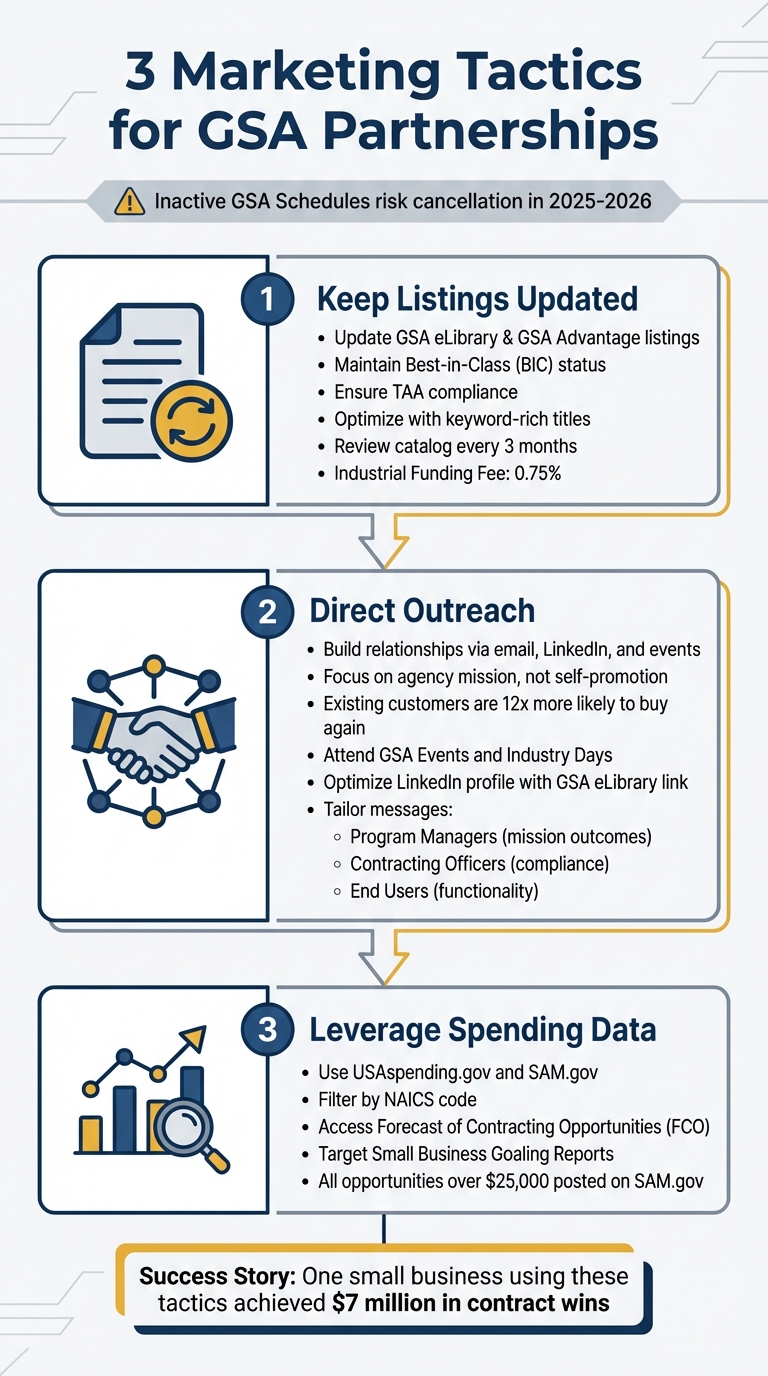
Securing a GSA Schedule is just the beginning – you need an active marketing strategy to make it work. Federal buyers value GSA contractors for their pre-vetted pricing and reliability, but without visibility, your schedule may underperform or risk cancellation. Here’s a quick overview of three key tactics to maximize your GSA partnerships:
- Keep Listings Updated: Regularly update your GSA eLibrary and GSA Advantage listings to improve visibility and trust. Ensure accurate product details, pricing, and compliance with government standards.
- Direct Outreach: Build relationships with government buyers through personalized emails, LinkedIn connections, and federal contracting events. Focus on understanding agency missions and providing tailored solutions.
- Leverage Spending Data: Use tools like USAspending.gov and SAM.gov to identify agencies actively purchasing your products or services. Target agencies with unmet small business goals for better opportunities.
3 Essential Marketing Tactics for GSA Schedule Success
Marketing your GSA Schedule
1. Keep Your GSA eLibrary and GSA Advantage Listings Current
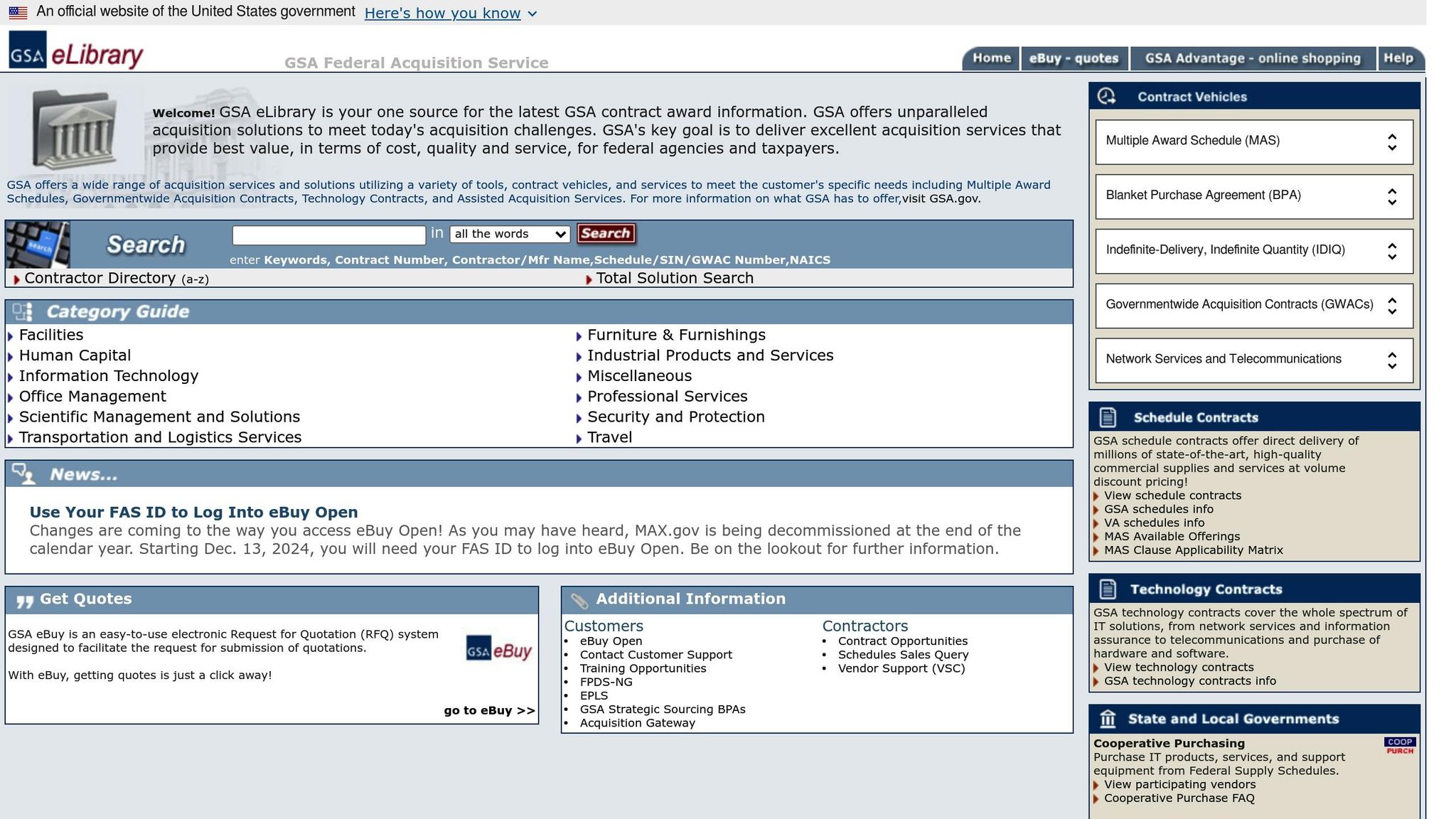
GSA Advantage is the go-to online shopping and ordering platform for federal buyers, offering access to thousands of contractors and millions of products and services. If your listings are outdated, federal buyers may not find your offerings, which could hurt your visibility and credibility in the marketplace.
Keeping your listings up to date is essential for maintaining Best-in-Class (BIC) status. This designation highlights the best pricing, terms, and conditions in the federal market. Additionally, staying compliant with the Trade Agreements Act (TAA) – which requires products to be manufactured or substantially transformed in the U.S. or a TAA-approved country – makes it easier for buyers to trust and choose your solutions.
Accurate legal and DBA (Doing Business As) names are equally important. The GSA eLibrary uses alphabetical indexing as a key discovery method. If your legal or DBA name is outdated or incorrectly formatted, potential buyers might not find you in the A–Z directory. Updating both names ensures buyers can locate your listing under either.
An effective listing goes beyond just being accurate – it should also be optimized. Include keyword-rich titles that feature the brand name, model number, and primary function. Add detailed, government-specific technical descriptions (noting TAA compliance) and high-quality images (minimum 500×500 pixels on a white background). To stay ahead, review your GSA Advantage catalog every three months to update pricing, remove discontinued items, and fix broken links. Use the eMod system to add new products or adjust prices promptly, as delays can make your listings invisible to buyers.
Regular updates not only improve your visibility but also enhance federal procurement processes by providing better transactional data for analyzing buying trends. With a 0.75% Industrial Funding Fee (IFF), keeping your listings current is a small but impactful investment in your success within the federal marketplace.
2. Build Direct Outreach to Government Buyers
Securing a GSA Schedule is just the first step – it doesn’t guarantee buyers will come knocking. In federal sales, relationships are everything. Building trust through direct outreach – whether via email, LinkedIn, or in-person events – is key to landing Blanket Purchase Agreements (BPAs) and fostering repeat business.
When it comes to email, focus on the agency’s mission, not self-promotion. Instead of boasting about awards, ask questions that resonate with their objectives, like, "What’s changed in your mission this year?" Including a link to your GSA eLibrary page in your email signature can add instant credibility. Research shows that existing customers are 12 times more likely to buy from you again than new prospects, making follow-up emails to past buyers a smart move.
Face-to-face interactions can take your outreach to the next level. Federal contracting events are excellent opportunities to connect with program managers and contracting officers. Regularly check resources like the GSA Events and Training page and GSA Interact for Industry Days and training sessions. Beyond the typical conferences, look for informal federal contracting events where you can meet federal employees and contractors in a more relaxed setting.
LinkedIn is another powerful tool when used strategically. Start by optimizing your profile – add a shortened URL linking directly to your GSA eLibrary page in your bio and "Featured" section. Connect with program managers, end users, and contracting officers in your NAICS codes or Special Item Numbers (SINs). Share insights that align with their needs to reinforce your outreach efforts. Judy Bradt, CEO of Summit Insight, emphasizes:
"Position your messages around serving, not selling. Ask questions or open conversations like: ‘What’s changed in your mission this year?’"
When reaching out to new contacts, back up your claims with metrics. For example, mention specific results like, "Reduced error rates by 43% over the legacy provider" or "Staff onboarded in 5 days or less." Tailor your message to the recipient: Program Managers care about mission outcomes, Contracting Officers prioritize compliance, and End Users focus on product functionality. Finally, join LinkedIn groups and NCMA chapters where federal buyers are active to make your outreach even more effective.
3. Use Government Spending Data to Find Opportunities
Having a GSA Schedule and building strong relationships are essential, but incorporating a data-driven strategy takes your marketing efforts to the next level. Government spending data can help you zero in on specific federal agencies – and even individual offices – that are already purchasing the kinds of products or services you offer. Instead of casting a wide net across the entire federal government, you can focus your outreach on the segments most likely to need what you provide.
Platforms like USAspending.gov and the Federal Contracts Summary make this process easier. These tools allow you to filter spending by NAICS code, helping you identify which bureaus are active in your industry. By downloading and analyzing CSV files, you can uncover spending patterns and pinpoint your best prospects for future contracts. This kind of data analysis also sets the stage for predicting upcoming procurement needs.
For early insights into future opportunities, the Forecast of Contracting Opportunities (FCO) tool on the Acquisition Gateway is invaluable. This tool lets you filter forecasts by agency, NAICS code, and estimated award date to find contracts that match your business capabilities. It’s particularly useful for identifying opportunities reserved for small businesses, including 8(a), HUBZone, SDVOSB, and WOSB set-asides.
Another valuable resource is the Small Business Goaling Reports on SAM.gov. These reports highlight agencies that are falling short of their small business spending goals. By cross-referencing this information with historical spending data, you can prioritize agencies that not only have unmet goals but also the budget to act on them.
Don’t forget that all federal contracting opportunities valued at over $25,000 are posted on SAM.gov. By integrating data from multiple sources, you can build a complete picture of the market. This allows you to fine-tune your outreach strategy and craft targeted messages for the right contracting officers and program managers at the right time.
At GSA Focus, we specialize in turning complex government data into actionable strategies, helping small businesses seize every federal contracting opportunity available.
Conclusion
Turning your GSA Schedule into a steady revenue source requires a thoughtful marketing approach. The three strategies discussed here work together to shift your GSA partnership from being just a credential to becoming a proactive tool for growth. Keeping your GSA eLibrary and GSA Advantage listings up-to-date sets up your official federal storefront, boosting your credibility with government buyers. From there, direct outreach builds on that credibility, opening doors to relationships before bid notifications even go live. And by leveraging government spending data, you can ensure your efforts are laser-focused on the right agencies at the right time, with messaging that aligns with their procurement priorities.
These strategies don’t just enhance visibility – they safeguard your contract’s future. As Judy Bradt, CEO of Summit Insight, warns:
"If you’re not actively marketing your GSA Schedule – if you’re not showing up, building visibility, and driving demand – you’re not just leaving money on the table. You might be at risk of losing your contract altogether".
With the GSA tightening its grip on underperforming contracts in 2025 and 2026, proactive marketing is no longer optional – it’s essential. These approaches deliver real results. For instance, one small business that adopted a relationship-first "serve, don’t sell" mindset landed $7 million in contract wins by focusing on understanding client needs instead of simply chasing bid alerts.
Federal contracting is a competitive arena, and many GSA Schedule holders overlook these core marketing practices. By consistently applying all three strategies, you can carve out a competitive edge and transform your GSA Schedule into a reliable federal revenue stream. With integrated and strategic marketing, your GSA Schedule evolves from a mere credential into a powerful business engine.
GSA Focus specializes in helping small businesses secure GSA Schedule contracts and craft targeted marketing strategies.
FAQs
How often should I update my GSA eLibrary and GSA Advantage listings to stay compliant and competitive?
It’s a good practice to refresh your GSA eLibrary and GSA Advantage listings every quarter. Keeping your listings updated ensures your pricing remains correct, your keywords stay relevant, and your information aligns with the latest regulations.
By staying on top of updates, you not only maintain compliance but also boost your chances of standing out to federal buyers, keeping your offerings competitive and easy to find.
What are the best ways to build strong connections with government buyers?
Building strong relationships with government buyers requires preparation and thoughtful outreach. Start by ensuring your business is registered on SAM.gov, holds the required certifications, and has a detailed capability statement tailored to the specific needs of the agency you’re targeting. This statement should emphasize your past successes and what makes your business stand out. From there, connect with potential buyers through targeted emails, phone calls, LinkedIn, or by attending events like industry days or GSA matchmaking sessions. These interactions are your chance to introduce your solutions and demonstrate how well you understand their mission.
After making that initial connection, focus on nurturing the relationship. Stay in touch by following up after meetings, sharing relevant updates or success stories, and addressing any questions or concerns promptly. Building trust is key. Expanding your network within the agency – such as connecting with program managers or contracting officers – can further solidify your position. Additionally, keeping your GSA Advantage profile updated and maintaining open, consistent communication can help establish your business as a dependable partner, paving the way for future opportunities.
How can I use government spending data to identify the right agencies for my business?
Analyzing government spending data can direct your attention to agencies already purchasing the type of products or services you provide. A great starting point is USAspending.gov, which offers detailed breakdowns of spending by agency, fiscal year, and product-service codes (PSCs). Focus on agencies that show consistently high or increasing spending within your PSC or NAICS category – these are prime candidates that may benefit from a GSA Schedule contractor.
You can dig deeper using tools like the GSA Schedule Sales Query (SSQ+) or federal procurement data available on SAM.gov. These platforms allow you to identify specific contracts, dollar values, and buying offices. Narrowing your search to contracts worth $10,000 or more can reveal active procurement patterns, helping you prioritize agencies based on total expenditures, frequency of awards, and upcoming contract expiration dates.
Armed with this information, you can craft a focused marketing strategy. Adjust your capability statement to align with the agency’s goals, connect with procurement officers, and set pricing that reflects historical trends. If navigating this process seems daunting, working with specialists can simplify the analysis, ensure compliance, and assist with contract negotiations.
Related Blog Posts
- 5 Tips for GSA Advantage Sales Success
- How to Market a GSA Schedule Effectively
- How to Promote GSA Contracts to Agencies
- 5 GSA Marketing Mistakes to Avoid