

Federal contracts aren’t just about submitting bids – they’re about building trust. Over 50% of government contracts receive only 1-3 bids because agencies prefer vendors they know. Relationships with decision-makers can help you:
- Gain early insights into agency needs before public solicitations.
- Tailor proposals to agency priorities, aligning with performance-based contracting trends.
- Build trust through consistent engagement, improving your chances of winning contracts.
Winning contractors engage early, attend industry events, and connect with Small Business Specialists, Program Managers, and prime contractors. By focusing on trust, consistent performance, and ethical conduct, you position your business as a reliable partner in the federal marketplace.
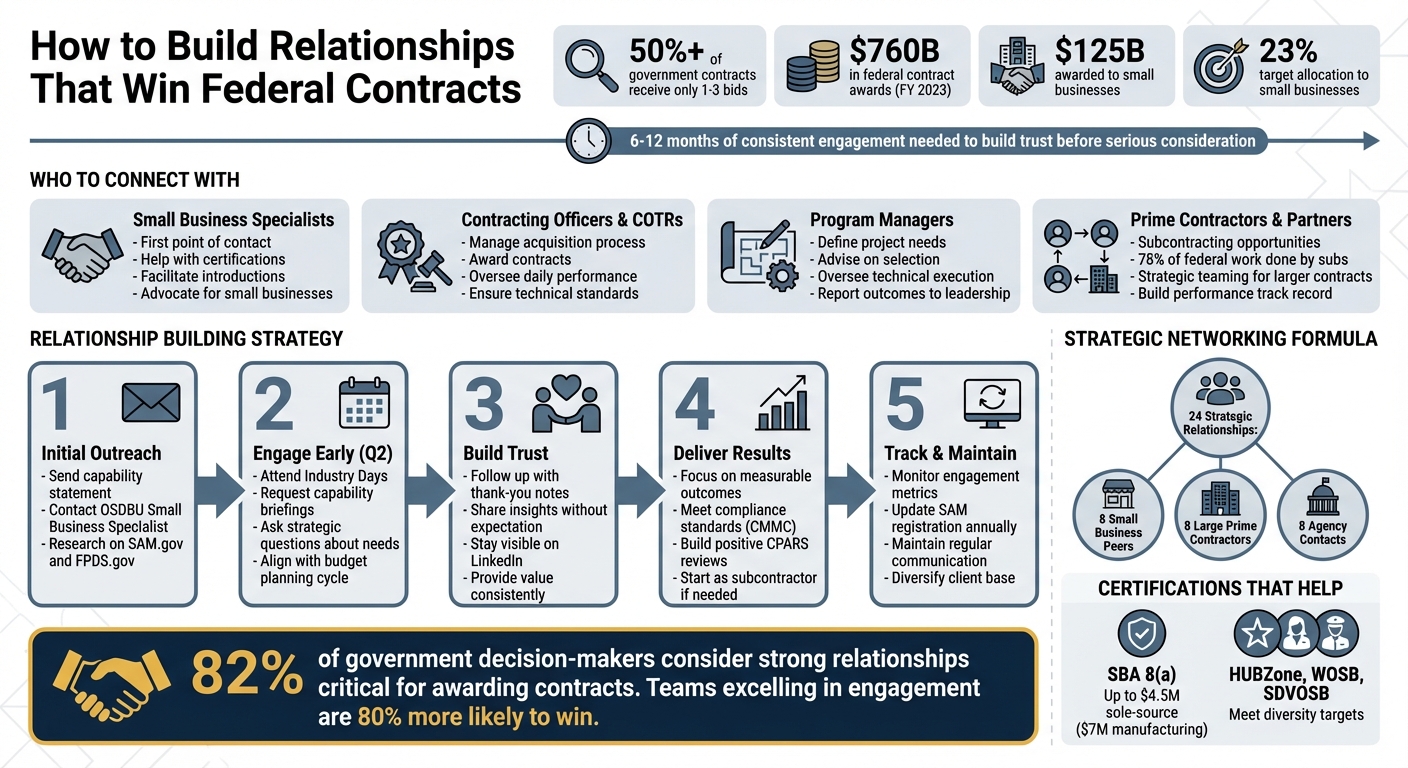
Federal Contracting Relationship Building Strategy: Key Stakeholders and Action Steps
Win More Federal Contracts Through ‘Strategic’ Relationships
How Relationships Impact Federal Procurement
Building strong relationships with federal agencies can give you more than just an introduction – it can reshape how you access vital information, craft tailored proposals, and establish yourself as a trusted partner.
One of the biggest advantages is gaining early insight into agency needs before they become public solicitations. When you’ve earned the trust of program and technical staff, you’re often in the loop early, allowing you to align your capabilities with what the agency truly needs. This kind of early positioning is crucial, especially now, as bid protests are on the rise and agencies are focusing on more defensible solicitations. Let’s dive into how relationships can also redefine your market research.
Using Relationships for Better Market Research
The best market intelligence often doesn’t come from online databases or reports – it comes from conversations. Program and technical staff frequently shape their requirements based on vendors they trust and have seen deliver results. These informal discussions can uncover insights that no amount of desk research can match.
"The leverage point is almost always before a solicitation is posted, with the program or technical staff shaping the requirement." – USFCR
By maintaining strong connections, you can create informal feedback loops that allow you to test your solutions early. This feedback helps you refine your approach before investing time and resources into proposals that may not align with the agency’s needs.
It’s worth focusing your relationship-building efforts on program and technical staff rather than solely on Contracting Officers, who are bound by strict procurement rules. Additionally, working with Small Business Specialists at the Office of Small and Disadvantaged Business Utilization (OSDBU) can help you identify key decision-makers and determine if the agency is meeting its contracting goals.
During these conversations, ask strategic questions about purchase frequency, typical quantities, past pricing, and future needs. Tools like FPDS.gov and USAspending.gov can also provide insights into current contract holders and their performance, giving you a clearer picture of where you might have an edge.
These insights directly translate into more targeted, agency-specific proposals.
Writing Better Proposals Through Agency Connections
When you have strong relationships with agency staff, you can create proposals that address their priorities head-on. Agency officials often structure procurement processes to meet legal requirements while incorporating criteria that favor vendors they know and trust. Understanding the agency’s internal hierarchy – like differentiating between political influencers and civil servants – can also give you an edge in predicting contract awards.
Instead of proposing a fixed number of Full-Time Equivalents (FTEs), focus on delivering measurable outcomes that solve specific agency challenges. For example, rather than staffing up, suggest ways to reduce processing times or streamline workflows. This aligns with the trend toward performance-based contracting, where agencies prioritize results over labor hours.
Here’s a real-world example:
At a Department of Defense Logistics Center, a contractor reimagined the workflow instead of hiring 47 new staff. By deploying only 18 specialists to address critical bottlenecks and redesigning processes, the backlog was cleared in four months. This approach reduced costs by 35% and cut processing times in half.
Similarly, at a Veterans Affairs Regional Office (2024–2025), a strategic partner redesigned the intake process after the office lost 40% of its benefits counselors. Rather than replacing all 40 roles, they deployed specialists to key areas, increasing claims processing speed by 25%, reducing staff needs by 25%, and improving veteran satisfaction scores.
Timing also plays a critical role. Engaging with agencies during Q2, when budgets and procurement plans are being assessed, positions you as a top contender when agencies rush to allocate funds in Q4. Contractors who establish relationships during this planning phase often remain top-of-mind when opportunities arise.
This approach doesn’t just lead to better proposals – it builds trust for the long haul.
Establishing Trust and Credibility
Government buyers prefer to work with low-risk, familiar partners. It often takes 6 to 12 months of consistent engagement to build the trust needed for serious consideration. As Gallium puts it, “Nothing feels safer than working with someone they already know”.
"Work only advances at the speed of trust." – Laura Blumenthal, A1M Solutions
Trust not only reassures agency officials about your ability to deliver but also helps resolve potential disputes without resorting to costly litigation. For instance, during the COVID-19 pandemic, 21 out of 31 social service providers under the UK Government’s £70 million Life Chances Fund adapted their services and payment terms with minimal paperwork, thanks to trust-based relationships.
Consistent performance builds your reputation as a reliable contractor. This can lead to agencies seeking your input on new policies or upcoming requirements. Stay top-of-mind by maintaining regular communication, whether through follow-ups, debriefs, or even simple thank-you notes summarizing key takeaways from meetings.
This ongoing engagement lays the foundation for deeper relationships and ensures you’re among the first considered for non-public opportunities. Strong trust and credibility can transform transactional relationships into collaborative partnerships, setting the stage for broader strategies discussed in the next section.
Who to Connect With in Federal Contracting
Building the right connections is essential for success in federal contracting. The federal procurement process involves various stakeholders, each with a specific role. To thrive, you need to understand these roles and focus your outreach efforts strategically. Every connection you make strengthens your network, improves your proposals, and gives you a competitive edge.
Contracting Officers and Acquisition Teams
Contracting Officers (COs) are the key players in federal procurement. They manage the entire acquisition process, from issuing solicitations to negotiating terms and awarding contracts. While they have significant decision-making authority, their actions are guided by strict procurement rules.
"Contracting officers are the middleman between businesses and government agencies, holding the authority to award and manage contracts." – SelectGCR
To stand out, tailor your proposals to meet both the technical and administrative requirements that COs prioritize. Don’t overlook the Contracting Officers’ Technical Representatives (COTRs). These individuals oversee daily contractor performance and ensure deliverables meet the agency’s technical standards. Establishing a strong relationship with COTRs can streamline project execution and lead to long-term success.
"COTRs serve as the primary point of contact between the contractor and the contracting agency, making their role critical in the day-to-day management of contracts." – Dr. Rafael Marrero, CEO, Rafael Marrero & Company
Before reaching out, research the agency’s procurement history on SAM.gov. This will help you craft pitches that are both relevant and targeted. Additionally, agency Small Business Offices can be valuable allies, especially if your business aligns with federal diversity goals.
Agency Small Business Offices
Small Business Specialists within federal agencies are tasked with ensuring that small businesses get their share of federal contracts. The government aims to allocate at least 23% of contracting dollars to small businesses. These specialists advocate for small and minority-owned businesses, guiding them through certifications and helping identify contracts with set-asides.
They often recommend qualified small businesses to Contracting Officers and facilitate introductions to other decision-makers. Certifications like HUBZone, WOSB, or 8(a) can make your business more appealing by helping agencies meet their diversity targets. For example, the SBA 8(a) program provides access to sole-source contracts worth up to $4.5 million (or $7 million for manufacturing).
"Liaisons act as advocates for small businesses within government agencies… and may recommend small businesses to contracting officers based on their capabilities and performance." – SelectGCR
Attending Industry Days and small business conferences hosted by agencies is a great way to connect with these specialists and increase your visibility.
Program Managers and End Users
Program Managers (PMs) play a vital role in shaping project outcomes. These technical leaders define challenges, outline project needs, and advise Contracting Officers during the selection process. They also oversee day-to-day technical execution and have the authority to recommend re-scoping, extending, or even canceling projects based on performance.
"The PM advises the contracting officer in selecting and negotiating contractual agreements and milestones." – ARPA-H
Building trust with PMs is crucial. When your solutions align with their project goals, you position yourself as a reliable partner. Agencies like ARPA-H often rotate Program Managers every three to six years, so maintaining relationships with new PMs is an ongoing effort. Use data-driven metrics to demonstrate your progress, as PMs are responsible for reporting program outcomes to agency leadership.
Other Contractors and Partners
Strategic partnerships with prime contractors and peers can significantly boost your growth. Large prime contractors often look for small business partners to meet subcontracting requirements or provide specialized expertise. Starting as a subcontractor allows you to build a track record of performance and trust.
"Being on the ground [through subcontracting] builds trust faster than any cold call." – USFCR
A balanced approach to networking can be highly effective. One strategy suggests maintaining 24 strategic relationships: 8 small business peers, 8 large prime contractors, and 8 agency contacts. Partnering with other small businesses can also open doors to more set-aside opportunities.
"If you’re competing against larger contractors with deeper resources, your advantage is focus and relationships, not scale." – Neil McDonnell, President, GovCon Chamber of Commerce
To stay visible, register on supplier portals for major primes like Lockheed Martin, Northrop Grumman, and Boeing, and keep your profiles updated. The SBA’s SubNet database is another valuable resource for connecting with prime contractors seeking subcontractors. Always have a polished, one-page capability statement ready, including your UEI, CAGE code, NAICS codes, and key differentiators, to share with potential partners.
How to Build and Maintain Federal Relationships
Establishing connections with federal stakeholders takes dedication and consistent effort. It’s not a quick process – successful contractors often spend 6–12 months building trust before submitting their first bid. The journey typically begins with the Small Business Specialist in the agency’s Office of Small and Disadvantaged Business Utilization (OSDBU). This individual acts as the gatekeeper for new vendors, making them your first and most important point of contact.
"Existing connections or warm introductions drive early wins." – Gallium Solutions
Before reaching out, you should send a capability statement that clearly explains how your business can address a specific need within the agency. If your contact hasn’t reviewed it before your meeting, make sure to resend it afterward. Use your conversations to ask insightful, data-driven questions about purchasing habits, typical order sizes, and future needs – this helps you tailor your approach to their requirements. When scheduling meetings, aim for professional settings like agency offices or video calls rather than informal locations, which may undermine credibility. Additionally, LinkedIn has become a valuable tool for connecting with government officials. By engaging with their posts and sending personalized, value-focused messages, you can open doors without coming across as overly sales-driven.
The following sections dive into practical strategies for engaging at events, maintaining regular contact, and building a strong reputation.
Attending Industry Events and Conferences
Industry Days and matchmaking events hosted by federal agencies are excellent opportunities to meet Contracting Officers, Program Managers, and Small Business Specialists. These events, often listed on SAM.gov, are designed to connect agencies with potential vendors and discuss upcoming procurement plans. They also allow you to request capability briefings, where you can showcase how your business addresses specific agency challenges. Attending presentations by agency leaders is another effective way to stay informed about shifting priorities and budget changes.
Face-to-face interactions at these events are invaluable. They build trust and credibility far more effectively than an email or cold call, giving you the chance to demonstrate your expertise and commitment in a direct, personal way.
Staying in Touch and Following Up
Keeping your agency contacts engaged between solicitations is essential. After any meeting, send a thank-you note that also summarizes key takeaways from your discussion. Before reaching out again, research the contact’s LinkedIn activity or recent program updates to show you’ve done your homework. This small step can go a long way in building rapport.
For established relationships, asynchronous communication – like LinkedIn messages – offers a quick and informal way to stay on their radar. Meanwhile, SAM.gov can help you identify key decision-makers, such as Contracting Officers or Small Business Specialists, who have previously purchased services similar to yours. To stay informed about their needs, monitor agency websites, read consultation documents, and follow their social media channels.
Your ultimate goal is to become a trusted resource – someone they think of first when a need arises. Consistently sharing helpful insights without expecting anything in return can solidify this perception. And don’t forget to update your SAM registration annually to ensure you remain eligible for opportunities.
"Work only advances at the speed of trust." – Laura Blumenthal, A1M Solutions
Strong relationships are built on consistent follow-through, but performance is what cements them – a topic we’ll explore next.
Building Your Reputation Through Performance
Once you’ve developed relationships, delivering results becomes the foundation of lasting partnerships. In federal contracting, your reputation hinges on reliability and measurable outcomes. Agencies are increasingly favoring performance-based agreements, where achieving specific metrics matters more than simply logging hours. Completing projects on time and within budget not only builds trust but also earns you positive reviews in the Contractor Performance Assessment Reporting System (CPARS), which is critical for winning future contracts.
Starting as a subcontractor for a prime contractor is a smart way to build your "Past Performance" record – arguably the most important asset for securing prime contracts down the line.
"Being on the ground [through subcontracting] builds trust faster than any cold call." – USFCR
To maintain strong relationships, keep agency stakeholders informed with regular updates and proactive communication. Suggesting ways to improve processes or introducing new efficiencies demonstrates your commitment to their mission. Meeting compliance standards, such as the Cybersecurity Maturity Model Certification (CMMC), is also crucial for maintaining your status as a trusted vendor.
Federal program managers are naturally risk-averse, so showing a track record of consistent, measurable results is the most effective way to influence their decisions and position yourself as a preferred partner.
Using Subcontracting and Teaming to Build Relationships
Jumping into federal contracting can feel like a daunting task, especially if you’re waiting to build up the credentials and experience needed to bid as a prime contractor. But there’s a faster way in – partnerships. By forming strategic alliances, you can gain federal experience and expand your network within the government contracting world, opening doors to future opportunities.
The federal government has set an ambitious goal: awarding 23% of prime contract dollars to small businesses. On top of that, large prime contractors handling contracts above certain thresholds are required to include small business subcontracting plans. This built-in demand makes subcontracting and teaming excellent ways to break into the market. Here’s how you can get started.
Starting as a Subcontractor
Subcontracting is a great way to dip your toes into federal contracting while building a track record with government agencies. Did you know that subcontractors handle roughly 78% of all federal work? That statistic alone shows how vital this pathway is.
To start, register in supplier portals of major prime contractors like Lockheed Martin, Northrop Grumman, or Boeing. These platforms connect small businesses with primes actively seeking partners. Additionally, tools like the SBA’s Subcontracting Network (SubNet) and GSA’s Subcontracting Directory can help you find opportunities.
Make sure your Small Business Search (SBS) profile is complete and includes your NAICS codes, core capabilities, and performance history. This makes it easier for prime contractors to discover and evaluate your business.
When reaching out to potential prime partners, a well-crafted capability statement is essential. Highlight your core strengths, what sets you apart, and any relevant certifications like HUBZone, WOSB, or SDVOSB. Also, ensure you meet federal regulatory and cybersecurity standards, such as the Cybersecurity Maturity Model Certification (CMMC). Prime contractors often "flow down" specific contract clauses, so being prepared to comply with these requirements will make you a more attractive partner.
Once you’ve built up subcontracting relationships, you can explore teaming arrangements to go after larger contracts.
Forming Teams for Larger Contracts
Teaming is a smart way to combine resources and expertise to tackle bigger contracts. Two popular options for teaming are Contractor Team Arrangements (CTAs) and Joint Ventures (JVs), both of which allow businesses to present a stronger, unified solution to federal agencies.
"The government doesn’t just buy from one company. They buy from teams." – USFCR
A Contractor Teaming Arrangement is formed before a contract is awarded. It allows companies to submit a joint proposal while maintaining their individual identities (and GSA Schedules, if required). On the other hand, a Joint Venture creates a new, separate legal entity with its own UEI and CAGE code. This setup lets members combine their past performance records and, if necessary, create a new JV Schedule together.
When forming a team, it’s critical to establish clear agreements upfront. Define roles, subcontracting terms, pricing, and responsibilities to avoid conflicts down the line. This ensures that each partner can focus on what they do best. Small businesses should also consider the SBA Mentor-Protégé Program, which pairs them with experienced mentors to strengthen their bids on set-aside contracts.
Here’s a quick comparison of these partnership types:
| Partnership Type | Legal Entity | GSA Schedule Requirement |
|---|---|---|
| Contractor Teaming Arrangement (CTA) | Not a separate legal entity | All members must hold their own GSA Schedule |
| Joint Venture (JV) | New legal entity with its own UEI/CAGE code | Members can form a new JV Schedule together |
| Subcontracting | Relationship between Prime and Sub | Only the prime contractor must hold a GSA Schedule |
For small businesses eager to dive into these strategies, companies like GSA Focus offer services to help you secure and manage GSA Schedule Contracts efficiently. By leveraging these relationships, you’ll be well on your way to carving out a space in federal contracting.
Maintaining Ethics in Relationship Building
When it comes to winning federal contracts, ethical relationship building is just as important as performance and connectivity. Navigating federal relationships requires a solid commitment to ethical conduct. The Federal Acquisition Regulations (FAR) clearly outline the ethical boundaries that safeguard both contractors and government employees. Understanding and adhering to these rules is not just a legal obligation – it’s key to building a sustainable and successful career in the federal marketplace.
"Government business shall be conducted in a manner above reproach and, except as authorized by statute or regulation, with complete impartiality and with preferential treatment for none." – FAR 3.101-1
Failing to uphold these standards can lead to serious consequences, including contract termination, suspension, or even criminal charges. On the flip side, maintaining a reputation for ethical behavior can open doors and build trust, which are invaluable assets in federal contracting. Simply put, ethical conduct is the foundation of strong, reliable federal relationships.
Preventing Conflicts of Interest
Avoiding conflicts of interest – or even the perception of one – is a cornerstone of ethical federal contracting. Transparency and clear boundaries are essential to staying on the right side of the rules.
For example, offering gifts, entertainment, or anything of monetary value to government employees involved in procurement decisions is strictly prohibited. If a government official approaches you about potential employment, you’re required to document the interaction in writing immediately. This ensures the official is removed from any procurement decisions involving your company. Federal agencies keep these employment contact reports on file for two years.
The rules also apply to former government officials. If someone served in a key role on contracts worth more than $10 million, they cannot accept compensation from your company for one year after leaving their position. Before hiring a former official for a sensitive role, confirm they weren’t involved in your contracts during the past year.
If your company handles acquisition functions for the government, you must take additional steps to ensure impartiality. Establish procedures to screen employees for financial interests, personal activities, or relationships that could compromise their objectivity. Require these employees to disclose financial interests, outside employment, and gifts received while working on government tasks, and make sure they update these disclosures as needed.
Beyond managing conflicts, following the letter of the law is crucial to maintaining ethical integrity.
Following Federal Acquisition Regulations (FAR)
The Procurement Integrity Act lays out strict guidelines for handling sensitive information. For instance, contractors are prohibited from knowingly obtaining or disclosing contractor bid or proposal information – or source selection information – before a contract is awarded. To safeguard this data, label it as "contractor bid or proposal information" and require non-disclosure agreements for access.
Even advertising comes with its own set of rules. Contractors must never imply that a federal agency endorses their products or services. While it’s fine to mention that you hold a GSA Schedule or have completed work for specific agencies, avoid any language that suggests the government views your offerings as superior.
"Transactions relating to the expenditure of public funds require the highest degree of public trust and an impeccable standard of conduct." – FAR 3.101-1
To reinforce compliance, develop a formal code of ethics as outlined in FAR Subpart 3.10. If violations occur, report them to the contracting officer immediately. Self-disclosure demonstrates accountability and can reduce penalties, highlighting your commitment to operating ethically.
Every interaction should be conducted in a way that you’d feel comfortable disclosing publicly. If you’re ever unsure whether certain information qualifies as "source selection information" or if a relationship might raise ethical questions, consult with agency ethics officials before proceeding. By adhering to these principles, you’ll not only meet regulatory requirements but also strengthen your federal relationships for the long term.
Tracking Your Relationship-Building Results
Building strong relationships is at the heart of winning federal contracts, but how do you know if your efforts are working? With small businesses investing between $80,000 and $130,000 – and often waiting up to two years for results – tracking your progress is essential. Without it, you risk wasting resources without moving closer to your goals.
Monitoring Key Metrics
The best way to measure success in relationship-building is to track both leading and lagging indicators. Lagging indicators, like win rates, total contract value, and deal volume, show what’s already happened. On the other hand, leading indicators give you a glimpse into future performance.
Start with engagement and outreach metrics. How many meetings have you scheduled with Small Business Specialists, Contracting Officers, or Contract Specialists? Track both in-person and virtual interactions. Then, measure how much valuable information you’re gathering – such as agency purchase patterns, typical order sizes, and future needs. These insights signal that your relationships are deepening.
Proposal and feedback metrics are equally important. Are agencies sending you solicitations directly? Are you receiving detailed feedback on your proposals, even when you don’t win? Constructive feedback suggests that contracting officers see potential in your business and want you to succeed.
You might also consider using a Customer Relationship Score (CRS) to evaluate trust, emotional connection, and alignment with agency goals. Research shows that 82% of government decision-makers consider strong relationships critical for awarding contracts. Teams that excel in engagement are 80% more likely to win. Define what a strong relationship means for your business – like understanding an agency’s strategic objectives, funding constraints, or emerging needs – and have your team assess trust and alignment for every account.
Keep an eye out for red flags, such as weak proposals, unexpected losses, or sudden shifts in agency priorities. Spotting these early gives you time to adjust your approach.
Leverage tools like the Federal Procurement Data System (FPDS) and USASpending.gov to see which agencies are buying services like yours and which competitors are winning contracts. This market intelligence helps you gauge whether your relationship-building efforts are increasing your share of agency spending over time.
By tracking these metrics, you’ll not only understand your past performance but also refine your strategy for future success.
Maintaining Relationships Through Regular Engagement
Tracking metrics is just the first step – you need to act on what you learn. Consistent engagement is what turns initial connections into long-term partnerships. For example, always send your capability statement before meetings, and follow up quickly if it hasn’t been received. During discussions, ask about the agency’s most recent purchase price for your services to better position yourself for future opportunities.
Stay aligned with upcoming opportunities by reviewing Agency Recurring Procurement Forecasts. Incorporate relationship quality assessments into your pipeline reviews to identify gaps before requests for proposals (RFPs) are issued.
It’s also crucial to stay updated on agency priorities and adjust as their procurement practices evolve. Once you’ve secured a contract, your day-to-day contact will likely shift to the Contract Specialist, while the Contracting Officer’s Representative will oversee your performance. Keep these relationships strong – not just when pursuing new work, but throughout the contract lifecycle.
Set measurable growth targets tied to your relationship metrics. For instance, aim to improve average relationship scores across key accounts within six months. Compare your business development spending to industry benchmarks to ensure you’re using resources wisely. Strong engagement strategies can increase annual revenue by up to 23%, making this investment worthwhile when done right.
Lastly, don’t forget to maintain private-sector clients. These relationships provide steady cash flow while you navigate the lengthy timelines of federal relationship-building. Diversifying your client base ensures financial stability while you cultivate the government connections that will pay off in the long run.
If you’re looking for tailored advice on refining your strategy, consider exploring GSA Focus services.
Conclusion
Securing federal contracts isn’t just about expertise – it’s about building strong, trusted relationships. Neil McDonnell, President of the GovCon Chamber, captures this perfectly:
"It is not what you know, it is who you know… Actually it is both".
The connections you establish with Small Business Specialists, Contracting Officers, Program Managers, and prime contractors can determine whether your business stands out as a reliable partner or fades into the background as just another vendor. Whether you’re attending industry events, responding to RFIs, or gaining experience as a subcontractor, every interaction shapes your reputation and positions you as a trusted partner.
This emphasis on relationships is particularly important when considering the scale of federal contracting. In FY 2023, federal contract awards approached $760 billion, with about $125 billion awarded to small businesses. Success in this space hinges on understanding agency needs, maintaining visibility through consistent engagement, and proving your worth with strong performance.
Building these relationships takes time and persistence. Patience is key, as is refining your strategy with clear goals and metrics. Always adhere to ethical standards – trust and integrity are non-negotiable in government partnerships. Focus on connecting with the right people, those who hold the authority and influence to support your goals, and ensure compliance with Federal Acquisition Regulations to safeguard your reputation.
If navigating the complexities of federal contracting feels daunting, expert assistance can make all the difference. GSA Focus provides a full-service solution designed to streamline the process. With a 98% success rate, they handle document preparation, compliance, and negotiation, allowing you to focus on relationship-building and delivering top-tier results. Take the first step today: identify agencies that need your services, connect with their Small Business Offices, and position yourself as a partner they can trust. As FedBiz Access wisely notes:
"The journey to winning government contracts is paved with the relationships you build along the way".
FAQs
What are the best ways for small businesses to build relationships with federal agencies?
Small businesses can strengthen their connections with federal agencies by taking thoughtful, deliberate steps. Start by registering on SAM.gov, securing the necessary certifications, and crafting a capability statement that showcases your strengths and the value you bring to the table. This groundwork ensures you’re well-prepared to approach federal buyers.
To establish connections, consider reaching out through email, phone, or LinkedIn, and make it a point to attend industry events like agency days. These efforts demonstrate your dedication and help lay the foundation for meaningful relationships. Once you’ve made contact, focus on maintaining steady communication, fulfilling commitments, and tailoring your offerings to the agency’s specific needs – this builds trust and credibility over time.
Another effective approach is utilizing a GSA Schedule Contract, which simplifies transactions by offering pre-approved terms, making it easier to access federal opportunities. In the end, consistent, transparent, and value-oriented engagement is the cornerstone of building lasting partnerships with federal agencies.
What is the role of program managers in securing federal contracts?
Program managers play a critical role in the success of federal contracts. They are responsible for overseeing every aspect of project execution, ensuring that all federal requirements are met, timelines are followed, and the project stays within its defined scope. Acting as the bridge between contractors and federal agencies, they ensure clear communication, efficiently manage resources, and navigate complex regulations.
One of their key strengths lies in building trust with federal buyers, which is essential for fostering long-term partnerships and securing repeat business. By addressing potential challenges head-on, maintaining transparency, and aligning projects with federal priorities – such as cybersecurity and sustainability – program managers help streamline the contracting process. Their efforts not only contribute to smoother project execution but also improve the chances of winning and retaining federal contracts.
Why is ethical behavior important in building relationships for federal contracts?
Ethical behavior plays a crucial role in federal contracting, serving as the foundation for trust, accountability, and credibility between contractors and federal agencies. When contractors operate with integrity and transparency, they pave the way for stronger, long-lasting relationships. These relationships, built on open communication and mutual respect, are essential for the smooth execution of projects.
Adhering to ethical standards also helps avoid serious pitfalls like non-compliance or fraud, which can damage a contractor’s reputation and disrupt the federal procurement process. By prioritizing these principles, contractors not only ensure responsible use of taxpayer funds but also enhance their reputation, increasing the likelihood of future opportunities and solidifying partnerships with federal agencies.
Related Blog Posts
- Ultimate Guide to Federal Buyer Relationships
- Ultimate Guide to Engaging Procurement Officials
- Best Practices for Small Business Teaming Success
- Pre-RFP Engagement Tips for Small Businesses