
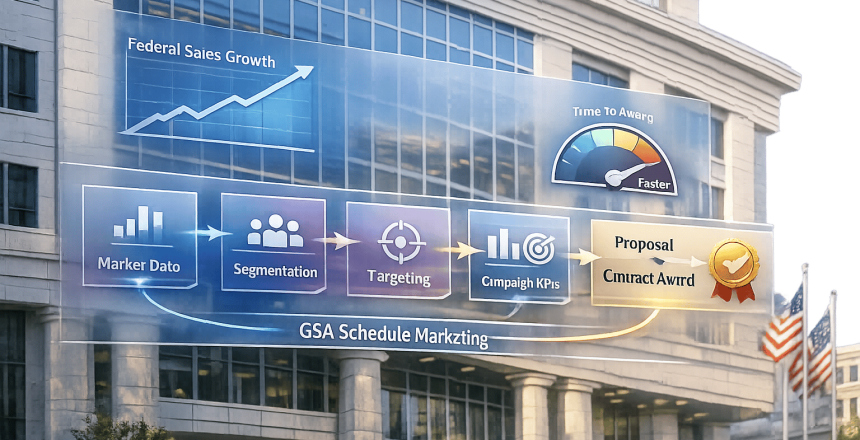
Analytics have transformed GSA Schedule marketing into a precise, results-oriented process. By leveraging data tools, businesses can better target federal buyers, optimize their listings, and improve ROI. Here’s how:
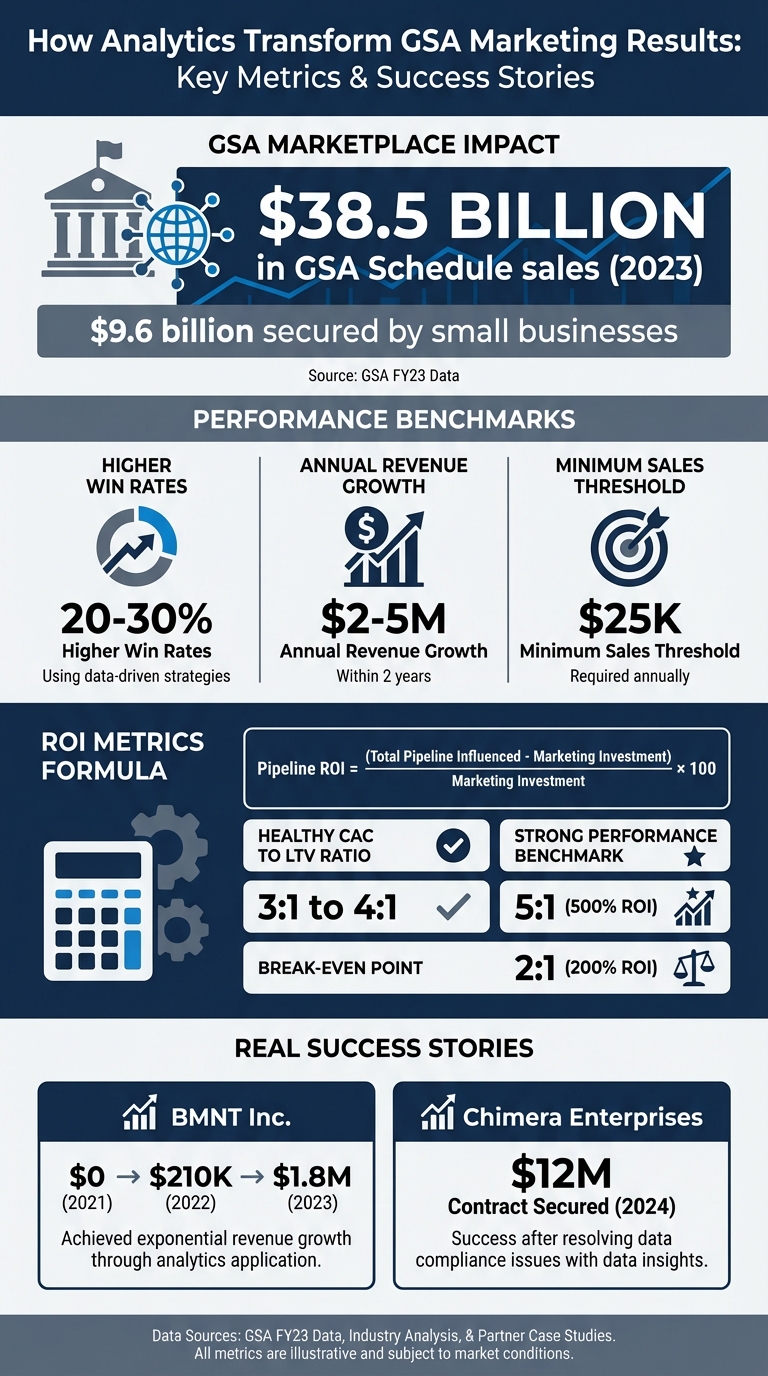
- Federal Marketplace Impact: In 2023, GSA Schedules generated $38.5 billion in sales, with small businesses securing $9.6 billion.
- Higher Success Rates: GSA Schedule holders see 20-30% higher win rates and report $2-5 million annual federal revenue growth within two years.
- Data-Driven Tools: Platforms like GSA Sales Query Plus (SSQ+), Google Analytics, and Ahrefs reveal buyer behavior, procurement trends, and keyword insights.
- Key Metrics: Tracking click-through rates, RFQs, and SEO performance helps businesses fine-tune strategies and measure ROI effectively.
- Case Studies: Companies like BMNT Inc. and Chimera Enterprises International achieved significant revenue growth by using analytics to refine their GSA marketing strategies.
The shift from intuition to data empowers businesses to secure contracts faster, allocate resources efficiently, and achieve measurable growth in the federal marketplace.
GSA Schedule Marketing Analytics: Key Metrics and ROI Performance
Key Metrics for GSA Schedule Marketing
Identifying Your Target Audience
Defining your target audience is a cornerstone of effective GSA Schedule marketing. Analytics tools play a pivotal role in this process, helping you uncover the keywords government buyers use. For instance, platforms like Ahrefs can track terms such as "government advertising agency" or "federal procurement solutions", enabling you to align your content with buyer intent.
Platforms like GSA Advantage and GSA eBuy are treasure troves of insights. By analyzing activity on these platforms, you can identify which agencies are exploring specific product categories or posting RFQs under your Special Item Numbers (SINs). Social listening tools, such as Hootsuite, provide a window into agency priorities, while link management tools like Bitly help you measure engagement across channels like email, LinkedIn, or SMS. For in-person events like trade shows, QR codes generated through Bitly can track which agencies engage with your printed materials, offering real-time geographic and behavioral insights.
Performance Metrics to Track
To gauge the success of your campaigns, it’s essential to track each step of the buyer journey – from website visits to contract inquiries. Metrics like click-through rates (CTR) on email signatures, LinkedIn posts, and capability statements highlight which channels resonate most with federal buyers. On GSA-specific platforms, your catalog’s accuracy on GSA Advantage and the number of RFQs you access and respond to on GSA eBuy are key indicators of success.
SEO and social media metrics also play a significant role. Tracking keyword rankings, organic traffic, Domain Rating, and your professional network reach can reveal how easily federal buyers are finding your offerings. During peak procurement cycles, Google Ads can provide immediate visibility, allowing you to monitor conversion rates and cost-per-acquisition for a clear picture of your ROI.
Calculating ROI in GSA Marketing
Tracking engagement is important, but calculating ROI ensures your marketing efforts translate into measurable results in federal contracting. Since GSA contracts can last up to 20 years, it’s crucial to calculate Pipeline ROI using this formula:
[(Total Pipeline Influenced – Marketing Investment) / Marketing Investment] x 100. This approach captures the long-term value of opportunities, not just immediate revenue.
Another critical metric is the CAC to LTV ratio (Customer Acquisition Cost to Customer Lifetime Value). For multi-year contracts, a healthy ratio in B2B and government sales typically falls between 3:1 and 4:1, with industry benchmarks identifying 5:1 (500% ROI) as strong performance and 2:1 (200% ROI) as the break-even point.
Attribution modeling is essential for assigning credit to each touchpoint, whether it’s a webinar, an RFI response, or clicks on GSA Advantage. For GSA marketing, it’s wise to extend attribution windows to at least 90–120 days. This ensures delayed conversions are captured, preventing premature ROI reporting and giving you a more accurate view of your campaign’s impact.
How Analytics Tools Improve Marketing Results
Refining Ad Campaigns
Analytics tools can take small business GSA marketing efforts to the next level by identifying which channels, messages, and budgets are hitting the mark. Take Improvado, for instance – it allows you to set up performance alerts that notify you if your average cost-per-click goes above benchmarks or if click-through rates fall below your targets. With this real-time feedback, you can quickly pause campaigns that aren’t performing and shift your budget to strategies that are driving results. Tools like Google Ads conversion tracking and GIS spatial analytics also help pinpoint the best-performing keywords and regions, making it easier to adjust bids and focus ad placements where they’ll have the most impact. This kind of fine-tuning ensures your campaigns are not just effective but also aligned with compliance and performance goals.
Improving Compliance and Documentation
While optimizing campaigns is essential, staying compliant is equally important – especially in GSA marketing, where even small errors can lead to big setbacks. Tools like Improvado MDG simplify this process by verifying your campaign setup and ensuring UTM naming conventions meet GSA standards. By catching issues early, these tools help you avoid reporting mistakes and reduce the risk of compliance breaches. It’s about building a solid foundation that supports both performance and accountability.
Using Predictive Analytics for Better Decisions
Analytics doesn’t just help you react – it helps you get ahead. Predictive tools allow you to anticipate trends and adjust your strategy before opportunities pass you by. For example, GSA eBuy provides early insights through Requests for Information (RFIs) and Sources Sought Notices, giving you a heads-up on future procurement needs before they’re officially announced. Tools like Ahrefs Keywords Explorer and Rank Tracker can predict demand by analyzing search patterns – if searches for "cybersecurity consulting services" spike in January, you’ll know to ramp up your outreach and content efforts before spring procurement starts. Social listening and real-time link analytics also highlight shifts in agency priorities and engagement trends, helping you refine your focus. With this proactive, data-driven approach, you can channel your energy into high-potential opportunities instead of spreading yourself too thin.
Case Study: Analytics Impact on GSA Marketing
Example: Small Business Using Analytics
BMNT Inc., a consulting firm based in Palo Alto, turned its GSA MAS contract performance around in a big way. Starting with $0 in 2021, the company achieved $210,000 in 2022 and an impressive $1.8 million in 2023.
How did they do it? By using market research to fine-tune their SIN codes and labor categories to match what federal buyers were actually looking for. This strategy not only eliminated rejections but also increased their visibility.
"We’ve seen our GSA sales grow exponentially year after year. We highly recommend GSA Focus."
– Steven P., BMNT Inc.
Another standout example is Chimera Enterprises International, which faced ongoing rejections until analytics pinpointed data compliance issues. Once those were resolved, the company secured a $12,000,000 contract in 2024. This illustrates how powerful targeted analytics can be in driving revenue growth through GSA marketing.
Lessons from Success Stories
These stories highlight some essential takeaways for businesses aiming to succeed with GSA contracts. First, focusing on the specific SIN codes federal buyers need is far more effective than casting a wide net. Second, fixing catalog data problems can turn repeated rejections into lucrative opportunities. Finally, using market research tools, like GSA’s Market Research As a Service (MRAS), can open the door to billions of dollars in business opportunities. Businesses that embrace analytics as a key part of their strategy consistently outperform those that rely on guesswork.
Conclusion
Key Takeaways
Analytics tools have turned GSA Schedule marketing into a precise, data-driven approach that delivers measurable outcomes. Using tools like Ahrefs for SEO, Google Ads for targeted campaigns, and Bitly for tracking engagement, small businesses can allocate their marketing budgets more effectively. These platforms reveal valuable insights into search patterns and procurement trends, helping businesses align their listings with federal buyer behaviors.
The advantages include better visibility in a competitive space, trackable ROI through conversion metrics, and a competitive edge by identifying market gaps and RFQ opportunities. Platforms like the FAS Catalog Platform simplify compliance by automating catalog updates, while social media management tools enhance credibility with procurement officers researching contractors online.
By leveraging these tools, businesses can make informed decisions and improve their chances of success in the federal marketplace.
Next Steps for Small Businesses
Start by focusing on government-specific keywords such as "federal procurement solutions" in your marketing campaigns, and time your efforts to align with federal budget cycles when agencies are finalizing purchases. Keep an eye on GSA eBuy for SIN-specific RFQs, and use link tracking to identify which marketing channels engage your audience the most.
Keep in mind that maintaining a GSA Schedule requires meeting a minimum sales threshold of $25,000 in the first two years and $25,000 annually after that. A solid marketing plan that integrates analytics tools and strategic targeting is essential for meeting these goals. Additionally, take advantage of socioeconomic certifications to access set-aside opportunities that can help accelerate your growth.
For businesses looking to streamline compliance and enhance their GSA Schedule marketing efforts, GSA Focus offers expert support designed to maximize results through data-driven strategies.
How To Use Analytics To Boost Your Marketing ROI
FAQs
Which analytics should I track first for GSA marketing?
Tracking the right metrics is crucial for staying informed and making data-driven decisions. Start by keeping an eye on federal sales data using tools like the Schedule Sales Query and the GSA Sales Reporting Portal. These platforms can help you stay updated on sales performance and trends.
Additionally, evaluate small business utilization and contracting opportunities. Resources like FPDS reports and the Small Business Dashboard are invaluable for assessing market performance and ensuring compliance with regulations. Together, these tools provide a comprehensive view of your federal contracting landscape.
How do I connect marketing activity to GSA revenue and pipeline?
To truly understand the impact of your marketing efforts, using analytics tools is a must. Platforms like the Schedule Sales Query (SSQ) and the FAS Sales Reporting Portal (SRP) are invaluable for analyzing federal sales data. These tools allow you to monitor trends, track performance, and gain insights into how your strategies are working.
Beyond just tracking results, analytics can help uncover irregularities, spot potential fraud, and refine your approach by evaluating key metrics like pricing, engagement, and conversions. Regularly reviewing these insights ensures your marketing stays aligned with federal opportunities, ultimately boosting GSA revenue and expanding your pipeline.
What’s the easiest way to spot and fix GSA catalog compliance issues with data?
The simplest approach to tackle GSA catalog compliance issues is by using automated monitoring tools alongside routine internal audits. Monitoring tools can keep an eye on sales, pricing, and catalog updates, while contract management software ensures everything aligns with GSA standards. Regular reviews make it easier to catch any inconsistencies and stay compliant.
Related Blog Posts
- How GSA Contractors Use Blogs for Marketing
- How Data Analytics Detects GSA Fraud
- How SEO Helps Federal Contractors Win Contracts
- 5 GSA Marketing Mistakes to Avoid