
WASHINGTON (AP) – In a bid to resolve a record-setting partial government shutdown, House Speaker Mike Johnson and Senate Majority Leader John Thune revealed a strategy on Wednesday to fully fund the Department of Homeland Security (DHS). The announcement follows a period of division between the two Republican leaders, which had left Congress unable to reach a resolution before lawmakers departed for a two-week recess.
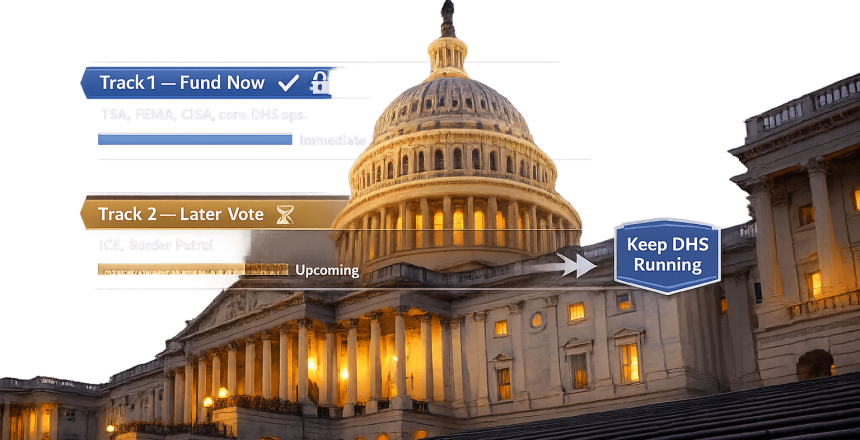
The proposed plan takes a two-track approach. The first track centers on reviving a Senate-backed bipartisan funding agreement to finance most of DHS operations, excluding U.S. Immigration and Customs Enforcement (ICE) and U.S. Border Patrol. The second track involves a later effort to fund these two agencies through a Republican party-line spending bill.
"We appreciate and share the President’s determination to once and for all bring an end to the Democrat DHS shutdown", Johnson, R-La., and Thune, R-S.D., said in a joint statement.
Challenges Ahead for Republican Unity
While the plan has the support of President Donald Trump, its success is far from guaranteed. The Republican leaders face opposition within their own party, particularly from staunch conservatives who demand full funding for immigration enforcement agencies.
"Let’s make this simple: caving to Democrats and not paying CBP and ICE is agreeing to defund Law Enforcement and leaving our borders wide open again", Rep. Scott Perry, R-Pa., stated in a post on X, signaling his disapproval of the plan.
The shutdown, which has now entered its 47th day, has created significant disruptions. Many DHS employees, including Transportation Security Administration (TSA) agents, have been working without pay, causing staffing shortages and long security lines at major airports. While these bottlenecks have started to ease due to backpay issued through an executive order from Trump, the broader issue of DHS funding remains unresolved.
Disagreements Persist Between the House and Senate
Last week, Senate Republicans had secured unanimous consent for a bipartisan funding measure to address the shutdown. However, this progress was derailed when House Republicans, led by Johnson, altered the legislation to include only a 60-day funding extension for all DHS operations. This decision sparked disagreements between Johnson and Thune, delaying further legislative action.
Senate Democratic leader Chuck Schumer attributed the GOP’s new strategy to pressure from his party. "For days, Republican divisions derailed a bipartisan agreement, making American families pay the price for their dysfunction", Schumer said.
Trump Weighs In
President Trump expressed urgency in ending the shutdown, urging Republicans to prioritize funding for immigration enforcement without seeking Democratic support. "We are going to work as fast, and as focused, as possible to replenish funding for our Border and ICE Agents, and the Radical Left Democrats won’t be able to stop us", Trump wrote in a social media post, calling for the legislation to reach his desk by June 1.
The narrower budget package proposed by Republicans aims to fund ICE and Border Patrol through the remainder of Trump’s term, aiming to prevent future funding lapses related to Democratic opposition to his immigration policies.
Next Steps Remain Unclear
The joint effort by Johnson and Thune reflects a temporary alignment of leadership, but whether their plan can gain enough support among Republicans remains uncertain. The House would need to reconvene before the mid-April recess ends to expedite the legislation, though no plans have been announced to recall lawmakers.
Meanwhile, Democrats continue to push back against Republican priorities. House Democratic leader Hakeem Jeffries criticized the GOP’s approach, stating, "It’s time to pay TSA agents, end the airport chaos and fully fund every part of the Department of Homeland Security that does not relate to Donald Trump’s violent mass deportation machine."
As efforts to resolve the shutdown continue, both parties remain locked in a contentious battle over the future of DHS funding, with no immediate resolution in sight.