

Submitting ISR reports is a must for federal prime contractors. These reports track subcontracting dollars awarded to small businesses, ensuring compliance with federal goals. If you’re a contractor with an approved subcontracting plan, here’s what you need to know:
- Who Files: Large businesses (OTSB) with subcontracting plans and Mentor-Protégé participants.
- Deadlines: Submit semi-annually – April 30 (covering October–March) and October 30 (covering April–September).
- Key Data: Report cumulative subcontracting dollars by category (e.g., Small Business, Women-Owned, Veteran-Owned) since contract award.
- Common Errors: Avoid prorating goals, misclassifying subcontractors, or skipping remarks for $0 entries.
- Submission: Use the eSRS system, ensuring data accuracy and alignment with your subcontracting plan.
Proper ISR preparation involves gathering data, verifying subcontractor classifications, and meeting deadlines. Tools like eSRS streamline the process, while services like GSA Focus can help contractors stay compliant and audit-ready. Missing deadlines or submitting inaccurate reports can lead to penalties, so staying organized is critical. Follow the steps outlined to ensure your ISR submissions are accurate and timely.
Who Must Submit ISR Reports and When
Businesses Required to Submit
If you’re an Other Than Small Business (OTSB) contractor with an approved subcontracting plan, filing an ISR (Individual Subcontracting Report) is mandatory. This requirement applies specifically to prime contracts that include a subcontracting plan.
For companies involved in the Mentor-Protege Program, there’s an additional layer of reporting. Mentor firms are required to separately report any unreimbursed costs related to supporting their protege. These costs must be listed apart from the dollar value of subcontract awards. Why? Because mentor firms can only earn credit toward their subcontracting goals for these protege-related expenses if they are distinctly itemized in the report.
ISR Reporting Deadlines
ISR reports follow a semi-annual submission schedule, with two key deadlines:
- April 30th: Covers the reporting period ending March 31st.
- October 30th: Covers the reporting period ending September 30th.
In the next section, we’ll break down the specific data you need to include in your ISR.
Required Data for ISR Reporting
Required Data Fields in ISR
When preparing your Individual Subcontract Report (ISR), ensure the data is precise and reflects cumulative subcontract awards from the date your GSA contract was awarded. This data should only account for subcontracting activity tied directly to fulfilling orders under your specific GSA contract.
You’ll need to categorize subcontracting dollars into the following groups: Small Business (SB), Small Disadvantaged Business (SDB), Women-Owned Small Business (WOSB), HUBZone Small Business, Veteran-Owned Small Business (VOSB), and Service-Disabled Veteran-Owned Small Business (SDVOSB). For each category, report both the dollar amounts and percentages.
- Input all amounts in whole dollars – no cents allowed.
- If any category has a $0 entry, provide an explanation in the "Remarks" section.
- The eSRS system cross-checks your entries with the System for Award Management (SAM) database to confirm subcontractor classifications. Any discrepancies will result in errors.
Make sure you report the full five-year goal values, not prorated amounts. If your contract is in an option period, the "Current Goals" column must display the total goals from all plans awarded under that contract. Additionally, check your approved subcontracting plan to determine whether indirect costs should be included in the reported figures, as this depends on the specific terms of your contract.
By following these guidelines, you’ll ensure your ISR data aligns with the required reporting standards.
Comparison Table: Data vs. Goals
| ISR Data Category | Corresponding Subcontracting Plan Goal | Alignment Requirement |
|---|---|---|
| Total Subcontracting | Total Planned Subcontracting Dollars | Must reflect cumulative actuals versus total projected spend |
| Small Business (SB) | SB Goal (Percentage & Dollars) | Actual dollars awarded to SB concerns |
| Small Disadvantaged Business (SDB) | SDB Goal (Percentage & Dollars) | Actual dollars awarded to SDB concerns |
| Women-Owned Small Business (WOSB) | WOSB Goal (Percentage & Dollars) | Actual dollars awarded to WOSB concerns |
| HUBZone Small Business | HUBZone Goal (Percentage & Dollars) | Actual dollars awarded to HUBZone concerns |
| Veteran-Owned Small Business (VOSB) | VOSB Goal (Percentage & Dollars) | Actual dollars awarded to VOSB concerns |
| Service-Disabled Veteran-Owned (SDVOSB) | SDVOSB Goal (Percentage & Dollars) | Actual dollars awarded to SDVOSB concerns |
| Current Goals Column | Full Five-Year Plan Values | Do not prorate; use the aggregate total of goals from the approved plan |
| Indirect Costs | Indirect Cost Methodology | Only include if specified in the approved subcontracting plan |
How to Prepare ISR Reports: Step-by-Step
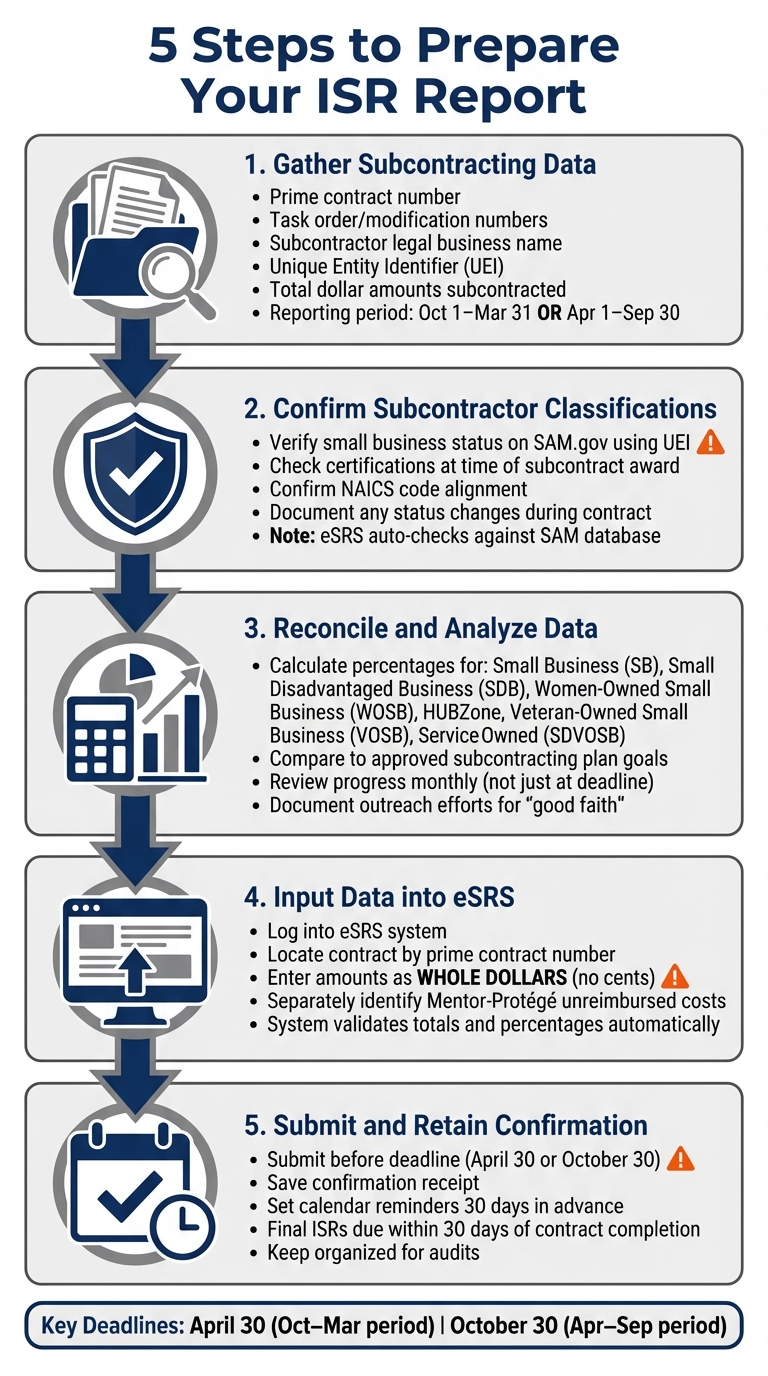
5-Step ISR Report Preparation Process for Federal Contractors
Step 1: Gather Subcontracting Data
Begin by collecting your prime contract number, along with any task order or modification numbers that apply. For each subcontractor, you’ll need their legal business name and Unique Entity Identifier (UEI) – this replaced the old DUNS number as the government’s standard identifier. Additionally, record the total dollar amount subcontracted during the reporting period, which typically covers either October 1–March 31 or April 1–September 30.
Pay extra attention to subcontractors that match the small business status outlined in your contract’s goals. If you’re reporting Mentor-Protégé data, make sure to follow the specific recordkeeping instructions provided earlier.
Step 2: Confirm Subcontractor Classifications
Once your data is in hand, verify each subcontractor’s classifications. Before entering anything into the Electronic Subcontracting Reporting System (eSRS), confirm small business statuses on SAM.gov using their UEI. It’s important to ensure that certifications reflect the subcontractor’s status at the time the subcontract was awarded – not the date you’re preparing the report. The eSRS will automatically check your entries against the SAM database and flag any discrepancies.
Also, make sure the subcontractor’s NAICS code aligns with the work they performed. Document any changes in status during the contract, noting the date and the effect on your reporting. This documentation can be critical if you’re ever audited by the government.
Step 3: Reconcile and Analyze Data
Now, it’s time to crunch the numbers. Calculate the percentages for subcontracting dollars in each category: Small Business (SB), Small Disadvantaged Business (SDB), Women-Owned Small Business (WOSB), HUBZone, Veteran-Owned Small Business (VOSB), and Service-Disabled Veteran-Owned Small Business (SDVOSB). Compare these percentages to the goals outlined in your approved subcontracting plan.
Instead of waiting until the reporting deadline, review your progress monthly. This gives you time to address any shortfalls by reaching out to specific small business categories. Keep detailed records of your outreach efforts, such as businesses contacted, opportunities shared, and responses received. These records will help demonstrate "good faith efforts" if you fall short of your goals.
Step 4: Input Data into the eSRS
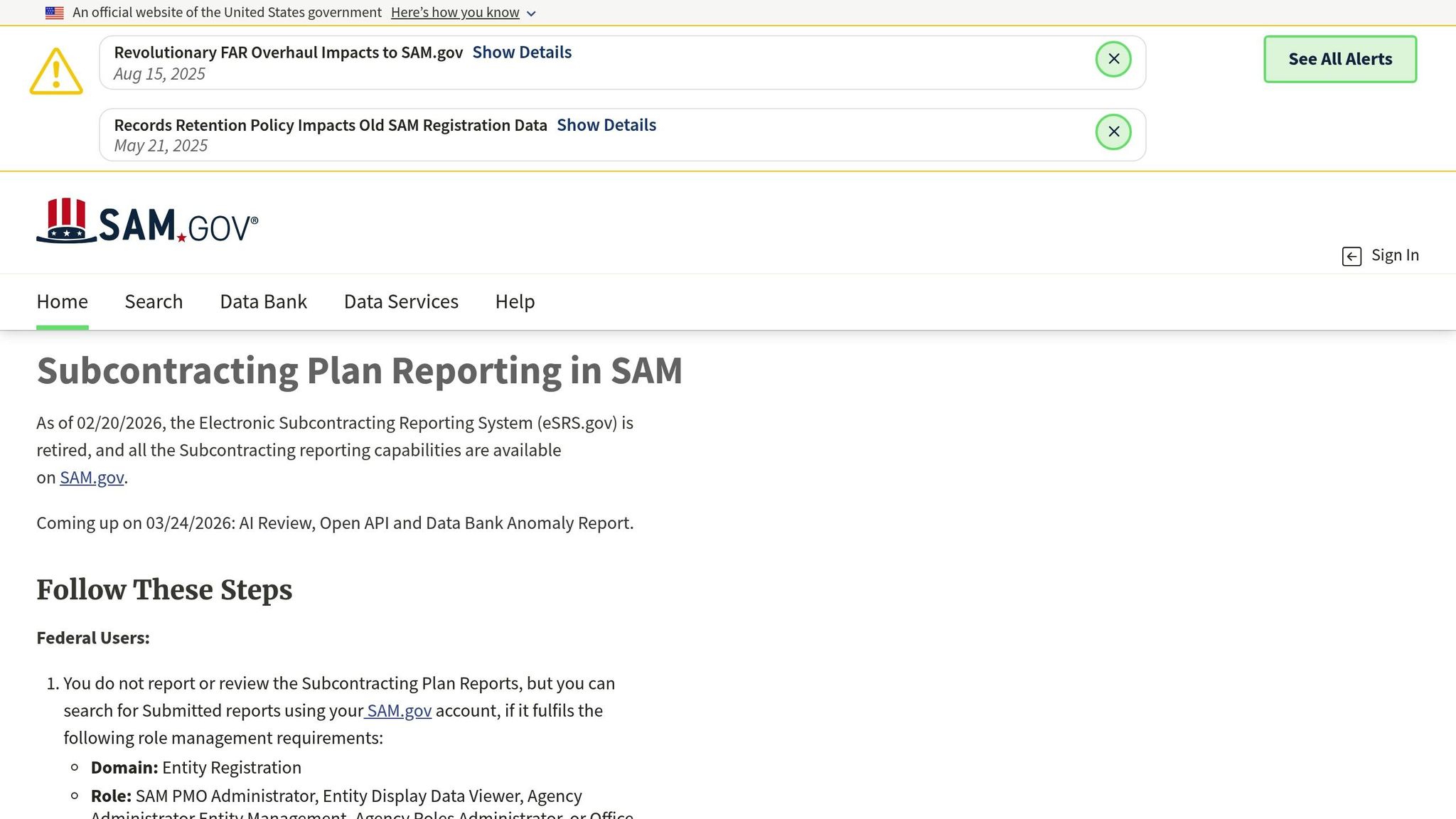
Log into the eSRS and locate your contract using the prime contract number. Enter all dollar amounts as whole numbers – no cents allowed. The system includes built-in validation to catch errors in totals or percentages.
If you’re reporting Mentor-Protégé data, make sure to separately identify unreimbursed costs, as required under DFARS Appendix I-112.1.
Step 5: Submit and Retain Confirmation
Submit your ISR before the deadline and save the confirmation receipt with your contract records. To stay ahead of deadlines, set calendar reminders at least 30 days in advance. For final ISRs, remember that they must be submitted within 30 days of the contract’s completion. Keeping everything organized ensures you’re ready for any follow-up or audit requests.
Common ISR Reporting Challenges and Solutions
Common Challenges in ISR Preparation
Once you’ve grasped the reporting process, tackling frequent hurdles is essential for staying compliant.
Some of the most frequent issues in ISR reporting include mistakes in prorating five-year goals, leaving out required remarks, entering incorrect administrator details, data entry errors, and confusion over report types.
One recurring error is prorating subcontracting goals for just one year instead of reporting the full five-year totals. As mentioned earlier, always use the complete five-year values. Failing to do so can raise compliance flags and delay your submission.
Another common oversight is skipping detailed remarks. For instance, if you report $0 for a socioeconomic category or select "No" for "Verify Data", the system expects a written explanation. Many contractors miss this step, leading to complications. Similarly, some businesses mistakenly input the wrong administrator details, such as listing a non-company representative in the "Contractor’s Subcontracting Plan Administrator" field.
Data entry errors are another major issue. These include reporting amounts with cents instead of whole dollars or failing to include cumulative totals from the start of the contract. Additionally, confusion between report types is prevalent, with some contractors submitting a Summary Subcontracting Report (SSR) when an Individual Subcontracting Report (ISR) is required.
Best Practices for Accurate ISR Reporting
To avoid these pitfalls, adopt a proactive approach. Don’t wait until the submission deadlines (April 30 or October 30). Instead, monitor your data consistently to ensure accuracy. Also, verify subcontractor status on SAM.gov at the time of award and confirm that the NAICS codes match the work performed.
Training your team is equally important. Assign a dedicated ISR administrator who understands the nuances of whole-dollar reporting, cumulative totals, and the proper use of the Remarks section. Setting reminders well ahead of deadlines can also help you sidestep last-minute errors.
| Common ISR Error/Challenge | Recommended Best Practice/Solution |
|---|---|
| Prorating goals for one year | Report full five-year totals instead of prorated annual figures |
| Incorrect administrator name | Ensure the listed administrator is a company employee, not a government official |
| Data entry errors (cents/totals) | Use only whole dollars and include cumulative totals |
| Missing remarks for $0 entries | Provide written explanations for $0 categories in the Remarks section |
| Classification errors | Verify subcontractor data and NAICS codes on SAM.gov during the award process |
For contractors participating in the Mentor-Protégé Program, remember to separately list unreimbursed costs from actual subcontract awards in your ISR. Check your subcontracting plan to confirm whether indirect costs should be included.
ISR Reports vs. Summary Subcontracting Reports (SSR)
Now that we’ve covered how to prepare an ISR, it’s time to break down how ISRs differ from Summary Subcontracting Reports (SSR). Understanding these differences is essential for accurate and compliant reporting.
An Individual Subcontracting Report (ISR) tracks subcontracting activity tied to a single contract, while a Summary Subcontracting Report (SSR) provides a big-picture view of all subcontracting activity for a government agency or across your organization as a whole. Think of the ISR as contract-specific and the SSR as a summary of your broader efforts.
Both reports are submitted through the Electronic Subcontracting Reporting System (eSRS), which replaced the older paper-based forms – SF 294 for ISRs and SF 295 for SSRs. For every contract requiring a subcontracting plan, you’ll need to submit one ISR. On the other hand, only one SSR is needed to cover your aggregate subcontracting activity. Both reports follow the same submission schedule outlined earlier.
The main difference lies in the scope of the data reported. ISRs focus on cumulative award totals since the contract award date and reflect the five-year goal values from your subcontracting plan. They require your accounting system to track subcontracting expenses at the individual contract level. SSRs, however, provide a broader overview, summarizing performance across agencies or your entire company.
Here’s the key takeaway: submit one ISR per contract and one SSR for overall subcontracting activity, as recommended by the Office of Naval Research. Before submitting an ISR, ensure your contract is flagged in the Federal Procurement Data System-Next Generation (FPDS-NG) as requiring a subcontracting plan – failing to do so will trigger an error. ISRs should be sent to your Administrative Contracting Officer (ACO) or Procuring Contracting Officer (PCO), while SSRs go to the office overseeing the majority of your subcontracting plans.
How GSA Focus Can Help with ISR Compliance

GSA Focus steps in to simplify ISR compliance, offering a solution tailored to small businesses that often find the process overwhelming. Preparing ISR reports and managing subcontracting plan compliance can be a heavy administrative lift, but GSA Focus takes on this burden, allowing you to concentrate on growing your business.
With more than 17 years of experience in federal contracting, GSA Focus has a proven track record, having secured over 550 GSA Contract awards and helped clients generate over $500 million in federal sales. Their expertise includes crafting subcontracting plans that meet FAR 52.219-9 standards, negotiating with contracting officers, and ensuring you meet ISR reporting deadlines without a hitch.
Their services go beyond just compliance. GSA Focus offers a customized approach, including personalized subcontracting plan development, negotiation support with contracting officers, and access to a centralized platform for organizing your records. This secure online system ensures you’re audit-ready and makes it easy to retrieve historical data for ISR reports or government audits. By automating critical tasks like data entry, subcontractor classification updates, and cumulative calculations, they help reduce errors and streamline the reporting process. Their "GSA Maintenance on Autopilot" service can speed up compliance tasks – such as submitting reports through eSRS – by up to five times compared to handling them internally.
Designed with small businesses in mind, GSA Focus offers affordable, full-service management to remove the administrative hassle while keeping you compliant with federal requirements. Whether it’s setting achievable goals based on market research or conducting monthly reviews to track subcontracting performance, GSA Focus provides the expertise and tools to keep your ISR reporting on track and stress-free.
Conclusion
Submitting accurate ISR reports isn’t just a box to check – it’s a key requirement for staying in good standing with federal agencies. As the Gormley Group puts it, "This report is a deliverable line item under your GSA contract and must be submitted for your company to be in compliance with contractual obligations". Missing the April 30 deadline for the reporting period ending March 31 can lead to penalties, contract complications, and damage to your reputation in the federal marketplace.
To stay on track, follow the five essential steps: gathering data, verifying classifications, performing calculations, entering details into eSRS, and submitting the report. Mistakes like misclassifying subcontractors or mismatched data can disrupt even the best-prepared plans, so attention to detail is key.
For small businesses that find ISR compliance overwhelming, teaming up with experts like GSA Focus can simplify the process. These partnerships not only help you meet your obligations but also protect your contract status and keep your business competitive.
Taking action early is crucial. Meeting deadlines without rushing ensures your reports are accurate and complete. Whether you handle ISR preparation internally or work with specialists, staying organized and ahead of schedule safeguards your standing and opens doors to future federal opportunities.
With the right strategy and support, ISR reporting becomes less of a hurdle and more of a stepping stone toward success in federal contracting.
FAQs
What happens if my ISR is late or wrong?
Submitting an ISR late or with errors can have serious repercussions. These include fines, the potential termination of contracts, and damage to your standing in the federal marketplace. Beyond that, it could jeopardize your chances of securing future contracts and negatively affect your performance evaluations. To steer clear of these issues, always double-check for accuracy and submit your reports on time.
How do I handle a subcontractor’s status change in my ISR?
To handle a subcontractor’s status change in your Individual Subcontract Report (ISR), you’ll need to update their status in the electronic Subcontracting Reporting System (eSRS) before submitting your report. Start by logging into eSRS and locating the specific ISR. From there, follow the prompts to amend or correct the report. Make sure the subcontractor’s updated status is accurately reflected in the system. Before resubmitting, double-check all entries for accuracy and completeness to avoid errors.
Should I include indirect costs in my ISR totals?
Including indirect costs in your ISR totals is essential if they are part of your subcontracting plan goals or funding budget. According to the FAR 52.219-9 clause, indirect costs must be reported whenever they are included in your subcontracting goals. To stay compliant, make sure to account for these costs if your plan or funding agreement specifies their inclusion.
Related Blog Posts
- GSA Subcontracting Plans: Key Requirements
- How to Track Subcontractor Performance in GSA Contracts
- Why Subcontracting Reports Matter for GSA Contracts
- Fixing Subcontracting Plan Compliance Issues