
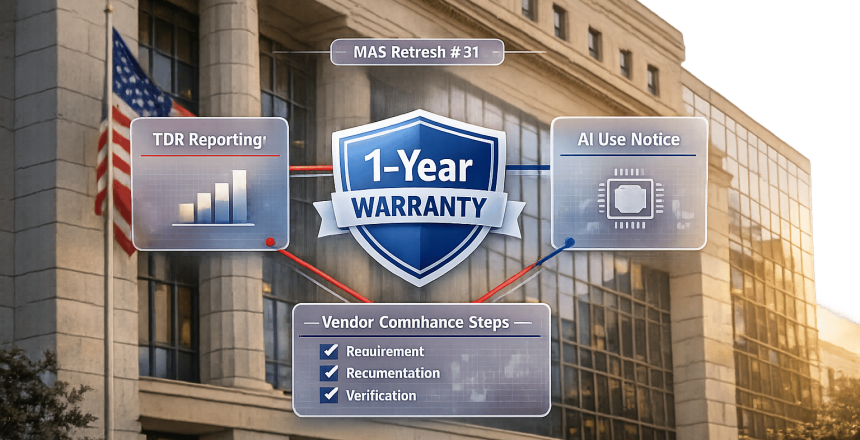
GSA warranty policies define vendor responsibilities when delivering products or services to the U.S. government. These policies, based on FAR 52.246-19, address defects, warranty duration, and remedies without increasing contract costs. Key updates in MAS Refresh #31 now require Transactional Data Reporting (TDR), stricter OEM certifications, and compliance with AI governance rules, making compliance more demanding for vendors, especially small businesses.
Key Takeaways:
- Warranty Scope: Covers defects in materials, workmanship, and design for a minimum of 1 year.
- Vendor Obligations: Repair/replace items, cover all costs, and ensure warranty details are clearly labeled.
- MAS Refresh #31 Changes: Introduces TDR, AI governance, and stricter reporting requirements.
- Compliance Tips: Maintain clear policies, secure subcontractor warranties, and keep detailed records.
These updates emphasize precision and thorough documentation. Vendors must act quickly to meet new requirements and avoid penalties.
Core Components of GSA Warranty Policies
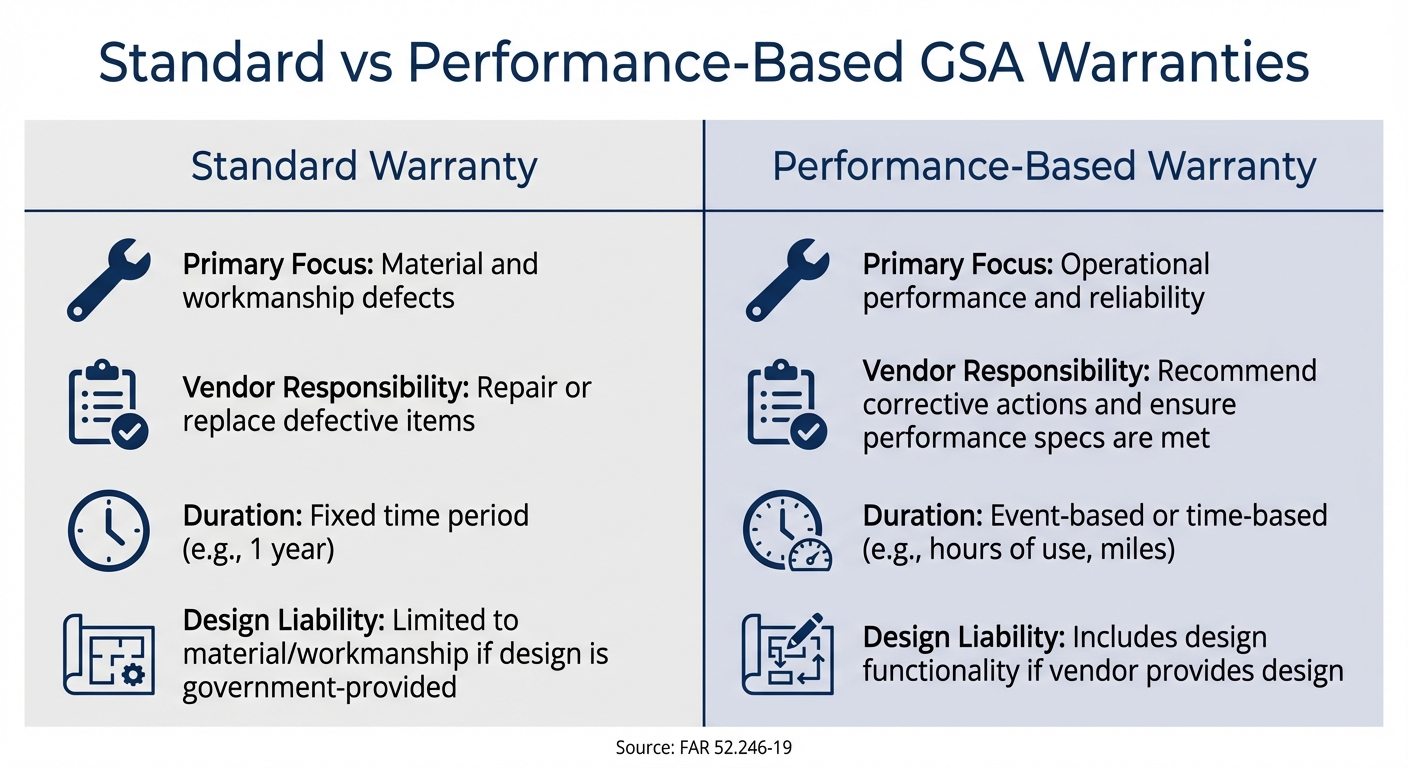
Standard vs Performance-Based GSA Warranty Requirements Comparison
Standard Warranty Requirements
GSA warranties are built around four key elements: the specific items and components covered, the contractor’s obligations, the remedies available to the government, and the scope and duration of the warranty. These are non-negotiable components.
Your warranty must ensure that all items are free from material and workmanship defects and meet contract specifications, provided the government hasn’t caused the issue. This includes covering all costs for labor, materials, and procedures such as re-inspection, repair, replacement, testing, and repackaging. Transportation costs are also your responsibility – this means covering shipping both ways, from the delivery point to your facility and back to the government.
Additionally, all delivered items must be clearly marked or labeled to inform government personnel of the warranty. These markings should include the warranty’s details, duration, and contact information for reporting defects. For commercial products, you can use your standard trade warranty markings as long as they provide enough information for government users.
The warranty period is determined by factors like the item’s expected lifespan, its nature (e.g., shelf-life), and industry norms. At a minimum, the warranty must allow the government to either request a contract adjustment or require you to repair or replace defective items.
These standards form the baseline for contractors to fulfill their obligations under government contracts.
Performance-Based Warranty Requirements
Performance-based warranties take things a step further by focusing on operational performance, maintenance, and reliability – ensuring the system works as intended. If you’re responsible for the design, your warranty must guarantee the design’s functionality, not just its construction.
According to FAR 52.246-19, you’re required to correct defects and also provide the Contracting Officer with a written recommendation for corrective actions, supported by data, all without increasing the contract price. Unlike standard warranties that rely on calendar time, performance-based warranties often use event-based metrics, such as hours of operation or miles.
| Feature | Standard Warranty | Performance-Based Warranty |
|---|---|---|
| Primary Focus | Material and workmanship defects | Operational performance and reliability |
| Vendor Responsibility | Repair or replace defective items | Recommend corrective actions and ensure performance specs are met |
| Duration | Fixed time period (e.g., 1 year) | Event-based or time-based (e.g., hours of use, miles) |
| Design Liability | Limited to material/workmanship if design is government-provided | Includes design functionality if vendor provides design |
Vendors need to understand these distinctions to meet the specific requirements of each warranty type.
Required Compliance Steps for Vendors
To align with GSA warranty policies, vendors need to take specific actions.
First, clearly define the start of the warranty period – whether it begins at delivery, government acceptance, or when the item enters service. Your contract should also outline how the government will notify you of defects and identify the responsible personnel for managing claims.
Check your warranty clause against other parts of the contract to avoid conflicting terms. Additionally, include a reasonable timeframe for the government to report any defects they discover. Ensure you sign GSA mass modifications within 90 days of receipt to stay compliant with updated federal regulations.
Your warranty policy must explicitly state that you’ll cover all labor and materials needed to meet performance standards, including re-inspection and testing costs. Importantly, you cannot charge extra for these corrections – repairs or replacements must not increase the price of firm-fixed-price contracts or the estimated cost of cost-reimbursement contracts.
How MAS Refresh #31 Changed Warranty Policies
What Changed in MAS Refresh #31
MAS Refresh #31 introduces a major shift in warranty compliance by requiring Transactional Data Reporting (TDR) for all MAS contractors. This update impacts 112 service SINs that previously relied on non-TDR reporting methods. Legacy clauses, such as the Price Reductions Clause (PRC) and Commercial Sales Practices (CSP-1), are being phased out in favor of transaction-level oversight.
"The shift to transactional data reporting represents a fundamental change in how we oversee schedule pricing – moving from periodic review to continuous visibility." – GSA
Another key change involves mandatory AI governance language across all Category Attachments, requiring vendors to show transparency and manage risks for AI-enabled products. Contractors must now document supply-chain details for AI components, including data sources and training sets. Additionally, vendors are required to report detailed data for every transaction – such as Manufacturer Name and Manufacturer Part Number – to verify Original Equipment Manufacturer (OEM) status and warranty eligibility. These updates set the stage for stricter verification rules, detailed further in the OEM Certification Requirements section.
OEM Certification Requirements
Under Refresh #31, warranty verification has shifted to a transaction-level approach. Contractors must include accurate Manufacturer Part Numbers and Manufacturer Names in their TDR reports, creating a continuous audit trail to confirm OEM relationships and warranty compliance. The new AI clauses (GSAR 552.239-7001) add another layer of compliance by banning foreign AI systems and requiring certification of AI origin. Vendors must disclose all AI systems used in fulfilling contracts and provide documentation on training data sources to demonstrate compliance. These changes have a direct impact on smaller businesses, which now face increased compliance demands.
What This Means for Small Businesses
Small businesses will need to adapt to significant compliance changes introduced in Refresh #31. With $38 billion in annual MAS sales now subject to stricter reporting requirements, contractors have limited time to adjust. Businesses have 90 days to accept the Refresh #31 Mass Modification, while those with pending non-TDR submissions must act within 10 business days to withdraw and resubmit, or risk rejection.
Meeting these new requirements will likely mean budget adjustments for IT upgrades, legal reviews, and process overhauls to ensure compliance with both TDR and AI governance clauses. For example, contractors must update ERP systems to capture the 18 mandatory TDR data elements and align catalog items with the correct TDR schemas. For those who accept the TDR modification in February 2026, TDR reporting will take effect on April 1, 2026, with the first report due by May 30, 2026.
The changes also narrow opportunities for startups. The Startup Springboard program, which previously helped newer businesses qualify for GSA schedules, is now limited to Information Technology Category (ITC) contractors eligible for the FASt Lane program. This effectively excludes non-IT startups from accessing this pathway.
Common Problems and How to Maintain Warranty Compliance
Common Warranty Compliance Mistakes
The updated standards in MAS Refresh #31 have introduced stricter requirements, and many contractors stumble over common pitfalls. One frequent issue is using vague warranty language that fails to include critical details like the warranty’s duration, scope, and remedies. For example, FAR 52.246-21 mandates a 1-year warranty starting from acceptance or possession, covering defects in materials, workmanship, and design. If these specifics aren’t clearly outlined, GSA reviewers may reject the warranty policy outright.
Another problem is incomplete documentation. Missing written warranties from subcontractors or OEMs – especially those executed for the Government’s benefit – or failing to keep detailed records of repairs and replacements can lead to non-compliance during audits. Similarly, neglecting to extend warranty obligations to subcontractors creates additional risks.
Contractors often struggle to differentiate between standard warranties and performance-based warranties. While standard warranties address basic defects, performance-based warranties set measurable goals, like equipment uptime or defect-free operations over a set period. MAS Refresh #31 places a strong emphasis on OEM certification, so vendors who don’t align their policies with federal standards or who include arbitrary exclusions risk rejection during contract reviews.
The consequences of these mistakes can be severe. Vendors relying on generic commercial warranties without tailoring them to Government-specific requirements have faced contract terminations, especially when defects surface after acceptance. Some contractors have incurred legal costs when incomplete subcontractor warranty documentation forced the Government to pursue claims directly with suppliers after the prime warranty expired. In extreme cases, small businesses have faced debarment risks due to such lapses.
How to Create Compliant Warranty Policies
To avoid these common pitfalls, contractors must focus on drafting clear and compliant warranty policies. Start by specifying a 1-year minimum warranty from the date of acceptance, covering defects in design, materials, and workmanship. Include remedies such as repair or replacement at no cost to the Government. Additionally, secure written warranties from subcontractors and OEMs that explicitly benefit the Government, and incorporate performance metrics that align with MAS Refresh #31 standards. This includes ensuring OEM certifications and proper flow-down clauses are in place.
Maintaining compliance doesn’t stop with drafting policies. Keep detailed, digital logs of warranty claims, repairs, and extensions. Per FAR 52.246-21, each repair triggers a new 1-year warranty period starting from the repair date. Conduct quarterly reviews to stay updated on policy changes, such as those introduced in MAS Refresh #31, and verify that no prohibited equipment is being used. Submission checklists can also help ensure that warranties meet Government requirements, particularly when exclusions are allowed under Alternate I. Finally, train your team on enforcement obligations to prevent liabilities related to latent defects.
For contractors struggling to meet these requirements, professional assistance can make a big difference.
Getting Expert Help with Compliance
Navigating the complexities of warranty compliance is no small task, but expert support can simplify the process. GSA Focus offers tailored document preparation services that align warranty policies with FAR 52.246-21 and MAS standards. Their team ensures proper OEM certifications, flow-down clauses, and thorough compliance reviews to catch errors before submission. They also provide negotiation support to help vendors avoid common audit pitfalls. For small businesses, professional guidance can reduce the risk of costly mistakes, safeguarding contract eligibility and ensuring warranty policies meet federal standards.
Summary and Next Steps
Main Takeaways
GSA warranty policies demand that vendors provide clear and compliant documentation covering a 1-year period from acceptance. This documentation must address defects in materials, workmanship, and design, as outlined in FAR 52.246-21. To meet these requirements, vendors should avoid using unclear language, maintain thorough records, and secure appropriate warranties from subcontractors. These practices are crucial for passing GSA reviews and reducing the risk of contract termination.
In addition to warranty compliance, vendors need to manage their contracts across various platforms. Your assigned Industrial Operations Analyst (IOA) will assist with compliance requirements. Vendors are required to sign mass modifications within 90 days of receipt to stay aligned with policy updates. Additionally, maintaining at least $100,000 in sales during the first five years – and $125,000 in every subsequent five-year period – is necessary to keep your contract active.
Actions to Take Now
- Upload your awarded price list: Ensure your price list, including warranty terms, is uploaded to GSA Advantage within 30 days of receiving a contract award or modification.
- Register and review compliance tools: Sign up for the MAS contract through the Vendor Support Center and review the Contractor Start-up Kit to fully understand compliance requirements.
- Keep your SAM.gov profile current: Update your profile annually and notify your contracting officer of any changes to your CAGE code or business structure within 30 days.
- Regularly review warranty policies: Ensure your warranty policies align with current GSA requirements. Maintain digital records of all warranty claims, repairs, and extensions.
- Report sales and fees: Submit the Industrial Funding Fee (currently 0.75% of sales) and sales data within 30 days after each reporting period.
- Work with your IOA: Address compliance concerns proactively with your Industrial Operations Analyst to avoid audit issues.
If this feels overwhelming, there are resources available to help simplify the process.
How GSA Focus Can Help

Navigating GSA warranty requirements and contract management can be challenging, but GSA Focus offers tailored support to make it easier. Their services ensure your warranty policies meet FAR 52.246-21 and MAS standards. With a strong track record and a refund guarantee, they handle compliance reviews, negotiation support, and ongoing contract management. By partnering with GSA Focus, you can save time, avoid costly errors, and ensure your documentation meets federal standards. This full-service approach helps small businesses maintain eligibility and steer clear of audit risks throughout the contract lifecycle.
FAQs
When does the GSA warranty period start for my contract items?
The GSA warranty period generally starts on the date when the government officially accepts the product or service. Warranty lengths can vary significantly, from a minimum of 90 days for non-consumable parts to as long as 20 years for GSA Schedule contracts. These specifics, including the exact terms and conditions, are detailed in federal regulations and individual contract clauses.
How do I prove OEM authorization and warranty eligibility under TDR?
To establish OEM authorization and ensure warranty eligibility under TDR, you need to submit verified product information and supplier authorization details via the Verified Products Portal (VPP). It’s essential that the manufacturer or authorized reseller provides precise product data, including supply chain details and the country of origin. This documentation serves as proof of your authorization to sell and support these products, aligning with TDR’s warranty requirements.
What records should I keep to pass a GSA warranty audit?
To successfully navigate a GSA warranty audit, it’s crucial to keep detailed and organized records. These include sales reports, contract modifications, quotes tied to GSA contract numbers, order-level materials, delivery and invoice documents, certifications, and correspondence. Make sure to hold onto these records for at least three years after the final payment – though some documents might need to be kept for up to six years. Staying on top of record-keeping not only ensures compliance but also helps prevent common pitfalls during the audit process.
Related Blog Posts
- Ultimate Guide to GSA Compliance Standards
- Common GSA Compliance Mistakes And Fixes
- GSA Ordering Rules: What to Know
- Top GSA Certification Requirements Explained