
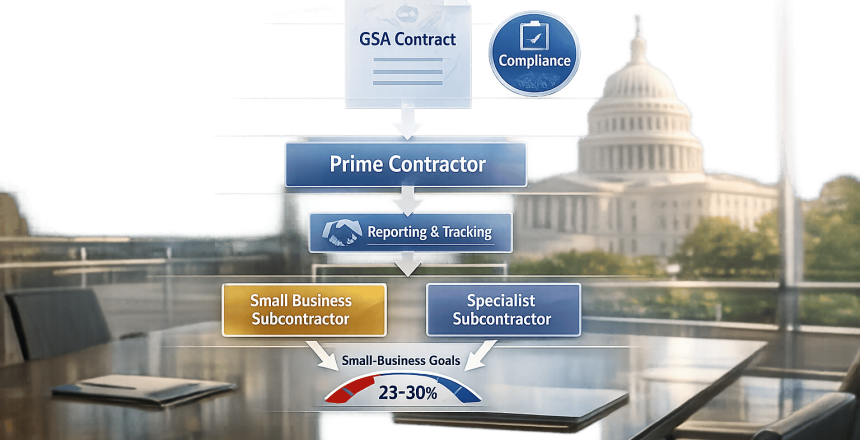
The GSA subcontracting rules are designed to ensure that small businesses, including those owned by disadvantaged individuals, women, veterans, and businesses in HUBZones, gain access to federal contracts. Large contractors with awards exceeding $700,000 (or $1.5 million for construction) must develop subcontracting plans to meet these goals. These rules also influence how partnerships are structured, from traditional subcontracting to Contractor Team Arrangements (CTAs), each with its own compliance and risk implications.
Key takeaways:
- Subcontracting Plans: Large contractors must allocate specific percentages of subcontracting funds to small businesses and submit detailed plans.
- Compliance Challenges: Flow-down requirements, small business certifications, and documentation are critical areas that demand attention.
- Partnership Models: Traditional subcontracting centralizes responsibility with the prime contractor, while CTAs distribute responsibilities and risks among team members.
- Reporting Systems: Tools like eSRS and SRP are essential for managing compliance and reporting obligations.
Subcontracting Plan Compliance
Common Compliance Challenges in GSA Subcontracting
Navigating compliance in GSA subcontracting is no small feat. For businesses aiming to sustain strong federal partnerships, understanding these challenges is a must.
Flow-Down Requirements: What You Need to Know
Flow-down requirements are the contractual rules and obligations that prime contractors must extend to their subcontractors. When a prime contractor secures a GSA contract, it’s their job to ensure that subcontractors follow federal regulations like labor standards, Buy American provisions, and Trade Agreements Act (TAA) compliance. If a subcontractor fails to comply, the prime contractor bears the responsibility.
Here’s where it gets tricky: identifying which clauses apply at each subcontracting tier can be overwhelming, especially when dealing with multiple layers of subcontractors. This complexity can make it harder to meet the required subcontracting goals.
Tackling Small Business Subcontracting Goals
Large contractors must dedicate a specific percentage of their subcontracting dollars to small businesses. The challenge? Finding subcontractors who not only meet technical needs but also hold the right socioeconomic certifications. To complicate matters, these certifications can change as business circumstances evolve, requiring constant verification.
Adding to the pressure, the Government Accountability Office has been keeping a closer eye on contractors’ "Good Faith Efforts." If a contractor doesn’t meet its small business subcontracting goals, they must provide detailed documentation – outlining outreach efforts, market research, and reasons for falling short – within 30 days of contract completion. Building strong partnerships with certified subcontractors can help contractors stay ahead of these challenges.
Staying on Top of Documentation
Compliance also demands strict recordkeeping. Contractors are required to use various systems to manage reporting:
- eSRS (Electronic Subcontracting Reporting System): For submitting Individual Subcontract Reports (ISRs) and Summary Subcontract Reports (SSRs).
- Sales Reporting Portal (SRP): For filing quarterly sales reports and paying the 0.75% Industrial Funding Fee (IFF).
Each platform has its own deadlines and data requirements, adding to the administrative burden.
Contractors must also maintain thorough records, including outreach efforts, subcontractor certifications (verified via SAM.gov), transaction details like quotes and invoices, and updated Country of Origin certificates for TAA compliance. All compliance and financial records must be kept for at least three years after the contract ends, while certain pricing records require a five-year retention period. Additionally, when signing mass modifications, contractors have 90 days to complete updates and ensure all related documentation is current.
These documentation requirements, while necessary, can feel like a maze to navigate. But with proper systems and diligence, contractors can stay compliant and avoid costly missteps.
How GSA Subcontracting Rules Affect Partnerships
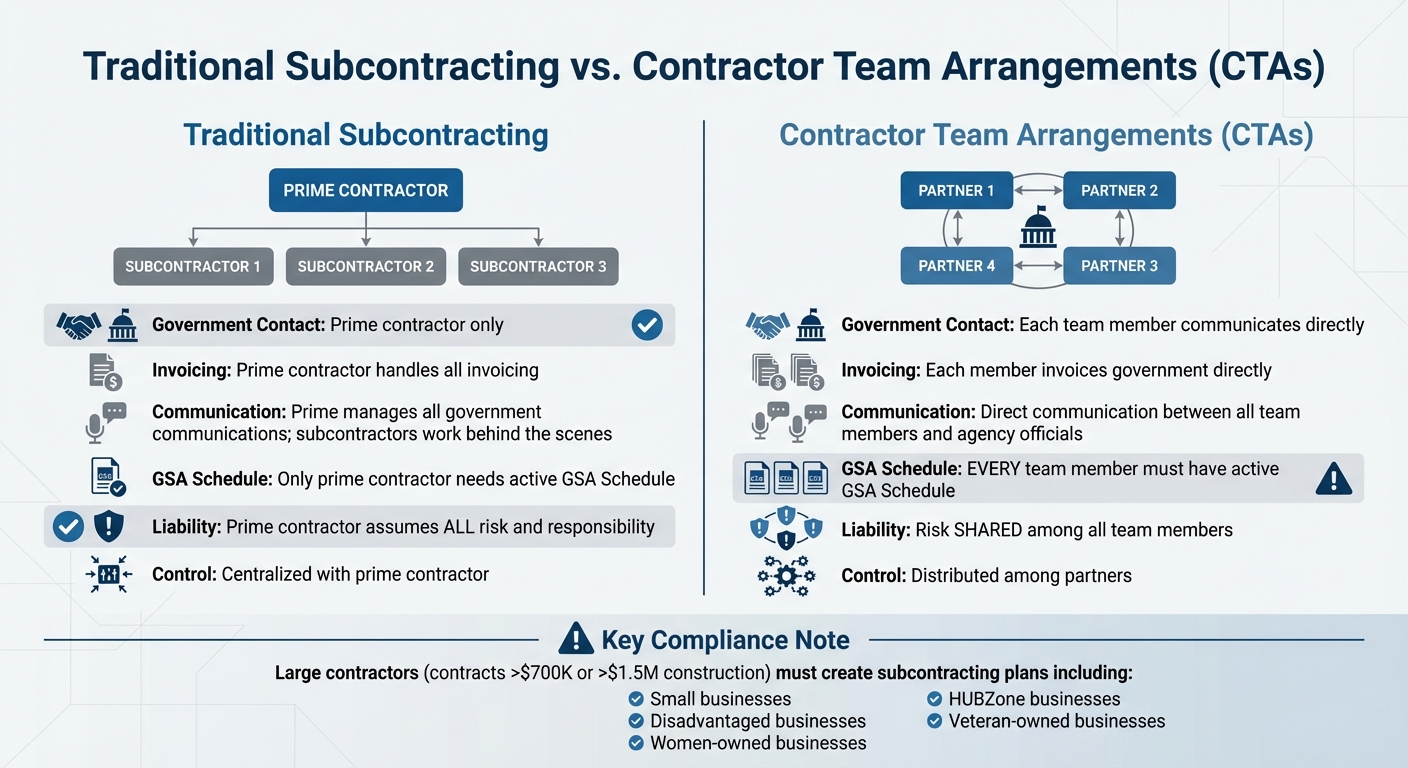
Traditional Subcontracting vs Contractor Team Arrangements in GSA Contracts
GSA subcontracting rules don’t just add paperwork – they reshape how businesses work together in federal contracting. These regulations define who does what, set the boundaries for liability, and determine how money moves between partners.
Effects on Partnership Structures
The rules play a big role in how partnerships are set up, whether as a traditional subcontracting arrangement or a Contractor Team Arrangement (CTA). In a traditional setup, the prime contractor is the main point of contact with the government. They handle invoicing, manage communications, and take full responsibility for the contract. Subcontractors, on the other hand, stay behind the scenes, with no direct interaction with the government.
CTAs work differently. Each team member keeps their own GSA Schedule, invoices the government directly, and communicates directly with agency officials. While this model offers more independence for each participant, it also comes with a catch: every member must have an active GSA Schedule. This requirement can exclude some potential partners.
For larger contractors, there’s an added layer. They’re required to create subcontracting plans that include certified small businesses across various categories, such as small, disadvantaged, women-owned, HUBZone, and veteran-owned businesses. This pushes prime contractors to actively include small businesses in their subcontracting plans, creating new dynamics and compliance responsibilities for all partners involved.
Compliance Risks for Partners
The choice between these partnership models also changes how liability is handled. In a traditional subcontracting setup, the prime contractor takes on all the risk. If a subcontractor doesn’t meet performance standards or fails to fulfill contract requirements, the prime contractor is on the hook.
In a CTA, the risk is shared. Each team member is individually responsible for their part of the contract. This setup means that every partner must have strong compliance systems in place, including accurate sales tracking and proper handling of Industrial Funding Fee payments. A compliance issue from one partner doesn’t just hurt the current project – it can also jeopardize future contract opportunities. Knowing these risks is essential for building effective compliance strategies.
Opportunities Through Partner Collaboration
While the rules bring risks, they also create chances for collaboration. The GSA Subcontracting Directory helps small businesses connect with prime contractors who have active subcontracting plans. This opens the door to federal contracts that might otherwise be out of reach.
For prime contractors, these partnerships aren’t just about meeting small business subcontracting goals – they’re also a way to access specialized expertise that smaller businesses bring to the table. These collaborations can be mutually beneficial, making the most of what each partner has to offer.
Solutions for Meeting GSA Subcontracting Requirements
Navigating GSA subcontracting requirements can feel overwhelming, but with the right strategies, businesses can stay compliant while maintaining efficiency. The key lies in combining expert guidance, thorough planning, and ongoing oversight to ensure partnerships remain both productive and aligned with regulations.
Working With a Specialized Service Provider
The administrative complexity of GSA compliance can be daunting, but specialized service providers can make a world of difference. For example, GSA Focus has helped secure over 625 GSA approvals over the past 17 years. Their expertise spans document preparation, compliance checks, and negotiation support – areas that often trip up businesses trying to manage the process internally.
What’s the payoff? Businesses that work with specialized providers can speed up the approval process by as much as four times. For small companies with limited resources, this time savings can mean quicker access to the market and less strain on internal teams. On average, clients using these services report $917,000 in GSA sales, highlighting the revenue potential that comes with proper compliance and expert assistance.
Creating an Effective Subcontracting Plan
A well-structured subcontracting plan is crucial to mitigating risks and meeting compliance requirements. The type of plan you need depends largely on your business operations and contract scope:
- Individual plans: Tailored to specific contracts and effective throughout the contract’s duration, including option periods.
- Commercial plans: Cover your entire business for a fiscal year and work best for standardized products or services.
- Master plans: Serve as three-year templates, simplifying the process for companies that regularly bid on similar contracts.
When drafting your plan, set clear small business participation goals for all target categories and outline your outreach strategy. Many GSA contracts require GSA Form 4006 to organize this information. If you fall short of your goals, you’ll need to demonstrate "good faith efforts" to the contracting officer within 30 days of completing the contract. Keep detailed records of your outreach activities and market research to support your case.
Maintaining Oversight and Reporting
Staying on top of compliance means consistent monitoring and reporting. The Electronic Subcontracting Reporting System (eSRS) is the go-to platform for submitting your reports. You’ll need to file Individual Subcontract Reports (ISRs) semi-annually and Summary Subcontract Reports (SSRs) annually or at the end of a contract. To avoid payment delays or negative performance ratings, set calendar reminders for these deadlines.
Monthly performance reviews can help you track progress toward your small business goals and address potential issues early. Keep meticulous records of your outreach efforts, including which small businesses you contacted, the solicitations you issued, and the criteria used for making decisions. Regularly verify subcontractor certifications on SAM.gov to ensure they remain valid.
In Contractor Team Arrangements, it’s common for each team member to handle their own sales reporting and Industrial Funding Fee payments. To avoid confusion, establish clear communication protocols and assign specific reporting responsibilities upfront. This ensures everyone stays on the same page and minimizes the risk of compliance errors.
Conclusion: Building Compliant Partnerships Under GSA Rules
GSA subcontracting rules play a central role in shaping how businesses structure deals, choose partners, and manage relationships. These regulations – covering flow-down requirements, small business goals, and reporting obligations – impact every aspect of federal contracting partnerships. Falling short on compliance can result in defaults or even contract termination.
But staying compliant doesn’t have to be overwhelming. With a solid subcontracting plan and consistent oversight, these requirements can actually work to your advantage. Companies that prioritize compliance not only minimize risks but also position themselves as trustworthy partners, increasing their chances of winning contracts.
If you’re managing compliance internally, having clear processes is non-negotiable. Assign dedicated staff to monitor portals and emails daily for updates from Industrial Operations Analysts. Conduct quarterly reviews of your commercial sales data and labor categories to ensure you’re meeting Price Reductions Clause requirements. Don’t overlook free resources like the SBA, GSA’s Office of Small and Disadvantaged Business Utilization, or your local Procurement Technical Assistance Center – they’re there to help.
For businesses that prefer external support, specialized providers can take the burden off your team. Companies like GSA Focus offer end-to-end services, handling everything from document preparation and partner vetting to eSRS reporting. This allows you to focus on delivering value to federal customers, while ensuring compliance with regulations like TAA requirements and NDAA Section 889 restrictions.
Thriving in GSA partnerships demands strategic planning and operational discipline. By addressing challenges like flow-down complexities and documentation requirements head-on, you can build partnerships that are not only compliant but also profitable and enduring. Whether you handle compliance in-house or rely on expert assistance, the key is understanding the rules and staying committed to adhering to them.
FAQs
Do I need a subcontracting plan for my GSA contract?
Yes, if your GSA contract exceeds $700,000 (or $1.5 million for construction projects), you’ll need to submit a subcontracting plan. This plan outlines how you’ll involve small businesses in your project, ensuring alignment with federal guidelines and promoting small business participation.
Should we use a subcontract or a CTA?
In GSA contracting, deciding between a subcontract and a Contractor Team Arrangement (CTA) comes down to the specific needs of your project.
A subcontract involves a prime contractor overseeing a subcontractor. This setup works well for projects where meeting subcontracting plan requirements is crucial, particularly for larger contracts.
On the other hand, a CTA lets GSA Schedule holders work together as co-prime contractors. This approach is perfect for more complex projects that demand a blend of expertise and shared responsibilities.
What reports and records are required to stay compliant?
To stay compliant, it’s crucial to prepare reports such as the Standard Form 294 (Subcontracting Report for Individual Contracts) and maintain thorough records of your subcontracting goals, payments, and performance. Keeping precise documentation of pricing, sales, and subcontracting activities is equally important. These records not only ensure you meet GSA subcontracting requirements but also serve as proof of compliance during audits.
Related Blog Posts
- Why Subcontracting Plans Matter for GSA Contracts
- GSA Subcontracting Plans: Key Requirements
- Teaming vs. Subcontracting: Compliance Differences
- Why Subcontracting Reports Matter for GSA Contracts