
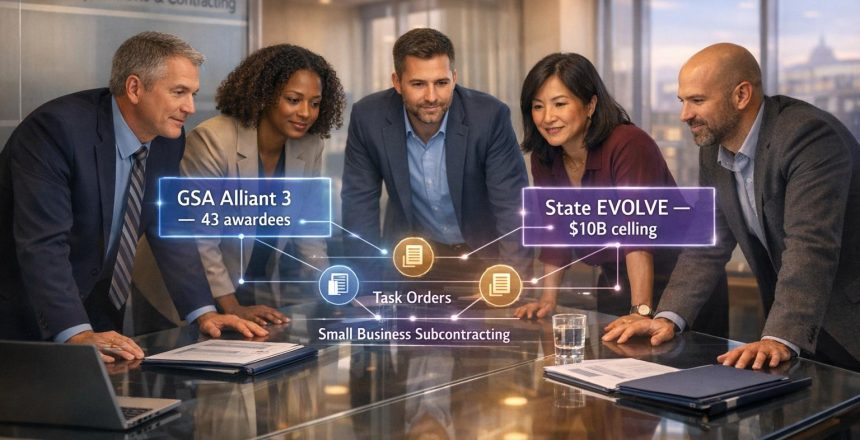
The General Services Administration (GSA) and the State Department recently awarded major IT contracts, reshaping how federal agencies acquire technology services. These contracts—Alliant 3 and EVOLVE—offer pre-vetted vendor pools to simplify procurement and cut costs for government IT projects.
Highlights:
- Alliant 3: Unlimited spending potential, focused on cloud, cybersecurity, and emerging technologies. Phase 1 awarded 43 spots, with 33 more open.
- EVOLVE: $10 billion ceiling over seven years, covering enterprise IT, digital modernization, and infrastructure.
- Competition: Highly selective—e.g., 133 proposals for Alliant 3’s first phase resulted in only 43 awards.
- Opportunities for Small Businesses: Subcontracting and teaming with prime contractors like IBM, Booz Allen, and Leidos can open doors.
Federal agencies are increasingly relying on these contracts, which prioritize efficiency and proven performance. For businesses, the focus should be on meeting GSA requirements, building partnerships, and targeting upcoming opportunities like the remaining Alliant 3 slots.
Recent GSA IT Contract Awards: What You Need to Know
Alliant 3 vs EVOLVE: GSA IT Contract Comparison
Contract Structure and Terms
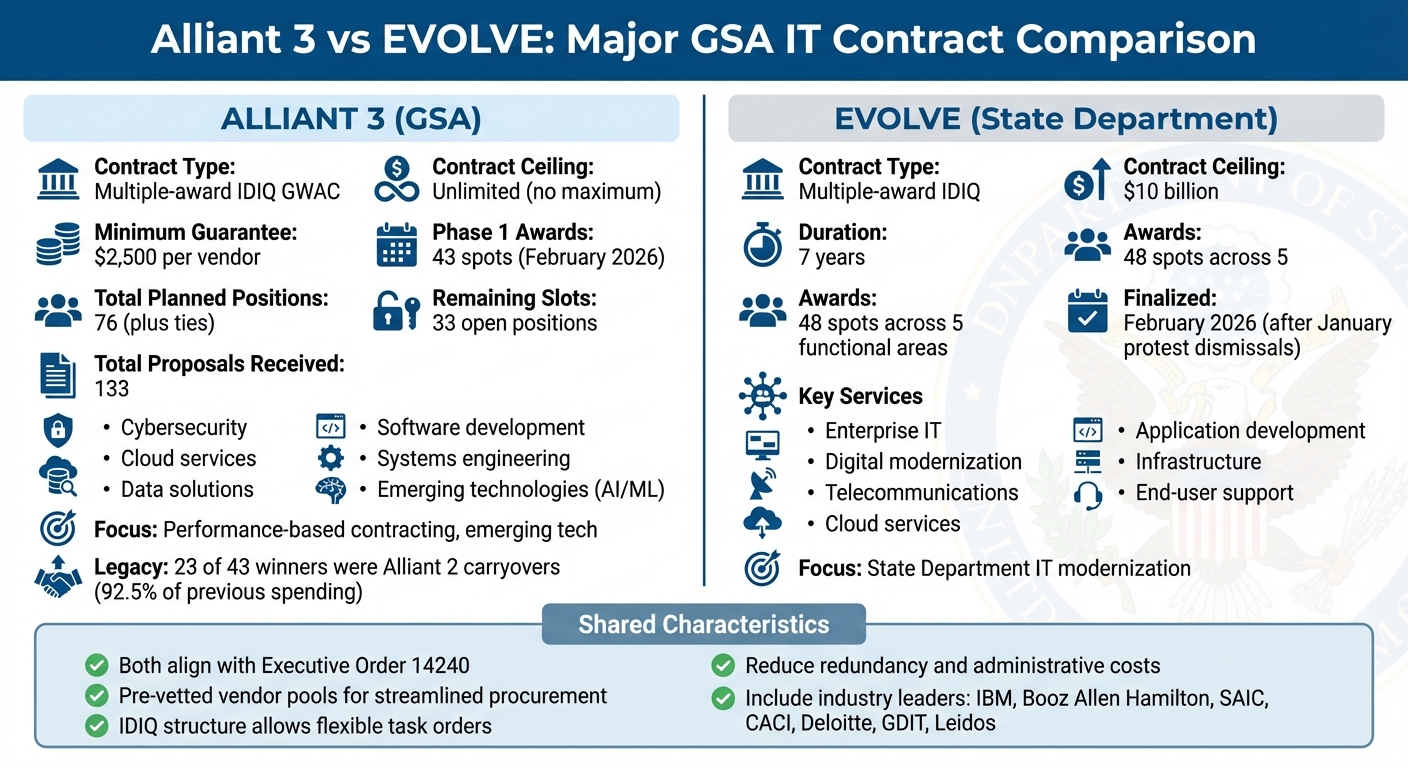
The Alliant 3 GWAC is structured as a multiple-award, indefinite-delivery, indefinite-quantity (IDIQ) contract. This setup gives federal agencies the flexibility to issue task orders when needed, without the hassle of running separate competitions for each task [6][9]. Unlike Alliant 2, which capped out at $82.8 billion, Alliant 3 has no ceiling, offering unlimited spending potential. Each vendor is guaranteed a minimum of $2,500, but the real value comes from securing individual task orders [9][2].
To streamline operations, the GSA is rolling out Alliant 3 in phases. The first phase, completed in February 2026, awarded 43 spots, with plans to expand to 76 positions (plus ties) over time [1][3]. While the contract is already in motion, GSA is still reviewing 90 of the initial 133 proposals submitted [1][9]. This phased approach ensures the contract can start functioning efficiently while evaluations continue.
The State Department’s EVOLVE program mirrors the IDIQ model but operates under different terms. Finalized in February 2026, after protests were dismissed in January, EVOLVE awarded 48 spots across five functional areas. It carries a $10 billion ceiling over a seven-year duration [1][8]. Both programs align with Executive Order 14240, which aims to streamline domestic procurement within GSA, reducing redundancy and cutting administrative costs [6][9].
Next, let’s explore the range of IT services these contracts encompass.
IT Services and Solutions Covered
| Contract Vehicle | Key IT Services | Duration & Value |
|---|---|---|
| Alliant 3 | Cybersecurity, cloud services, data solutions, software development, systems engineering, emerging technologies | No maximum ceiling; $2,500 minimum guarantee |
| EVOLVE | Enterprise IT, digital modernization, telecommunications, cloud, application development, infrastructure, end-user support | 7 years; $10 billion ceiling |
Alliant 3 places a strong focus on emerging technologies and performance-based contracting, reflecting the increasing demand for advanced solutions like artificial intelligence, machine learning, and data analytics. Lawrence Hale, Assistant Commissioner for GSA’s Office of Information Technology Category, summarized the initiative’s goals:
“Alliant 3 embodies GSA’s commitment to delivering smarter buying for the federal enterprise by simplifying how agencies access critical IT services through a single, governmentwide contract.” [1][6]
For businesses aiming to participate, understanding these contracts’ scope and priorities is crucial.
Companies That Won Contracts
The list of vendors awarded contracts under these programs showcases some of the biggest names in IT and highlights trends in legacy performance.
Alliant 3 Phase 1 winners include industry leaders such as IBM, Booz Allen Hamilton, SAIC, CACI, Deloitte, General Dynamics Information Technology (GDIT), Leidos, Maximus, and Northrop Grumman [2][3]. These companies now have access to task orders involving cloud services, cybersecurity, and software development.
Past performance plays a significant role in these awards. Of the 43 Phase 1 winners, 23 were carryovers from Alliant 2. Remarkably, these 23 vendors accounted for 92.5% of the spending on Alliant 2 since fiscal 2018 [7][6]. This pattern underscores the federal agencies’ preference for vendors with proven track records on similar contracts.
For the EVOLVE program, the State Department awarded contracts to 48 vendors, including Accenture Federal Services, Booz Allen Hamilton, CACI Federal, and GDIT [1][8]. Winning proposals highlighted strong technical expertise and a history of success [6][2]. While Alliant 3 is an unrestricted vehicle, it’s worth noting that prime contractors often include small-business subcontracting requirements, creating opportunities for smaller firms to collaborate [5]. Additionally, companies that missed out in Phase 1 of Alliant 3 can still compete for the remaining 33 slots as GSA continues its evaluations [1][3].
Benefits of These Contracts for Agencies and Businesses
Simplified Federal IT Procurement
Federal agencies are under constant pressure to modernize their IT systems while juggling tight budgets and strict deadlines. GSA IT contracts, such as Alliant 3 and EVOLVE, help ease this burden by offering pre-approved vendors with pre-negotiated pricing. Instead of starting new procurement processes from scratch, agencies can tap into these pre-vetted vendors, issuing task orders in just weeks by following the streamlined guidelines outlined in FAR 8.404 and 8.405 [13].
The financial advantages of this system are undeniable. For example, GSA MAS sales reached over $50 billion in fiscal year 2024. Additionally, the implementation of the Transactional Data Reporting (TDR) initiative saved $20.2 million in 2025, with projections indicating savings could climb to $50 million once fully implemented [12][13]. Josh Gruenbaum, Federal Acquisition Service Commissioner, highlighted the importance of TDR:
“Fully implementing TDR will equip our contracting officers with comprehensive data on purchased items and their prices so they can negotiate effectively and serve as uncompromising fiduciaries of taxpayer dollars.” [12]
But it’s not just about saving money. GSA’s “One Customer” approach, part of the Better Contracting Initiative, focuses on negotiating enterprise-wide software licenses directly with manufacturers. This ensures even smaller agencies can access the most competitive terms [15]. Interestingly, most of the funding for these efforts comes from a 0.75% Industrial Funding Fee, with only 1% relying on congressional appropriations [13].
By simplifying the procurement process, these contracts not only reduce costs but also create new opportunities for small businesses to thrive.
Opportunities for Small Businesses
For small businesses, entering the federal market can feel like navigating a maze of red tape. GSA contracts, however, are designed to lower these barriers. For instance, in December 2024, GSA awarded positions to 102 vendors under the Polaris GWAC, significantly expanding federal IT opportunities for small firms [16][17]. Just two months later, in February 2026, GSA further supported small businesses by identifying 55 successful offerors in the Women-Owned Small Business (WOSB) pool of Polaris [17][18].
The revenue potential here is enormous. Since 2018, federal agencies have issued over 825 task orders, totaling more than $46 billion, through Alliant 2 alone [1]. Unlike its predecessor, Polaris comes with no maximum dollar ceiling, which means limitless growth opportunities for those awarded contracts [16][18]. Robin Carnahan, GSA Administrator, underscored the program’s dual mission:
“The Polaris GWAC is another way we keep our commitment to supporting evolving federal IT needs while providing opportunities for the small business community to succeed in the federal marketplace.” [16]
Even companies that don’t secure prime contracts can still benefit through subcontracting. Large contracts like Alliant 3 require prime contractors to include small business subcontracting plans, opening doors for smaller firms to collaborate with industry leaders [5]. With the federal government maintaining a 23% goal for small business prime contracting [5], these contracts offer both direct and indirect pathways to steady federal revenue streams.
How to Win GSA IT Contracts
Meeting GSA Contract Requirements
Before diving into GSA contracts, businesses must meet specific requirements. For the Multiple Award Schedule (MAS), the basics include two years in operation, two years of financial records, and a proven track record of past performance. Why aim for MAS? It handles more than $39 billion in federal contracting sales annually, making it a key entry point for small and medium-sized businesses [20].
But what if you’re a startup? The Startup Springboard Program is designed to help newer companies bypass the two-year requirement if they meet other eligibility criteria [20]. Once you’re in, you’ll pay an Industrial Funding Fee of 0.75% on reported sales [20].
Higher-level contracts, like Alliant 3 and Polaris, come with tougher requirements. These Governmentwide Acquisition Contracts (GWACs) have strict submission windows and limited award slots. For example, out of 133 proposals for Alliant 3, only 43 advanced in Phase 1 [2][3]. Success here hinges on technical expertise and a strong performance history [20][6].
Adding socioeconomic certifications to your portfolio can also make a difference. Certifications like 8(a) Business Development, HUBZone, Women-Owned Small Business (WOSB), or Service-Disabled Veteran-Owned Small Business (SDVOSB) can open doors to exclusive contract pools [20][18]. For instance, in February 2026, 55 offerors succeeded in the WOSB pool of Polaris [17][18]. Additionally, compliance with the Trade Agreements Act (TAA) is mandatory, meaning your products must be made or significantly transformed in the U.S. or a TAA-approved country [20].
Once these requirements are squared away, the real work begins—positioning your business to stand out.
Positioning Your Business for Success
Meeting the basic criteria is just the start. To truly win GSA contracts, you need to differentiate yourself. Start with a strong capability statement. Rather than generic marketing language, focus on tangible outcomes like cloud migrations, cybersecurity upgrades, or systems engineering achievements. Federal agencies value specifics that align with their needs [18].
If you’re short on prime contract experience, consider forming partnerships. Options like Joint Ventures (JVs), Contractor Team Arrangements (CTAs), or the SBA Mentor-Protégé Program allow you to team up with more experienced firms while building your own track record [20][5].
Subcontracting is another route to explore. Keep your Small Business Search (SBS) profile updated with accurate NAICS codes, certifications, and performance records. Prime contractors often rely on this tool to find qualified subcontractors [5]. With the federal government aiming for 23% of prime contracts to go to small businesses [5], subcontracting opportunities abound. For example, the 43 Phase 1 winners of Alliant 3 frequently need specialized subcontractors to complete task orders [5][3].
Lastly, don’t overlook your local Procurement Technical Assistance Center (PTAC). These centers can guide you through federal requirements and help fine-tune your proposals [20].
Finding Upcoming Contract Opportunities
Once your proposal and partnerships are in place, it’s time to focus on finding new opportunities. Register on SAM.gov and join GSA Interact communities. These platforms provide real-time updates on IT solicitations over $25,000 and insights into GWAC developments via email alerts and community discussions [21][20].
Use GSA eLibrary to dig deeper into existing contracts. This tool helps you identify current contract holders, their services, and pricing. Armed with this information, you can refine your own proposals and target potential teaming or subcontracting partners [20].
GSA often rolls out major contracts like Alliant 3 and Polaris in phases [3][1]. If you miss the first round, don’t lose hope—additional opportunities may follow. Stay proactive by monitoring GSA’s procurement forecasts, which provide early notice of upcoming solicitations.
Conclusion: Growing Your Business Through GSA IT Contracts
Federal agencies are increasingly streamlining IT procurement through major contract vehicles like Alliant 3 and Polaris. With Phase 1 awards for Alliant 3 complete and the Polaris WOSB pool now active, these contracts are becoming central to how agencies purchase IT services [5][6].
For small businesses, the key isn’t just landing prime contracts—it’s about finding the right strategic partnerships. Consider this: Phase 1 awardees include many incumbents from Alliant 2, who previously managed 92.5% of the spending under that contract [7]. This creates a demand for specialized subcontractors who can fill technical and niche roles. Plus, with the federal government aiming to direct 23% of prime contracting dollars to small businesses, subcontracting and teaming arrangements are excellent ways to tap into this market [5].
To get started, ensure your business is set up for success. Complete your SAM.gov registration, secure the necessary socio-economic certifications, and keep your profile on the Small Business Search platform updated with relevant NAICS codes. Building relationships with Phase 1 prime contractors—like Booz Allen, Leidos, and CACI—can also open doors, especially if your expertise lies in areas like cloud migration, cybersecurity, or AI [5].
If you’re new to federal contracting, the GSA Multiple Award Schedule is a great entry point, though it comes with a 0.75% fee. And don’t forget: 33 slots for Alliant 3 are still up for grabs [1][3]. By keeping an eye on GSA’s procurement forecasts, you’ll be better positioned to seize the next big opportunity.
The federal IT marketplace offers enormous potential. With the predecessor Alliant 2 contract boasting a ceiling of $82.8 billion [1], there’s no shortage of opportunities for businesses ready to align with these trends for long-term success.
FAQs
How do agencies actually buy work through Alliant 3 and EVOLVE?
Agencies acquire services through Alliant 3 and EVOLVE by awarding contracts to pre-approved vendors via the GWAC (Governmentwide Acquisition Contract) process. This method simplifies procurement, offering agencies a straightforward way to access services while adhering to federal acquisition regulations.
What’s the best way for a small business to get in without a prime spot?
Small businesses should take the time to register with the relevant agencies and obtain certification as a small business. This step not only verifies your status but also opens the door to valuable opportunities. Strive to become a Schedule holder, or consider teaming up with existing contract holders to access contracts indirectly. Programs like GSA OASIS Small Business or Polaris IT GWAC can offer excellent pathways for participation in government contracting.
Beyond certification, focus on establishing a strong market presence. Show that your business complies with necessary regulations and requirements, as this builds trust and credibility. Additionally, explore subcontracting opportunities, which can serve as a stepping stone to larger contracts. These strategies combined can significantly improve your chances of success in securing contracts and growing your business.
When will the remaining Alliant 3 awards be decided, and how can I track them?
The remaining Alliant 3 awards will be revealed in upcoming phases until all 76 recipients are selected. More award rounds are anticipated, so stay tuned. For the latest updates, you can check the award notices posted on SAM.gov.
SOURCE: https://federalnewsnetwork.com/contractsawards/2026/02/gsa-state-award-spots-on-sought-after-it-contracts/
Related Blog Posts
- How GSA Plans $3.4B Infrastructure Upgrades
- Ultimate Guide To GSA Contracting Results
- GSA Contract Trends: What Past Awards Show
- How GSA IT Services Support Application Modernization