

If your business wants to sell to federal agencies, a GSA Schedule might be your best route. It’s a pre-negotiated contract with the General Services Administration, simplifying sales by skipping repeated price negotiations and giving you direct access to government buyers. With over $51 billion in annual sales, it’s a major opportunity for businesses, especially small ones.
Key Benefits:
- Long-term contracts: Up to 20 years with renewal options.
- Reduced competition: Only GSA-approved vendors can bid.
- Access to federal buyers: Includes agencies, DoD, and more.
- Predictable pricing: Pre-set rates allow for steady revenue.
Requirements:
- 2+ years in business or qualify under the Startup Springboard.
- Financial stability and TAA-compliant products.
- Maintain $100,000 in sales within the first five years.
However, the application process is complex and can take 6–12 months. You’ll need to manage compliance, sales benchmarks, and administrative duties. Before applying, evaluate your federal sales potential and ensure your team can handle ongoing requirements. If done right, a GSA Schedule can open the door to consistent government contracts.
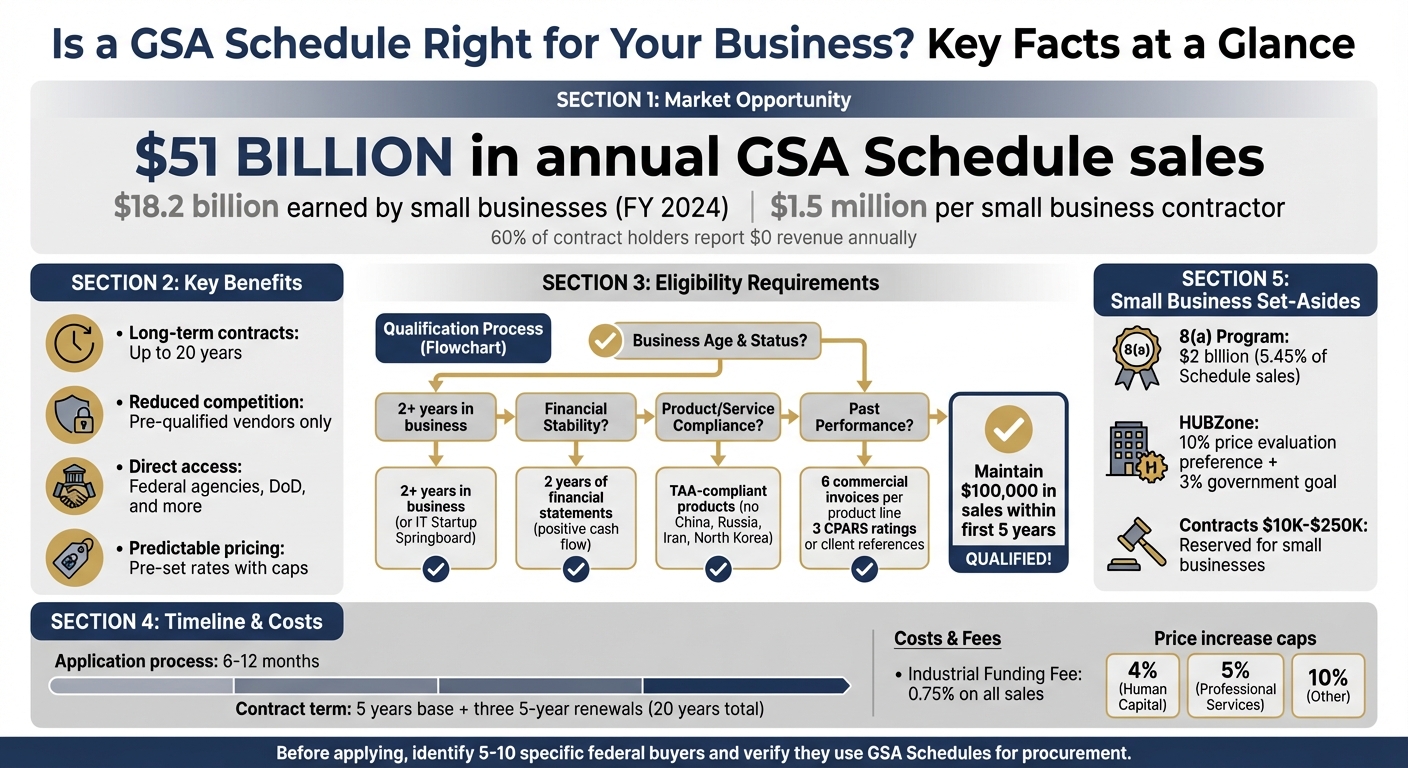
GSA Schedule Requirements and Key Statistics for Federal Contractors
Benefits of Getting a GSA Schedule
Faster Procurement and Long-Term Contracts
A GSA Schedule operates as an Indefinite Delivery, Indefinite Quantity (ID/IQ) contract, allowing federal agencies to buy your products or services without starting the negotiation process from scratch every time. This eliminates the need for repetitive RFPs and provides a five-year base term, with the option for three additional five-year renewals – offering a potential 20-year contract. That’s two decades of stability to help you plan for growth.
This extended term gives businesses the ability to forecast and prepare, whether it’s hiring new staff or upgrading infrastructure. Plus, as your contract approaches the end of its lifecycle, GSA’s "Streamlined Offer" process ensures you can continue selling without going back to square one. This not only simplifies procurement but also strengthens your position against competitors who may lack the same qualifications.
Reduced Competition and Direct Access to Federal Buyers
With a GSA Schedule, you’re pre-qualified, meaning you’ll face significantly less competition. Only vendors holding a GSA Schedule can bid on agency contracts issued under the program, which narrows the playing field compared to open market solicitations.
Additionally, GSA Schedule holders gain access to a broad range of buyers, including federal agencies, the Department of Defense, the District of Columbia, and even specific international organizations. Small businesses, in particular, can tap into set-asides for programs like 8(a) business development, HUBZone, and woman-owned small businesses (WOSB). Tools like GSA Advantage!, an online purchasing platform, and GSA eBuy, which allows real-time responses to government solicitations, further expand your reach and opportunities. These tools, combined with predictable pricing, give you a competitive edge.
Stable Pricing and Revenue Growth
One of the biggest perks of a GSA Schedule is predictable pricing, which lays the groundwork for steady revenue growth. Pricing is pre-set and capped annually – 4% for Human Capital, 5% for Professional Services and Travel, and 10% for most other categories. After your first year, you can request Economic Price Adjustments within the established limits.
This pricing transparency makes it easier for federal buyers to make decisions, as they know exactly what they’re getting, including delivery terms and warranties. Payment processing is also streamlined through government purchase cards. For businesses, this predictability means better revenue forecasting, which allows for smarter investments and more strategic growth planning.
Which Businesses Should Get a GSA Schedule?
Small Businesses Seeking Federal Work
For small businesses aiming to secure federal contracts, a GSA Schedule can be a game-changer. If your business qualifies for set-aside programs like 8(a) or HUBZone, the benefits are even greater. Federal agencies are required to prioritize GSA-approved small business vendors, which means less competition for you once you’re on the schedule. Here’s an example: the 8(a) Program alone accounted for over $2 billion (5.45% of Schedule sales) from 1,383 vendors. Plus, contracts ranging from $10,000 to $250,000 are exclusively reserved for small businesses.
HUBZone-certified businesses enjoy additional perks, like a 10% price evaluation preference in open competitions. On top of that, the government has an annual goal to award 3% of its contract dollars to HUBZone-certified companies. These advantages stem from the Small Business Act, giving certified businesses a clear edge in the federal marketplace.
Companies with Commercial Sales History
If your business has a strong commercial sales track record, you’re also an ideal candidate for a GSA Schedule. Industries like manufacturing, IT, and service provision often thrive in this space because the GSA looks for companies that can prove they’ve successfully sold products or services at market rates. This commercial pricing history becomes the foundation for GSA pricing negotiations.
Businesses already serving commercial customers usually have the systems and documentation needed to meet GSA standards. If you’re managing invoicing, warranties, deliveries, and customer support effectively, chances are you’re already aligned with federal compliance expectations. This operational readiness makes the application process smoother and positions your business as a reliable partner for government contracts.
Requirements and Obstacles for GSA Schedules
Eligibility Criteria and Required Documents
Securing a GSA Schedule isn’t a casual process – it comes with a detailed list of requirements. First, your business must have at least two years of operational history, although IT startups may qualify under the IT Startup Springboard exception. Financially, you need to provide two years’ worth of profit and loss statements and balance sheets that clearly show positive cash flow.
Your products must comply with the Trade Agreements Act (TAA), which means they cannot originate from restricted countries like China, Russia, Iran, or North Korea. Additionally, certain items are outright ineligible, including weapons, ammunition, construction services, and architectural work. Sales history is another critical factor – you’ll need to provide a minimum of six commercial invoices per product line, along with three CPARS ratings or equivalent client references.
Here’s a quick breakdown of the key requirements:
| Category | Requirement for Qualification |
|---|---|
| Business History | At least 2 years in operation (or use IT Startup Springboard) |
| Financials | 2 years of P&L statements and balance sheets; positive cash flow |
| Compliance | TAA-compliant products (no origins in China, Russia, Iran, or NK) |
| Prohibited Items | No weapons, ammunition, construction, or architectural services |
| Sales History | At least 6 commercial invoices per product line |
| Performance | 3 CPARS ratings or equivalent client references |
| Integrity | No bankruptcies in the past 3 years; strong business ethics |
Even after meeting these initial requirements, maintaining your GSA Schedule involves ongoing compliance to avoid penalties or contract termination.
Compliance Duties After Award
Winning a GSA Schedule is just the beginning. Once awarded, you’ll face several responsibilities to keep your contract in good standing. For starters, your SAM.gov registration must be renewed annually – every 365 days – to ensure your contract remains active.
There’s also a sales benchmark to meet: $100,000 in total sales within your first five years. Pricing adjustments are restricted during the first year of your contract, and any increases afterward are tightly regulated. For instance, price hikes are capped at 4% for Human Capital services, 5% for Professional Services, and 10% for other categories.
If you’re a small business utilizing set-aside contracts, subcontracting rules apply. For service contracts, you can’t subcontract more than 50% of the government payment. Similarly, for supply contracts, subcontracting is capped at 50%, excluding the cost of materials.
These ongoing obligations require careful planning and attention to detail, adding to the workload of managing a GSA Schedule.
Application Timeline and Complexity
The application process for a GSA Schedule is a marathon, not a sprint. On average, it takes six to twelve months to complete, and the complexity lies in the details. You’ll need to juggle a mountain of documents, ensure precise pricing, and stay updated on shifting federal regulations. Even a small mistake – like a missing document or a pricing misstep – can derail the process and cause delays.
Many businesses underestimate the administrative work involved. This isn’t just about submitting forms; it’s about building a compliance system that will sustain your business for years. To navigate these challenges, companies like GSA Focus offer tailored support, from preparing documents to ensuring compliance and even assisting with negotiations. Their expertise can make the entire process far more manageable for small businesses aiming to secure a GSA Schedule Contract.
How to Decide If a GSA Schedule Fits Your Business
Review Your Federal Sales Potential
Before diving into the GSA Schedule application process, it’s crucial to evaluate your potential for federal sales. Start by pinpointing specific federal buyers who are likely to need what you offer. Instead of assuming that a large agency like the Department of Defense will require your product, focus on 5–10 program offices or decision-makers who have previously purchased similar items. Tools like USASpending.gov and SSQ+ can help you track federal spending patterns on comparable products.
Here’s something to keep in mind: 60% of GSA Schedule contract holders report zero revenue in a given year. So, it’s important to confirm whether your target buyers use GSA Schedules for purchases or if they rely on other methods, such as GWACs or agency-specific IDIQs, which account for 40–70% of acquisitions. Without clear buyers or active opportunities, it might be wise to delay pursuing a GSA Schedule. This focused research will help you decide whether the administrative investment is worth it.
Check Your Compliance Capacity
Getting a GSA Schedule isn’t a one-and-done process – it requires consistent administrative effort. Your team will need to handle tasks like annual renewals on SAM.gov, tracking opportunities on the eBuy platform, and meeting the $100,000 minimum sales requirement within the first five years. Falling short of this benchmark could impact your contract renewal.
Ask yourself if your business has the resources to manage FAS ID logins, process contract modifications, and maintain Trade Agreements Act (TAA) compliance across your supply chain. Many successful small businesses dedicate time specifically for marketing and responding to RFQs. Once you’ve gauged your team’s capacity, weigh this effort against the potential market benefits.
Weigh Market Access Against Administrative Work
If you’ve identified federal spending opportunities and can handle the compliance workload, the next step is to evaluate whether the potential revenue justifies the effort. In fiscal year 2024, small businesses earned $18.2 billion through the GSA Schedule, with roughly 12,300 small business contractors averaging nearly $1.5 million in sales per firm. While the revenue potential is enticing, remember that the GSA Schedule involves a 3–6 month application process, ongoing compliance requirements, and a 0.75% Industrial Funding Fee on all sales.
If your target agencies prioritize "Spend Under Management" initiatives that favor GSA Schedules, the administrative workload might be worth it. However, if you’re new to federal contracting, consider starting as a subcontractor to validate your pricing and performance before committing to a GSA Schedule. Companies like GSA Focus can assist with document preparation and compliance, making the process more manageable. Carefully weigh these factors to determine if pursuing a GSA Schedule aligns with your business objectives.
Are You Ready for a GSA Schedule?
Conclusion
Securing a GSA Schedule can open the door to federal contracts – but success hinges on meeting eligibility requirements, understanding market demand, and maintaining compliance. As FEDSched aptly puts it: "The answer is really dependent on three key questions: 1) Do you Qualify, 2) Would You Benefit, and 3) Are you Ready".
Before diving into the application process, it’s crucial to confirm that the agencies you’re targeting actively use GSA Schedules for procurement. For instance, the National Archives and Records Administration (NARA) awards about 30% of its contracts through the GSA Schedule. Tools like SSQ+ can help you analyze whether competitors in your Special Item Number (SIN) are generating meaningful revenue. Interestingly, some businesses report $0 in total sales for certain SINs, underscoring the importance of thorough market research.
Once approved, managing a GSA Schedule comes with ongoing administrative responsibilities. These include maintaining required sales thresholds, paying the Industrial Funding Fee on transactions, submitting quarterly sales reports, and completing the mandatory 3–4 hour "Pathways to Success" training before applying.
If your business can meet federal demand and handle compliance requirements, a GSA Schedule grants access to exclusive systems like GSA eBuy. For those needing help with documentation and compliance, companies like GSA Focus provide full-service support to streamline the entire process.
FAQs
How do I know if federal buyers actually use a GSA Schedule for what I sell?
To determine whether federal buyers use a GSA Schedule for the products or services you offer, start by examining agency spending data and market trends. GSA Schedules are a popular procurement tool among government agencies, covering a wide range of needs. By analyzing this information, you can assess the demand for your offerings and better understand your potential market.
What are the biggest ongoing compliance tasks after I win a GSA Schedule?
After securing a GSA Schedule, staying on top of compliance is critical to maintaining your contract. Key tasks include:
- Submitting quarterly sales reports: These reports ensure transparency and track your sales under the GSA Schedule.
- Paying the Industrial Funding Fee (IFF): This fee, typically 0.75% of your GSA sales, must be paid on time to avoid issues.
- Maintaining updated SAM registration: Keeping your System for Award Management (SAM) registration current is essential for contract validity.
- Ensuring TAA compliance: Verify that all products or services meet the Trade Agreements Act (TAA) requirements.
- Updating contract details and pricing via eMod: Use the eMod system to make necessary updates to pricing, contact information, or terms.
- Monitoring adherence to GSA regulations: Regularly review and follow GSA rules to avoid penalties or contract termination.
By actively managing these responsibilities, you’ll safeguard your GSA Schedule and maintain a strong relationship with the government.
What can I do if I can’t hit $100,000 in Schedule sales within five years?
If your GSA sales don’t hit $100,000 within the first five years, your contract might be reviewed, or you could be asked to submit a sales improvement plan. To improve your results, prioritize marketing efforts, actively connect with federal buyers, and make sure you’re meeting compliance requirements. Still struggling? Reaching out to a GSA specialist, like GSA Focus, can provide tailored guidance to help you develop a strategy, boost sales, and keep your contract intact.
Related Blog Posts
- Top 7 GSA Schedule Benefits for Small Businesses
- How to Access GSA Small Business Support Programs
- What Is a GSA Contract and Why Should Small Businesses Care?
- Understanding the Basics of a GSA Schedule Contract