
GSA purchasing is a federal program that connects small businesses with government buyers through pre-negotiated contracts, offering a simpler and faster way to secure long-term federal contracts. With contracts lasting up to 20 years, small businesses can gain access to platforms like GSA Advantage! and GSA eBuy, which streamline procurement and eliminate the need for constant renegotiation.
Key points:
- Eligibility: U.S.-registered businesses with active SAM.gov registration and compliance with SBA size standards.
- Advantages: Faster sales cycles, stable revenue, and access to exclusive federal contracting opportunities.
- Requirements: Financial documents, past performance references, and compliance with Trade Agreements Act (TAA).
- Process: Submit applications via the eOffer system, prepare documents, and align offerings with appropriate NAICS codes.
For small businesses looking to grow through federal contracts, GSA purchasing offers a streamlined path to success.
What is GSA Purchasing and How Does Federal Procurement Work?
What is GSA Purchasing?
GSA purchasing, officially known as the Multiple Award Schedule (MAS) or Federal Supply Schedule, is a contract program managed by the U.S. General Services Administration. It provides federal, state, and local agencies with direct access to over 25 million commercial products and services at pre-negotiated, discounted rates. These contracts are set up as Indefinite-Delivery, Indefinite-Quantity (IDIQ) agreements, where pricing, compliance rules, and delivery terms are finalized upfront. Once approved, agencies can order anytime during the contract’s lifespan, which can last up to 20 years. This system, governed by FAR Subpart 8.4, simplifies the procurement process, cutting down on administrative work and speeding up purchases compared to traditional contracting methods.
One key aspect of GSA pricing is the "most favored customer" clause, which ensures the government gets rates equal to or better than your best commercial pricing. In return, vendors pay a 0.75% Industrial Funding Fee (IFF) on reported MAS sales to help fund the program. Annual price increases are capped at 10% per category item, unless you can provide justification for a larger adjustment.
Being part of the GSA Schedule also boosts your business’s visibility. Federal buyers can quickly find your offerings through established platforms, and agencies are incentivized to award contracts to small businesses, earning socioeconomic credits in the process. This structure makes it easier for small businesses to tap into federal opportunities.
Why Small Businesses Should Use GSA Purchasing
For small businesses, GSA purchasing offers a fast track to federal contracts, bypassing the lengthy and competitive bidding process. Agencies can set aside orders exclusively for small businesses if market research identifies at least three capable vendors. Additionally, certifications like 8(a), HUBZone, Women-Owned (WOSB), or Service-Disabled Veteran-Owned (SDVOSB) open doors to even more set-asides, further reducing competition.
The program is also designed to accommodate newer businesses. Through the Startup Springboard program, companies with less than two years of experience can substitute professional credentials for corporate history, eliminating the standard two-year requirement. This makes it easier for startups to enter the federal market.
Time is another advantage. Securing a GSA Schedule typically takes 3–6 months, compared to the 6–12+ months often required for open-market contracts. Once approved, your contract can last up to 20 years, far longer than the usual 5-year cap on standard contracts. This extended duration provides stable revenue and reduces the need to constantly pursue new opportunities.
Financially, the GSA program is a win for small businesses. Federal agencies actively seek out small vendors to meet their annual contracting goals, and pre-negotiated pricing eliminates the need for constant renegotiation. For small businesses looking to grow, GSA purchasing is a pathway to both stability and opportunity.
Is a GSA Schedule Right for Your Business?
Eligibility and Requirements for Small Businesses
Now that we’ve covered the perks of GSA Purchasing, it’s time to confirm your eligibility and get your paperwork in order.
Who Qualifies for GSA Purchasing?
To secure a spot on a GSA Schedule, your business must meet specific criteria. First, your company needs to be a legally registered U.S. entity, such as an LLC or corporation, with a physical presence in the United States. An active SAM.gov registration is also essential. This includes obtaining a Unique Entity Identifier (UEI) and a Federal Employer Identification Number (FEIN). Keep in mind, this registration must be renewed annually.
Typically, businesses are required to have at least two years of verifiable commercial operations. However, if you’re a new IT company, the Startup Springboard Program may allow you to substitute professional credentials for operational history. To qualify as a small business and access set-aside opportunities, your business must meet the SBA size standards for your primary NAICS codes. For example, most manufacturing companies qualify if they have 500 or fewer employees, while non-manufacturing businesses generally need average annual receipts under $7.5 million.
If your business holds socioeconomic certifications, you might gain an edge. Certifications like 8(a) (disadvantaged), WOSB (women-owned), HUBZone (located in underutilized areas), or SDVOSB (service-disabled veteran-owned) open doors to additional set-aside opportunities with less competition. Before moving forward, make sure to identify all applicable NAICS codes for your products or services. These codes determine which opportunities are available to you and which size standards apply.
Once you confirm your eligibility, it’s time to gather the necessary documents to meet GSA’s requirements.
Required Documents and Compliance
To demonstrate financial stability, you’ll need two years of Profit & Loss statements and Balance Sheets. The GSA advises maintaining cash reserves of 15–20% of your proposed contract value to show you’re financially prepared. Additionally, you’ll need to provide six commercial invoices per product or service, proving both commercial availability and fair pricing.
Your products must comply with the Trade Agreements Act (TAA), meaning they must be manufactured or substantially transformed in the U.S. or a designated country. Products originating from non-compliant countries like China or Russia will disqualify your application, so it’s important to review your supply chain early.
To verify your performance history, you’ll need three CPARS ratings or equivalent client references. These documents showcase your track record and reliability. Another requirement is completing the "Pathways to Success" training, which must be done by at least one company officer. This course covers the application process and compliance essentials.
If you’re planning to pursue Department of Defense contracts, you’ll also need to meet the Cybersecurity Maturity Model Certification (CMMC) levels specified in their requests for proposals. Preparing these documents several months in advance can help you avoid delays and make the application process smoother.
How to Get on a GSA Schedule
GSA Schedule Application Process for Small Businesses
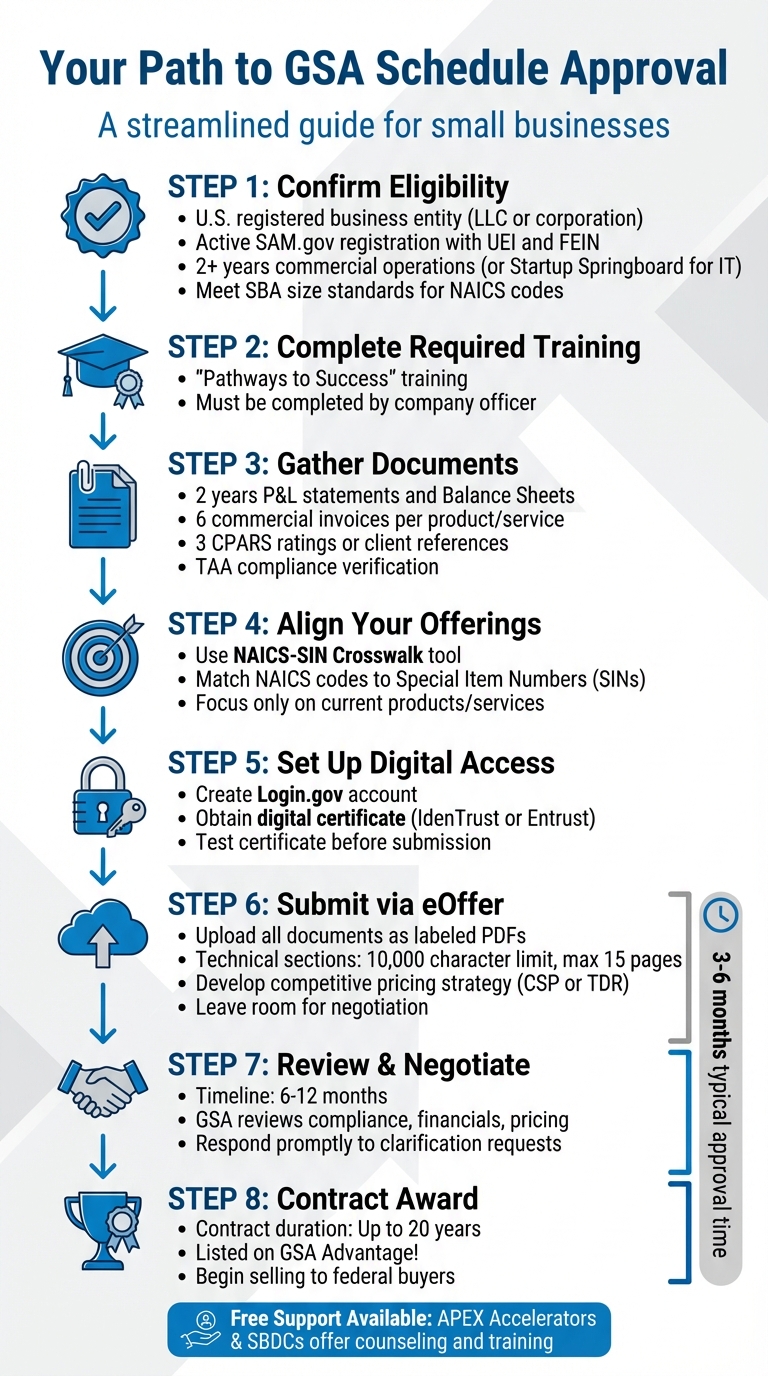
Once you’ve confirmed your eligibility and gathered all the necessary documents, the next step is submitting your proposal through the eOffer system. From there, you’ll work closely with a GSA Contracting Officer to finalize your contract.
Preparing Your Business for the Application
After completing the required training, your focus should shift to aligning your business offerings with the appropriate Special Item Numbers (SINs). The NAICS–SIN Crosswalk tool is a key resource here, helping you match the NAICS codes in your SAM.gov profile with the SINs you plan to apply for. Double-check these alignments – mistakes could result in rejection. Stick to SINs that directly reflect your current products or services; adding unrelated ones will only complicate the review process and slow things down.
To access the eOffer platform, you’ll need a Login.gov account and a digital certificate from an approved vendor like IdenTrust or Entrust. It’s a good idea to test your digital certificate beforehand to avoid technical hiccups. Organize all your required documents into clearly labeled PDFs following GSA’s guidelines, so everything is ready to go when it’s time to submit.
Once you’ve laid this groundwork, you can move forward with submitting your proposal through the eOffer system.
Submitting and Managing Your Application
Log into the eOffer system to begin your proposal. Upload all required documents, including financial statements, a Capability Statement, past performance reports, technical narratives, a Professional Compensation Plan (if you’re a service provider), and an organizational chart. Make sure each document is formatted as a PDF with clear labels. Keep in mind that technical proposal sections often have a 10,000-character limit, and total technical uploads shouldn’t exceed 15 pages.
When it comes to pricing, focus on developing a fair and competitive strategy. Use either Commercial Sales Practices (CSP) or Transactional Data Reporting (TDR) as your guide to ensure your rates are deemed "fair and reasonable." A helpful tip: don’t offer your absolute best pricing up front. GSA Contracting Officers are required to negotiate for better terms, so leaving some room for negotiation can work in your favor.
The review process typically takes 6–12 months and includes checks on compliance, financial stability, pricing, and more. Be sure to respond promptly to any questions or requests for clarification to avoid delays.
If you’re a small business, take advantage of free resources like APEX Accelerators (formerly PTACs) or Small Business Development Centers (SBDCs). These organizations offer counseling, training, and hands-on support to help you refine your proposal and pricing strategies, making the process smoother and more manageable.
Benefits of GSA Purchasing for Small Businesses
Access to Federal Buyers and Greater Visibility
Having a GSA Schedule puts your business in front of thousands of federal buyers. With a listing on GSA Advantage!, you can connect directly with these buyers and skip the usual long and tedious open-market bidding process. Small businesses in industries like Transportation and Logistics (76%) and Industrial Products (61%) are already securing a large share of federal contracts. Plus, having a GSA Schedule contract signals trustworthiness – GSA has already vetted your financial health, technical skills, and past performance.
A Faster Way to Do Business
Speed is another big win. GSA Schedules simplify the procurement process by eliminating the need for repeated negotiations. Once pricing, terms, and conditions are set, they stay locked in for up to 20 years. This means government buyers can skip lengthy due diligence and place orders almost instantly – sometimes in minutes instead of months. For small businesses, this faster process shortens sales cycles and gets revenue flowing quicker.
Federal Contracts as a Revenue Booster
The financial rewards are hard to ignore. In FY2024, small businesses earned $18.2 billion through GSA Schedule sales, with an average of nearly $1.5 million per contractor. Over the last five years, sales under GSA Multiple Award Schedule contracts have grown by about 26%. Today, small businesses make up roughly 35% of all GSA MAS contract sales. On top of that, federal law mandates that at least 23% of the government’s yearly contracting budget goes to small businesses. With total GSA MAS sales hitting over $50 billion in FY2024, the earning potential for small businesses is only increasing. These advantages give small businesses the tools they need to succeed in the federal marketplace.
How GSA Focus Helps Small Businesses
Full-Service Solutions for Small Businesses
Getting a GSA Schedule contract isn’t exactly a walk in the park. It can involve over 100 pages of paperwork and plenty of detailed documentation. That’s where GSA Focus steps in. They handle the entire process for you – from preparing and submitting documents to managing clarifications with the GSA and negotiating the final award. For business owners, this means your time commitment is cut down to just 3–4 hours.
Their approach includes an online portal with a guided checklist, making it easier to upload documents and track progress. Once you secure your contract, their "GSA Maintenance on Autopilot" service takes care of compliance and administrative updates, so you can concentrate on growing your business. Plus, GSA Focus uses its connections within the GSA to help you stay ahead of any regulatory changes. This all-in-one service ensures you’re supported from start to finish – and beyond.
"GSA Focus was crucial in helping us get our GSA contract quickly with no headaches, setting us on the path to some big wins." – Deena T., Pacific Point
Proven Success and Support
The numbers speak for themselves. GSA Focus has helped secure over 550 GSA contracts, driving more than $500 million in federal sales. On average, clients see $927,000 in revenue after being awarded a GSA Schedule. With a 98% success rate, their skill in navigating the complex application process is clear.
But it doesn’t stop there. If they don’t secure your GSA Award, they offer a full refund. They also back their Accelerator marketing program with a 5X ROI guarantee over 18 months (provided you meet the effort requirements). Beyond just getting you the contract, they offer ongoing support like twice-monthly coaching calls, federal branding audits, and marketing services including bid pipeline development and proposal writing. Impressively, about 57% of their clients are first-timers to the GSA world, proving their ability to guide newcomers through the federal contracting maze.
Conclusion
GSA purchasing opens the door to a federal marketplace worth billions of dollars. With contracts that can extend up to 20 years, it offers businesses not just steady revenue but also a pathway to sustained growth. Plus, federal agencies actively look for small business vendors to meet their procurement goals, giving smaller companies a real shot at success.
Yes, the process can feel overwhelming with its paperwork and compliance requirements. But the rewards? They’re well worth it. Once you’re on a GSA Schedule, you can sell repeatedly under pre-negotiated terms, cutting down your sales cycle and minimizing the administrative hassle that often comes with traditional contracts.
To get started, register on SAM.gov and gather your financial and performance documents. If the process feels too complex, GSA Focus can help. They specialize in guiding small businesses through the system, taking care of the hard parts so you can concentrate on running your business. With a 98% success rate, they’ve proven they know how to deliver.
The federal marketplace is waiting. Take the next step and grow your business.
FAQs
How do I pick the right SINs for my business?
To choose the best SINs (Special Item Numbers), start by aligning your services and expertise with the appropriate SIN categories. For example, if your focus is IT services, SIN 54151S is a natural fit, while management consulting aligns with SIN 541611. Use resources like the GSA eLibrary to research market demand and identify SINs that showcase your strengths and proven track record. Steer clear of high-risk categories unless you have substantial experience in those areas. This approach ensures you’re targeting opportunities that play to your strengths while minimizing unnecessary risks.
What are the most common reasons GSA Schedule applications get delayed or rejected?
Common causes for delays or rejections often stem from errors that can be easily avoided with proper preparation. These include incorrect or mismatched Social Insurance Numbers (SINs), incomplete or outdated documentation, pricing that isn’t competitive or lacks clear justification, and issues with compliance or performance. Paying close attention to these details can help prevent unnecessary setbacks.
After award, how do I actually start getting orders through GSA Advantage! and eBuy?
Once you’ve been awarded a GSA Schedule, there are a few key steps to get started. First, upload your catalog and price list to GSA Advantage! – this is the government’s online shopping and ordering system. Next, update your profile on the Vendor Support Center (VSC), making sure your contact details and business capabilities are accurate and current.
For GSA eBuy, create an account and set up your profile. This platform allows you to browse and respond to Requests for Quotes (RFQs) and Requests for Proposals (RFPs) from government buyers actively searching for the products or services you offer. This is your opportunity to connect directly with agencies looking to make purchases.
Related Blog Posts
- Top 7 GSA Schedule Benefits for Small Businesses
- How to Access GSA Small Business Support Programs
- What Is a GSA Contract and Why Should Small Businesses Care?
- Understanding the Basics of a GSA Schedule Contract