

The GSA Price Reductions Clause (PRC) ensures the federal government gets pricing equal to or better than what contractors offer their most favored commercial customers. This clause, GSAR 552.238-81, applies to GSA Multiple Award Schedule (MAS) contracts not under Transactional Data Reporting (TDR). Contractors must maintain the agreed discount relationship with their Basis of Award (BOA) customer throughout the contract. Offering better terms to the BOA triggers an obligation to extend similar benefits to the government within 15 days. Non-compliance can lead to serious penalties, including fines under the False Claims Act.
Key Points:
- BOA Customer: Sets the benchmark for pricing relationships.
- Triggers: Price reductions, better discounts, or improved terms for the BOA customer.
- Reporting: Notify the GSA Contracting Officer within 15 days of any trigger.
- Exemptions: PRC does not apply under TDR or certain sales scenarios (e.g., sales to federal agencies or voluntary price reductions).
Understanding and adhering to PRC requirements is critical to avoid costly mistakes and maintain compliance.
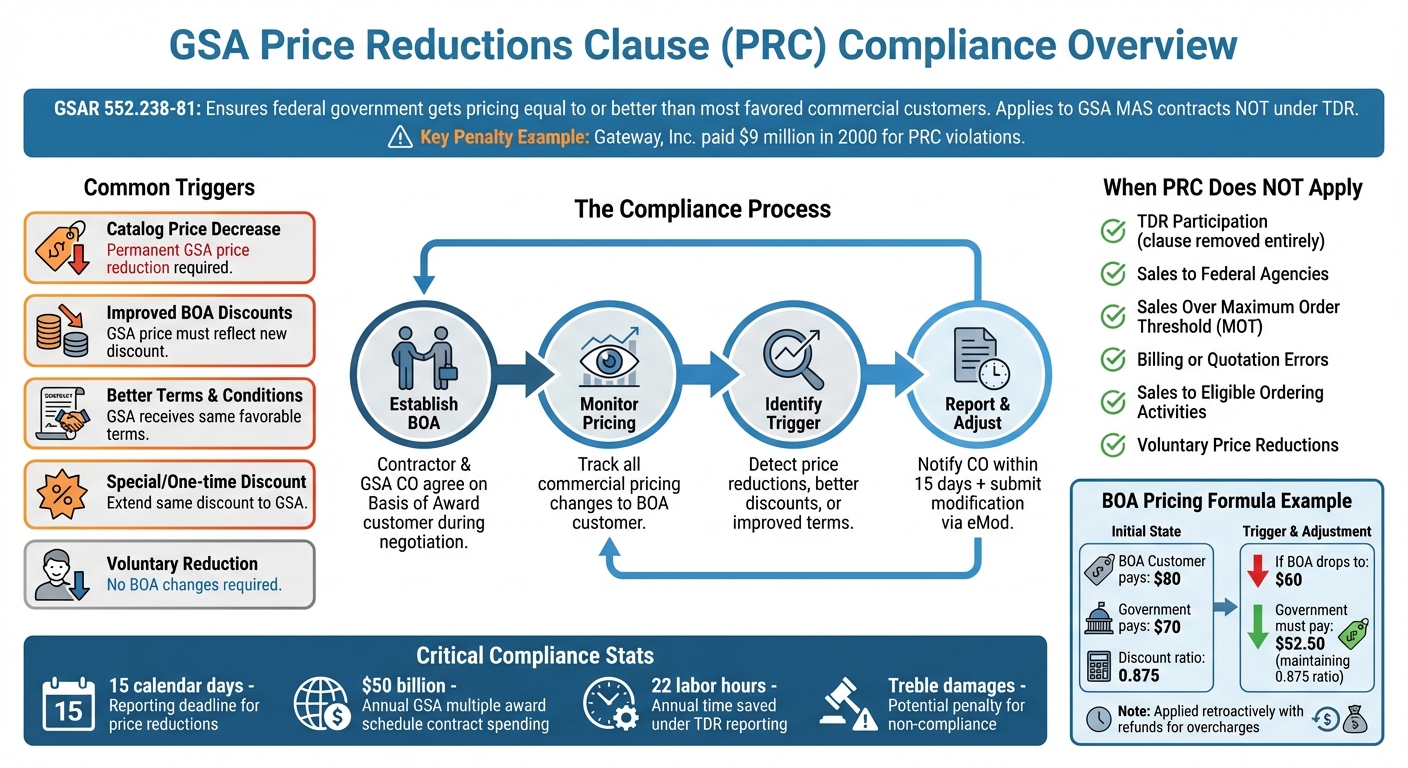
GSA Price Reductions Clause Compliance Process and Trigger Scenarios
Government Contracting – Understanding the GSA Price Reduction Clause – Win Federal Contracts
What Is the GSA Price Reductions Clause?
The Price Reductions Clause (PRC), officially labeled as GSAR 552.238-81, applies to traditional GSA Multiple Award Schedule (MAS) contracts that don’t use Transactional Data Reporting (TDR). Its purpose? To guarantee that federal agencies get pricing that’s just as good – or better – than what a contractor offers to their most favored commercial customers.
Here’s how it works: During contract negotiations, the contractor and the GSA Contracting Officer agree on a specific Basis of Award (BOA) customer or customer group. They also define the exact pricing or discount relationship between that BOA and the government. This relationship is locked in for the duration of the contract. If, at any point, the contractor gives the BOA customer a lower price or better discount, the GSA must receive a proportional price reduction within 15 calendar days. This mechanism is key to how the PRC is enforced.
Think of the PRC as a safeguard for taxpayer dollars, operating much like a "Most Favored Customer" clause but with stricter rules and enforceable penalties. For instance, in 2000, Gateway, Inc. paid $9 million to settle allegations of PRC violations – highlighting just how critical compliance is.
Grasping these basics is essential for understanding how your Basis of Award impacts PRC compliance.
The Basis of Award and How It Affects PRC Compliance
The Basis of Award (BOA) plays a key role in your GSA contract, serving as the foundation for all government pricing. It’s a benchmark agreed upon during contract negotiations between you and the GSA Contracting Officer, identifying a specific customer or customer class as the pricing standard. This agreement establishes a fixed price or discount relationship that must remain consistent throughout the contract term.
Here’s the catch: if you offer your BOA customer a better deal, you’re required to extend a proportional price reduction to the government. You must notify the GSA within 15 calendar days of such changes. Let’s take a closer look at how the BOA sets your pricing parameters and impacts compliance requirements.
How the BOA Defines Your Pricing Rules
The BOA essentially creates a formula that dictates your GSA pricing. For instance, if your BOA customer pays $80 for a product, and the government pays $70, the discount ratio is 0.875 ($70 ÷ $80). Now, if the BOA customer’s price drops to $60, the government’s price must adjust to $52.50 to maintain the same 0.875 ratio. This adjustment applies retroactively to the date the lower pricing began, and any overcharges must be refunded to the government.
"Before award of a contract, the Contracting Officer and the Offeror will agree upon the customer (or category of customers) which will be the basis of award, and the Government’s price or discount relationship to the identified customer (or category of customers)." – GSAR 552.238-81
Common BOA Customer Choices
Selecting the right BOA customer is a strategic decision because it directly affects your compliance responsibilities. Here are some typical examples:
- All Commercial Customers: This broad category means that any discount you offer across your entire commercial customer base could trigger a government price adjustment.
- Industry-Specific Customers: You might choose a sector like Healthcare or Education to align with federal purchasing patterns.
- Named Corporations: In some cases, a specific company may serve as your BOA customer.
- Exclusions: Contractors sometimes exclude Value Added Resellers (VARs) from the BOA, especially when their services differ significantly from what the government procures.
The choice of BOA customer determines how pricing adjustments ripple through your GSA contract, so it’s a decision that requires careful consideration.
What Triggers the Price Reductions Clause
To stay compliant with the Price Reductions Clause (PRC), it’s crucial to understand what triggers it. A trigger happens when there’s a change in the pricing or discount relationship between your Basis of Award (BOA) customer and the government. Essentially, any commercial pricing decision that impacts your BOA customer could also create an obligation under your GSA contract.
"Any change in the Contractor’s commercial pricing or discount arrangement applicable to the identified customer (or category of customers) which disturbs this relationship shall constitute a price reduction." – GSAR 552.238-81
Below are some common scenarios that can activate the PRC and require immediate attention.
Common PRC Triggers
The most common triggers involve reductions in catalog prices and improved discount terms for your BOA customer. For instance, if you lower the prices in a commercial catalog or pricelist that was used to establish your GSA contract, you’re required to pass that reduction on to the government. Similarly, if you offer your BOA customer a better discount – even for a one-time promotion – you must adjust your GSA pricing accordingly.
Changes to terms and conditions can also activate the PRC. This includes offering benefits like extended warranties, faster delivery, or longer payment terms that go beyond what’s outlined in your GSA contract. It’s critical to ensure that your commercial and government sales teams are aware of these triggers, as decisions made on the commercial side can inadvertently affect your government compliance.
Table: Trigger Scenarios and Required Actions
| Trigger Scenario | PRC Impact | Required Contractor Action |
|---|---|---|
| Catalog Price Decrease | GSA price must be permanently reduced to maintain the agreed ratio | Notify the Contracting Officer (CO) within 15 days and submit a contract modification with the updated pricelist |
| Improved BOA Discounts | GSA price must reflect the updated discount | Recalculate the GSA price, notify the CO within 15 days, and adjust the contract terms accordingly |
| Better Terms & Conditions | GSA must receive the same favorable terms | Notify the CO and update the contract terms to align with the improved commercial offer |
| Special/One-time Discount | Requires extension of the same discount to GSA | Offer the same discount to GSA for the applicable period and notify the CO |
| Voluntary Reduction | Contractor-initiated; no BOA changes required | Notify the CO when voluntarily reducing prices to remain competitive |
These scenarios highlight how specific actions can directly affect your contract compliance. By staying vigilant and proactive, you can avoid potential issues while maintaining good standing with GSA requirements.
How to Report and Adjust Prices for PRC Compliance
Staying compliant with PRC requirements is critical for safeguarding your business and maintaining federal trust. One key rule: notify your GSA Contracting Officer (CO) within 15 calendar days of any price reduction trigger. Missing this deadline can lead to serious penalties, so timing is everything.
When reporting, you need to go beyond just stating the new price. According to GSAR 552.238-81(b), "The Contractor’s report shall include an explanation of the conditions under which the reductions were made". Essentially, you must explain what caused the price reduction, identify the customer who received it, and clarify how it impacts your Basis of Award (BOA) relationship. All modification requests must be submitted through the eMod system at eOffer.gsa.gov. To avoid delays, document the trigger in detail to support accurate and timely price adjustments.
You’ll also need to provide supporting documentation, such as an updated price list or customer communications outlining the discount terms. This proof should confirm the trigger and its effective date. Importantly, price reductions are applied retroactively to the date you first offered the lower price to your BOA customer. If there’s a delay between offering the discount and finalizing the contract modification, you must refund any overcharges to the government. This level of detail ensures your reporting process aligns with internal controls.
To stay ahead, implement formal procedures and conduct regular audits. These measures help your sales team quickly spot and report any price reductions. Michelle L. Caton, Partner at Husch Blackwell LLP, cautions: "Identifying and reporting a relevant price change and the time lag that follows in accordance with the PRC can be a potential trap for schedule contractors".
Violating PRC rules can have serious consequences. Alleged PRC violations are a leading cause of post-award GSA Schedule audits. Non-compliance can result in harsh penalties, including treble damages. Taking proactive steps to ensure compliance is not just smart – it’s essential.
When the PRC Does Not Apply
Understanding when the Price Reductions Clause (PRC) doesn’t apply is just as important as knowing how to manage it. Recognizing these exemptions can save you time and reduce unnecessary paperwork. One of the most comprehensive exemptions occurs when you participate in Transactional Data Reporting (TDR). Under TDR, monthly reporting eliminates the PRC from your contract entirely. Patrick Morgans, Manager at Winvale, clarifies:
"If you report monthly, you are under Transactional Data Reporting, and the Price Reductions Clause does not apply".
Since June 26, 2025, TDR reporting has been mandatory for eligible Special Item Numbers (SINs), saving contractors roughly 22 labor hours each year. Beyond TDR, there are specific scenarios where the PRC is also exempt, helping streamline compliance and avoid costly adjustments.
According to GSAR 552.238-81:
"There shall be no price reduction for sales – To commercial customers under firm, fixed-price definite quantity contracts with specified delivery in excess of the maximum order threshold specified in this contract; To Federal agencies…"
PRC Exemptions
Several scenarios exempt your contract from triggering the PRC, including sales to federal agencies, transactions exceeding the Maximum Order Threshold (MOT) under fixed-price agreements, billing errors, and orders from Eligible Ordering Activities. For billing or quotation errors, it’s essential to provide supporting documentation to your Contracting Officer to confirm the error was unintentional. This includes gathering all correspondence and corrected invoices to demonstrate your case.
Voluntary price reductions are another exemption. While these do not trigger the PRC, you must notify your Contracting Officer and process a contract modification if you choose to lower your GSA prices. The table below outlines these exemptions in detail.
Table: Exemptions and Non-Triggers
| Scenario | Triggers PRC? | Required Action |
|---|---|---|
| TDR Participation | No (Clause removed) | Report transactional data monthly |
| Sales to Federal Agencies | No | None |
| Sales Over Maximum Order Threshold (MOT) | No | Ensure sale is firm-fixed-price with specified delivery |
| Billing or Quotation Errors | No | Provide documentation to the Contracting Officer |
| Sales to Eligible Ordering Activities | No | Confirm order is placed under the GSA contract |
| Voluntary Price Reductions | No (Optional) | Notify CO; contract modification required |
Conclusion
Managing your Price Reductions Clause (PRC) obligations requires diligence and a proactive approach.
The PRC is more than just a contractual detail – it’s a safeguard against financial and legal risks. With GSA multiple award schedule contracts accounting for approximately $50 billion in annual spending, even a small oversight, like failing to report a discount to your Basis of Award customer, can lead to mandatory price adjustments, retroactive damages, or even severe penalties under the False Claims Act.
The cornerstone of compliance lies in internal coordination. Your commercial sales team must understand that their pricing decisions directly affect your GSA contract. As FEDSched emphasizes:
"Non-compliance with the Price Reductions Clause can lead to costly mistakes. Educating your team on the PRC is the first step towards compliance".
To stay ahead, implement clear procedures, educate your team on PRC triggers, and conduct regular audits. If navigating PRC compliance feels overwhelming, consider consulting specialists who can guide you through the complexities. For instance, GSA Focus offers tailored support, helping businesses manage GSA Schedule compliance, pricing strategies, and contract modifications.
FAQs
How do I choose the best BOA customer?
To determine the best Basis of Award (BOA) customer for a GSA Schedule contract, it’s crucial to choose a customer or category with steady and predictable pricing, discounts, or terms. Prioritize factors such as consistent business volume, reliable pricing practices, and a strong commercial relationship. This approach helps maintain compliance with the Price Reductions Clause and establishes a solid pricing benchmark for the government contract.
What discounts count as a PRC trigger?
Discounts that match or go beyond those given to your largest commercial customer, leading to a drop in the commercial price or market rate, are known as PRC triggers. When these discounts occur, you may need to adhere to the GSA Price Reductions Clause to maintain consistent pricing practices.
What happens if I miss the 15-day notice?
If you fail to meet the 15-day deadline to report a price reduction as outlined in the Price Reductions Clause, your contract might be adjusted to reflect the agreed pricing terms. This adjustment could result in lower contract prices to ensure compliance with the government’s standards.
Related Blog Posts
- Ultimate Guide to GSA Compliance Standards
- 5 GSA Discounting Rules for Compliance
- How GSA Pricing Works: A Guide for Vendors
- What Is GSA Most Favored Customer Pricing?