

Want to tap into the $51.9 billion federal marketplace? For small businesses, the GSA Schedule offers an efficient way to sell directly to federal agencies without the hassle of bidding on individual contracts. In 2024, small businesses secured $18.2 billion in GSA sales – proof that this opportunity isn’t just for large corporations.
Here’s what you need to know to succeed in 2025:
- Optimize your GSA listings: Use the right SIN categories, clear descriptions, and competitive pricing to stand out on GSA Advantage and eBuy.
- Enhance your online presence: Align your website with your GSA offerings, focus on SEO, and keep your information current.
- Target the right agencies: Research agency needs on SAM.gov, use fiscal year spending patterns to time your outreach, and build relationships with decision-makers.
- Leverage partnerships: Subcontract with primes or form teaming agreements to increase your chances of winning contracts.
- Create professional materials: Update capability statements regularly and showcase past performance with measurable results.
Consistency is key. By refining your digital strategy, building trust with federal buyers, and staying active in the marketplace, you can secure a steady stream of contracts. Need help? Services like GSA Focus can guide you through the process.
Marketing your GSA Schedule
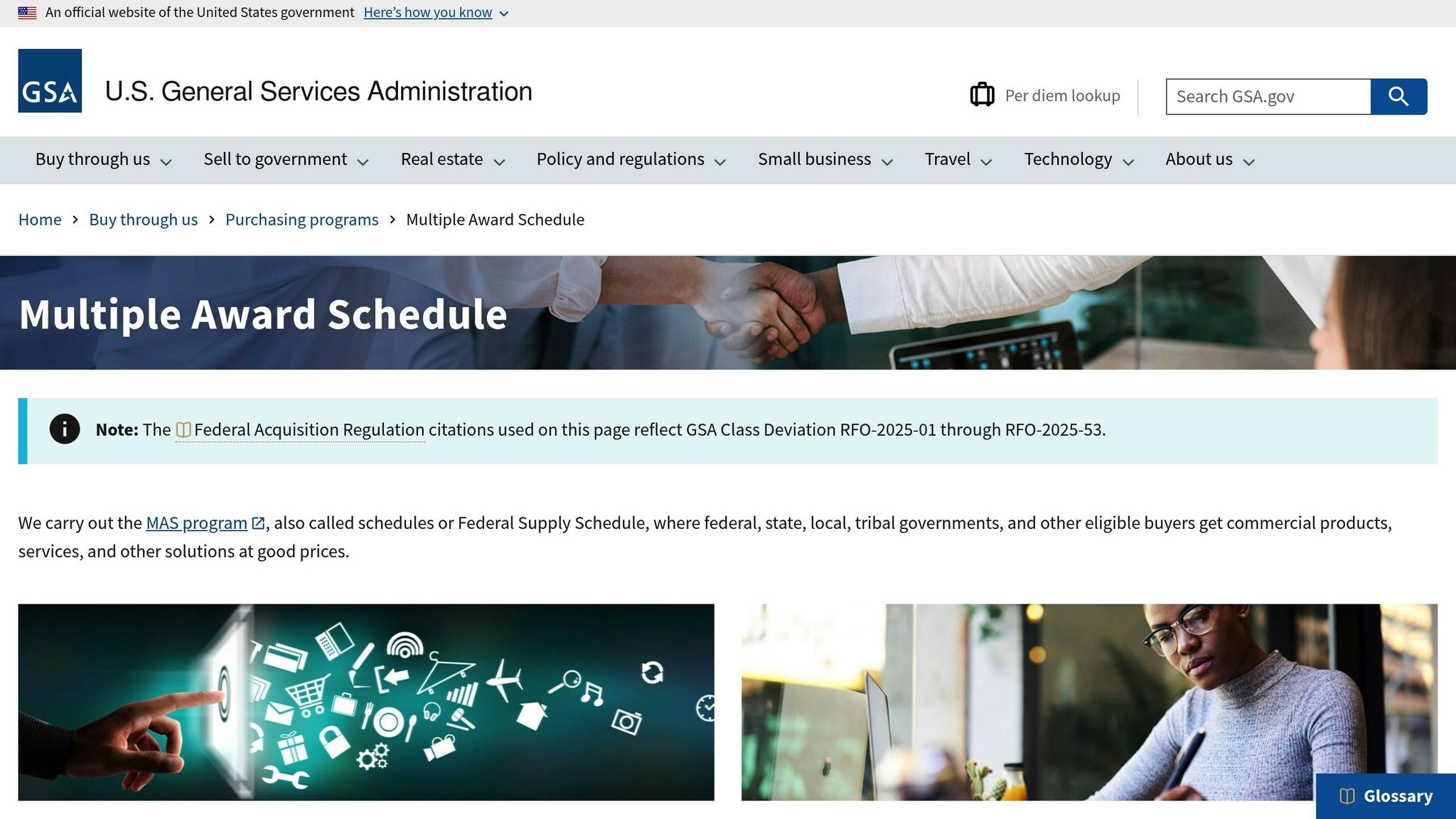
Improving Your GSA Online Presence
Getting approval for your GSA Schedule is just the beginning. To truly succeed, you need to optimize your listings to grab the attention of federal buyers. Without proper optimization, your products or services may get overlooked, leading to missed sales opportunities. Federal buyers rely on specific platforms to find solutions, and your visibility on these platforms plays a huge role in whether they choose to work with you.
A passive approach to your listings won’t cut it. To attract organic traffic and qualified leads, you need to take deliberate steps to make your offerings stand out. Here’s how you can fine-tune your GSA marketplace listings and digital storefront to better engage federal buyers.
Creating Better GSA Advantage and GSA eBuy Listings
Federal agencies frequently turn to GSA Advantage and GSA eBuy to find the products and services they need. If your listings aren’t optimized, they may never even see your offerings.
- Focus on the Right Special Item Numbers (SINs): Federal buyers typically search by SIN categories rather than company names. Make sure your products or services are correctly aligned with the appropriate SINs, such as IT, Facilities, or Professional Services. Each SIN comes with its own technical, pricing, and compliance standards, so double-check your categorization using the GSA eLibrary.
- Write Descriptions That Speak to Federal Buyers: Your descriptions need to do more than explain what you’re selling – they should highlight how your offerings solve federal agency challenges. Include technical specs, compliance certifications, and any unique features that set you apart. Use keywords that federal buyers are likely to search for, and organize your descriptions with bullet points or headers to make them easy to scan.
- Price Competitively and Transparently: Federal buyers compare vendors to find the best value. Research competitor pricing on GSA Advantage to understand the market, but avoid pricing so low that it hurts your bottom line. Instead, focus on fair pricing and be ready to explain your Basis of Award (BOA) if offering discounts.
- Add Visuals and Keep Information Accurate: Professional photos, diagrams, or other visuals can help buyers better understand your offerings. Ensure your listings reflect your current inventory and capabilities – outdated or incomplete information can harm your credibility and lead to missed opportunities.
- Stay Updated: Make it a habit to review and update your listings at least once every quarter. Whether it’s a price change, a new product, or an updated certification, keeping your listings fresh shows federal buyers that your business is active and reliable.
Using Your GSA eLibrary Page Effectively
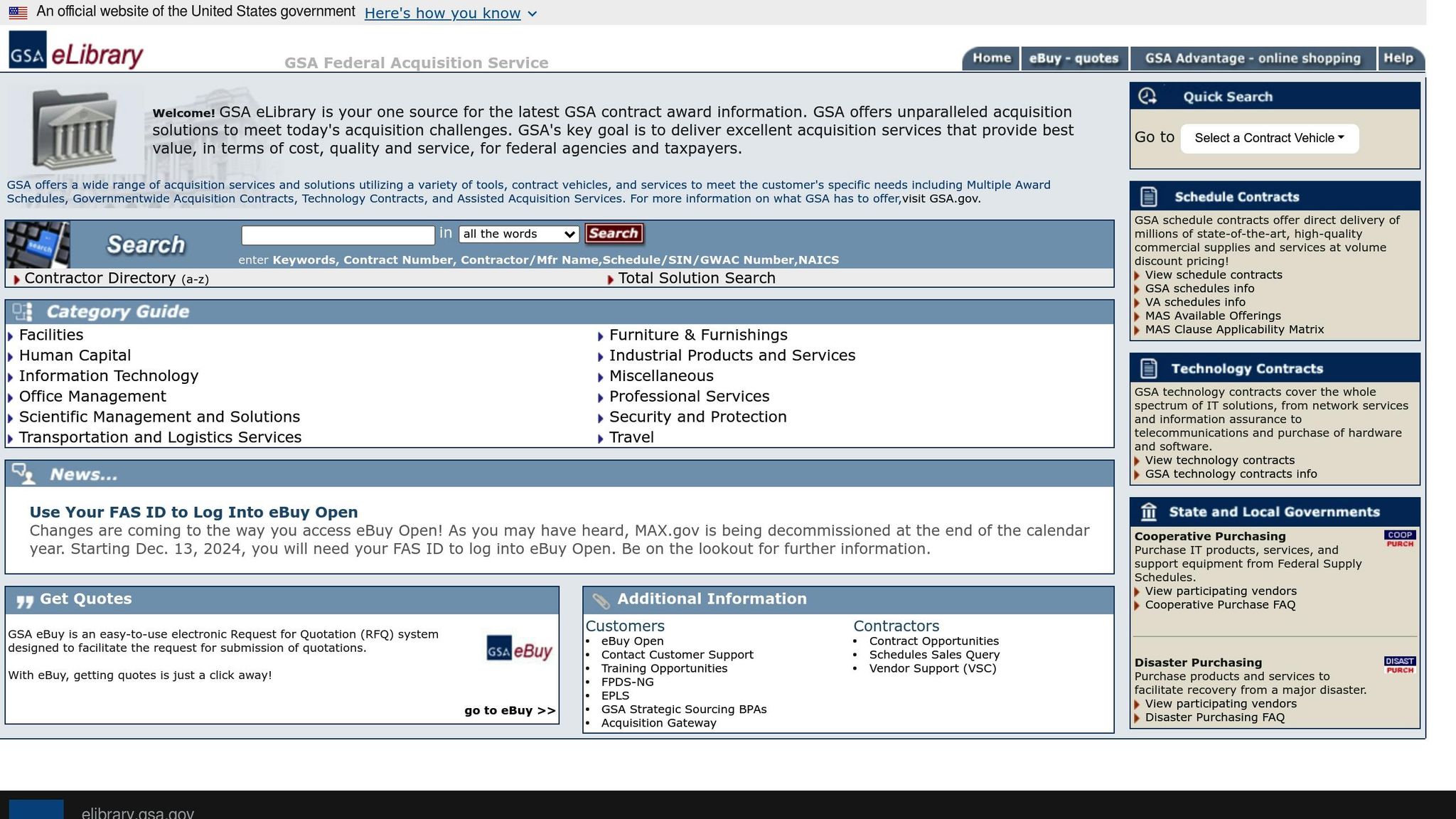
Your GSA eLibrary page is more than just a listing – it’s your digital storefront in the federal marketplace. Treat it with the same care and attention you give to your main website.
- Keep Branding Consistent: Your company description, logos, and messaging on your eLibrary page should align with your website and other marketing materials. Consistent branding builds trust and helps buyers quickly understand who you are and what you offer.
- Showcase Your Credentials and Successes: Use your eLibrary page to highlight certifications, past federal contracts, and any other credentials that demonstrate your reliability. Federal buyers are more likely to choose vendors with a proven track record of success.
A strong online presence can make all the difference in the competitive federal marketplace. If you need expert guidance, GSA Focus offers comprehensive support to help you optimize your digital presence and seize federal contracting opportunities.
Setting Up Your Marketing Foundation
To market your GSA Schedule effectively, you need to start with the basics: understanding which federal agencies are looking for what you offer and making sure they can find you online. Skipping these steps is a common mistake among small businesses, often leading to underperforming GSA contracts.
The federal marketplace is massive, with hundreds of agencies and thousands of buyers. If you’re not targeting the right agencies or optimizing your online presence, your efforts won’t deliver. A strong digital presence is your starting point. From there, focus on strategically identifying the federal agencies that need your solutions. Here’s how to set the stage for a successful GSA marketing strategy.
Researching Federal Agencies and Their Needs
Not every federal agency will be a match for your business. Step one is figuring out which agencies align with your products or services and have a track record of buying similar offerings.
Start by reviewing your own history. If you’ve worked with federal agencies before, analyze those relationships: Who bought from you? What did they purchase? How much did they spend? This data can highlight where you’ve already succeeded. If you’re new to federal contracting, think about whether any of your commercial clients operate in industries that overlap with federal needs.
Use SAM.gov as a research hub. Beyond registration, it’s a goldmine of contract opportunities across all federal sectors. You can filter opportunities by industry, product category, and business size to see what agencies are prioritizing.
Tap into resources like the GSA’s Office of Small and Disadvantaged Business Utilization (OSDBU). They host outreach events, matchmaking sessions, and webinars to connect small businesses with federal buyers. In FY 2024, for instance, their "Small Business Works" event paired 60 prime vendors with 60 small businesses.
Register in the SBA’s Dynamic Small Business Search to increase your visibility. Many prime contractors are required to award a significant portion of their subcontracts – often 30% or more – to small businesses.
Also, ensure your offerings are categorized under the correct Special Item Numbers (SINs), as federal buyers search by these codes rather than company names.
Timing matters, too. Federal agencies follow a fiscal year that runs from October 1 to September 30. Spending often spikes in the fourth quarter (July through September) as agencies work to use up their budgets. Aligning your outreach with these cycles can improve your chances of success, complementing your digital efforts.
Optimizing Your Website and SEO for GSA Contracts
In today’s federal marketplace, simply listing your products on GSA Advantage or GSA eBuy won’t cut it. You need a comprehensive digital strategy that actively draws in federal buyers. While optimized listings are important, your website must back them up with clear, persuasive content. Unfortunately, many GSA contractors overlook the basics of SEO and web analytics, giving an edge to those who invest in a strong online presence.
Make sure your website aligns with your GSA offerings. Your site, promotional materials, and web copy should clearly highlight your GSA-approved products and services. Include essential details like pricing, compliance certifications, SINs, and examples of past federal contracts to make it easy for buyers to understand what you bring to the table.
Focus on GSA-specific keywords. Research the terms federal agencies use when searching for solutions in your field. For instance, if you offer IT Professional Services, create content that showcases offerings like “FISMA-compliant IT support for federal agencies” or “Section 508 accessibility testing for government systems.” These specifics address the compliance standards federal buyers prioritize.
Use web analytics to fine-tune your strategy. Track which pages federal buyers visit most, which keywords drive traffic, and where visitors drop off. This data helps you continuously improve your digital approach.
Keep your GSA Schedule information up to date. Add new case studies from recent federal contracts and stay on top of procurement regulation changes. Regular updates not only improve your search engine rankings but also show buyers that you’re active and reliable.
Don’t forget the technical side of your website. Ensure it’s mobile-friendly and loads quickly. Federal buyers may be accessing your site from mobile devices or slower networks, so performance matters.
Building this foundation now can set you up for long-term success. GSA contracts typically last five years, with options to extend. By researching your target agencies and refining your digital presence, you can create a steady pipeline of qualified leads and contract opportunities. If navigating GSA marketing feels like too much to handle, GSA Focus offers tailored support to help small businesses succeed in the federal marketplace.
Building Relationships with Federal Buyers
Having a GSA Schedule and a strong online presence can open doors, but what truly secures contracts is trust. Federal buyers value contractors who have demonstrated reliability, affordability, and a clear understanding of their needs over time. GSA marketing goes beyond digital visibility – it’s about forming meaningful connections with decision-makers and proving your ability to deliver results consistently.
Federal buyers aren’t swayed by flashy presentations. Instead, they focus on vendors who can solve specific problems while staying within budget and complying with regulations. Your goal is to establish yourself as a dependable partner through focused outreach and strategic networking. This personal approach builds the foundation for long-term success.
Contacting Federal Buyers with a Clear Value Proposition
When reaching out to federal buyers, avoid generic pitches. Your value proposition must clearly show how your products or services address specific agency challenges while aligning with their goals and budget. Federal buyers care about outcomes: cost savings, improved efficiency, compliance with federal standards, and reliability.
Start by doing your homework. Research the agency’s strategic priorities and recent contracts. Tools like SAM.gov can help you identify agencies actively purchasing your type of products or services and the contracting officers involved. Visit agency websites to pinpoint procurement offices, program managers, and contracting officers who align with your offerings. For example, if an agency focuses on digital transformation, tailor your IT services to emphasize modernization and security compliance.
Your outreach should be concise, personalized, and focused on the buyer’s needs. A strong initial email might include:
- A brief introduction to your company.
- A specific value proposition tied to the agency’s goals.
- A reference to your GSA Schedule contract.
- A clear call-to-action, such as requesting a meeting or offering additional information.
If you don’t hear back, follow up within one to two weeks.
Personalized communication is key. Federal buyers can spot generic messaging instantly, so demonstrate that you understand their agency’s unique challenges. Use concrete metrics, such as on-time delivery rates or cost savings, to back up your claims and build credibility.
Leverage your GSA Schedule status to establish trust quickly. Mention it early in your communication – it signals credibility and reduces perceived risk. Provide a link to your GSA Advantage listing so buyers can easily review your products, services, pricing, and past performance. This transparency makes it easier for buyers to verify your qualifications.
Consistency in messaging is also critical. From your emails to your capability statement, ensure your materials present a cohesive and professional image. Combine inbound leads with active outreach using resources like SAM.gov to maximize your reach.
Once you’ve built a solid foundation with direct communication, expand your efforts through networking and teaming.
Networking and Forming Teaming Partnerships
In federal contracting, networking is essential. Many contracts are won through relationships, not just proposals. Building connections with decision-makers and forming partnerships with other contractors can significantly increase your chances of securing larger contracts.
The GSA’s Office of Small and Disadvantaged Business Utilization (OSDBU) plays a vital role in connecting small businesses with federal opportunities. Through outreach events, training webinars, and forums, OSDBU provides insights into federal procurement processes and facilitates connections with prime contractors. Participating in these events allows you to engage directly with GSA representatives, SBA officials, and potential partners.
Subcontracting with prime contractors is another effective strategy. Federal regulations often require prime contractors to allocate a portion of their contract value – typically 30% or more – to small businesses. This creates opportunities for subcontractors to gain experience and build a federal track record without taking on the full responsibility of managing a prime contract. Registering in the SBA’s Dynamic Small Business Search can help you get noticed by prime contractors looking for subcontractors.
Teaming partnerships allow small businesses to compete for larger contracts by combining their strengths with other contractors. Look for partners whose capabilities complement your own, and establish clear agreements on roles, responsibilities, pricing, and profit-sharing before submitting proposals. A well-crafted joint value proposition can highlight how your combined expertise delivers superior results.
Successful partnerships rely on open communication, mutual respect, and a shared commitment to quality. Federal buyers appreciate contractors who prioritize long-term relationships over one-off transactions. Building a reputation for reliability and cost-effectiveness is crucial for sustained success.
In FY 2024, the federal marketplace achieved over $51.9 billion in contract sales through the GSA Multiple Award Schedule program, with approximately 35% ($18.2 billion) awarded to small businesses. By networking effectively and forming strategic partnerships, you can position your business to secure a meaningful share of these opportunities.
Aligning Marketing with Federal Fiscal Cycles
The federal fiscal year runs from October 1 through September 30, creating predictable spending patterns. Agencies tend to spend cautiously during the first half of the year, with activity ramping up in the third quarter as budgets become clearer. By the fourth quarter, agencies often rush to obligate remaining funds before they expire.
By aligning your marketing efforts with these cycles, you can improve your chances of securing federal contracts. Reaching out during periods of increased spending means your proposals are more likely to receive attention and quicker responses. This approach is especially effective when planning your fourth-quarter (Q4) outreach and using federal tools to your advantage.
Targeting Q4 for End-of-Year Budget Spending
The fourth quarter, running from July through September, is a critical window for federal procurement. Agencies work quickly to use any remaining funds, creating opportunities for contractors who are prepared and responsive. To make the most of this period, start your Q4 marketing efforts in early July. This gives agencies time to evaluate your proposals and complete necessary paperwork.
Your Q4 strategy should focus on speed and simplicity. Federal buyers during this time value contractors who can deliver quickly and without unnecessary complications. Be sure to highlight your GSA Schedule status in all communications – it signals that you’re pre-approved and ready to transact immediately. Stress your ability to meet tight deadlines, navigate expedited procurement processes, and fulfill orders efficiently. Increase your outreach during this time to ensure you’re capturing as many opportunities as possible. Tailor your capability statements and proposals to emphasize fast delivery, streamlined ordering through GSA Advantage or GSA eBuy, and your readiness to act immediately.
Don’t ignore smaller agencies or offices. While major departments like Defense and Homeland Security dominate spending, smaller agencies often have leftover funds in Q4. These contracts may be smaller, but they can help build your track record and lead to larger opportunities down the line.
After September 30, the fiscal year resets. October and November bring a shift in focus as agencies plan for the new year. Use this time to build relationships, schedule meetings, and present your capabilities. It’s an ideal moment to understand agency priorities for the upcoming year and position yourself for future opportunities.
Using Federal Resources to Find Opportunities
Federal agencies offer several free tools to help contractors identify opportunities and track spending trends. Leveraging these resources can refine your marketing efforts and help you stay ahead.
SAM.gov is the central hub for federal procurement. Make sure your SAM.gov profile is complete, including your GSA Schedule number and NAICS codes. Set up email alerts for relevant opportunities and check the site regularly, especially during Q4 when many new opportunities appear. When you find a match, respond promptly with proposals that reference your GSA Schedule pricing and terms.
USAspending.gov provides transparency into federal spending, offering insights into contracts, grants, and payments. Use this tool to analyze spending patterns and identify agencies that purchase products or services similar to yours. Search by agency, contractor name, product or service code, or dollar amount to better understand the market.
This data can guide your outreach. For example, if an agency frequently buys IT services like yours, it may already have budgeted for similar needs. Researching past purchases and identifying contracting officers allows you to craft targeted proposals that align with the agency’s history and requirements.
FPDS-NG (Federal Procurement Data System-Next Generation) offers more detailed insights, such as contract modifications, subcontracting plans, and socioeconomic data. Advanced users can create custom reports to track trends in specific categories, helping anticipate when agencies might release new solicitations.
Combine these tools with your GSA eLibrary page to build a complete market intelligence strategy. Your eLibrary page can show which agencies have purchased from you, providing opportunities to gather testimonials and references. It also reveals agencies that have viewed your offerings but haven’t made a purchase – giving you warm leads for follow-up.
Review these tools weekly. While federal procurement follows predictable cycles, opportunities can emerge at any time. Contractors who monitor these resources consistently and act quickly often outperform those who check sporadically. In Q4, consider increasing your monitoring frequency to seize time-sensitive opportunities. By integrating these insights into your broader strategy, you can sharpen your approach and maximize your GSA marketing efforts.
Developing Professional Marketing Materials
Once you’ve established an online presence and built strong relationships, professional marketing materials become the next step in securing your credibility in the federal marketplace. These materials are more than just informational – they’re a reflection of your reliability and compliance. Federal buyers often rely on them to gauge your understanding of government requirements and your ability to deliver. Well-crafted materials can demonstrate efficiency, precision, and a commitment to quality – all crucial factors in federal contracting decisions.
For small businesses, there’s often a perception of being less sophisticated than larger firms. High-quality marketing materials can help dispel this notion by clearly presenting your capabilities and creating a competitive edge. Federal buyers need to see that you understand their specific needs and offer clear value. A generic brochure or an outdated capability statement won’t cut it; tailoring your materials to the federal market is a must.
Writing Effective Capability Statements
A capability statement is your one- to two-page pitch to federal buyers, highlighting your core competencies, experience, and value. Start with a concise and compelling executive summary that clearly outlines your primary services or products. Since federal buyers often sift through numerous capability statements, it’s critical to lead with your strongest points. Include key details like your GSA Schedule number and any socioeconomic certifications (e.g., 8(a), HUBZone, WOSB, VOSB) to quickly establish your compliance.
Organize your capability statement to emphasize relevant experience, technical certifications, and past performance. This aligns with the digital strategies and communication practices discussed earlier, ensuring consistency in your outreach. The key is customization: tailor your statement to address the specific needs of each agency. Use resources like USAspending.gov to research procurement priorities. For instance, if you’re targeting the Department of Defense, highlight security clearances and compliance with defense requirements. For civilian agencies, focus on cost savings and operational efficiency.
Ensure your website and promotional materials stay in sync with your current government offerings and contract goals. Regularly update your capability statements – at least every quarter or whenever there are significant changes to your GSA Schedule, pricing, or services.
Support your claims with measurable achievements. For example: "15+ years of federal contracting experience with over $50 million in GSA MAS sales", "100% on-time delivery for more than 50 federal contracts", or "reduced procurement costs by 15–20% for federal agencies". Also, include Special Item Numbers (SINs) under which your company is registered, as federal buyers often search by SIN and expect clear alignment with technical, pricing, and compliance requirements.
Showcasing Past Performance and Client Results
Past performance is often a deciding factor for federal buyers. Agencies favor vendors with a proven track record because it reduces perceived risks. This ties back to the proactive monitoring and targeted communication strategies mentioned earlier. Even if your federal contracting experience is limited, you can still build credibility by showcasing relevant achievements.
Highlight past performance that demonstrates your capabilities, quality, and customer satisfaction. Include measurable metrics like on-time delivery rates, customer retention percentages (e.g., "maintained a 98% retention rate over five years"), or cost savings achieved. These details provide concrete evidence of your effectiveness.
When selecting customer references, focus on clients whose needs align with those of federal agencies. Obtain detailed testimonials that emphasize your reliability, technical expertise, and ability to handle complex projects. For case studies, outline the client (if permitted), describe the challenge, explain your solution, and include measurable results.
If you’re new to federal contracting, subcontracting opportunities can be a great starting point. Subcontracting allows you to gain experience, build relationships with prime contractors, and develop a record of past performance that strengthens future bids and GSA Schedule applications. Highlight relevant certifications, such as ISO or other industry-specific accreditations, to underscore your commitment to quality and adherence to federal standards.
Stay informed about federal spending trends and agency priorities using tools like SAM.gov and GSA procurement data. For example, if there’s an increased focus on cybersecurity, update your capability statements and marketing materials to showcase your expertise in that area. This proactive approach demonstrates your engagement with the federal market and responsiveness to buyer needs, setting you apart from competitors who fail to keep their materials current.
Conclusion
To achieve lasting success in the GSA marketplace, combining your digital presence, relationship-building efforts, and professional materials into a well-rounded strategy is essential. The federal marketplace in 2025 offers more opportunities than ever for small businesses ready to take the leap.
An optimized GSA Advantage and eBuy listings can help you gain initial visibility. Pairing these with a strong website and effective SEO creates a solid digital foundation. Beyond listings, building connections with federal buyers and teaming partners can open doors that static platforms cannot. Timing your outreach to align with federal fiscal cycles ensures you’re engaging buyers when they’re actively looking to purchase. Additionally, professional capability statements and well-documented past performance establish credibility and compliance in the eyes of decision-makers.
The key to success? Consistency. Many GSA Schedule holders mistakenly adopt a "set it and forget it" mindset, assuming that simply listing their products will generate sales. But the contractors who consistently win federal contracts are those who put in the effort – updating their marketing materials, tracking SEO performance, and leveraging web analytics to refine their approach. Over time, these businesses prove their reliability and affordability through persistence and relationship management.
Small businesses don’t have to navigate the complexities of GSA marketing alone. Tools like GSA eOffer/eMod and support from the Office of Small and Disadvantaged Business Utilization have made it easier to break into federal contracting. For those seeking additional help, consulting services like GSA Focus offer full-service solutions, simplifying the process and reducing the time investment while opening doors to federal opportunities.
With only 4% of small businesses holding GSA Schedules and around 44% of government awards receiving just one bid, there’s a huge opportunity for those who are prepared. Start with strategies that match your current resources – whether that’s optimizing GSA listings, enhancing your website’s SEO, or creating stronger capability statements. The businesses that succeed in federal contracting treat marketing as an ongoing effort. By implementing these strategies and continuously refining your approach based on performance data, you can carve out your space in the federal marketplace.
FAQs
What’s the best way for small businesses to identify and target the right federal agencies for GSA contracts?
To pinpoint and engage the right federal agencies for your GSA contracts, start by diving into research. Tools like the GSA eLibrary and SAM.gov are invaluable for uncovering procurement histories and spotting trends in agency buying habits. This step helps you identify which agencies are actively purchasing the types of products or services you offer, so you can focus your efforts where they matter most.
Once you’ve identified potential opportunities, it’s time to build connections. Attend industry days, government-hosted webinars, or networking events to meet procurement officers and other key decision-makers. These interactions can open doors and provide insights into their specific needs. Don’t forget to tailor your marketing materials to showcase how your offerings align with their requirements – this personal touch can leave a lasting impression.
If navigating the process feels overwhelming, partnering with a GSA Schedule expert like GSA Focus can be a game-changer. They can help simplify the steps and position your business for success in the competitive world of federal contracting.
How can businesses optimize their GSA Advantage and GSA eBuy listings to attract more federal buyers?
To grab the attention of federal buyers, it’s crucial to craft clear, detailed, and accurate listings on platforms like GSA Advantage and GSA eBuy. Start by writing precise product or service descriptions that incorporate keywords federal buyers are likely to use. This not only improves searchability but also ensures your offerings resonate with their needs.
Competitive pricing is another key factor – be transparent and ensure your rates align with market expectations. Highlighting the unique features or benefits of your products or services can further set you apart from competitors.
Don’t forget to keep your listings fresh. Regular updates to reflect current inventory, pricing, and compliance requirements show professionalism and reliability. Including high-quality images and detailed specifications can also make a big difference, as they help buyers make well-informed choices. By maintaining professional, accurate, and buyer-focused listings, you’ll position your business for greater success in the GSA marketplace.
Why is it important to align your marketing strategy with the federal fiscal year when pursuing GSA contracts, and how can small businesses prepare effectively?
The federal fiscal year, running from October 1 to September 30, plays a significant role in how federal agencies manage their budgets. As the fiscal year winds down, many agencies ramp up their spending to utilize remaining funds, which can open doors for businesses looking to secure government contracts.
For small businesses, preparation is key. Start by building strong connections with agency buyers early in the fiscal year. Make sure your GSA Schedule is current and aligns with federal standards. Additionally, tailor your marketing efforts to clearly demonstrate how your business meets federal requirements and delivers value. By staying proactive and carefully timing your outreach, you can position yourself for greater success in this competitive space.
Related Blog Posts
- 5 Tips for GSA Advantage Sales Success
- How to Market a GSA Schedule Effectively
- How to Promote GSA Contracts to Agencies
- 5 GSA Marketing Mistakes to Avoid