
GSA market research helps businesses and federal agencies understand the federal contracting landscape. It involves analyzing data about suppliers, products, services, and market trends to make informed decisions. Businesses, especially small ones, can use this research to align their offerings with federal needs, identify opportunities, and improve their chances of winning contracts.
Key Takeaways:
- Purpose: Helps agencies assess needs, choose contract methods, and promote competition.
- Benefits for Small Businesses: Identifies demand trends, competitive pricing, and compliance standards.
- Tools Available: GSA eLibrary, GSA Advantage!, CALC Tool, GSA eBuy, and Market Research as a Service (MRAS).
- Compliance: Adhering to FAR Part 10 guidelines is mandatory for federal market research.
GSA market research is essential for navigating the $600 billion federal contracting space and unlocking opportunities like the $45 billion annual spend through the GSA Schedule program.
Purpose and Benefits of GSA Market Research
Main Objectives of GSA Market Research
GSA market research plays a vital role in helping federal agencies make informed decisions while supporting the broader contracting community. A key purpose is to determine whether commercial products or services can meet specific agency needs, ensuring that solutions align with mission goals and operational requirements. Another major objective is to identify the best acquisition strategies and contract types for each procurement. This includes choosing the most effective contracting vehicle, such as a GSA Schedule contract or a Blanket Purchase Agreement, to streamline processes and maintain compliance. Additionally, market research is essential for fostering competition. By analyzing the vendor landscape, agencies can encourage broader participation, which often leads to better pricing and innovative solutions. Lastly, this research ensures adherence to federal policies, such as meeting socioeconomic procurement targets and utilizing Best-in-Class contracts. It also helps agencies identify qualified small businesses that can fulfill their specific needs.
These objectives not only benefit agencies but also create opportunities for small businesses.
Benefits for Small Businesses
For small businesses, GSA market research opens doors to valuable insights and opportunities. By understanding agency demand and examining competitors’ pricing and offerings, small businesses can identify untapped market gaps and tailor their services to meet federal needs. This knowledge also helps them align with typical contract requirements, compliance standards, and performance expectations, enabling them to craft stronger proposals. With a clear picture of market benchmarks, small businesses can set competitive pricing and improve their chances of securing federal contracts.
GSA Focus simplifies the process by assisting with document preparation, compliance, and negotiations, making it easier for small businesses to turn market insights into actionable strategies.
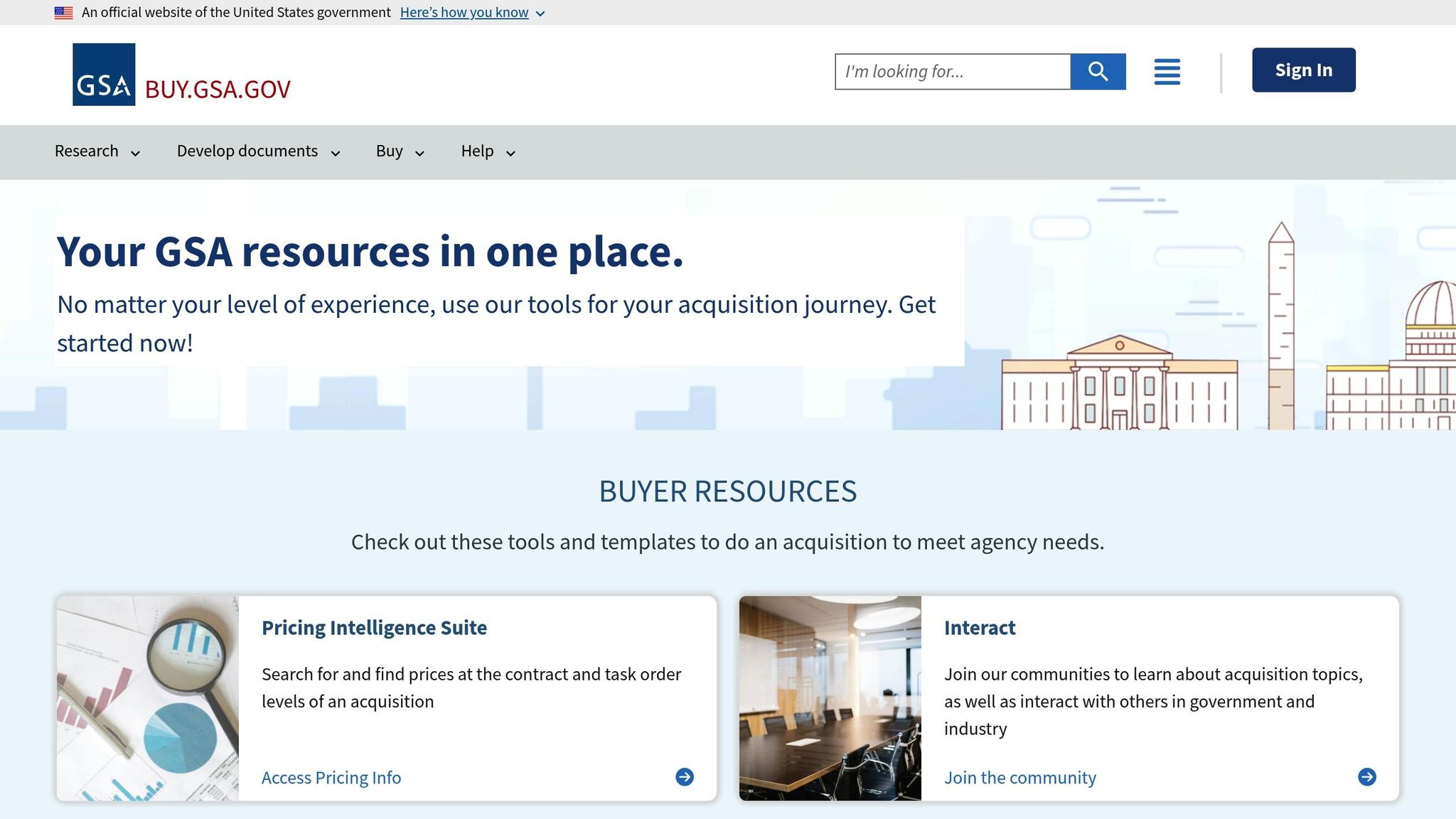
buy.GSA.gov – A Smart Place to Do Market Research
How to Conduct GSA Market Research
Navigating the world of GSA market research requires a structured approach that balances thorough preparation with regulatory compliance. By breaking the process into three essential phases, you can gather the insights needed to succeed in federal contracting.
Define Objectives and Requirements
The first step in conducting effective GSA market research is to establish clear objectives. Start by identifying your procurement goals, understanding the needs of federal agencies, and pinpointing your target market within the federal space. Ask yourself: What products or services are you researching? What outcomes are you aiming for? Are there specific compliance or performance criteria to consider? Answering these questions helps lay the groundwork for focused research efforts.
If you’re a small business entering the federal market, this phase is especially important. Determine whether you’re targeting IT services, office supplies, professional services, or another category. Additionally, clarify if there are socioeconomic participation goals, like small business or minority-owned business set-asides, that apply to your efforts. Being specific about your objectives ensures your research stays on track and delivers actionable insights.
Document key details such as which federal agencies may need your services, the contract values you’re aiming for, and any geographic or timing considerations. This step helps you avoid scope creep and keeps your research aligned with your goals. Once your objectives are clearly defined, you can move on to the next phase: data collection.
Gather and Analyze Data
With your objectives in place, it’s time to collect and analyze data. The GSA offers several tools to help you uncover valuable information, including:
- GSA eLibrary for reviewing contracts.
- GSA Advantage! for comparing prices.
- CALC Tool for benchmarking labor rates.
- GSA eBuy for exploring active RFQs.
- Acquisition Gateway for category management insights.
- SAM.gov for comprehensive contract opportunities and agency purchasing trends.
Using multiple data sources ensures your findings are robust and reliable. Look for recent contracts that align with your capabilities, and pay attention to trends in agency purchasing habits, seasonal demands, and emerging needs. Document your findings in an organized way, and when possible, consult with subject matter experts to validate your insights.
Follow FAR Part 10 Requirements
Adhering to Federal Acquisition Regulation (FAR) Part 10 is a critical aspect of conducting GSA market research. These regulations are designed to ensure that federal agencies prioritize commercial solutions, promote fair competition, and encourage small business participation.
To comply, you’ll need to document your research findings using standardized methods and ensure your process doesn’t favor any specific vendors. Use publicly available data whenever possible to minimize the burden on industry participants and avoid redundant or overly broad requests for information. Tools like GSA’s Market Research As a Service (MRAS) and Rapid Review can help you collect data efficiently while staying within FAR Part 10 guidelines.
For small businesses new to federal contracting, partnering with experienced professionals can simplify this process. Organizations like GSA Focus provide services such as document preparation, compliance guidance, and negotiation support, helping you navigate the complexities of federal procurement.
GSA Tools and Resources for Market Research
The General Services Administration (GSA) provides a range of tools designed to simplify market research for federal agencies and small businesses. These tools offer data-driven insights to help navigate the complexities of federal contracting, making it easier to identify opportunities and make informed decisions.
Market Research As a Service (MRAS)
Market Research As a Service (MRAS) is a no-cost resource that delivers tailored market intelligence to government agencies at the federal, state, and local levels. By gathering information directly from GSA contract holders, MRAS generates detailed reports on vendor capabilities, competition, and socioeconomic factors.
Here’s how it works: agencies collaborate with their GSA Customer Service Director to outline their research goals. The MRAS team then surveys relevant contract holders and produces a comprehensive report – usually within two weeks. These reports provide actionable insights that help agencies make informed procurement decisions.
MRAS ensures compliance with FAR Part 10 while offering in-depth analysis. Reports typically include evaluations of vendor capabilities, competitive landscapes, socioeconomic participation metrics, and suggested acquisition strategies. This information helps agencies structure their procurements effectively before issuing solicitations.
GSA Rapid Review Tool
For agencies needing quick answers, the GSA Rapid Review Tool is a time-saving solution. It connects agencies with GSA Customer Service Directors and subject matter experts to identify the most suitable acquisition vehicles for their needs.
Agencies submit documents like Statements of Needs, Statements of Objectives, or Performance Work Statements to their Customer Service Director. Within 24 hours, they receive tailored guidance on the best contract options. This quick response allows agencies to build accurate acquisition packages from the start. Together with MRAS, the Rapid Review Tool ensures that agencies have the support they need to turn insights into actionable strategies.
How GSA Focus Simplifies the Process
While GSA’s tools provide valuable market intelligence, navigating the federal contracting space – especially for small businesses – can be daunting. That’s where GSA Focus steps in, offering hands-on support throughout the GSA Schedule acquisition process.
GSA Focus specializes in helping small businesses secure and manage GSA Schedule Contracts. Their full-service approach includes preparing documentation, ensuring compliance, supporting negotiations, and providing ongoing assistance. This expertise is especially valuable during market research, as they help businesses interpret GSA data and turn it into practical strategies.
The results speak for themselves: GSA Focus has a 98% success rate, delivers results 4–6 times faster than a do-it-yourself approach, and has supported over 600 clients – more than half of whom had no prior experience with government contracting. By handling over 100 hours of work (including 95% of the paperwork) while requiring just a few hours of client input, GSA Focus allows business owners to concentrate on growing their operations.
"GSA Focus was crucial in helping us get our GSA contract quickly with no headaches, setting us on the path to some big wins." – Deena T., Pacific Point
From eligibility assessments to contract approval and ongoing management, GSA Focus provides end-to-end support. They not only help small businesses enter the federal market but also position them for long-term success. By leveraging tools like MRAS and the Rapid Review Tool, GSA Focus ensures businesses understand their opportunities and know how to compete effectively for federal contracts.
Best Practices for Small Businesses
Breaking into the federal market requires a well-thought-out strategy grounded in solid research. For small businesses, understanding the market landscape can uncover promising opportunities, guide the creation of competitive proposals, and simplify the often-challenging GSA Schedule process.
Finding Federal Market Opportunities
To identify opportunities in the federal space, you’ll need to rely on thorough research and the right tools. Platforms like GSA eLibrary are essential for exploring contracts in your industry. By searching through NAICS codes, you can pinpoint which agencies are actively purchasing your products or services and gain insight into competitor contract terms. Similarly, GSA Advantage! provides real-time pricing and product listings, helping you analyze competitor offerings and identify potential market gaps.
Another key tool is GSA eBuy, which allows you to track Requests for Quotes (RFQs) in your area of expertise. Regularly monitoring this platform helps you stay informed about procurement trends and agency buying habits. Pay close attention to solicitations with few responses – these can be golden opportunities since less competition often means a better chance to win. In fact, approximately 44% of government awards receive only one bid, suggesting that the federal market may be less saturated than many assume.
For service providers, the CALC tool is invaluable for benchmarking labor rates. By comparing your pricing to that of current GSA contract holders, you can ensure your rates are competitive and aligned with market expectations.
Preparing for GSA Schedule Participation
Once you’ve identified opportunities, the next step is preparation. Your market research should shape every aspect of your GSA Schedule strategy, from pricing to compliance. Start by analyzing awarded contracts that align with your offerings to understand their terms, conditions, and pricing structures.
Compliance is another critical area. If your research indicates that agencies are prioritizing cybersecurity standards or sustainability certifications, make sure your products or services meet these requirements before applying. It’s also vital to ensure your proposals comply with trade laws and federal regulations.
When it comes to pricing, benchmarking is key. Use GSA Advantage! and CALC to study the competitive landscape. Instead of simply undercutting prices, focus on your unique strengths – your value proposition – and price accordingly. For example, if agencies in your market favor bundled services, consider packaging complementary offerings at a competitive rate.
Don’t overlook the importance of engaging with Requests for Information (RFIs) and Sources Sought notices. These tools allow you to showcase your capabilities directly to contracting officers and can even influence how requirements are shaped.
Getting Expert Support for Success
Turning research into a winning proposal can be daunting, especially with the complexity of the GSA Schedule process. With over 100 pages of forms and strict compliance requirements, it’s easy for small businesses to feel overwhelmed.
This is where expert support can make all the difference. Consultants who specialize in federal contracting can help you interpret market data, craft competitive strategies, and navigate the bureaucratic challenges that often trip up first-time applicants. For example, firms like GSA Focus provide comprehensive assistance throughout the GSA Schedule acquisition process, helping businesses position themselves effectively.
Although only 4% of small businesses currently hold GSA Schedules, the potential rewards are significant. In 2023 alone, the GSA Schedule program facilitated $45 billion in federal spending. By investing in research, leveraging the right tools, and seeking expert guidance when needed, small businesses can carve out a successful path in the federal marketplace.
Conclusion
GSA market research plays a crucial role in helping small businesses succeed in federal contracting. By analyzing agency purchasing trends, spotting market opportunities, and understanding the competitive landscape, businesses can carve out a strong position in a marketplace that processes over $45 billion annually through the GSA Schedule program alone. These insights are key to shaping strategies for pricing, compliance, and overall market approach.
Tools like GSA eLibrary, GSA Advantage!, CALC, and GSA eBuy offer a wealth of data that businesses can use to make informed decisions. Additionally, advanced services such as MRAS provide customized insights, enabling agencies to efficiently identify qualified vendors and conduct thorough market analyses.
Despite the opportunities, navigating the GSA Schedule process can be challenging. With only 4% of small businesses currently holding GSA Schedules, there’s a vast pool of untapped potential. However, the complexities of documentation, compliance requirements, and negotiations can be daunting – even for experienced businesses. That’s where expert support can make all the difference. Services like GSA Focus offer end-to-end assistance, simplifying the acquisition process and turning a potentially overwhelming task into an achievable goal.
The federal marketplace offers consistent opportunities, often with less competition than expected. For small businesses ready to invest in thorough market research and take advantage of available tools and expert guidance, the GSA Schedule program can be a gateway to steady growth and lasting success in the federal sector. By combining strategic insights with skilled support, small businesses can confidently navigate the complexities of federal contracting and secure a strong foothold for the future.
FAQs
What is GSA market research, and how can small businesses use it to win federal contracts?
GSA market research involves digging into federal procurement data to uncover trends in government purchasing. It’s a way to figure out what products or services are in demand, identify key buyers, and determine how to price competitively within the GSA Schedule program.
For small businesses, this research is a game-changer. It provides insights into federal contracting opportunities, helping companies refine their offerings to align with government needs. By understanding what buyers are looking for, businesses can position themselves more effectively and boost their chances of winning contracts. In short, solid market research equips businesses with the knowledge to make smarter decisions and connect with federal buyers on the right terms.
What tools does GSA provide for market research, and how can businesses use them to gain insights?
The General Services Administration (GSA) has developed several tools to help businesses navigate federal contracting and gain a deeper understanding of government purchasing patterns. These tools offer valuable insights into government spending, vendor competition, and agency buying habits.
Among the most useful resources is the GSA eLibrary, which lets businesses explore existing GSA Schedule contracts. This tool can help you identify competitors or potential partners. Another essential platform is GSA Advantage!, where businesses can see the products and services federal agencies are already purchasing. For broader access to federal contract opportunities and historical procurement data, SAM.gov is an indispensable resource. It allows businesses to track demand trends and pinpoint potential customers.
Using these tools, businesses can make smarter decisions about entering the federal market, fine-tuning their offerings to align with agency requirements, and setting themselves up for success in government contracting.
What challenges do small businesses face with the GSA Schedule process, and how can expert guidance help?
Small businesses frequently face obstacles such as intricate regulations, piles of paperwork, and stringent compliance demands when working through the GSA Schedule process. For companies venturing into federal contracting for the first time, these challenges can feel daunting.
Having an experienced guide can transform this process. Experts help streamline the steps, ensure all paperwork aligns with GSA standards, and offer support during negotiations. This not only saves time and reduces the risk of expensive errors but also gives businesses the confidence to tap into federal contracting opportunities.
Related Blog Posts
- Ultimate Guide to GSA Market Research
- How GSA Advantage Simplifies Federal Buying
- 5 Steps for GSA Market Research
- Federal Market Research: Data to Decision-Making