
The GSA Commercial Platforms Program (CPP) simplifies federal procurement by connecting government agencies with eight approved e-commerce platforms, including Amazon Business, Staples, and Grainger. This initiative, established under Section 846 of the FY2018 National Defense Authorization Act, focuses on micro-purchases under $10,000, accounting for $6 billion in annual spending. It streamlines purchases, ensures compliance with federal regulations, and supports small businesses, with 98% of suppliers on certain platforms being U.S.-based small businesses.
Key highlights of the program include:
- Efficient Purchasing: Federal buyers use user-friendly platforms for routine purchases while staying compliant.
- Small Business Support: Simplified entry into federal contracting, with small business credit automatically applied for eligible purchases.
- Compliance Tools: Built-in checks for regulations like Section 889 and AbilityOne, ensuring secure and compliant transactions.
- Automation: Product catalog synchronization, automated order processing, and real-time inventory updates reduce manual work for vendors.
The program, which began as a 2020 pilot, has grown to serve nearly 40 agencies and over 55,000 buyers, processing more than 300,000 orders annually. It benefits both federal agencies and small businesses by improving procurement efficiency, offering better visibility into spending, and creating new opportunities for vendors.
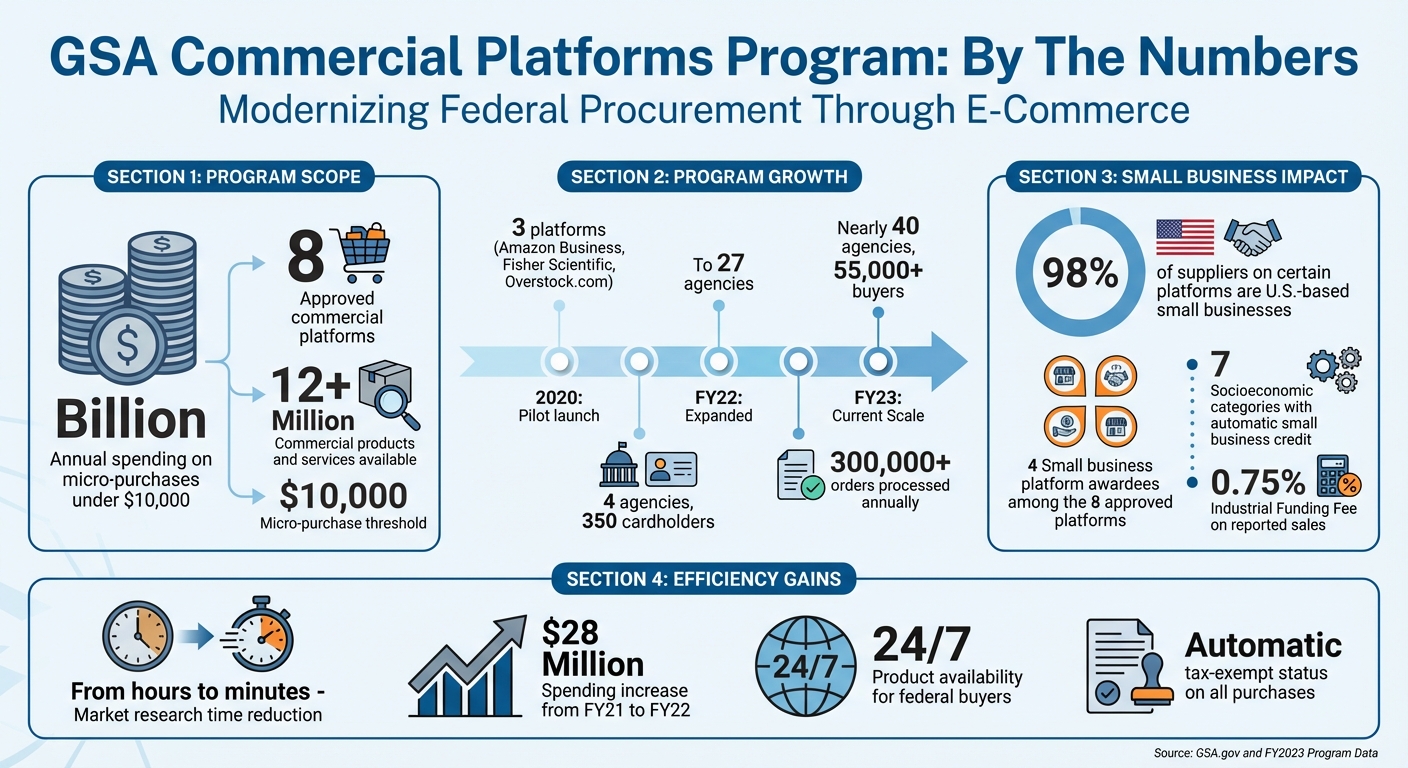
GSA Commercial Platforms Program: Key Statistics and Growth Metrics
What Is the GSA Commercial Platforms Program?
The GSA Commercial Platforms Program (CPP) is a federal initiative designed to simplify how government employees purchase everyday products. Instead of relying on traditional procurement methods, federal purchase cardholders can now shop through approved online marketplaces – platforms that are already widely used in the private sector. These marketplaces make it easier to buy commercial goods while staying compliant with federal purchasing regulations.
Created under Section 846 of the FY2018 National Defense Authorization Act, the program aims to modernize how agencies handle routine purchases and encourage more competition. Federal micro-purchases, which account for about $6 billion in annual government spending, are a key focus of this effort.
As part of the Federal Marketplace Strategy, the CPP enhances the buying process and provides better oversight of open-market purchases. GSA Administrator Emily Murphy highlighted its impact:
"As federal procurement continues to evolve, simplifying how we purchase basic commodities will allow agencies to focus more on work that directly serves their missions."
This foundation helps clarify the program’s purpose and sets the stage for understanding its goals and early testing outcomes.
Program Goals and Purpose
The Commercial Platforms Program tackles several challenges in federal procurement:
- Streamlining Efficiency: Cardholders benefit from user-friendly, consumer-grade platforms that cut market research time from hours to minutes.
- Reducing Costs: By fostering competition within the micro-purchase market, the program helps lower costs. Plus, all purchases through the program are automatically tax-exempt.
- Expanding Product Access and Security: The platforms enforce vendor restrictions and mandatory sourcing rules automatically, ensuring compliance with federal regulations without extra manual checks.
- Improving Spend Visibility: Before the CPP, agencies had limited insight into purchases made with government cards. Now, detailed transaction data helps administrators track spending and ensure alignment with small business and socioeconomic goals.
To test these objectives, GSA launched a pilot program to evaluate the program’s efficiency and effectiveness.
The Initial Pilot Program
In June 2020, GSA awarded three no-cost contracts for a three-year proof-of-concept to Amazon Business, Fisher Scientific (now Thermo Fisher Scientific), and Overstock.com. The pilot officially began in August 2020, involving four agencies and about 350 cardholders.
GSA embraced a flexible "fast launch and iterate" strategy, allowing the program to be tested and refined based on user feedback. Julie Dunne, Commissioner of GSA’s Federal Acquisition Service, explained:
"The proof-of-concept will start small and be refined through repeated testing… Such data will help with compliance in areas like AbilityOne, small business, and supply chain risk management."
This pilot approach allowed GSA to gather valuable insights and adjust the program to meet its goals effectively.
How GSA Connects with Commercial Platforms
The Commercial Platforms Program bridges federal buyers and approved marketplaces through centralized technology. This system ensures smooth catalog synchronization and automated order processing, making it easier for vendors to manage their listings and for federal buyers to access accurate, compliant product information. Vendors can oversee product data, pricing, and inventory from a single dashboard, ensuring consistency across GSA and commercial platforms.
At the core of this connection is Electronic Data Interchange (EDI), a mandatory tool for government contractors working with GSA systems. EDI streamlines the exchange of documents like purchase orders and invoices between systems. Most vendors integrate EDI with an Enterprise Resource Planning (ERP) system, such as Oracle NetSuite, which acts as their central hub. Updates made to pricing or inventory in the ERP automatically sync with GSA Advantage, Amazon Business, and other connected platforms.
For platforms like Amazon that rely on Application Programming Interfaces (APIs) instead of EDI, vendors use middleware to bridge the gap. This middleware converts GSA’s flat file formats into API-ready JSON, compatible with Amazon’s SP-API. This setup enables smooth, two-way communication: orders flow in while inventory updates flow out, keeping all eight approved platforms in sync.
Product Catalog and Pricing Synchronization
Synchronizing product catalogs between GSA and commercial platforms involves meeting different data requirements. For example, GSA Advantage mandates fields like Trade Agreements Act (TAA) country of origin, manufacturer part numbers, and contract numbers. In contrast, Amazon Business emphasizes retail identifiers such as UPC, EAN, or ASIN codes.
To handle these differences, vendors maintain a master catalog in their ERP system and map the data to meet the specific needs of each platform. GSA uses the FAS Catalog Platform (FCP) for catalog synchronization, replacing older tools like the Schedule Input Program. Vendors upload updates – such as new products, price adjustments, or deletions – through the FCP while an eMod modification request is active. The FCP validates these updates through three stages: formatting checks, business rule verification, and final repository validation before publishing them to GSA Advantage.
Commercial platforms, on the other hand, update via APIs or CSV uploads, allowing for real-time adjustments to SKUs and pricing. Vendors also implement automated inventory triggers to deactivate listings when stock runs low, preventing overselling. This centralized approach ensures price consistency and keeps federal buyers from encountering out-of-stock products. By aligning catalogs across platforms, vendors lay the groundwork for fully automated order processing.
Automated Order Processing
Once the catalog is synchronized, the ordering process becomes fully automated. Federal orders generate an EDI 850 Purchase Order in the vendor’s ERP. This is followed by an EDI 856 Advance Ship Notice and an EDI 810 Invoice after delivery, eliminating manual data entry and reducing errors. Inventory updates occur automatically across all platforms. For instance, if an item sells on Amazon Business, the ERP deducts that quantity from available stock on GSA Advantage and other connected marketplaces, ensuring compliance by avoiding overselling.
Compliance checks are also built into the ordering systems. These checks exclude vendors flagged on SAM.gov, enforce Section 889 certifications for telecommunications equipment, and apply tax-exempt status to federal purchases. For orders over $3,500, the system flags mandatory sources like UNICOR and AbilityOne, ensuring buyers adhere to Federal Acquisition Regulation requirements. Vendors commonly use EDI 846 Inventory Inquiry transactions to reconcile stock levels, ensuring accuracy across all channels.
Commercial Platforms in the GSA Program
The GSA Commercial Platforms Program connects federal agencies with eight approved commercial platforms, simplifying routine purchases, encouraging competition, and supporting small businesses. By aligning commercial practices with government procurement needs, the program brings a modern approach to federal purchasing. As of FY23, it served nearly 40 agencies and over 55,000 buyers, processing over 300,000 orders.
What started as a 2020 pilot with three providers – Amazon Business, Fisher Scientific, and Overstock.com – has grown into a program with eight platforms. Recent expansions have emphasized small business participation. Keil Todd, Commercial Platforms Program Manager at GSA, highlighted this milestone:
"This is a pivotal turning point in the Commercial Platforms Program as we expand the number of platforms available, including a number of small business awardees."
Below is a closer look at the key participants, beginning with Amazon Business.
Amazon Business
Amazon Business stands as the largest platform in the program, offering a user-friendly shopping experience tailored to federal purchasing rules. It streamlines micro-purchases under the $10,000 threshold. Features like cart-sharing allow non-purchasing staff to conduct market research and forward pre-filled carts to authorized purchase card holders for final approval. Additionally, its analytics tools help agencies track spending and address supply chain concerns. While Amazon Business leads in size, other platforms provide equally tailored solutions for diverse procurement needs.
Other Approved Platforms
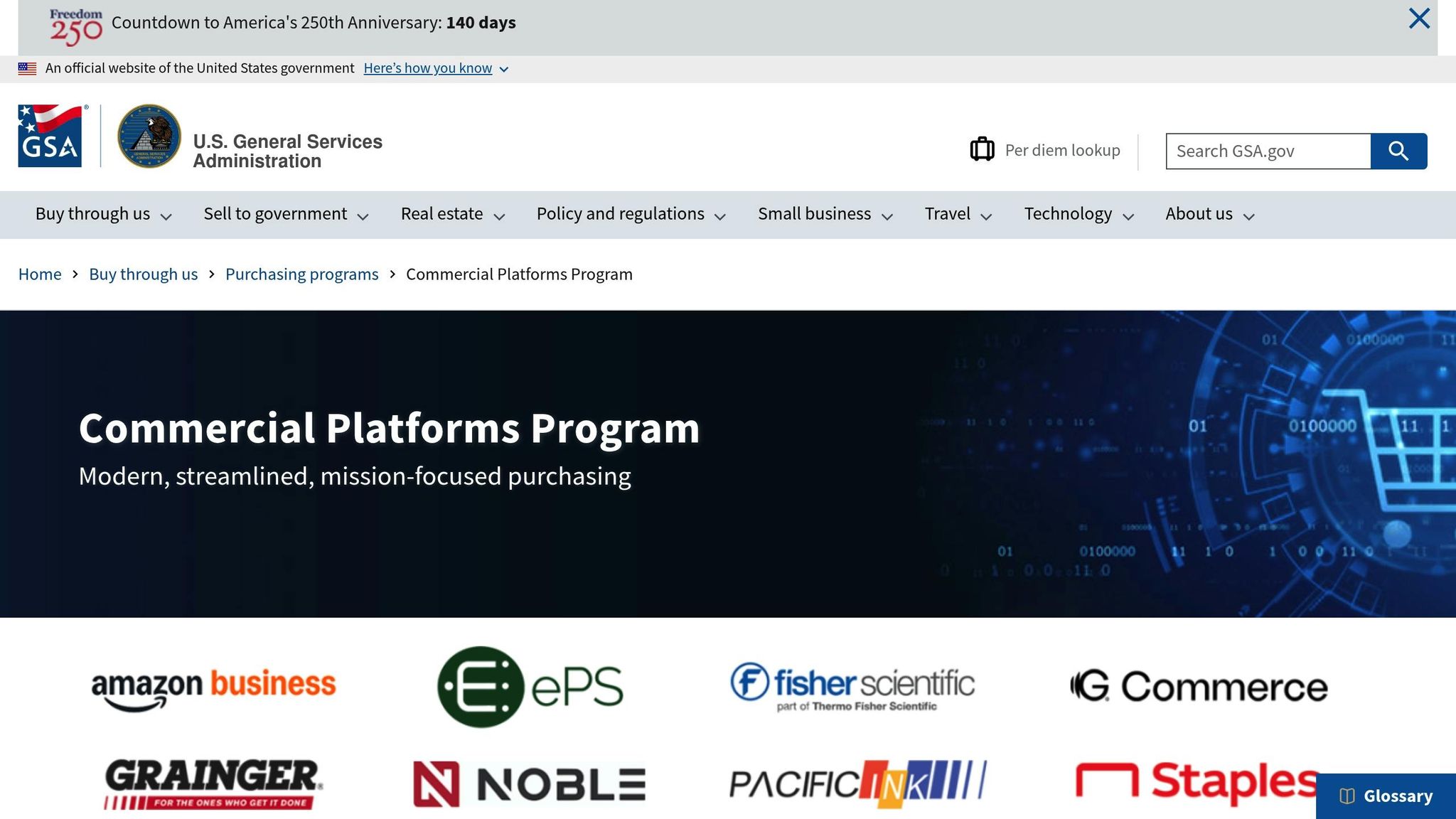
Beyond Amazon Business, the program includes seven other platforms, each contributing unique strengths, often with a focus on small businesses:
- Fisher Scientific: Specializes in laboratory equipment, instruments, consumables, chemicals, and life science products.
- Grainger: Offers over one million MRO (Maintenance, Repair, and Operations) products sourced from thousands of suppliers.
- Staples: Focuses on office, janitorial, furniture, and technology supplies, with an emphasis on environmentally conscious options.
Four platforms are small business awardees, demonstrating the program’s commitment to supporting smaller enterprises:
- e-Procurement Services: Features an eMarketplace where 98% of suppliers are U.S.-based small businesses, offering over five million products.
- Noble Supply & Logistics: Supplies industrial and office management products from approximately 15,000 suppliers.
- Pacific Ink: A Women-Owned Small Business providing office, facility, and industrial supplies.
- G-Commerce (by Social Glass): Focuses on IT and industrial equipment, offering round-the-clock procurement assistance.
These platforms collectively enhance federal procurement by offering specialized services, supporting small businesses, and ensuring compliance with government requirements.
Compliance Requirements for Vendors
Selling through GSA-approved commercial platforms comes with a set of strict compliance rules designed to uphold the integrity of federal procurement. These rules ensure that vendors’ products, pricing, and catalog data align with government standards, making them eligible across all platforms. This framework also ensures consistency in automated order processing and vendor compliance.
Pricing and Catalog Standards
Vendors must submit their electronic catalog to GSA Advantage through FCP or EDI/SIP within 30 days of receiving a contract award. This catalog serves as the official price list and should include only the products awarded in the vendor’s contract. The GSA Vendor Support Center explains:
"Contractor’s electronic catalog file must be received no later than 30 days after award, in accordance with clause I-FSS-600."
Each product in the catalog must be uniquely identified by the contract number, manufacturer part number, manufacturer name, and, when required, Universal Product Codes (UPC). Without an approved catalog, vendors cannot participate in eBuy or appear in searches conducted by federal buyers. Additionally, pricing must remain consistent across all channels to avoid penalties or even contract termination. Vendors are also required to pay an Industrial Funding Fee (IFF) of 0.75% on all reported sales under Multiple Award Schedule contracts.
Beyond pricing and catalog requirements, vendors must also manage product restrictions to ensure compliance with federal mandates.
AbilityOne and Product Restrictions
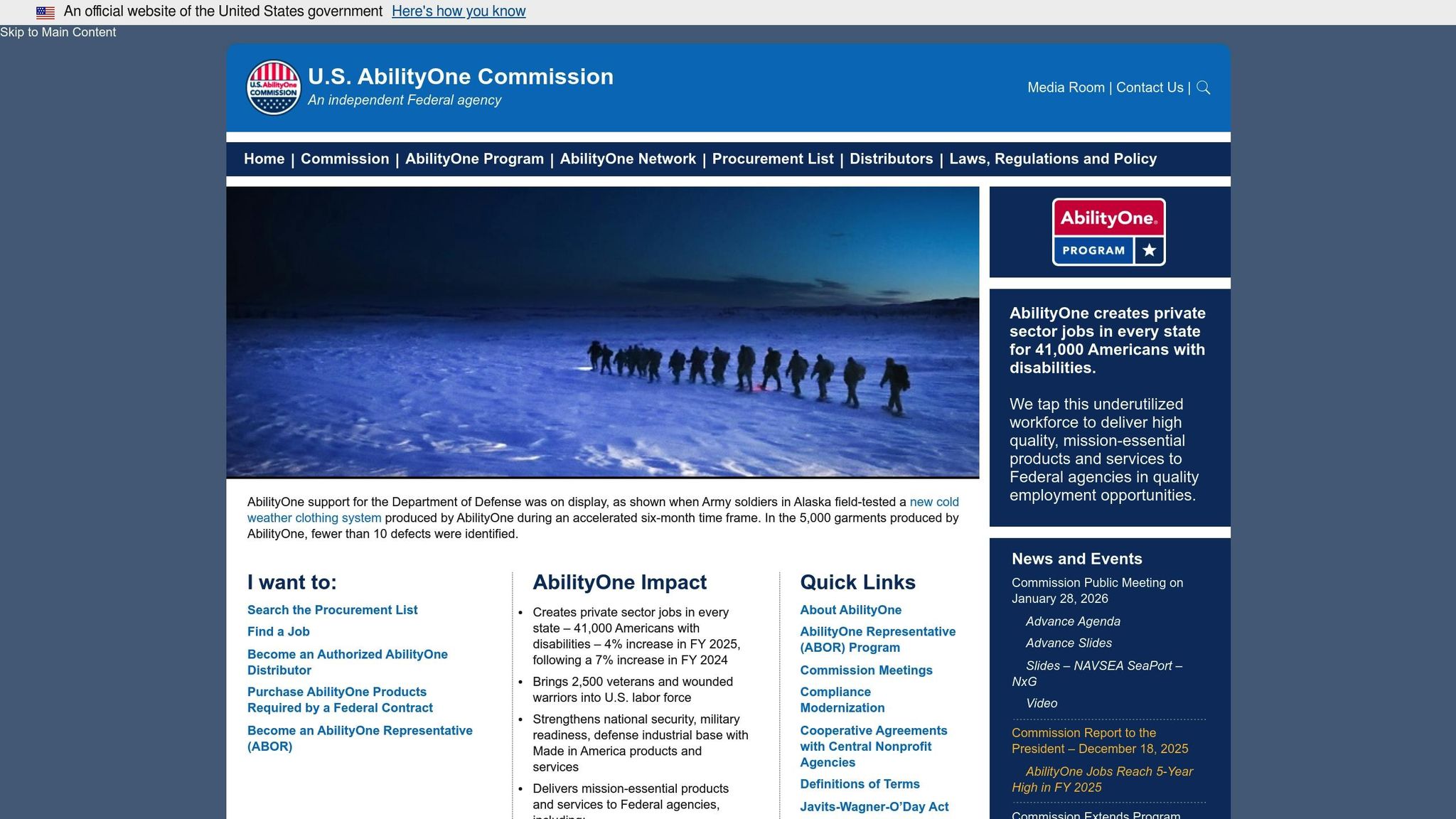
In addition to catalog standards, vendors must adhere to specific product restrictions. Federal agencies are obligated to purchase certain products exclusively from AbilityOne nonprofit agencies. GSA platforms include built-in tools to identify these mandatory sources and block the sale of "essentially the same" commercial items that would violate this requirement. As stated on GSA.gov:
"Purchasers must buy products on the procurement list from an AbilityOne participating nonprofit agency."
Vendors must also ensure compliance with Section 889 and the Trade Agreements Act (TAA) by using platform-provided tools to automatically restrict non-compliant products. All GSA platforms are Section 889 certified, offering resources to help vendors maintain compliance. Additionally, vendors should regularly monitor SAM.gov to avoid potential sales restrictions.
These detailed compliance measures are essential for maintaining the efficiency and integrity of GSA e-commerce transactions.
Benefits for Agencies and Contractors
The GSA Commercial Platforms Program offers clear advantages for both federal agencies and small business contractors. Since its inception in 2020, the program has expanded significantly, now supporting nearly 40 federal agencies and over 55,000 buyers. By the close of fiscal year 2023, it handled more than 300,000 orders annually. This growth highlights improved procurement processes and increased opportunities for small businesses, made possible through the integration of GSA systems with commercial platforms.
Benefits for Federal Agencies
For federal agencies, the program simplifies procurement while improving oversight and compliance. Agencies gain access to a shopping experience similar to what consumers enjoy, making micro-purchases quicker and more efficient. Features like real-time updates and tracking ensure smoother operations. Plus, federal buyers benefit from business-to-business pricing options such as volume discounts, tiered pricing, automatic tax exemptions, and no minimum order requirements.
The program also enhances financial transparency by providing visibility into approximately $6 billion in annual open-market purchases made with government purchase cards. Previously, this spending occurred outside of tracked contracts. As Julie Dunne, Federal Acquisition Service Commissioner at GSA, explained:
"Such data will help with compliance in areas like AbilityOne, small business, and supply chain risk management".
Compliance tools are built into the system, helping agencies meet requirements for Section 889, AbilityOne, Made in America, and small business goals. Additionally, through an agreement with the SBA, GSA automatically reports and credits purchases made with SBA-certified small businesses, saving agency staff from manual reporting tasks.
Benefits for Small Business Contractors
The program also creates opportunities for small business contractors by expanding their reach. Through eight approved platforms – including Amazon Business, Grainger, and Staples – small businesses gain access to over 55,000 federal buyers. Federal purchasers can easily find small business vendors using search filters that highlight sellers across seven socioeconomic categories. This increased visibility allows small businesses to compete on a more equal footing and sell their products 24/7.
Integration with tools like QuickBooks and Order Management Systems further streamlines operations for small businesses. These tools automate processes such as order handling, inventory updates, and financial reconciliation. As Tom Howder, Acting Federal Acquisition Service Commissioner, noted:
"This is about meeting our customers where they are with a modernized user experience and streamlined process for government purchase cardholders".
Additionally, e-commerce tools automatically align catalogs and pricing with GSA-approved lists, making compliance easier. While vendors pay a 0.75% Industrial Funding Fee on reported sales under Multiple Award Schedule contracts, the savings from centralized management and automation often balance out this cost. Notably, several of the approved platform providers are themselves small businesses, reinforcing the program’s dedication to supporting this vital sector.
Common Challenges for Vendors
While the program simplifies procurement for federal agencies and small businesses, vendors encounter unique technical and compliance hurdles. The GSA Commercial Platforms Program offers opportunities, but success in government e-commerce requires overcoming these operational challenges.
Data Mapping and System Integration
Managing diverse data formats is a significant hurdle. For instance, GSA Advantage mandates the use of Electronic Data Interchange (EDI) for document exchanges, while commercial platforms like Amazon and Walmart utilize APIs, XML, or flat files. Bipin Dhungana of Commerce Network highlights this complexity:
"Government marketplaces like GSA Advantage from GSA explicitly require EDI for document exchanges. So, all government contractors must have EDI enabled."
This variation creates compatibility headaches. Vendors must translate ERP data to fit platform-specific requirements – converting flat files into API-ready JSON, adjusting character limits (e.g., Amazon’s 200-character title limit versus Walmart’s 150), and aligning identifiers like ASINs and GTINs. Additionally, GSA Advantage demands unique data points not typically required on commercial platforms, including the Trade Agreements Act (TAA) country of origin, Special Item Numbers (SIN), and government contract numbers.
Real-time inventory synchronization across multiple channels adds another layer of difficulty. Delays in updating stock levels can result in overselling on one platform while products appear unavailable on another. Dhungana further emphasizes:
"Manual catalog updates via Excel increase risk."
Middleware solutions, such as SaaS tools that connect ERP systems with platform-specific data needs, can automate these processes. These tools can also trigger automatic actions, like pausing listings when inventory drops below a certain threshold, reducing the risk of overselling. While these tools address technical issues, vendors must also navigate evolving compliance requirements.
Staying Compliant with Changing Requirements
Adapting to shifting regulations is an ongoing challenge. Vendors must meet mandates like Section 889, AbilityOne rules, and TAA standards. Systems must also be configured to block products deemed "Essentially The Same" (ETS) as items provided by AbilityOne mandatory sources.
Cybersecurity adds another layer of complexity. Integrating with federal systems requires robust measures to safeguard against potential threats. Even minor compliance missteps can have financial consequences, such as the 0.75% Industrial Funding Fee on reported sales.
A standardized master catalog within an ERP system can serve as a reliable source of truth, ensuring consistent data across platforms. Automated validations, like regex checks for UPC/EAN data, can minimize manual errors. Dashboards that monitor synchronization – aiming for latency under one hour for EDI transactions – can help vendors maintain accurate and compliant data across all channels.
Conclusion
The GSA Commercial Platforms Program has reshaped how federal agencies purchase everyday commercial products. By partnering with eight major commercial platforms, the program now taps into roughly $6 billion in annual open-market spending and over 12 million available commercial products and services. This streamlined approach has turned procurement into a process that takes just minutes, offering agencies a buying experience similar to what consumers enjoy.
For small businesses, this program opens doors to federal contracting without the usual red tape. With a micro-purchase threshold set at $10,000, smaller vendors can now participate through well-known e-commerce platforms instead of navigating cumbersome government-only systems. To make it even better, GSA has automated small business credit across seven socioeconomic categories, providing federal buyers with incentives to support these vendors. Anne Rung, Director of Public Sector at Amazon Business, highlights this shift:
"We are helping to level the playing field and to make it easier for sellers to reach government buyers".
The program’s rapid growth speaks volumes. Starting with six agencies in 2020, it expanded to 27 agencies by FY22, with spending increasing by $28 million from FY21 to FY22. From its pilot phase to broader adoption, the program has consistently provided efficient and compliant procurement solutions. Features like built-in compliance tools for Section 889, AbilityOne requirements, and tax-exempt status simplify the process for both buyers and sellers while safeguarding the federal supply chain.
FAQs
How do vendors connect their ERP to GSA platforms?
Vendors link their Enterprise Resource Planning (ERP) systems to GSA platforms through Electronic Data Interchange (EDI). This technology automates the flow of procurement data – like purchase orders and invoices – helping to maintain accuracy and minimize errors. Additionally, some vendors rely on integration tools or APIs to synchronize product catalogs and order details across platforms such as GSA Advantage and commercial marketplaces. This approach simplifies procurement tasks and ensures compliance with necessary processes.
What rules can block a product from being sold?
Products might face restrictions or removal if they violate laws, regulations, or directives tied to national security concerns. Additionally, items that are classified as prohibited or are exclusively compatible with restricted products can be suppressed or removed from GSA Advantage! and associated contracts.
How is small business credit applied automatically?
When transactions are made through authorized platforms like Amazon Business or Walmart Marketplace, small business credit is automatically applied within the GSA e-commerce system. This built-in feature aligns with federal procurement policies, removing the need for manual adjustments. By automating the process, purchasing becomes more streamlined, and eligible small businesses can effortlessly access the benefits they’re entitled to.
Related Blog Posts
- How GSA Advantage Simplifies Federal Buying
- GSA Advantage Website 101: A Small Business Guide
- What is the GSA Advantage Platform and How to Use It
- What Are GSA eTools?