
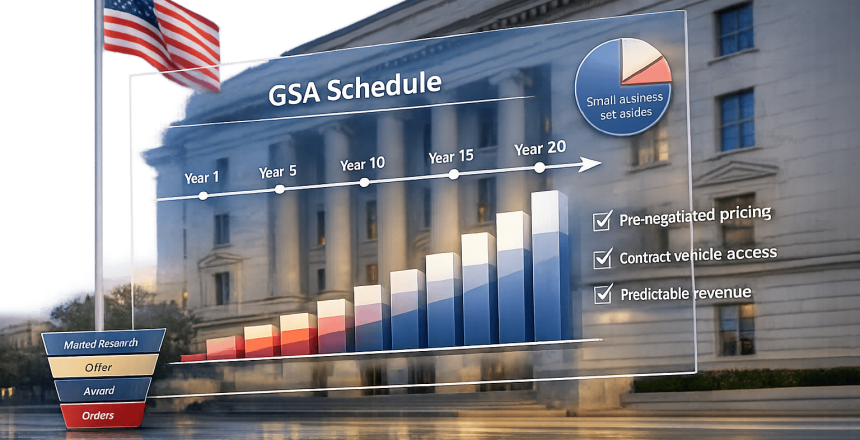
GSA Schedule Contracts provide businesses with a long-term pathway to consistent revenue. With a potential 20-year term (5-year base plus three 5-year renewals), they reduce the need for frequent bidding and allow access to federal spending, which exceeded $220 billion annually. In FY2024 alone, GSA MAS reported $51.9 billion in sales, with small businesses contributing $18.2 billion. These contracts ensure steady income through pre-negotiated pricing, predictable government purchasing, and exclusive small business set-aside opportunities.
Key Highlights:
- 20-Year Revenue Potential: Contracts include renewals and streamlined extensions.
- Federal Spending Stability: Essential services remain funded even during economic downturns.
- Small Business Advantage: 44% of government awards receive only one bid; set-asides reserve contracts for small firms.
- Growth Opportunities: Add products/services, leverage performance for larger contracts, or subcontract with prime contractors.
With professional management services like GSA Focus, businesses can navigate compliance, renewals, and optimization to maximize their contract’s potential.
Stop Bidding, Start Winning, The 20 Year Federal Strategy
How GSA Contracts Are Structured for Long-Term Revenue
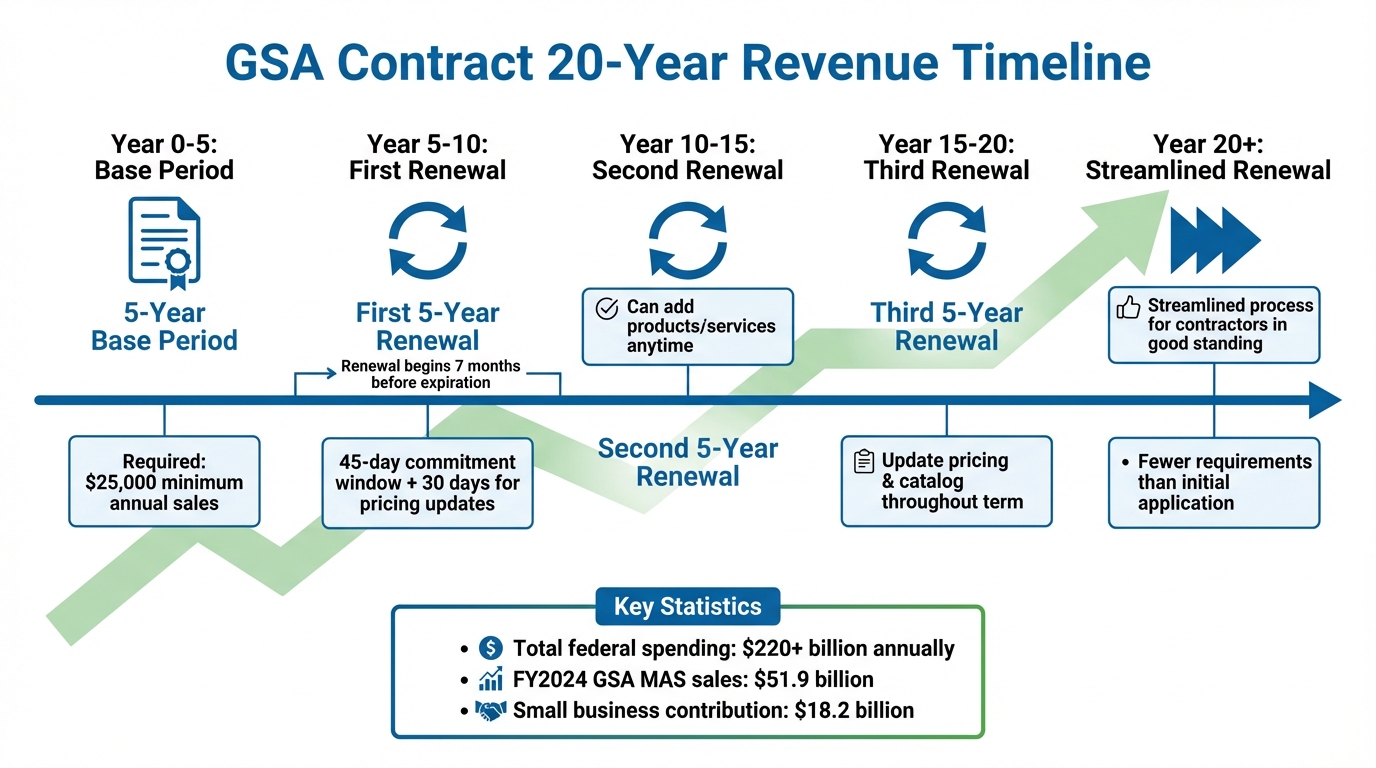
GSA Contract 20-Year Timeline and Revenue Potential
The 20-Year Contract Timeline
A GSA Schedule Contract offers a long-term framework, starting with a five-year base period and extending through three optional five-year renewals, totaling a potential 20-year term. To maintain the contract, contractors must meet an annual sales threshold of $25,000. The renewal process begins seven months before the current period ends, with a 45-day window to commit and an additional 30 days to update pricing on GSA eLibrary. This extended timeline reduces the administrative burden of frequent recompeting and provides a stable revenue stream, which is essential for business growth.
Once the full 20-year term concludes, contractors in good standing can apply for a new 20-year contract through a streamlined process. This renewal process eliminates many of the requirements from the initial application, making it easier to continue securing federal revenue with less administrative hassle. This structure ensures a steady foundation for long-term income.
Why Federal Contracts Provide Consistent Income
Federal contracts stand out for their reliability, thanks to the stable, annually allocated budgets of government agencies. These budgets prioritize funding for essential products and services, ensuring consistent purchasing – even during economic downturns. This stability contrasts sharply with the commercial market, where demand can be unpredictable.
Another advantage of a GSA Schedule Contract is its built-in flexibility. Throughout the 20-year term, contractors can update pricing, add new offerings, or modify administrative details without waiting for a renewal period. This adaptability ensures your contract stays aligned with your business’s growth and continues to function as a dependable revenue source.
How to Increase Revenue with Your GSA Schedule
GSA Contracts provide a steady revenue stream, but there’s plenty of room to grow if you approach your GSA Schedule strategically. By making smart adjustments and staying proactive, you can transform your schedule into a powerful tool for long-term revenue growth.
Using Pre-Negotiated Pricing to Win Repeat Orders
One of the biggest advantages of your GSA Schedule is its pre-negotiated pricing. These capped rates give federal agencies budget predictability and shorten procurement timelines to less than 30 days. This streamlined process makes it easier for agencies to place repeat orders, especially since the pricing is already vetted and compliant with federal standards.
To keep your business top of mind when buyers are ready to place orders, ensure your GSA Advantage! listings are always up to date. Include current product descriptions, pricing, and high-quality images. This simple step keeps your offerings visible and accessible, increasing the likelihood of repeat business.
Adding New Products or Services to Your Schedule
Your GSA Schedule isn’t static – it can grow with your business. At any point, you can modify your contract to include new products or services. But before you make additions, do your homework. Use tools like USASpending.gov to identify what agencies are buying and check competitor pricing on GSA eLibrary to ensure your offerings align with federal demand.
Once your additions are approved, update your catalog on GSA Advantage and the Vendor Support Center. Don’t stop there – monitor GSA eBuy for RFQs that match your expanded portfolio. To make it even easier for federal buyers to find you, create a dedicated page on your company website featuring your GSA Schedule number and updated Special Item Numbers (SINs). This visibility can help position your business as a go-to option for government procurement.
Using Contract Performance to Win Bigger Opportunities
Delivering strong performance on your GSA Schedule can open doors to larger contracts. Think of your schedule as a "license to hunt" – it gives you the framework to pursue opportunities, but your growth depends on how actively you engage with those opportunities.
Consistent, high-quality performance builds trust, helping you move from subcontracting roles to securing prime contracts. Early wins on your GSA Schedule not only boost your credibility but also set the stage for tackling bigger projects through platforms like GSA eBuy. By leveraging your performance history, you can position your business for sustained growth over the 20-year lifespan of your schedule.
How Small Business Set-Asides and Subcontracting Increase Revenue
The federal government has a clear goal: allocate 23% of its prime contract dollars to small businesses annually. In FY2024, this translated to over 26% of federal contracting dollars – close to $160 billion – flowing to small businesses through set-aside programs. These programs offer smaller firms a dependable revenue stream by reserving contracts specifically for them, reducing competition from larger corporations. Below, we’ll explore how to qualify for these set-asides and how subcontracting can be a game-changer for revenue growth.
Qualifying for Small Business Set-Aside Programs
Small business set-asides build on the consistent revenue potential of GSA contracts by opening up exclusive federal opportunities. These programs are designed to support certified small businesses by excluding larger companies from certain contracts. The government also sets specific sub-goals: 5% for Small Disadvantaged Businesses (including 8(a) firms), 5% for Women-Owned Small Businesses (WOSB), 3% for Service-Disabled Veteran-Owned Small Businesses (SDVOSB), and 3% for HUBZone businesses. To qualify, businesses must register on SAM.gov and align their services with the appropriate NAICS codes.
One standout program is the 8(a) Business Development Program, which allows contracting officers to grant sole-source contracts directly to certified businesses. These awards can go up to $4.5 million for services and $7 million for manufacturing without competition. For instance, A Square Group (ASG), an IT services firm, leveraged the GSA MAS 8(a) Pool to secure a $4.5 million sole-source contract. This single deal led to a 30% increase in annual revenue and enabled the company to hire 15 new employees. Similarly, The Kenjya-Trusant Group, LLC used the same pool in 2022 to win a $3.2 million program management contract, closing the deal in just 60 days.
Getting certified takes time, so start early. The 8(a) application process typically takes about 90 days, while SDVOSB (VetCert) certification requires 60–90 days. For HUBZone certification, use the SBA’s map tool to confirm that your principal office and at least 35% of your employees are in a designated historically underutilized business zone.
Working as a Subcontractor on Federal Projects
Subcontracting offers small businesses a quicker pathway into federal contracting, especially for those building a track record. Large prime contractors are often required to partner with smaller firms to meet subcontracting plan requirements, creating opportunities for small businesses to gain federal experience and secure consistent income.
To position your business effectively, prepare well before federal RFPs are released. Develop a one-page teaming brief that clearly outlines your services, unique strengths, and any security clearances. Map your labor categories to common task-order needs, and establish pre-negotiated rates. Additionally, assemble a complete subcontractor package, including your SAM/UEI registration, insurance information, certifications, and a summary of your security measures.
"The small businesses that win consistently are already pre-vetted and positioned with a clear role. Your goal is to be a named teammate, not a last-minute staff augmentation call."
– FedBiz Access
A great example of subcontracting opportunities is the Alliant 3 awards announced in late 2024/early 2025. Out of 133 proposals, GSA selected 43 companies for an unrestricted enterprise IT services contract. While large integrators secured the prime contracts, the structure of the vehicle ensures a steady stream of task-order work for small businesses. These opportunities include advanced IT services like cloud migration and AI implementation. By partnering strategically as a subcontractor, small businesses can establish a consistent pipeline of work, reinforcing their long-term growth strategy with GSA contracts.
Managing Your GSA Contract with Professional Support
Securing a GSA contract is just the beginning. The real challenge lies in managing it effectively over its 20-year term to ensure compliance and maximize revenue. Navigating the FAR (Federal Acquisition Regulation) can be tricky, often leading to multiple rejections for those attempting a DIY approach. Professional management takes this load off your shoulders, allowing you to focus on winning contracts while experts handle the administrative complexities. This approach not only ensures compliance but also creates opportunities for consistent revenue growth.
How GSA Focus Simplifies the Process
GSA Focus provides a comprehensive, done-for-you solution that covers every stage of the GSA contract lifecycle. From the outset, they streamline the process by preparing over 30 critical documents through a secure portal. This efficiency reduces your time commitment to just 3–4 hours. They also support you during negotiations to ensure your pricing remains both competitive and profitable.
"MacGyver Solutions is one of GSA Focus’ success stories – having them do the heavy lifting on the initial contract was a huge help."
– Mike Jackson, Founder, MacGyver Solutions, Inc
With a track record of over 625 contract awards in 17 years, GSA Focus has delivered impressive results, including an average ROI of 87x and bottom-line boosts of approximately $927,000 per schedule. They also speed up the contract acquisition process, making it 4 to 6 times faster than going it alone.
Staying Compliant and Managing Renewals
Once your contract is up and running, maintaining compliance becomes essential to avoid penalties and ensure smooth renewals. GSA Focus offers a maintenance service that handles critical tasks like tracking sales requirements, managing pricing updates, and overseeing Transactional Data Reporting (TDR). This service ensures your contract remains in good standing throughout its 20-year term without requiring constant attention from your team.
As your contract approaches its expiration, GSA Focus provides a Streamline renewal service for $7,500. This service addresses necessary contract modifications, updates product or service offerings, and manages all administrative tasks through the GSA Vendor Support Center. With professional management, your GSA contract continues to generate steady income, freeing you to concentrate on serving federal clients effectively.
Conclusion
GSA contracts offer a reliable path to long-term success in the federal marketplace. With terms lasting up to 20 years, they provide a dependable revenue stream, even during economic uncertainty, as federal agencies consistently require essential goods and services.
While managing a GSA contract can be complex, having professional support turns it into a strategic advantage. Companies that tap into expert services – like those provided by GSA Focus – often experience significant growth. Looking ahead, a 2025 Executive Order aimed at centralizing federal procurement through GSA is expected to substantially boost spending, positioning GSA contract holders as pre-qualified, trusted partners in an expanding market.
With pre-negotiated pricing, reduced competition, and simplified procurement processes, GSA contracts become a valuable revenue asset. By relying on professional guidance to handle compliance, renewals, and optimization, your GSA Schedule can deliver consistent returns year after year. Partnering with experts ensures your business is set up for lasting success in the federal contracting space.
FAQs
How do I know if a GSA Schedule is worth it for my business?
To figure out if a GSA Schedule is the right move for your business, start by weighing a few critical factors. First, consider the potential revenue opportunities in the massive $220 billion federal marketplace. Next, assess your eligibility – this typically means being in business for at least two years and having solid financial stability. Finally, take a hard look at the upfront costs, which can range from $5,000 to $25,000.
GSA Schedules come with some attractive perks, like long-term contracts that can last up to 20 years and a more efficient procurement process. If you’re prepared to commit the necessary time and resources, a GSA Schedule could be a smart step toward steady growth in the government sector.
What happens if I don’t meet the $25,000 annual sales minimum?
If your annual sales fall below $25,000, GSA might ask you to demonstrate your efforts to boost sales. Failure to comply consistently can jeopardize your contract renewal or future eligibility. To keep your GSA Schedule Contract intact, it’s essential to stay proactive and work toward meeting this sales threshold.
What should I do first to start getting orders on GSA Advantage! and eBuy?
To start selling on GSA Advantage! and eBuy, the first step is securing a GSA Schedule contract – this is your ticket to accessing these platforms. Once you have the contract, focus on presenting your product catalog in the best possible light. Use clear, concise descriptions, high-quality images, and ensure your pricing is accurate and competitive.
Next, register your business on SAM.gov and the GSA Vendor Support Center. These registrations are crucial for maintaining compliance and boosting your business’s visibility to government buyers. After completing these steps, you can list your products or services and actively respond to opportunities, paving the way to landing government orders.
Related Blog Posts
- 11 Features of GSA Schedules That Drive Success
- Top 7 GSA Schedule Benefits for Small Businesses
- Ultimate Guide To GSA Contracting Results
- How a GSA Federal Contract Can Transform Your Small Business