
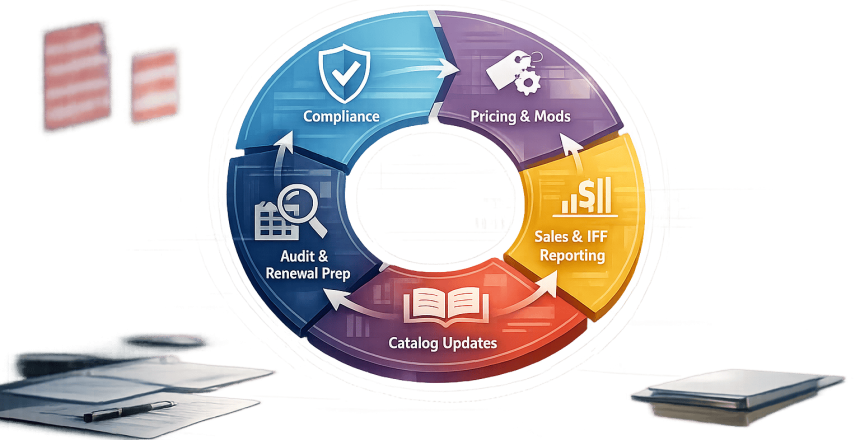
Maintaining a GSA contract is critical for small businesses aiming to succeed in the federal marketplace. With over $700 billion in federal contract spending in FY2024, GSA Schedules contributed significantly to small business awards. However, only 60% of contract holders renew without issues due to lapses in management. This guide outlines five essential tasks to keep your GSA contract compliant and profitable:
- Stay compliant: Track contract terms, renew SAM.gov annually, and adhere to regulations like the Trade Agreements Act and Price Reduction Clause.
- Update pricing and modifications: Use the eOffer/eMod system for changes like price adjustments or adding products.
- File sales reports and IFF payments: Report sales monthly and pay the 0.75% IFF quarterly to avoid penalties.
- Maintain your GSA Advantage! catalog: Update your catalog within 30 days of modifications and refresh it every two years.
- Prepare for audits and renewals: Start renewals 6–9 months in advance and keep detailed records to ensure smooth audits.
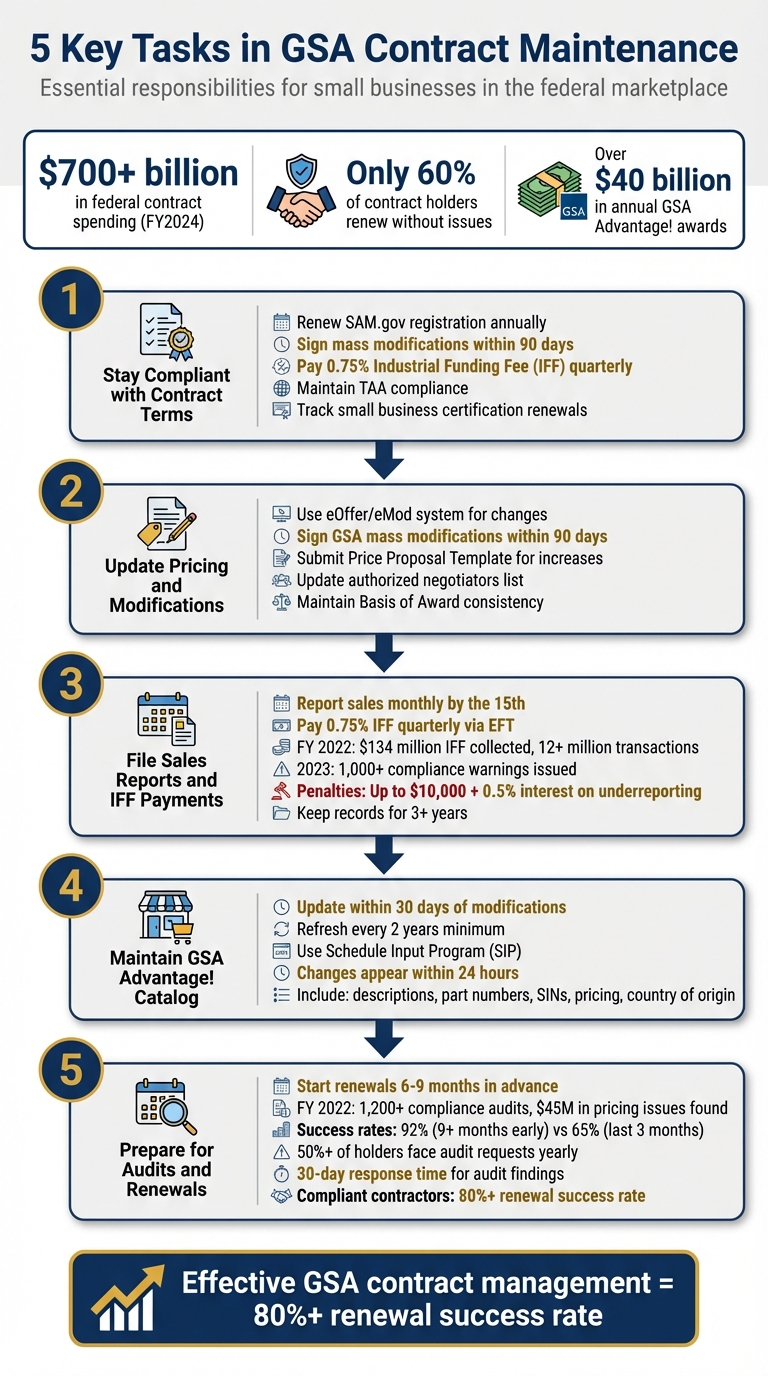
5 Essential GSA Contract Maintenance Tasks for Federal Contractors
Keeping your GSA Multiple Award Schedule (MAS) Contract Compliant
1. Staying Compliant with Contract Terms
When you’re working under a GSA contract, compliance is non-negotiable. Falling short on requirements can lead to penalties, suspension, or even losing your contract. To avoid these pitfalls, you need to stay on top of your responsibilities and any updates to the rules.
One key task is renewing your SAM.gov registration every year and promptly updating any changes to your company details. GSA also sends out mass modifications to update contract clauses, and you’re required to sign these within 90 days of receiving them.
Another important regulation to understand is the Trade Agreements Act (TAA). Unless stated otherwise in your contract, you can only sell products made or "substantially transformed" in the United States or in a TAA-designated country. Similarly, the Price Reduction Clause (FAR 552.238-81) ensures that the pricing or discount relationship you agreed to at the start of your contract – your Basis of Award – remains consistent.
You’ll also need to account for the Industrial Funding Fee (IFF), which is a 0.75% fee on your reported sales. Sales must be reported quarterly, and the fee must be paid within 30 calendar days after the quarter ends. If you’re a product contractor, you’re required to maintain active accounts on the Advantage PO Portal and OMS Vendor Portal to manage order statuses and meet delivery standards.
For small businesses with certifications like HUBZone, 8(a), or Women-Owned Small Business status, each program has its own renewal deadlines, separate from your GSA contract schedule. Missing these deadlines could mean losing set-aside eligibility and valuable contracting opportunities. To stay organized, set reminders for renewing your SAM.gov registration, certifications, and any regulatory updates. Bookmarking resources like Acquisition.gov can help you keep track of changes to the Federal Acquisition Regulation.
2. Updating Pricing and Making Contract Changes
Keeping your GSA contract up-to-date is essential for aligning with your business growth and shifts in the market. Whether it’s adjusting pricing, adding new offerings, or handling administrative updates, these changes ensure your contract stays relevant. Updates happen in two main ways: GSA-initiated mass modifications and contractor-initiated modifications.
Mass modifications are initiated by GSA, often to refresh the solicitation or revise contract clauses. You’re required to sign these updates within 90 days of receiving them. But what about changes you need to make yourself? That’s where contractor-initiated modifications come into play.
When you need to make updates – like adjusting prices, adding products, or changing company details – you’ll use the eOffer/eMod system. The specific type of modification dictates the required documentation. For instance:
- Price increases: You’ll need a Price Proposal Template (PPT) and must adhere to the Economic Price Adjustment (EPA) clause in your contract, such as GSAR 552.238-82 or I-FSS-969.
- Adding new products: This requires technical descriptions and, if reselling products not listed in the Verified Products Portal, a Letter of Supply from the manufacturer.
It’s also important to evaluate whether changes to your commercial pricing require a GSA modification. Ensuring your pricing remains consistent with your Basis of Award is key. Don’t forget to update your authorized negotiators list to avoid submission delays. Once the GSA Contracting Officer approves your modification, promptly update your GSA Advantage! catalog to reflect those changes.
3. Filing Sales Reports and IFF Payments
Keeping your reporting accurate and timely is a key part of staying compliant with your GSA Schedule contract. Each month, you need to submit your sales reports through the Contractor Center on GSA eLibrary by the 15th day after the end of the month. These reports must include all sales under your GSA Schedule, whether they involve federal, state, or local governments – or even resellers.
In addition, you’re required to pay a 0.75% Industrial Funding Fee (IFF) on your quarterly sales via Electronic Funds Transfer. This fee helps fund GSA’s acquisition systems. For instance, in FY 2022, GSA collected $134 million in IFF, which supported over 12 million federal transactions.
What counts as a reportable sale? Generally, any sale is reportable if the product or service is part of your GSA contract, the GSA contract number is listed on the purchase order, or the customer reached you through GSA Advantage! or eBuy. To make reporting easier, tag GSA-related sales in your accounting system as they happen. This step ensures you have the correct data when it’s time to report. Mistakes in tagging or reporting can lead to penalties, so accuracy is critical.
Missing deadlines or submitting incorrect reports can have serious consequences. In 2023 alone, over 1,000 compliance warnings were issued, with 5–10% of contractors encountering late reporting issues annually. Underreporting sales or IFF payments can result in back payments with 0.5% interest, plus fines of up to $10,000.
To avoid these pitfalls, set calendar reminders well before the 15th of each month. Keep all records for at least three years in case of an audit. If you spot an error in a previous report, contact the GSA Schedule program office immediately. Filing an amended report or making supplemental payments right away shows good faith, which often leads to more lenient treatment during audits.
4. Keeping Your GSA Advantage! Catalog Current
Your GSA Advantage! catalog is essentially your storefront in the federal marketplace. Nicholas Williamson, Lead Consultant at Winvale, puts it this way:
"Frequently known as the ‘Amazon’ of the government contracting world, GSA Advantage! is an important tool that government contractors use to publish their pricelist and market their approved GSA products."
Keeping your catalog up to date isn’t just a good practice – it’s a requirement. After any contract modification, you have 30 days to update your catalog. Even if no changes occur, you’re expected to refresh it at least every two years. Ignoring these rules can lead to suspension from GSA Advantage! and GSA eBuy, cutting off your access to federal buyers. Plus, your catalog functions as a legally binding document that procurement officials rely on to compare your products or services against competitors.
To stay compliant, use the Schedule Input Program (SIP) to submit updates. Once approved, these changes typically show up on GSA Advantage! within 24 hours. Be sure to include all the essentials: product descriptions, manufacturer part numbers, SINs, pricing, ordering and delivery terms, country of origin, and for services, detailed labor category titles with education and experience requirements. Adding strong capability statements and examples of field experience can also help your catalog stand out in the crowded federal marketplace.
5. Getting Ready for Audits and Renewals
Audits can strike when you least expect them, and the stats don’t lie: over half of GSA Schedule holders face audit requests each year. In fiscal year 2022, GSA conducted more than 1,200 compliance audits, uncovering $45 million in pricing issues. The difference between navigating an audit smoothly versus running into trouble often boils down to preparation. This same proactive mindset applies to contract renewals, which are essential for staying compliant and competitive.
Start your renewal process 6–9 months before your contract expires. Why? Early preparation leads to better outcomes. Contracts submitted 9 or more months in advance have a 92% success rate, while waiting until the last 3 months drops that rate to just 65%. During this preparation window, take time to review your contract performance, update your pricing to reflect the current market, and compile sales data that showcases your value in the federal marketplace. Keeping detailed records is critical for both audit readiness and renewal success.
What records should you have ready? Pricing sheets, sales reports, IFF payment receipts, contract modification approvals, and customer communications are all key. The GSA typically gives contractors 30 days to produce these documents during an audit. Using a cloud-based system to organize records by category – like SIN pricing, customer quotes, or compliance certifications – can make retrieval much easier. Don’t forget to keep your SAM.gov registration, CAGE code, and small business certifications up to date throughout this process.
If an audit flags issues, act fast. You’ll have 30 days to respond with a corrective action plan. Address each finding by identifying the issue, explaining its cause, outlining your plan to fix it, and detailing steps to prevent it from happening again. For pricing discrepancies – the most common issue – you might need to issue customer credits or adjust future pricing. Other frequent problems include incomplete sales reporting, missed IFF payments, and poor record retention. Conducting internal quarterly audits can help you spot and fix these issues before they escalate. Promptly resolving findings also strengthens your case for renewal.
Audit readiness and renewal preparation go hand in hand. When submitting your renewal, include sales data that highlights contract utilization, revenue growth, and new customer acquisition. Add on-time delivery records, customer satisfaction scores, and any updates or improvements to your offerings. Testimonials and case studies from satisfied customers can provide powerful third-party validation to bolster your application. A strong renewal submission doesn’t just keep your contract active – it can open doors to expanded opportunities, additional schedule additions, or even priority consideration for future GSA initiatives.
Conclusion
The five tasks we’ve discussed are the cornerstone of maintaining a successful GSA Schedule Contract. Keeping your GSA Schedule Contract active isn’t a one-and-done task – it requires consistent effort across these key areas. By staying on top of these responsibilities, you can reduce risks, maintain profitability, and build strong relationships with federal agencies. Compliance with contract terms protects you from penalties and potential termination. Regularly updating your pricing and processing modifications ensures your offerings stay competitive in the federal market. Timely submission of sales reports and IFF payments keeps you in good standing and avoids costly penalties. Keeping your GSA Advantage! catalog accurate and up-to-date enhances visibility and maximizes sales in a marketplace that sees over $40 billion in annual awards. Lastly, being prepared for audits and renewals secures your position for the long haul, with compliant contractors enjoying renewal success rates of over 80%.
These responsibilities are the foundation of effective GSA contract management. When handled well, they reduce compliance risks, protect profitability, strengthen trust with federal agencies, drive sales through accurate catalogs, and ensure seamless renewals. This strategy not only supports compliance but also fosters steady growth in federal revenue.
For many small businesses, tackling these tasks can feel overwhelming. That’s where expert guidance can make all the difference. GSA Focus offers a comprehensive solution with its "Maintenance on Autopilot" service, managing modifications, sales reporting, and providing expert advice. With over 17 years of experience and more than 2,500 GSA modification approvals, they process changes roughly four times faster than businesses managing the process alone. Berj Garibekian from TransPacific Technologies shared his experience:
"GSA Focus delivered as advertised. We couldn’t have received our GSA contract without them."
By mastering these tasks, you can turn federal contracting into a reliable path for sustainable growth.
FAQs
What sales count as GSA reportable sales?
When it comes to GSA reportable sales, these include any products or services sold under your GSA contract. However, items sold outside the contract – often referred to as non-GSA sales or open market items – don’t fall under this category.
To stay compliant and ensure accurate fee calculations, you’re required to regularly report your GSA sales through the FAS Sales Reporting Portal. Keeping this process consistent is key to maintaining your contract in good standing.
When do I need a GSA contract modification?
When your GSA contract undergoes changes – whether it’s terms, pricing, scope, or administrative details – you’ll need a contract modification. This could mean adding or removing products or services, adjusting prices, updating your company’s information, or aligning with new regulations.
Another key point: Mass modifications issued by the GSA must be accepted within 90 days to stay compliant. Make sure all changes are thoroughly documented and approved to prevent any potential issues down the line.
What should I keep on file for a GSA audit?
To prepare for a GSA audit, it’s essential to keep detailed records, including contracts, invoices, delivery documents, certifications, and correspondence. These documents should be retained for at least three years after the final payment. However, certain records, like those related to GSA SmartPay, must be kept for up to six years.
Make sure both digital and physical copies are well-organized and securely stored. This not only ensures compliance but also makes the audit process smoother and more manageable.
Related Blog Posts
- How to Manage GSA Contract Performance
- Ultimate Guide to GSA Compliance Standards
- Common GSA Compliance Mistakes And Fixes
- Ultimate Guide To GSA Contracting Results