

Getting a GSA Multiple Award Schedule (MAS) contract can take anywhere from 6 to 12 months – or even longer. Why? It depends on several factors, including your proposal’s accuracy, the complexity of your offering, and how quickly you respond to GSA reviewers. Here’s what you need to know:
- Documentation Errors: Over 60% of first-time offers are rejected due to incomplete or incorrect paperwork. Missing financial statements or pricing issues are common culprits.
- Product/Service Complexity: Product-based offers, especially those with extensive catalogs, take longer than service-based ones.
- Response Time: Delays in replying to GSA requests can push your timeline well beyond the typical 120-day review goal.
- GSA Workload: High application volumes and certain schedule categories (like Industrial Products) can extend review times.
- Preparation: Thorough readiness assessments and compliance with requirements like Trade Agreements Act (TAA) standards are critical to avoid setbacks.
Want to save time? Focus on submitting a complete, accurate proposal and responding promptly to GSA inquiries. For businesses feeling overwhelmed, working with experts like GSA Focus can help simplify the process and improve your success rate.
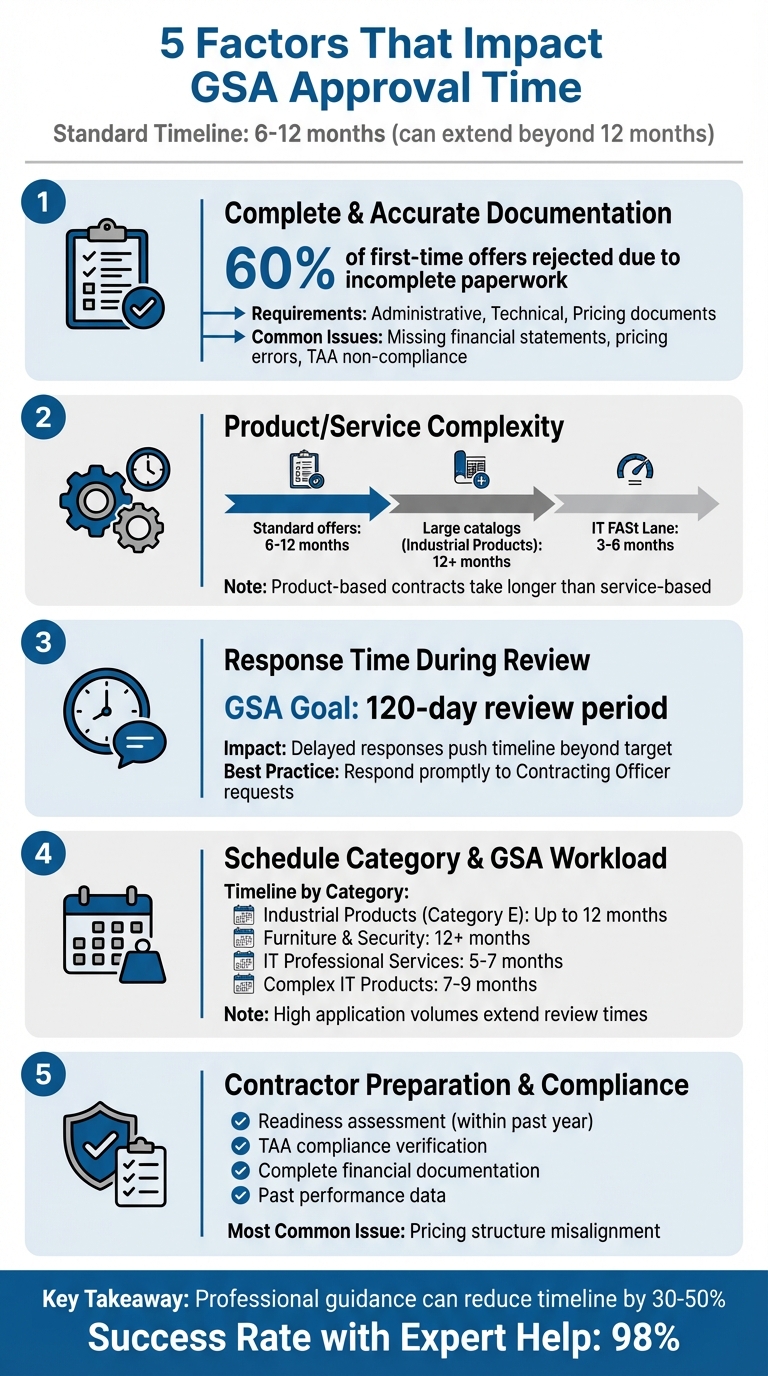
5 Key Factors That Impact GSA Contract Approval Timeline
Get On The GSA SCHEDULE – Executive Orders, Proposal Requirements & Timelines
1. Complete and Accurate Proposal Documents
When it comes to GSA submissions, incomplete or incorrect documentation is the leading cause of delays and rejections. Contracting Officers (COs) review your proposal in three key areas – administrative, technical, and pricing. Missing or incorrect information in any of these categories can lead to requests for clarification, dragging out the approval process for weeks or even months.
"One of the first aspects they [Contracting Officers] evaluate is the completeness of the offer. If your offer lacks any of the required documents… your CO or Contract Specialist (CS) will reach out to get that information before moving forward in the process."
- Jen Camp, Proposal Writer, Winvale
Here’s a closer look at what each category requires:
Administrative Requirements
Start with the basics: ensure your SAM.gov registration is complete and up to date. Your NAICS codes must align with your SINs, and you’ll need two years of financial statements. If there are net losses, include a clear explanation to address them.
Technical Requirements
This section focuses on your company’s expertise. Prepare concise narratives that highlight your corporate experience and quality control processes. Be specific when describing past projects, ensuring they directly relate to the SINs you’re applying for.
Pricing Requirements
Pricing is often where things get tricky. Include a commercial pricelist, clearly outline your GSA pricing (including discount terms), and provide a method for Economic Price Adjustment (EPA). To back up your pricing, include supporting documents like prior sales records or market research to demonstrate that your rates are fair and reasonable.
Avoid Common Pitfalls
Double-check that your SAM.gov registration acknowledges both the Federal Acquisition Regulation (FAR) and the Defense Federal Acquisition Regulation Supplement (DFARS). Additionally, ensure all your products meet Trade Agreements Act (TAA) compliance standards. Submitting non-compliant products will result in an automatic rejection.
For small businesses, the process can feel overwhelming. Partnering with a resource like GSA Focus can simplify the preparation of your proposal. They can help ensure your documents are complete and accurate, potentially speeding up the approval process.
Once your documentation is in order, it’s time to think about how your specific product or service might impact the complexity of the review process.
2. Product or Service Complexity
The complexity of your product or service plays a big role in how long it takes for the GSA to review your application. Even with all the required documents in place, the type and scope of what you’re offering can significantly impact the timeline. For example, product-based contracts often take longer than service-based ones. Why? Each product needs its own technical specs, pricing details, and market comparison data, which adds layers of review time.
"Large Categories like Industrial Products and Services (Large Category E) often require more effort due to larger catalogs, which extend review time."
- Stephanie Hagan, Training and Communications Manager, Winvale
When it comes to service-based contracts, the challenges are different. Whether it’s consulting, IT services, or facility management, the GSA will scrutinize your past performance data. That means they’ll dive into customer reviews and performance ratings. If your documentation doesn’t clearly demonstrate your ability to deliver, expect them to ask for more information.
Here’s a rough idea of the timeline: standard offers usually take 6 to 12 months for approval. However, if your submission involves large catalogs or multiple Large Categories, the process can stretch beyond 12 months. On the other hand, IT contracts submitted through the FASt Lane program can drastically shorten the timeline, with approvals in as little as 3 to 6 months.
Want to speed things up? Start small. Focus your initial offer on your core capabilities rather than submitting an extensive catalog. You can always add more products or services later through contract modifications. This approach can reduce review time and help you get your foot in the federal marketplace faster. The combination of product or service complexity, document accuracy, and responsiveness ultimately determines how long the approval process will take.
3. Response Time During Review and Negotiation
During the review process, a GSA Contracting Officer (CO) will request clarifications, corrections, and engage in pricing discussions. Quick responses are key to keeping your proposal on track. This step builds on the solid groundwork of a complete proposal, helping to accelerate the approval process.
GSA’s goal is to complete reviews within 120 days. However, delays in your responses can push the timeline beyond this target.
"You should always reply promptly to any correspondence from your CO. This will help your proposal remain at the top of your CO’s mind."
- Patrick Morgans, Manager, Winvale
Timely communication is crucial, especially after submitting a well-prepared proposal and understanding the complexity of your products or services. Prepare in advance by gathering market rate data and pricing justifications to respond quickly. Streamline internal review processes to prevent bottlenecks.
Designating a single point of contact for all communication with the CO can help avoid confusion or delays. When reaching out, introduce yourself early to establish a professional rapport. However, balance is important – frequent follow-ups may come across as pushy rather than helpful. The objective is to stay responsive and professional without overstepping.
4. Schedule Category and GSA Workload
When it comes to GSA approval timelines, the specific schedule category and the workload at GSA centers play a huge role in determining how long the process takes.
Product-heavy categories require more time. Categories such as Industrial Products and Services (Large Category E) can take up to 12 months for approval. This is especially true when GSA centers are managing a high volume of applications, paired with the technical complexity of reviewing extensive product catalogs. These categories demand detailed technical specifications and pricing for every item, which adds to the review process. Furniture and Security categories often exceed the 12-month mark as well.
"Some Large Categories, such as the Industrial Products and Services (Large Category E) can be heavily product-based and can require more effort… These types of offers could take a year from submission of materials to GSA to the actual award."
- Stephanie Hagan, Training and Communications Manager, Winvale
GSA center workload affects timelines. The amount of work handled by specific GSA Management Services Centers is another key factor. Since 2009, the growing interest in federal contracts has led to an increase in application volume, often stretching approval times to close to 12 months. Each center manages different schedules, and those with heavier workloads face longer review periods. For example, offers processed by centers handling Schedules 874, 871, and 899 typically take between 7 and 12 months due to both the complexity of the applications and the sheer volume.
IT categories move quicker. IT Professional Services (SIN 132-51) have shorter timelines, usually requiring 5 to 7 months for approval. However, more complex IT product proposals may take slightly longer, around 7 to 9 months.
To navigate these challenges effectively, focus your offer on your core strengths instead of submitting an extensive catalog. Choosing the appropriate schedule category and understanding the workload dynamics at individual GSA centers can help streamline the process and potentially shorten your approval timeline.
5. Contractor Preparation and Compliance
How well you prepare before submitting a GSA offer can make or break the approval process. Many first-time offers are delayed – or even rejected – because of incomplete documentation. Missing financial statements or insufficient past performance data often lead to resubmissions, stretching out the timeline unnecessarily.
Conducting a detailed readiness assessment beforehand can help you catch and fix these issues before they become roadblocks. GSA requires an authorized officer to complete a self-evaluation in the eOffer system, which must be done within the past year. This step is crucial for spotting potential problems early. As Michael Perch, CEO of Road Map Consulting, points out:
"The readiness assessment is less about passing or failing and more about uncovering hidden risks."
One of the most common challenges? Pricing. According to Perch:
"Pricing is the most frequent readiness issue. Many businesses use flexible commercial pricing that works well in private markets but doesn’t translate cleanly to GSA expectations."
Beyond pricing, compliance is another critical area. For instance, adhering to the Trade Agreements Act (TAA) is non-negotiable. If you’re offering products, you’ll need to confirm the country of origin for every single item. Products from non-compliant countries are an automatic dealbreaker. To avoid future issues, set up a system to track any changes from your manufacturers so you don’t accidentally include non-compliant items later.
Being thorough and compliant not only aligns with GSA’s expectations but also helps you stay within the typical 6–12 month approval window. Submitting incomplete proposals – whether it’s missing profit and loss statements, bank references, or past performance documentation – can result in delays. In some cases, the GSA might even suspend your proposal or remove it from the eOffer system entirely. To avoid this, start gathering required documents early and double-check them against GSA-provided checklists.
If you’re unsure about any part of the process, GSA Focus offers expert guidance to help you navigate compliance and preparation efficiently.
Conclusion
Getting GSA contract approval is about more than just completing forms. The process, which generally takes 6 to 12 months, hinges on how well you manage five key areas: ensuring complete documentation, understanding the complexity of your product or service, staying responsive during reviews, accounting for the GSA’s workload, and thorough preparation. Any misstep in these areas can lead to delays that stretch the timeline significantly.
One of the biggest hurdles? Documentation. Around 60% of first-time offers are rejected due to incomplete or incorrect paperwork, adding months to the process as businesses scramble to start over. To avoid this, it’s essential to confirm TAA compliance early, stick to strict internal deadlines for gathering documents, and prepare pricing justifications ahead of time.
But accuracy alone isn’t enough – your responsiveness plays a huge role too. Patrick Morgans from Winvale highlights this point:
"You should always reply promptly to any correspondence from your CO. This will help your proposal remain at the top of your CO’s mind."
Quick and detailed responses keep your proposal moving forward. On the flip side, delays in communication can push your timeline back, creating unnecessary roadblocks.
For many businesses, professional guidance makes all the difference. Partnering with an experienced consultant can cut the GSA contract acquisition timeline by as much as 30% to 50%. GSA Focus, for example, offers comprehensive support, including document preparation, compliance checks, and negotiation assistance. With a 98% success rate, they help small businesses navigate the complexities of the GSA process, so you can focus on running your business while they handle the heavy lifting. Let their expertise keep your approval process on track from start to finish.
FAQs
What documents does GSA reject most often?
When submitting documents to the GSA, rejections often stem from issues like outdated information, incomplete submissions, or errors. Typical problems include expired SAM registrations, incorrect pricing details, missing or mismatched forms, inconsistent product descriptions, and omitted supporting materials. Double-checking for accuracy and ensuring all required elements are included can significantly reduce the chances of rejection.
How can I speed up GSA review and negotiation?
To speed up the GSA review and negotiation process, make sure your proposal is thorough and complies fully with GSA standards. Double-check that all documentation is accurate to prevent unnecessary delays. Partnering with a GSA consultant can simplify the preparation process and help resolve any potential issues upfront. If delays continue, you have the option to submit a Letter to Expedite – but only after verifying that your proposal is complete and meets every requirement.
How do I confirm TAA compliance for my products?
To ensure TAA compliance, your products must either be entirely manufactured in the U.S. or in a designated trade agreement country, or they must undergo substantial transformation in one of these locations. Once this is confirmed, you’ll need to submit a Certificate of Compliance to the government. This document serves as proof that your products align with the Trade Agreements Act standards required for GSA contracts.
Related Blog Posts
- GSA Schedule Timeline: Step-by-Step Guide
- Ultimate Guide to GSA Proposal Documents
- GSA Bid Follow-Up: Timing and Best Practices
- How Long Does It Take to Get a GSA Contract?