
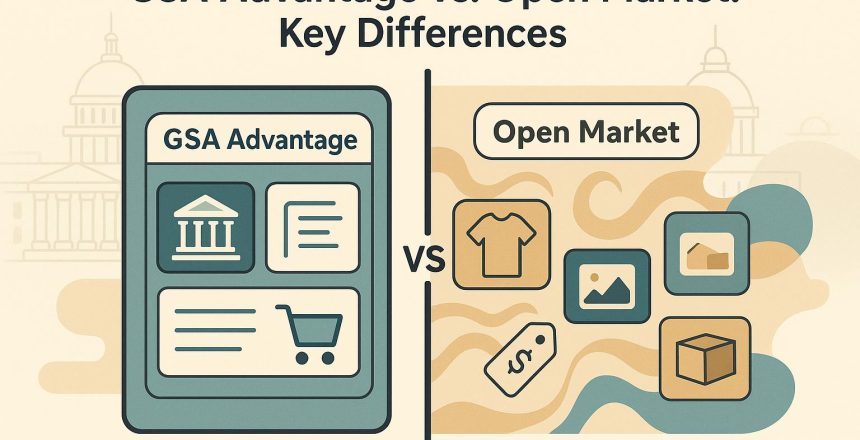
Choosing between GSA Advantage and Open Market procurement can shape your federal contracting success. Here’s a quick breakdown to help you decide:
- GSA Advantage: A streamlined, pre-negotiated marketplace for federal buyers. Benefits include:
- Fixed pricing for predictable revenue.
- Pre-approved vendors with reduced competition.
- Faster sales cycles and compliance assurance.
- Long-term contracts (up to 20 years).
- Open Market: A flexible, competitive bidding process. Features include:
- Dynamic pricing and custom terms.
- Broader vendor pool with higher competition.
- Longer procurement timelines.
- Ideal for unique or specialized projects.
Quick Comparison:
| Aspect | GSA Advantage | Open Market |
|---|---|---|
| Pricing | Fixed, pre-negotiated | Market-driven |
| Competition | Smaller, vetted pool | Larger, open pool |
| Process Speed | Faster | Slower |
| Best For | Standardized products | Custom solutions |
| Contract Length | Long-term (5-20 years) | Varies by project |
Key Insight: Only 4% of small businesses hold GSA contracts, offering a unique opportunity for reduced competition and steady revenue. Choose GSA Advantage for simplicity and stability, or Open Market for flexibility and tailored deals.
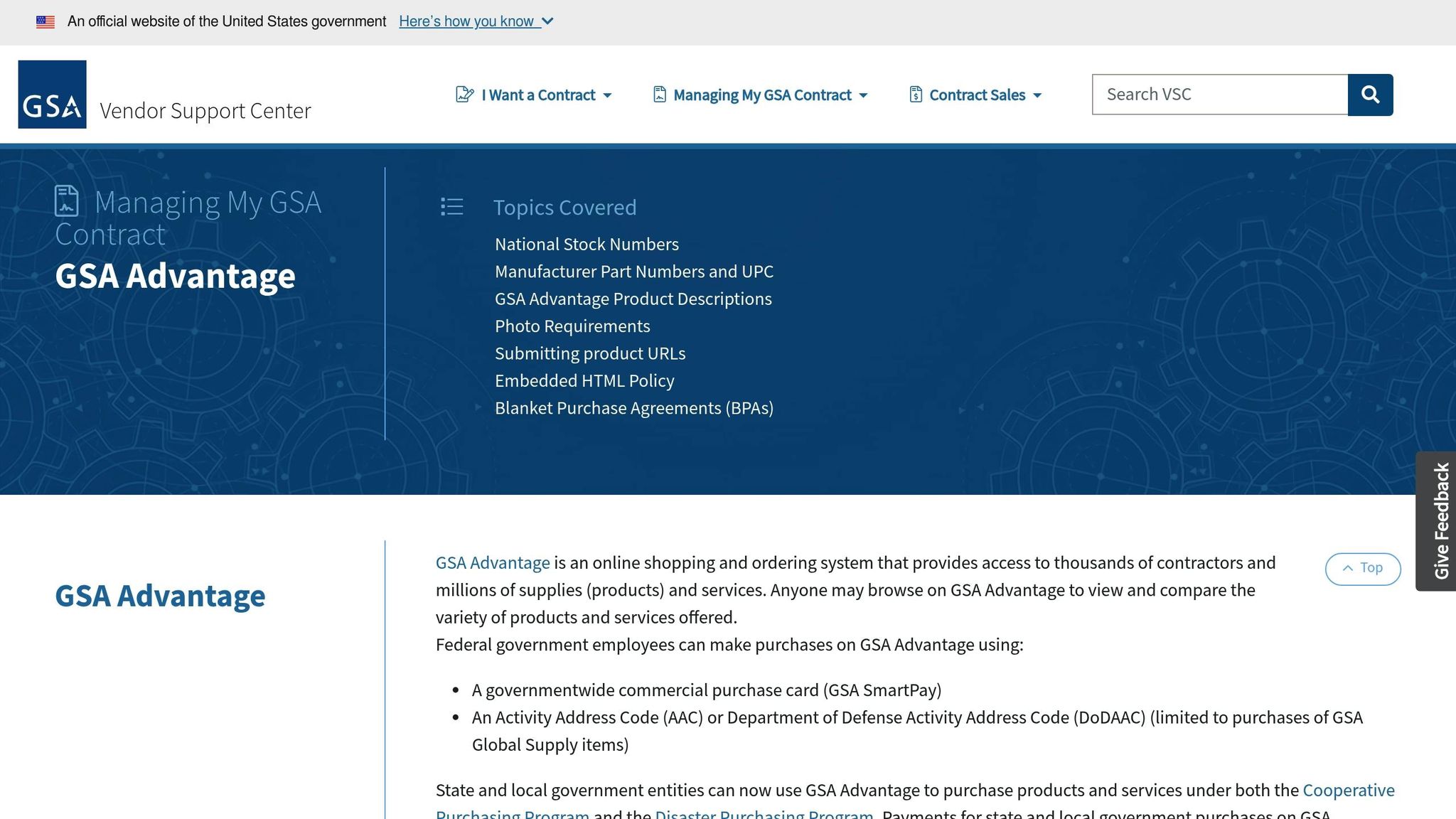
What Is GSA Advantage! And How Is It Used? – Making Politics …
How the Procurement Process Works
Understanding the steps involved in procurement helps in choosing the best federal contracting method for your needs.
GSA Advantage Process Steps
GSA Advantage uses a pre-approved system to simplify and speed up purchasing. It starts with obtaining a GSA Schedule contract, which involves submitting detailed documentation. While this initial paperwork can be time-consuming, it sets up an efficient, long-term procurement process.
Key benefits of GSA Advantage:
| Benefit | What It Means |
|---|---|
| Pre-negotiated Pricing | Prices are agreed upon upfront, so there’s no need for repeated bidding. |
| Simplified Purchasing | Agencies can buy directly from a pool of pre-vetted vendors. |
| Compliance Assurance | Vendors meet all federal requirements before being approved. |
| Long-term Contract | Contracts typically include a 5-year base period, with options for extension. |
Now, let’s look at how the open market process compares.
Open Market Process Steps
The open market approach involves a traditional competitive bidding process. Vendors must:
- Identify opportunities that fit their services or products.
- Prepare and submit tailored proposals.
- Negotiate pricing and terms.
- Ensure compliance with federal regulations.
Time to Complete Purchase
The time required for procurement depends on the method used. GSA Advantage offers a faster process thanks to its pre-approved vendor list and fixed pricing. On the other hand, open market procurement can take longer due to multiple rounds of proposal reviews and negotiations. Businesses with GSA Schedule contracts often benefit from shorter sales cycles and less administrative hassle.
Price and Contract Terms
Fixed GSA Advantage Pricing
GSA Advantage operates on a fixed-pricing model, simplifying the procurement process. Vendors negotiate competitive rates once, and those rates remain stable for the entire contract term. This approach supports approximately $160 million in daily awards across the federal marketplace.
Here’s how the fixed pricing model benefits both vendors and agencies:
| Benefit | Impact |
|---|---|
| Predictable Revenue | Vendors can plan their income with consistent rates. |
| Reduced Administrative Work | No need for repeated price negotiations. |
| Simplified Budgeting | Agencies can easily plan purchases with set costs. |
| Transparent Pricing | All parties know the exact costs upfront. |
On the other hand, the open market uses a flexible pricing model, which changes the dynamics of negotiations.
Open Market Price Negotiation
In open market procurement, prices are dynamic and tied to current market conditions. Each transaction requires separate negotiations, leading to variable pricing and longer deal timelines. This variability can influence cost structures and operational strategies, especially for smaller businesses.
Small Business Cost Impact
For small businesses, GSA Schedule contracts provide several advantages:
- Consistent Revenue Stream
Small businesses gain access to stable demand, even during economic downturns. - Improved Competitive Position
Reduced competition on GSA Schedules increases success rates for small vendors. - Long-Term Opportunities
Contracts can last up to 20 years, offering sustained access to high-value projects.
These pricing models play a key role in shaping financial strategies and competitiveness in the federal marketplace. Industry experts often highlight the importance of this system.
"We’ll be there with you, on-call, as your authorized negotiator, to make sure you get the prices your Small Business deserves."
– Josh Ladick, President and Founder, GSA Focus
Market Competition Analysis
GSA Advantage Vendor Pool
The GSA Advantage marketplace consists of a select group of pre-approved vendors, creating a more focused and competitive space. This curated vendor pool provides distinct benefits for those who qualify.
Here’s a breakdown of its key features:
| Aspect | Impact on Competition |
|---|---|
| Pre-approval Process | Only vetted vendors can participate |
| Market Size | $45 billion in annual contract value |
| Bid Response Rate | Fewer competitors per opportunity |
| Small Business Presence | Limited, selective participation |
These factors highlight the streamlined yet exclusive nature of GSA Advantage, offering a stark contrast to the broader dynamics of the open market.
Open Market Competition
The open market, on the other hand, is characterized by a larger number of vendors and lower barriers to entry. While this setup leads to increased competition for contracts, it also presents opportunities for vendors who are well-prepared and stand out.
Agency Access Comparison
Federal agencies approach procurement differently depending on the method. GSA Advantage simplifies the process by offering direct access to pre-vetted vendors. In contrast, open market procurement requires broader research and evaluation. Notably, many federal buyers prefer vendors with a GSA contract, emphasizing the importance of GSA Schedule access for success in federal procurement.
Here’s a comparison of the two environments:
| Factor | GSA Advantage | Open Market |
|---|---|---|
| Competition Level | Smaller, more exclusive pool | Larger, more diverse pool |
| Barrier to Entry | Higher (requires pre-approval) | Lower (minimal restrictions) |
| Bid Success Rate | Higher due to fewer competitors | Varies by contract |
| Agency Preference | Streamlined access to vendors | Requires extensive research |
This side-by-side comparison helps vendors weigh the advantages of each approach, guiding their strategy for entering the federal market effectively.
sbb-itb-8737801
Best Uses for Each Method
Best GSA Advantage Scenarios
GSA Advantage is ideal for agencies that need standardized products with pre-negotiated terms. Here are some common scenarios where it shines:
| Scenario | Benefits |
|---|---|
| Recurring Purchases | Pre-negotiated pricing, simplified process |
| Standard Products | Quick access to approved vendors |
| Time-Sensitive Needs | Faster procurement cycles |
| Budget-Conscious Projects | Competitive, pre-negotiated rates |
Best Open Market Scenarios
The open market is better suited for situations that require flexibility or tailored solutions, including:
- Custom or specialized products and services
- One-time, unique purchases
- Complex requirements needing detailed negotiations
- Items or services not found on the GSA Schedule
These distinctions highlight the importance of aligning the procurement method with the specific needs of the project.
Standardized vs. Custom Requirements
The decision between GSA Advantage and the open market often depends on how standardized the requirements are. GSA Advantage is the go-to option for standardized products with fixed, pre-negotiated terms. In fact, many agencies mandate the use of GSA Schedule contracts. In 2023, the GSA Schedule program facilitated $45 billion in transactions, emphasizing its role in federal procurement.
For businesses deciding which path to take, here’s a quick comparison:
| Requirement Type | Best Procurement Method | Key Advantage |
|---|---|---|
| Standard Products | GSA Advantage | Faster processing |
| Custom Solutions | Open Market | Flexibility in negotiations |
| Recurring Supplies | GSA Advantage | Predictable demand, steady sales |
| Specialized Solutions | Open Market | Flexible terms and conditions |
| High-Volume Orders | GSA Advantage | Simplified purchasing process |
Interestingly, GSA Advantage offers a unique opportunity for small businesses. With only 4% of small businesses participating in GSA Schedules, those that secure contracts can benefit from reduced competition and more streamlined sales processes, potentially boosting revenue significantly.
Quick Reference Comparison
Here’s a streamlined table comparing the key features of GSA Advantage and Open Market procurement methods. It highlights their main attributes side by side for easy reference.
Key Dimensions
| Aspect | GSA Advantage | Open Market |
|---|---|---|
| Price Structure | Fixed, pre-negotiated pricing | Market-driven, negotiable pricing |
| Competition Level | Limited to a curated vendor pool | Open to all qualified vendors |
| Documentation | Standardized contract documents | Requires a full procurement package |
| Purchase Limits | Set purchasing thresholds | Criteria vary by agency |
| Small Business Access | Direct access through set-aside programs | Competes within the broader market |
| Payment Terms | Standardized terms | Varies by contract |
| Product Availability | Pre-approved catalog items | Broad market options |
| Quality Assurance | Vendors and products are pre-vetted | Credentials verified per purchase |
| Contract Duration | Long-term contracts with renewal options | Tailored to specific project needs |
| Price Updates | Periodic adjustments included | Updated per individual contract |
| Delivery Terms | Standardized conditions | Negotiable terms |
Scenario Comparisons
| Scenario | GSA Advantage | Open Market |
|---|---|---|
| Emergency Purchases | Faster processing | Longer lead times |
| Volume Discounts | Built-in rates | Negotiated case by case |
| Vendor Performance | Standardized tracking system | Monitoring handled by the agency |
| Compliance | Pre-verified | Verification required by the agency |
This comparison underscores GSA Advantage’s structured and predictable framework, ideal for routine procurement. On the other hand, Open Market offers greater flexibility, making it a better fit for specialized or unique purchasing needs.
Conclusion
Deciding between GSA Advantage and open market procurement can significantly impact a small business’s success in federal contracting. As discussed earlier, GSA Advantage provides a structured approach with pre-negotiated pricing, simplified processes, and less competition. With only 4% of small businesses currently participating in GSA Schedules, there’s a considerable opportunity for businesses looking to enter the federal marketplace.
Industry experts emphasize the importance of this opportunity:
"Every day you’re not on GSA, you’re missing out on $50m+ in opportunities"
– Josh Ladick, President and Founder, GSA Focus
GSA Advantage offers stability with fixed pricing and efficient processes, appealing to businesses aiming for consistent federal revenue. On the other hand, open market procurement allows for more flexible pricing and customized terms but comes with longer procurement cycles and tougher competition.
Choosing the right strategy depends on your business goals and strengths. If your priority is steady federal revenue with reduced competition, GSA Advantage might be the right fit. However, if flexibility and tailored agreements are more critical, the open market could be worth considering despite its challenges.
Whichever path you choose, success requires a deep understanding of federal procurement rules and strict compliance. When approached correctly, both methods can open doors to substantial federal opportunities.
FAQs
What are the key benefits of using GSA Advantage instead of the open market for federal procurement?
Using GSA Advantage for federal procurement offers several key benefits compared to the open market. First, it provides access to pre-negotiated, fair, and reasonable pricing, which eliminates the need for repeated price negotiations. This can save time and streamline the purchasing process.
Additionally, GSA Advantage reduces competition by limiting the pool of vendors to those with GSA Schedule Contracts. This often results in shorter sales cycles and more predictable sales, as federal agencies frequently rely on GSA-approved vendors for their consistent, economy-proof demand for goods and services.
Overall, GSA Advantage simplifies procurement while ensuring compliance with federal regulations, making it an efficient and reliable choice for government buyers and contractors alike.
What are the key differences in competition between GSA Advantage and the open market, and how do they affect small businesses?
The competition on GSA Advantage is significantly different from the open market. GSA Advantage generally features fewer competitors, reducing the need for extensive marketing efforts by small businesses. In the federal market, about 44% of government awards receive only one bid, creating opportunities for small businesses to secure contracts more easily.
This reduced competition often leads to shorter sales cycles and more predictable revenue streams for small businesses. By leveraging GSA Advantage, small businesses can focus on providing value to federal buyers without the intense competition typically seen in the commercial market.
What are the steps to become a GSA Advantage vendor, and what benefits does it offer to businesses?
To become a vendor on GSA Advantage, your business needs to secure a GSA Schedule Contract. This involves preparing the necessary documents, ensuring compliance with federal requirements, and negotiating terms. Many small businesses find this process easier with professional support to streamline the application and approval steps.
The benefits of having a GSA Schedule Contract include access to a large federal customer base, reduced competition, quicker sales cycles, and the opportunity to secure consistent revenue. Additionally, GSA contracts often provide fair and transparent pricing, making it a valuable tool for businesses looking to grow in the federal marketplace.
Related posts
- GSA Schedules vs. Open Market Bidding
- GSA Bidding vs. Open Market Bidding
- GSA Ordering vs Open Market Purchasing
- Types of Federal Procurement Methods Explained