

The U.S. is spending billions to prepare for climate disasters. Here’s why: In 2023, the country faced 28 climate-related disasters, each costing over $1 billion. These events are increasing in both frequency and cost, putting homes, infrastructure, and the economy at risk. Federal policies now emphasize prevention over recovery, with investments in flood control, energy resilience, and infrastructure upgrades.
Key Takeaways:
- Rising Costs: Climate disasters cost $94.1 billion in 2023, up from $91 billion in 2018.
- Proactive Spending: Programs like FEMA‘s BRIC and DOE’s Weatherization Assistance Program are prioritizing pre-disaster measures.
- Business Opportunities: Small businesses can tap into federal funding through grants, loans, and GSA schedules.
Why It Matters: Shifting to resilience-focused spending saves money long-term, reduces disaster recovery costs, and creates opportunities for businesses to align with federal priorities.
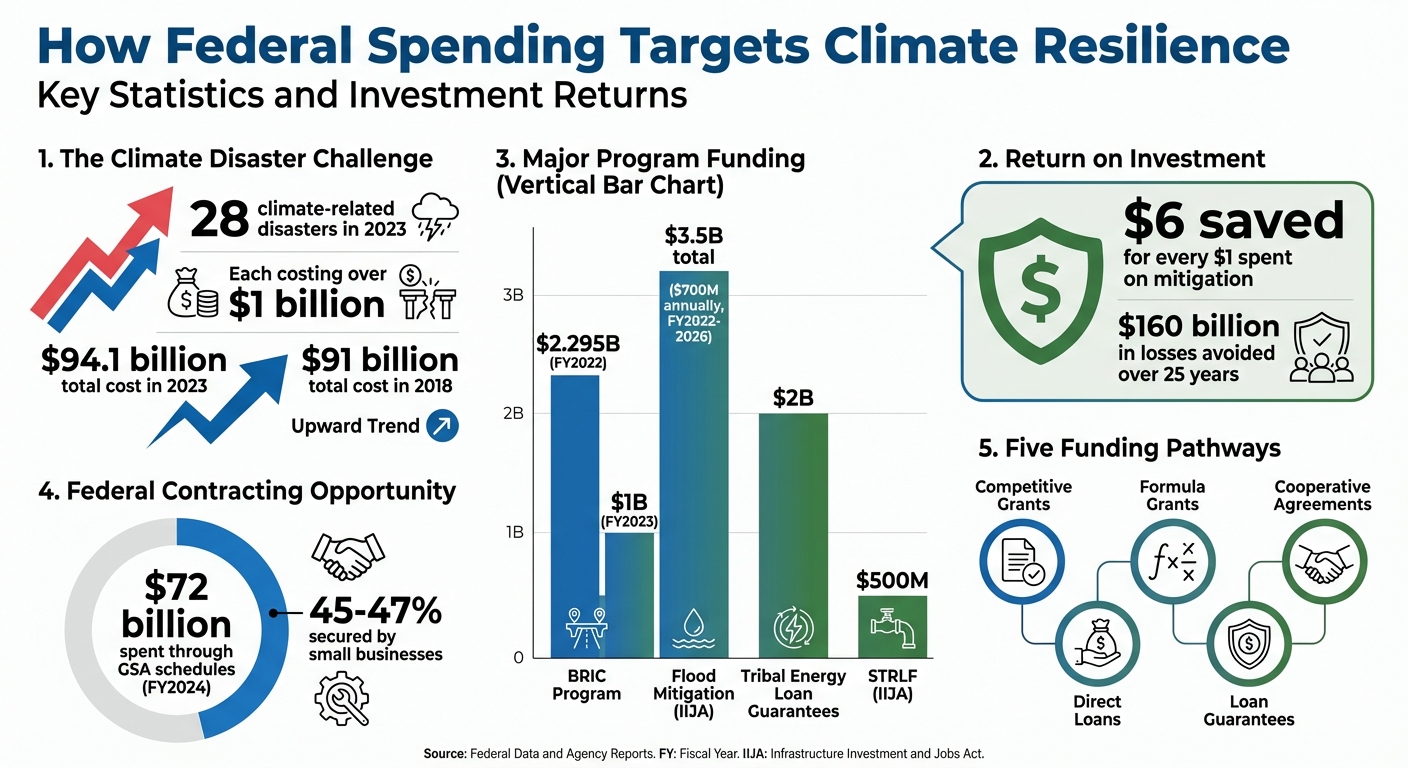
Federal Climate Resilience Spending: Key Statistics and ROI
Federal Budget Priorities for Climate Resilience
Sectors Receiving Federal Investment
The federal government is channeling significant funding into areas like infrastructure upgrades, flood risk management, and energy resilience. These investments have proven cost-effective, delivering $6 in savings for every $1 spent on mitigation through major federal grants. Over the past 25 years, programs led by FEMA, the EDA, and HUD have helped avoid $160 billion in losses, showcasing the value of these efforts.
Infrastructure and flood mitigation receive the lion’s share of funding due to their role in addressing the nation’s most costly climate-related challenges. For example, the Building Resilient Infrastructure and Communities (BRIC) program was allocated $2.295 billion in FY2022 and $1 billion in FY2023. Meanwhile, the Infrastructure Investment and Jobs Act (IIJA) dedicated $3.5 billion to Flood Mitigation Assistance, disbursed as $700 million annually from FY2022 to FY2026.
Energy resilience is also gaining attention. The Department of Energy’s Tribal Energy Loan Guarantee Program offers up to $2 billion in partial loan guarantees for energy development projects. Additionally, the Weatherization Assistance Program (WAP) – the largest initiative for residential energy efficiency in the U.S. – helps households withstand extreme weather while reducing energy bills. To further bolster resilience, the Safeguarding Tomorrow Revolving Loan Fund (STRLF) received $500 million through the IIJA to enable states and tribes to create low-interest loans for hazard mitigation projects.
These investments are carefully structured and carried out through targeted federal initiatives.
Major Programs Driving Climate Resilience
Federal climate resilience efforts are anchored by well-established programs. FEMA’s Hazard Mitigation Assistance (HMA) suite of programs plays a central role, supporting both pre- and post-disaster mitigation projects. A significant shift toward pre-disaster investments occurred after the Disaster Recovery Reform Act of 2018, which designated 6% of the Disaster Relief Fund for proactive mitigation projects. As the Congressional Research Service explains:
"Mitigation actions have a long-term impact, as opposed to actions associated with immediate preparedness, response, and recovery activities".
The BRIC program funds a range of projects, from sea walls to advanced flood control systems. Starting in FY2023, BRIC introduced "plus up" allocations aimed at modernizing building codes and improving enforcement. Equity is a key focus, with the program offering up to 90% or 100% cost-share matches for small, economically disadvantaged communities.
Other federal agencies also contribute to climate resilience. The EPA’s Clean Water and Drinking Water State Revolving Funds enhance water infrastructure security, while NOAA’s National Coastal Zone Enhancement program addresses coastal hazards and rising sea levels. The Department of Energy’s State Energy Program ensures energy security and emergency preparedness across all 50 states.
These coordinated efforts showcase the federal government’s commitment to reducing climate risks through targeted, cost-effective programs.
How Federal Funding Reaches Climate Projects
Funding Mechanisms and Grant Opportunities
Federal agencies channel climate resilience funding through five main pathways: competitive grants, formula grants, cooperative agreements, direct loans, and loan guarantees. Each plays a specific role in getting funds where they’re needed most.
Competitive grants are awarded based on the strength of an applicant’s proposal and how well it aligns with federal goals. For example, FEMA’s BRIC program evaluates submissions against a set of criteria to allocate funds. On the other hand, formula grants – like the Department of Energy’s (DOE) Weatherization Assistance Program (WAP) – distribute money using pre-set formulas that often consider factors like population size, income levels, or geographic needs.
Federal-state partnerships also play a crucial role in distributing funds efficiently. Programs like the EPA’s Clean Water and Drinking Water State Revolving Funds (SRF) provide ongoing, low-cost financing for local infrastructure projects. States manage these funds, offering loans to municipalities and utilities, which then contract the necessary work to local businesses.
To ensure projects meet federal standards and priorities, technical assistance programs offer valuable support. For instance, the DOE’s Office of Indian Energy and NOAA’s National Coastal Zone Enhancement programs provide free guidance to help refine proposals and build local expertise. Additionally, loan guarantees, such as those offered through the DOE’s Tribal Energy Loan Guarantee Program, back up to $2 billion in loans for tribal energy initiatives, extending eligibility to for-profit corporations as well.
These funding mechanisms collectively empower a wide range of climate and resilience projects.
Types of Projects Funded
The projects supported by these federal funding streams are as varied as the challenges they address.
Water infrastructure projects benefit significantly from programs like the Clean Water State Revolving Fund. These initiatives fund stormwater management systems, water conservation efforts, and measures to secure drinking water systems.
Energy resilience projects range from small-scale residential upgrades to major grid enhancements. For instance, the Weatherization Assistance Program has spurred a thriving private-sector industry focused on energy efficiency. Contractors and technology providers work to weatherize low-income homes, making them more resistant to extreme weather while cutting energy costs.
Federal funding also invests in natural infrastructure, supporting efforts like coral reef restoration, wetland rehabilitation, and coastal hazard mitigation through NOAA programs. Meanwhile, the Department of the Interior’s Tribal Climate Resilience program aids tribal communities with adaptation planning and vulnerability assessments.
Federal procurement policies further encourage the use of recycled-content materials in infrastructure projects. By prioritizing items like insulation, cement, concrete, and roofing made from recycled materials, these guidelines reduce greenhouse gas emissions and promote sustainable construction practices.
Lastly, disaster recovery and economic resilience projects help communities rebuild stronger after natural calamities. The EDA’s Economic Adjustment Assistance Program funds planning and recovery efforts, often involving specialized consultants and creating opportunities for small businesses with relevant expertise.
These diverse projects showcase how federal funding directly supports climate adaptation and resilience across the nation.
How Small Businesses Can Align with Federal Priorities
Understanding GSA Schedules for Federal Contracting
In fiscal year 2024, government agencies spent over $72 billion through GSA schedules, with small businesses securing roughly 45–47% of those awards. The GSA Multiple Award Schedule (MAS) simplifies the process for small businesses to provide products and services to federal buyers. It eliminates the need for lengthy procurement steps, offering pre-negotiated pricing that allows agencies to place orders without extended competitive bidding.
For businesses focused on climate resilience, specific Special Item Numbers (SINs) align with federal objectives. For example, SIN 541690E supports energy services aimed at infrastructure resilience, while SIN 561210FAC includes energy management control systems. Additionally, the Cooperative Purchasing Program enables state and local governments to use GSA Schedules for disaster recovery and infrastructure resilience solutions, broadening the customer base for small businesses.
Steps to Position Your Business for Federal Opportunities
To take full advantage of GSA schedules, small businesses need a strategic approach. Start by identifying the SINs that best align with your offerings. Then, review your commercial sales practices, pricing, and discount policies to ensure they are clearly outlined in your GSA Schedule proposal. Don’t forget to register your business on SAM.gov, the federal contracting system required for opportunities over $25,000.
Obtaining certifications can also provide a competitive edge. The federal government has set goals to award at least 3% of contracting dollars to service-disabled veteran-owned businesses and 5% to women-owned small businesses each year. Programs like the 8(a) Business Development Program, HUBZone, WOSB, and SDVOSB offer access to set-aside contracts and exclusive opportunities within vehicles like OASIS+ and 8(a) STARS III.
When pursuing grants, develop a SMART action plan with specific goals, measurable outcomes, and a detailed budget. Partnering with local governments, tribal organizations, or academic institutions can boost credibility and improve your chances of success. Use federal resources like Grants.gov and the U.S. Climate Resilience Toolkit to find funding opportunities tailored to your business.
Financial readiness is essential for federal contracts. Grants often operate on a reimbursement basis, meaning payments may take up to 90 days after invoicing. Additionally, the time between receiving a Notice of Award and actual fund disbursement can stretch beyond a year. To navigate this, ensure your business has sufficient working capital and is prepared for detailed recordkeeping and potential audits.
How GSA Focus Can Help

Navigating the GSA Schedule process can be daunting, especially for first-timers. Between strict documentation, compliance requirements, and complex negotiations, it’s easy to feel overwhelmed. That’s where GSA Focus comes in. They offer a comprehensive, done-for-you service to streamline the entire process.
With a 98% success rate and a refund guarantee, GSA Focus helps small businesses secure GSA Schedule contracts faster, opening doors to billions in federal climate resilience opportunities [website]. Their team handles everything from document preparation and compliance checks to negotiation support. They also provide ongoing advisory services and marketing assistance to ensure your contract gets noticed by federal buyers. For small businesses looking to align with federal climate priorities, expert guidance can make all the difference in accessing these lucrative opportunities.
Conclusion
Key Points Recap
Federal spending on climate resilience has become a major focus of national infrastructure planning. Agencies like the DOE, EPA, DOI, and NOAA are channeling billions of dollars into both pre-disaster mitigation and post-disaster recovery efforts. These public-sector investments have shown strong returns, especially as the frequency and cost of climate disasters continue to rise.
Funding is distributed to businesses and communities through various mechanisms, including competitive grants, formula funds, technical assistance, and loan guarantees. Programs such as FEMA’s BRIC, the DOE’s Weatherization Assistance Program, and the EPA’s Clean Water State Revolving Fund provide opportunities for small businesses to get involved. By integrating resilience goals into broader infrastructure projects, the federal government has made it easier for businesses to align their services with priorities like energy efficiency, water quality, and coastal management. For small businesses, this represents a significant opportunity to tap into federal funding by aligning their services strategically.
Next Steps for Small Businesses
For small businesses operating in climate-related fields, the time to act is now. Start by registering on SAM.gov, identifying GSA Schedule SINs that match your offerings, and pursuing certifications like WOSB or SDVOSB to qualify for set-aside contracts. Keep an eye on funding opportunities through platforms like Grants.gov.
Navigating compliance and contract negotiations can be challenging, but GSA Focus offers a streamlined solution. Their done-for-you service covers everything from document preparation to ongoing advisory support. With a 98% success rate and a refund guarantee, they make it easier for small businesses to access billions in federal climate resilience funding through GSA Schedules.
FAQs
How do federal programs like BRIC and WAP fund climate resilience projects?
Federal initiatives like the Building Resilient Infrastructure and Communities (BRIC) program are designed to fund projects that minimize risks from natural disasters while helping communities prepare for the challenges posed by climate change. These efforts often focus on upgrading infrastructure, implementing nature-based solutions, and adopting hazard-resistant building methods. A key priority is ensuring that underserved communities receive support, aiming to build resilience that lasts.
Take the Bipartisan Infrastructure Law as an example – it allocated more than $6.8 billion to bolster resilience across the country. This funding targets projects aimed at addressing the effects of climate change and extreme weather. These programs emphasize proactive, research-backed strategies to strengthen infrastructure, advance equity, and explore innovative ways to mitigate hazards.
How can small businesses benefit from federal climate resilience initiatives?
Small businesses have a lot to gain by tapping into federal climate resilience programs. These initiatives offer access to substantial funding and contracts focused on climate adaptation and resilience, paving the way for new growth opportunities. For example, federal budgets have earmarked millions of dollars for high-priority climate projects, giving businesses a chance to actively contribute to sustainable development efforts.
Beyond financial incentives, participating in these programs can boost a company’s reputation. Demonstrating a commitment to sustainability is becoming a key factor for attracting government agencies and private partners alike. On top of that, aligning with federal priorities provides businesses with valuable guidance on compliance and opens doors to government procurement opportunities. This can be a game-changer for staying competitive and adapting to shifting regulations.
In short, engaging with these initiatives not only drives financial growth but also helps businesses build resilience in an ever-evolving market.
How can small businesses access federal funding for climate resilience projects through GSA Schedules?
Small businesses have a unique opportunity to tap into federal funding for climate resilience projects through GSA Schedule Contracts. These contracts simplify the process of collaborating with federal agencies, giving businesses a direct route to participate in initiatives aimed at climate adaptation and strengthening infrastructure.
Programs like the Climate and Resilience Program and funding from the Inflation Reduction Act open doors for businesses working on vulnerability assessments, mitigation plans, and sustainable infrastructure. Beyond that, grants and community-driven initiatives often emphasize equitable climate resilience, offering additional opportunities for businesses that align with these objectives.
Securing a GSA Schedule Contract can boost your business’s credibility and edge in the competitive federal contracting space. By tailoring your proposals to match federal priorities, you not only position your business for success but also play an active role in advancing climate resilience efforts through federal funding and support.
Related Blog Posts
- How to Find Target Agencies for GSA Contracts
- 5 Tips for Navigating Federal Buying Cycles
- How GSA Plans $3.4B Infrastructure Upgrades
- Federal Infrastructure Spending: Opportunities for Contractors