

A Federal Acquisition Circular (FAC) is the official vehicle the government uses to amend the Federal Acquisition Regulation (FAR). When one publishes, your first move is to download it from Acquisition and read the companion Small Entity Compliance Guide (SECG) before anything else.
Every FAC appears simultaneously in the Federal Register and on Acquisition.gov. The SECG, prepared under section 212 of the Small Business Regulatory Enforcement Fairness Act of 1996, distills the rule changes into plain language specifically for small businesses, as confirmed by the FAC 2026-01 Small Entity Compliance Guide. Skipping it is the single most common compliance mistake small contractors make.
Three immediate steps when a FAC publishes:
- Download the FAC introduction and SECG from Acquisition.gov or the Federal Register
- Triage each FAR case in the items list against your active contract portfolio
- Assign a named owner to track effective dates and required modifications
Pro Tip: Subscribe to Acquisition.gov’s FAR News feed and bookmark the Smart Matrix to get notified the moment a new FAC posts, rather than discovering it during an audit.
Key Takeaways
A Federal Acquisition Circular amends the FAR through bundled FAR cases, and contractors must read the SECG, confirm effective dates, and update clause libraries before the next solicitation or modification cycle.
| Point | Details |
|---|---|
| Read the SECG first | The SECG summarizes each FAC’s rules for small businesses and is the fastest triage tool available. |
| Confirm effective dates per item | A single FAC can contain items with different effective dates; read each FAR case entry individually. |
| Update clause libraries immediately | Map changed FAR sections to your active contracts and solicitation templates before the next award cycle. |
| Assign a single owner | One named person per FAC cycle prevents obligations from falling through the cracks. |
| Use FAR XML for automation | Rev attributes and LSA markers in FAR DITA XML let contract-writing systems detect clause changes by FAC number. |
Table of Contents
- What a federal acquisition circular actually contains
- Where to find and download FACs, SECGs, and the current FAR
- How FAC numbering and effective dates work
- Practical contractor impacts and compliance steps
- Reading recent FACs as practical models
- Technical integration: FAR XML, DITA, and contract-writing systems
- How Gsascheduleservices approaches FAC updates for clients
- Sources
- FAQ
What a federal acquisition circular actually contains
A FAC bundles multiple FAR cases that have completed the full rulemaking cycle into a single, numbered publication. Think of it as a patch release for the FAR: each “item” in the FAC corresponds to one FAR case, and the FAC introduction summarizes what changed, why, and when it takes effect.
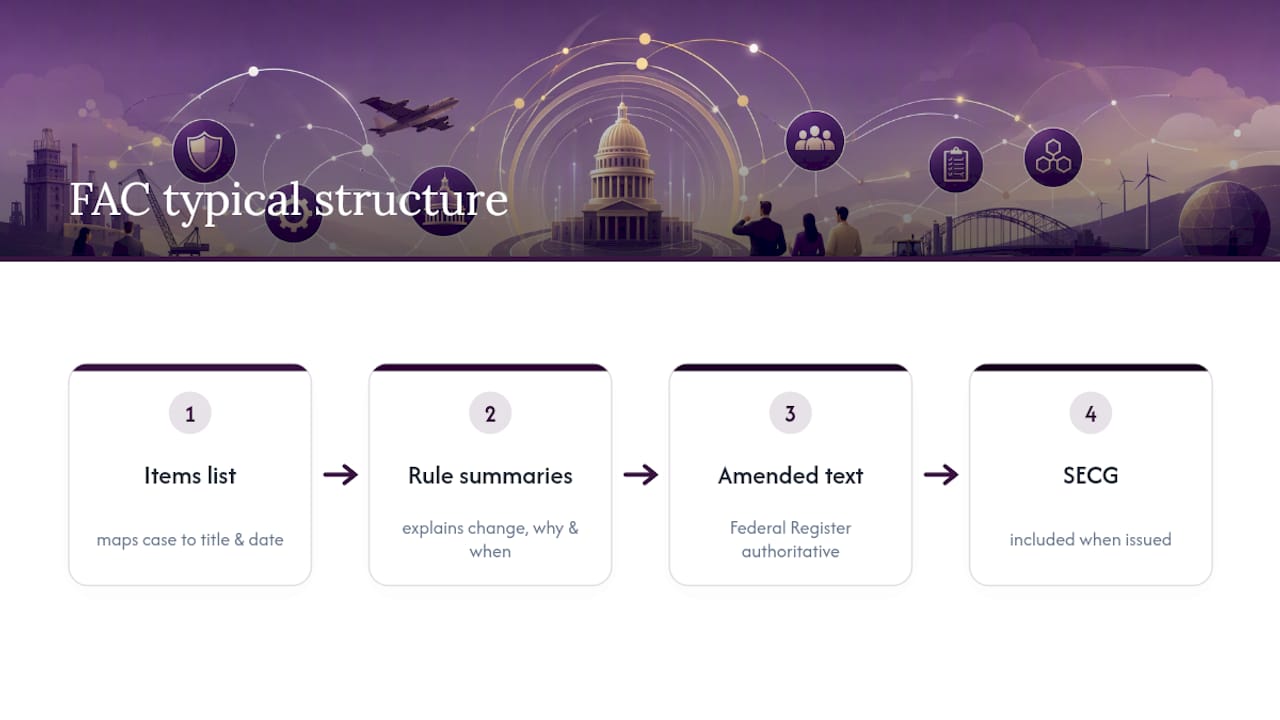
The typical structure runs: an items list (a table mapping each FAR case to its title and effective date), individual rule summaries, the amended regulatory text, and the SECG when one is issued. The regulatory text published in the Federal Register is the authoritative legal source. Acquisition.gov’s formatted version is operationally convenient but secondary for legal reference.
FACs are issued jointly by the Department of Defense (DoD), the General Services Administration (GSA), and NASA, under the oversight of the Office of Federal Procurement Policy (OFPP). That joint authority is why FAC changes bind virtually every civilian and defense acquisition.
The FAR is maintained as a joint regulation by DoD, GSA, and NASA, and FACs are the exclusive mechanism for amending it. Any change to FAR text, whether a threshold adjustment, a new clause, or a technical correction, must flow through a published FAC before it carries legal force.
The preamble of each FAC introduction explains the policy rationale behind each FAR case. Reading it matters: it tells you whether a change is substantive (new obligations) or technical (correcting a cross-reference), which directly affects how much triage your team needs to do. For a plain-English grounding in how FAR clauses work, the Federal Acquisition Regulations for Dummies guide is a useful starting point for teams newer to the structure.
Where to find and download FACs, SECGs, and the current FAR
Two channels carry every FAC. The Federal Register is the legal record; Acquisition.gov is the operational hub where most contracting professionals actually work day to day. Both are official. Neither is optional.
Primary access points:
- Federal Register (federalregister.gov and govinfo.gov): The official publication of record. Use this for legal reference, regulatory text, and SECG documents tied to specific FACs.
- Acquisition.gov FAC pages: Lists every FAC with links to the Federal Register entry, the SECG, and the included FAR cases. The FAC 2026-01 publication page is a clean example of how these pages are structured.
- Acquisition.gov FAR browse: Lets you navigate the current FAR by part and section in HTML or PDF.
- GSA GitHub (GSA-Acquisition-FAR): Machine-readable FAR content in XML (DITA format) for developers and contract-writing system integrators.
| Channel | What it provides | Best use |
|---|---|---|
| Federal Register / govinfo.gov | Official legal text, SECG PDFs, preambles | Legal reference, audit documentation |
| Acquisition.gov FAC pages | FAC summaries, FAR case lists, SECG links | Day-to-day contractor triage |
| Acquisition.gov FAR browse | Current FAR in HTML and PDF | Clause lookup and operational reference |
| GSA GitHub (FAR XML/DITA) | Machine-readable FAR with rev attributes | System integration and automation |
The GSA Small Entity Compliance Guide page explains the legal basis for SECGs under SBREFA and notes the limited cases where a separate SECG may not be issued. Check it when a FAC introduction does not include an SECG link.
How FAC numbering and effective dates work
FAC numbers follow a consistent convention: the first four digits represent the fiscal year, and the last two represent the sequence within that year. FAC 2025-06 is the sixth circular issued in fiscal year 2025. FAC 2026-01 is the first of fiscal year 2026. That structure makes it straightforward to track whether your clause library is current.
Effective dates require more careful reading. A FAC introduction may list different effective dates for different FAR cases within the same circular. Some items take effect on the date of Federal Register publication. Others carry a future effective date, particularly when agencies need time to update systems or solicitation templates. A third category applies only to contracts awarded after the effective date, not to existing contracts, which is a critical distinction for modification planning.
Effective date language in a FAC introduction is not uniform across items. Read each FAR case entry individually. A single FAC can contain items effective immediately, items effective 30 or 60 days out, and items that apply only to new solicitations, all in the same document.
The rulemaking timeline that precedes a FAC typically runs: proposed rule published in the Federal Register, public comment period (usually 30–60 days), agency review of comments, final rule publication, and then FAC publication bundling the final rule with others. Interim rules can take effect immediately upon publication when an agency finds good cause to bypass the notice-and-comment period, and they appear in FACs alongside final rules with a notation distinguishing them.
Practical contractor impacts and compliance steps
A FAC can touch your business in four main ways: new or revised contract clauses you must flow down to subcontractors, adjusted dollar thresholds that change which rules apply to your contracts, SAM.gov registration timing requirements, and domestic sourcing or subcontracting changes. Missing any one of these during implementation creates audit exposure.
Triage checklist when a FAC publishes:
- Pull the items list from the FAC introduction and identify every FAR case
- Determine whether each change applies to new awards only, existing contracts, or both
- Map affected clauses to your active contract portfolio and flag contracts requiring modification
- Update your internal clause library and solicitation templates
- Verify SAM.gov registration status if the FAC touches registration requirements
- Train contracts and proposal staff on substantive changes before the next solicitation cycle
- Document completion of each step for audit readiness
FAC 2025-05, for example, clarified SAM preaward registration requirements under FAR Case 2023-018, directly affecting when contractors must be registered before award. Teams that missed the effective date language found themselves scrambling to update subcontract flow-downs mid-solicitation.
The most common pitfall is relying on a secondary summary (a newsletter, a law firm alert) instead of reading the FAC introduction directly. Summaries are useful for initial awareness, but they occasionally miss item-level nuances, particularly on effective dates and applicability scope. Your GSA Schedule maintenance checklist should include a FAC review step as a standing item.

Pro Tip: Assign one named person, not a team, as the FAC owner for each publication cycle. That person reads the introduction, completes the triage checklist, and signs off on implementation. Diffuse ownership is where obligations fall through the cracks.
Reading recent FACs as practical models
The best way to learn how to read a FAC is to open one. The four most recent circulars each illustrate a different type of change.
FAC 2025-06 adjusted acquisition-related thresholds for inflation, the kind of change that ripples across simplified acquisition procedures, micro-purchase limits, and subcontracting plan thresholds simultaneously. FAC 2025-04 updated the Buy American domestically nonavailable articles list, a change that looks narrow but can affect product substitution decisions on active delivery orders.
When you open a FAC introduction, the items table is your triage starting point. Each row names the FAR case, the rule title, and the effective date. Items marked as interim rules need immediate attention; final rules with future effective dates give you a planning window. The SECG link, when present, sits in the introduction or on the Acquisition.gov FAC page. For changes to how you handle contract modifications after a FAC, the GSA Schedule modification guide covers the operational steps in detail.
Technical integration: FAR XML, DITA, and contract-writing systems
For teams running contract-writing systems or clause libraries programmatically, the FAR’s machine-readable format is the right integration target. Acquisition.gov’s developers page documents the full DITA schema, including how rev attributes and LSA markers are embedded in FAR XML to identify exactly which sections changed in which FAC.
Integration checklist for technical teams:
- Ingest FAR XML from Acquisition.gov or the GSA GitHub mirror after each FAC publication
- Parse
revattributes to identify sections revised in a specific FAC number - Cross-reference LSA (List of Subjects in CFR Parts Affected) markers to map changed parts to your local clause identifiers
- Flag contracts in your system that reference any changed clause or threshold
- Log each FAC ingestion with the FAC number, effective date, and list of changed sections
The detection pattern is straightforward conceptually: query the XML for rev attribute values matching the FAC number (for example, rev="FAC 2026-01"), extract the affected section identifiers, and compare them against your clause library index. Any match surfaces a potential modification requirement. This is an integration pattern, not production code, and your implementation will depend on your contract-writing system’s data model.
FAR XML rev attributes are the most reliable signal for detecting clause-level changes by FAC number. Secondary sources, including formatted HTML on Acquisition.gov, are useful for human reading but should not be the primary input for automated clause-library updates. Always verify against the XML source.
Pro Tip: Maintain a change log that records the FAC number, the affected FAR sections, the date you ingested the update, and the person who verified implementation. That log is your first line of defense in a DCAA or IG audit.
Cross-reference your ingested XML against the GSA GitHub repository (GSA-Acquisition-FAR) to catch any discrepancies between your local copy and the published source. GitHub commit history also gives you a timestamped record of when each FAC’s changes were merged into the repository.
How Gsascheduleservices approaches FAC updates for clients
FAC monitoring is not a quarterly task. Treating it that way is how contractors end up with clause libraries that are one or two circulars behind, which is exactly the gap auditors find.
At Gsascheduleservices, the approach is to treat each FAC publication as a trigger event, not a scheduled review. When a new circular posts, the triage process starts the same day: pull the items list, map it against the client’s active contract portfolio, and identify which changes require modifications versus which require only internal documentation updates. Ownership is assigned to a single point of contact for each client engagement, so there is never ambiguity about who is responsible for verifying implementation.
The SECG is always the first document reviewed for small-business clients. It is not a shortcut; it is the fastest way to determine whether a FAC item creates a new obligation or simply clarifies existing practice. From there, the Federal Register entry provides the authoritative text for any item that needs deeper analysis.
What makes this approach defensible in an audit is documentation. Every FAC review generates a dated record: which items were reviewed, which contracts were affected, what actions were taken, and who verified completion. That paper trail is what separates a contractor who is compliant from one who can prove it.
Sources
Use these official channels as your primary references, not secondary summaries:
- Federal Acquisition Regulation; Federal Acquisition Circular 2026-01; Small Entity Compliance Guide
- Federal Acquisition Regulation; Federal Acquisition Circular 2025-06; Introduction
- Acquisition
- Small Entity Compliance Guide | GSA
For legal reference, the Federal Register entry is authoritative. For day-to-day operational use, Acquisition.gov is faster and better organized. Subscribe to Acquisition.gov’s FAR News and set up a Federal Register email alert for “Federal Acquisition Circular” to receive notifications on the day each FAC publishes.
FAQ
What is a Federal Acquisition Circular?
A Federal Acquisition Circular is the official document that amends the Federal Acquisition Regulation, bundling multiple completed FAR cases into a single numbered publication issued jointly by DoD, GSA, and NASA.
Where can I download the latest FAC and its SECG?
Download FACs and their Small Entity Compliance Guides from Acquisition.gov’s FAC publication pages or from the Federal Register at federalregister.gov and govinfo.gov.
How do I read a FAC number like FAC 2026-01?
The first four digits identify the fiscal year and the last two identify the sequence within that year, so FAC 2026-01 is the first circular issued in fiscal year 2026.
Do all FACs include a Small Entity Compliance Guide?
Most FACs include an SECG prepared under SBREFA, but GSA notes there are limited cases where a separate SECG is not issued; check the GSA SECG page and the FAC introduction to confirm.
What is the difference between a final rule and an interim rule in a FAC?
A final rule completes the full notice-and-comment rulemaking cycle before publication; an interim rule takes effect immediately upon publication when the agency finds good cause to bypass that process, and both can appear within the same FAC.
Recommended
- Federal Acquisition Regulations for Dummies: Plain-English Guide
- Bridge Contract: What GSA Schedule Holders Must Know
- How to Get Your First Federal Contract?
- Federal Procurement Guidelines Simplified