
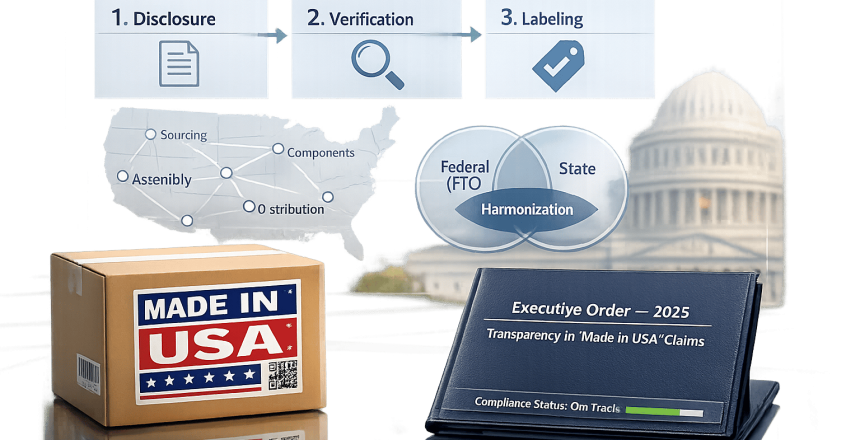
President Trump signed a new Executive Order (EO) on March 13, 2026, titled "Ensuring Truthful Advertising of Products Claiming to be Made in America." The directive tasks the Federal Trade Commission (FTC) with prioritizing enforcement against fraudulent "Made in USA" (MUSA) claims, particularly those made by "foreign manufacturers and sellers" and "digital marketplaces" targeting patriotic consumers with misleading advertising.
The EO emphasizes protecting "American businesses building, growing, and manufacturing all, or virtually all, aspects of their products onshore." These businesses, the EO notes, are "entitled to the undiluted branding benefits that come with supporting the American economy", and the directive aims to ensure that "American citizens attempting to buy American products should have certainty as to what American-origin claims mean."
Increasing Complexity for Manufacturers
Despite its intentions to combat deceptive practices, the EO introduces potential challenges for businesses attempting to comply with multiple, and often inconsistent, standards for MUSA claims. These include federal regulations such as the Buy America Act (BAA), the Build America, Buy America Act (BABA), and the FTC’s own Made in USA Labeling Rule, as well as state-level laws like California’s "Made in USA" labeling regulations.
For example, under the BAA, a product qualifies as a domestic end product for federal procurement if it is manufactured in the U.S. and satisfies a "domestic content" threshold, currently set at 65% of the total cost of components. This threshold will rise to 75% in 2029. By contrast, the FTC’s Made in USA Labeling Rule imposes a stricter standard for unqualified MUSA claims, requiring that:
- Final assembly or processing occurs in the United States.
- All significant processing takes place in the United States.
- The product contains "all or virtually all" domestically sourced components.
Violations of the FTC’s Labeling Rule can result in civil penalties of up to $53,088 per violation.
Additionally, California’s labeling law creates another layer of complexity, with a product qualifying as "Made in USA" only if foreign parts do not exceed 5% of the product’s wholesale value, or 10% if the foreign parts are proven to be unavailable domestically. Unlike the FTC’s standard, this law specifies thresholds based on percentage values tied to the product’s wholesale value.
These conflicting requirements mean that a product meeting the BAA’s 65% domestic content threshold may still fall short of the FTC’s stricter criteria or California’s specific percentage thresholds.
FTC’s Past Actions Set the Stage
The FTC has long prioritized the enforcement of MUSA claims. In 2025, FTC Chairman Andrew Ferguson designated July as "’Made in the USA’ Month", during which the agency issued warning letters to four companies for noncompliance with the Labeling Rule. The FTC also sent similar warnings to major online retailers like Amazon and Walmart, highlighting allegedly deceptive MUSA claims made by third-party sellers on their platforms.
The latest EO builds on this foundation, directing the FTC to consider regulations that hold online marketplaces accountable for country-of-origin verification. It also calls for voluntary labeling initiatives and requires federal agencies to periodically review American-origin claims for products acquired through government-wide contracts.
Legal and Marketing Risks Persist
The EO’s spotlight on MUSA claims adds to a growing wave of scrutiny, including an increase in consumer class actions targeting misleading claims. From January to June 2025 alone, manufacturers faced 13 class actions related to MUSA claims – nearly double the total for 2024. These lawsuits extend beyond "Made in USA" claims, targeting phrases like "America’s coffee" or "American craftsmanship", as well as visual elements like the U.S. flag.
In this challenging landscape, businesses must carefully navigate the overlapping standards while remaining compliant with FTC regulations. Experts emphasize the importance of robust supply chain monitoring, detailed record-keeping, and accurate marketing practices. As the EO states, "failure of an online marketplace to establish procedures for verifying country-of-origin claims may constitute an unfair or deceptive act or practice under the FTC Act."
Conclusion
President Trump’s Executive Order underscores the administration’s commitment to protecting truthful advertising and supporting domestic manufacturing. However, the directive introduces additional complexities for businesses seeking to comply with federal and state standards for MUSA claims. As enforcement efforts intensify and legal risks grow, manufacturers must remain vigilant, ensuring their claims are truthful, accurate, and legally compliant under the varying requirements. Scrutiny of "Made in USA" claims is expected to continue, shaping the future of marketing and compliance practices for years to come.