
Start with three sources: USAspending.gov, Sam, and GSA’s eBuy and Market Research as a Service. Pick two agencies showing repeat spend in your category, then update your SAM and Small Business Search profile so the SINs and capability narrative match what those buyers actually search for.
That single move, shortlisting agencies from spending data and matching your profile to it, does more for your pipeline than weeks of cold outreach. Agencies research vendors before they ever post a solicitation, and most of that research happens in databases you can see too.
TL;DR:
- Filter USAspending by NAICS or SIN and sort by award count, then prioritize agencies with repeat purchases over those with one large contract.
- Check SAM.gov weekly for sources sought notices and RFIs, and review agency forecast files for planned purchases and set aside status months ahead.
- Agencies can reuse market research for up to 18 months, so refresh SAM.gov and Small Business Search profiles every 6 to 12 months.
- GSA eBuy filters vendors by SIN, and contractors need an approved price list under each claimed SIN to appear in buyer search results.
- SBA scorecards identify agencies that missed small business or socioeconomic goals; prioritize those buyers because corrective action plans can create pressure to find vendors.
Table of Contents
- What federal data sources reveal agency buying patterns?
- Why do agencies conduct market research before they buy?
- How do SINs and eBuy determine who gets found?
- What does a practical agency outreach sequence look like?
- How do you stay visible when contracting officers search for vendors?
- How consulting support speeds up agency targeting
- A realistic view on timelines and when to get help
- How Gsascheduleservices helps with agency targeting
- FAQ
- Sources
What federal data sources reveal agency buying patterns?
SAM.gov lists active solicitations and points of contact. Watch it for sources-sought notices and RFIs in your NAICS or SIN, since those appear before a formal award and signal that an agency is actively planning a purchase.
USAspending and the Federal Procurement Data System show the history behind that activity: which agencies bought what, from whom, and how often. A recipient search by NAICS or SIN turns up the awarding agencies that return to the same categories year after year, and that repetition matters more than any single contract size.
Procurement forecasts fill the gap between history and the next solicitation. Agencies publish these through tools like the Acquisition Gateway forecasting tool, often exportable as CSV, showing planned purchases months ahead along with expected set-aside status.
A few habits make these sources useful instead of overwhelming:
- Filter USAspending by NAICS and sort by award count, not just dollar value, to find agencies that buy frequently rather than once.
- Check SAM.gov sources-sought notices weekly in your category rather than waiting for a solicitation to post.
- Pull forecast CSVs from agency and Acquisition Gateway pages to flag upcoming set-asides before competitors notice.
Our free federal market research tools roundup walks through each portal in more depth if you want a second pass.
Why do agencies conduct market research before they buy?
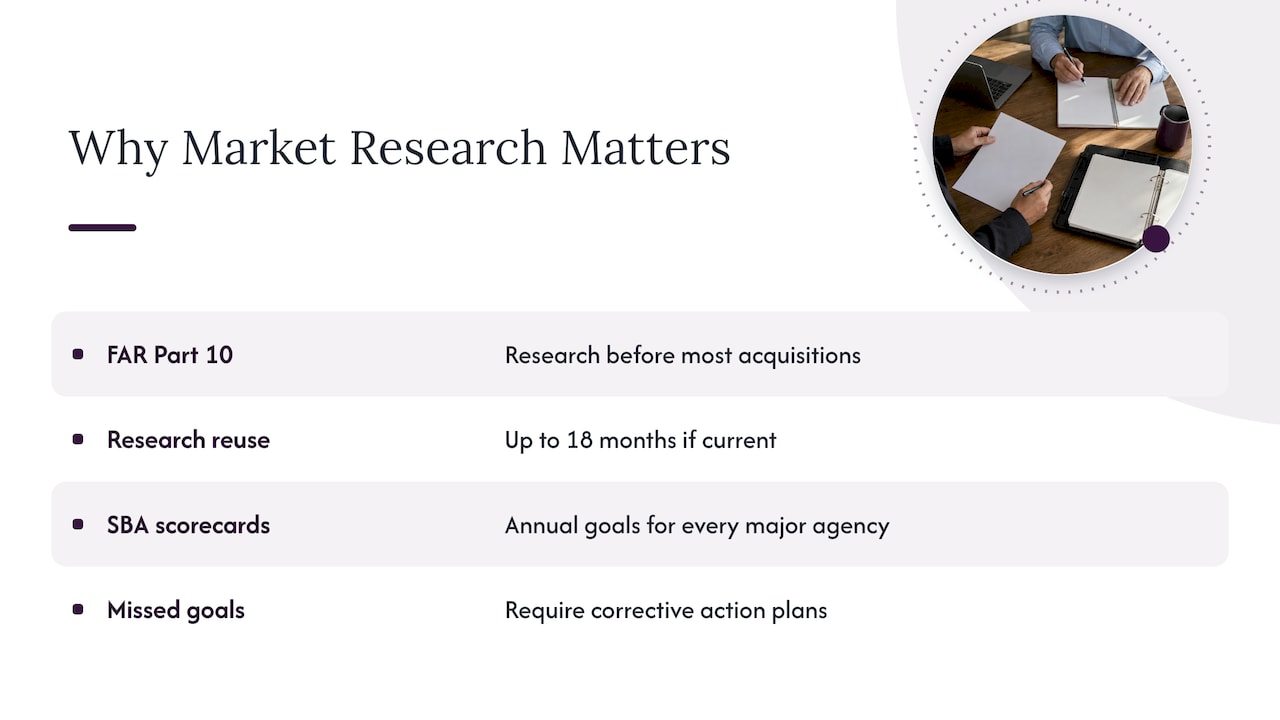
FAR Part 10 requires agencies to conduct market research on an ongoing basis before most acquisitions, which is why contracting officers routinely search vendor databases long before a solicitation goes public. It also lets them reuse research for up to 18 months if it is still current, which rewards vendors who keep their profiles fresh rather than updating once and forgetting about it.
An agency that keeps missing its small-business goal has to explain why, and that explanation often turns into a reason to call vendors it hasn’t talked to yet. The SBA publishes annual small-business contracting goals and scorecards for every major agency, and agencies that miss those goals must file corrective action plans.
Scorecards are public, so you can check which agencies are underperforming in your socioeconomic category, whether that’s small business generally, WOSB, SDVOSB, or HUBZone, and prioritize outreach there. An agency under pressure to close a goaling gap has more incentive to find and vet a new vendor than one already meeting its targets.
How do SINs and eBuy determine who gets found?
GSA structures its Multiple Award Schedule around Special Item Numbers, and eBuy buyers filter by SIN before they ever see a contractor name. Matching your capability statement to the right SIN matters more than matching keywords to a product description, because that’s literally how the eBuy buyer interface sorts contractor lists. A contractor without an approved price list on file under that SIN doesn’t appear in the results at all, no matter how well the capabilities fit.
GSA’s Market Research as a Service program runs its own FAR Part 10 compliant research and sends RFIs to vendors registered under relevant SINs. Vendors who respond often receive the requesting agency’s point of contact along with the final MRAS report, which is a direct line past the usual cold-outreach wall.
Pro Tip: Run a SIN-filtered search in eBuy for your own category and see how many competitors actually have an active price list loaded. If the list is short, that’s your opening.
A short mapping checklist before you touch outreach:
- List every SIN that plausibly covers your products or services, not just the obvious one.
- Confirm your GSA price list is approved and visible under each SIN you claim.
- Search eBuy under those SINs to see who else shows up and how complete their listings are.
Our breakdown of how GSA market research works covers MRAS mechanics in more detail.
What does a practical agency outreach sequence look like?
Research only pays off once it turns into a contact. A tight sequence keeps it from stalling:
- Pull forecast and USAspending data for your category, then shortlist two to three agencies with repeat awards in your SIN.
- Identify each agency’s small business specialist or procurement point of contact and draft a one-paragraph capability statement that references a specific past award pattern.
- Respond to any open sources-sought notice or RFI before a formal solicitation posts, or send the capability statement directly if nothing is open yet.
- Log every response, request a debrief when you lose a bid, and fold what you learn into the next round of outreach.
Timing carries as much weight as the message itself. A capability statement sent during a forecast window, before a draft RFP exists, lands very differently than one sent after a solicitation already has three responses. Our guide to market research for GSA contracts has sample language for that first email.
How do you stay visible when contracting officers search for vendors?
Contracting officers doing their FAR-mandated research query a short list of fields: NAICS code, PSC or SIN, business size status, capability narrative, and point-of-contact details. A SAM.gov profile with a thin narrative or an outdated contact gets skipped even when the underlying business is a perfect fit.
Small Business Search (formerly Dynamic Small Business Search) and GSA eLibrary are where officers verify what SAM.gov shows, so both need to match. A capability statement that reads differently across the three creates doubt rather than confidence.
| Where to check | What to update | How often |
|---|---|---|
| SAM.gov | NAICS, PSC/SIN, size status, capability narrative, POC | Every 6 to 12 months |
| Small Business Search | Business description, certifications, socioeconomic status | Every 6 to 12 months |
| GSA eLibrary | Approved price list, SIN listings, contract number | After every modification |
- Confirm NAICS and SIN codes still reflect what you actually sell, not what you sold when you first registered.
- Upload the current approved price list to GSA Advantage and eLibrary after any modification.
- Refresh the capability narrative with a recent award reference every time you update SINs.
Agencies can reuse market research for up to 18 months under FAR Part 10, so a stale profile stays stale in their files for a long stretch unless you refresh it on a schedule rather than waiting for a reason.
How consulting support speeds up agency targeting
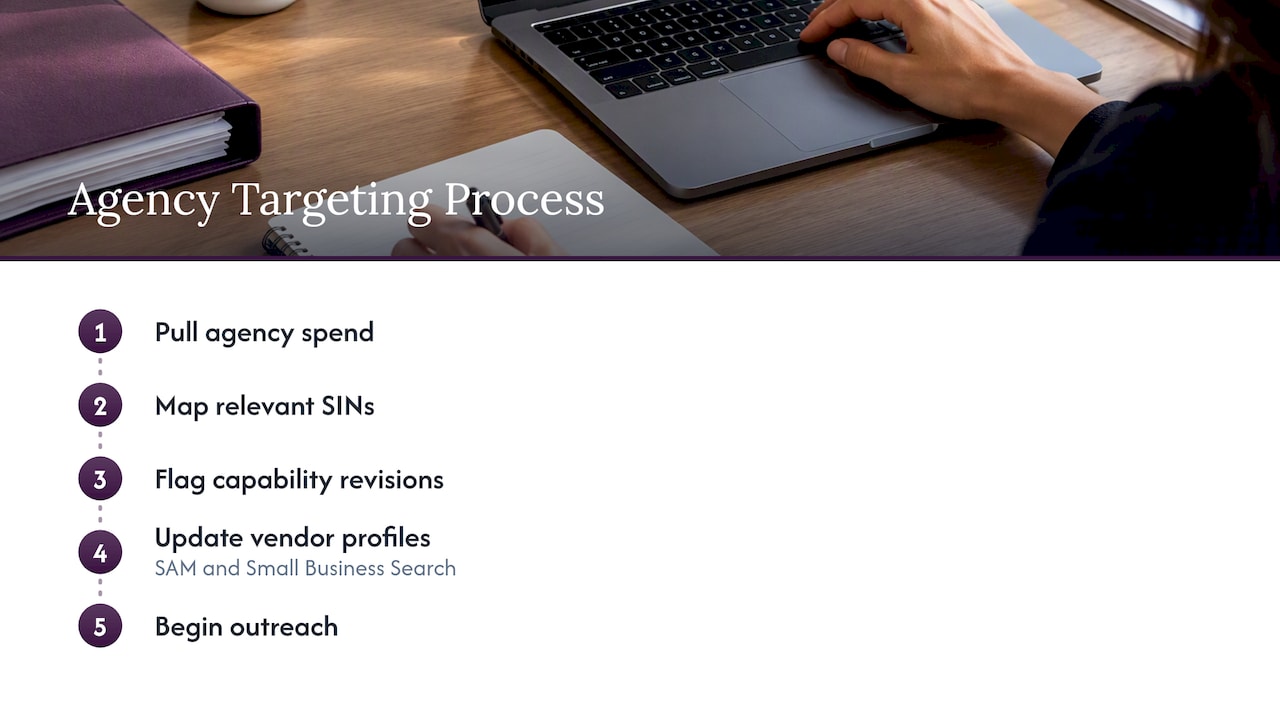
A structured discovery process turns the research above into a shortlist in days rather than weeks: pulling agency spend data, mapping it to the right SINs, and flagging where your capability statement needs rework with tools like Adaptify AI alternatives comparison. We handle that discovery and SIN mapping directly, then update SAM and Small Business Search profiles so contracting officers find a consistent, current listing. For businesses with tight internal bandwidth, outsourcing that first pass usually gets outreach started sooner than building the research muscle from scratch.
A realistic view on timelines and when to get help
Most businesses underestimate how long agency targeting takes alone. Mapping SINs, checking spend data, and keeping three profiles consistent is steady work, not a weekend project. If you’re spending more hours chasing data than talking to agencies, that’s the signal to bring in help rather than push through solo.
— Josh
How Gsascheduleservices helps with agency targeting
We handle the parts of agency targeting that eat the most time: discovery and SIN mapping, SAM and Small Business Search profile updates, and outreach support once you’ve got a shortlist worth pursuing. Clients typically experience a significantly shorter timeline to award while spending minimal time, compared with businesses working through it alone, whose timelines are much longer.
- Discovery and SIN mapping to turn spend data into a real shortlist.
- Profile updates across SAM, Small Business Search, and GSA eLibrary so contracting officers find a consistent listing.
- Outreach templates and ongoing support once you’re ready to respond to RFIs.
If you’re not sure where your business fits yet, start with a free eligibility check or review current package options to see what matches your timeline.
FAQ
Which consulting firms have been targeted by DOGE?
That question falls outside what this article covers and outside what we can answer from a verified source. For agency-specific procurement activity, check USAspending.gov directly.
What is the GSA agency?
GSA, the General Services Administration, manages the Multiple Award Schedule program that lets federal agencies buy pre-vetted goods and services from approved vendors. It also runs tools like eBuy and Market Research as a Service that connect agency buyers with vendors in specific SIN categories.
Who are the biggest government contractors?
Federal spending data tracked through USAspending and FPDS shows award totals by recipient, which is the authoritative way to see which contractors receive the largest federal awards in a given year. That list shifts by agency and category, so checking current USAspending data for your specific market segment gives a more useful answer than a fixed ranking.
How many federal agencies are there in the United States?
The federal government includes numerous departments and independent agencies, and the exact count depends on how sub-agencies and components are categorized. For procurement purposes, SAM.gov and USAspending list every agency that posts solicitations or awards contracts, which is the more actionable reference for vendors.
How much does GSA Schedule consulting cost?
Pricing depends on the scope of work, from initial Schedule acquisition packages to ongoing maintenance retainers. Current packages and rates are listed on our pricing page, including a retainer option for ongoing contract management.
Sources
Keep these open while you work: SAM.gov for live opportunities, USAspending.gov for spend history, FAR Part 10 for research requirements, and GSA eBuy and MRAS for SIN-level targeting. Bookmark these official portals for repeated checks.
Recommended
- How to Find Target Agencies for GSA Contracts
- GSA Contract Trends: What Past Awards Show
- What GSA Sales Data Reveals About Competitors
- Federal Agencies Using GSA for Contract Awards