

You must state a definite number of calendar days after receipt of order (ARO) for every item on your GSA price list, and that number cannot exceed your normal business practice under GSAM clause 552.238-86. Your electronic catalog also needs expedited or overnight options and a clearly listed delivery area, at minimum the continental 48 states.
TL;DR:
- Vendors must publish a specific number of calendar days after receipt of order for each item, based on their actual historical fulfillment times from the last 12 to 24 months.
- Leaving delivery time fields blank on the schedule signifies acceptance of the government’s default delivery time, which can lead to compliance issues.
- Expedited and overnight options must be clearly documented on the price list cover sheet, including availability and pricing details, to prevent order disputes.
- Contracting officers negotiate delivery times based on realistic data, pushing vendors to narrow wide ranges and provide proof via carrier records or fulfillment reports.
- Maintaining accurate, up-to-date lead time data in all catalog and price list documentation is essential, with routine audits to avoid drifting apart and common compliance risks.
Table of Contents
- What GSA Rules Require Vendors to State Lead Times?
- How Do You Set Lead Times for Your Price List and Catalog?
- How Should You List Expedited and Overnight Delivery?
- How Do Contracting Officers Negotiate Your Delivery Times?
- What Are the Most Common Lead-Time Compliance Risks?
- A Consultant’s Take: When to Handle Lead Times Yourself
- How Gsascheduleservices Helps You Publish Compliant Lead Times
- Sources
- FAQ
What GSA Rules Require Vendors to State Lead Times?
The controlling rule is 552.238-86 Delivery Schedule, a clause built into most Multiple Award Schedule contracts. It requires you to insert a specific number of calendar days ARO for each item on your contract, not a range, not a season, not “varies by demand.” The clause also sets a hard ceiling: whatever you offer cannot exceed your actual normal business practice. If you routinely ship in 15 days, you cannot publish 30 just to build in a cushion.
There’s a trap hiding in that clause that catches new vendors off guard. If you leave the delivery time blank on a schedule item, you’re treated as having accepted the government’s own stated delivery time from the solicitation, according to Cornell Law’s summary of 48 CFR 552.238-86. Leaving a field empty isn’t neutral. It’s a default commitment you never chose.
Beyond the base clause, three other pieces of guidance shape what you actually publish:
- Vendor Support Center rules require every GSA Advantage listing to show delivery days, lead time, and delivery area, alongside fields like unit of measure and government price inclusive of the Industrial Funding Fee, per Vendor Support Center delivery requirements.
- GSAM Subpart 511.4 distinguishes “desired” from “required” delivery times in solicitations and tells contracting officers to negotiate for the best times available, per Acquisition.
- I-FSS-600 price list templates and Mass Mod guidance tell you exactly where this information belongs: the cover sheet of your price list, mapped consistently into your SIP or EDI catalog upload, per the Mass Mod A812 Price List Text File Guide.
None of this is optional paperwork. It’s the language a contracting officer reads before ever picking up the phone.
How Do You Set Lead Times for Your Price List and Catalog?
Setting compliant delivery days isn’t a guessing exercise. It’s a data project with a handful of concrete steps, done in order.
- Pull your real ARO history. Look at actual order and shipping records from the last 12 to 24 months, not your best month. This is the baseline that becomes your “normal business practice” defense if anyone challenges your published times.
- Segment by item or SIN if performance varies. A vendor selling office furniture and office supplies under different Special Item Numbers should rarely publish one blanket lead time across both. Break out delivery days where your actual fulfillment speed differs.
- Document expedited or overnight capability separately. If you can offer 2-day or overnight delivery on some items, note it on the cover sheet with either a flat rate or “contact for rates” language, consistent with Mass Mod price list guidance.
- Update three places at once: cover sheet, T&C price list, and SIP/EDI file. Your I-FSS-600 price list, your electronic catalog data, and your GSA Advantage listing all need to say the same thing. The Vendor Support Center’s SIP/EDI guidance makes clear these fields must mirror each other exactly.
- Keep the evidence. Save the shipping logs, carrier invoices, or fulfillment reports that back up your stated days. This is what you hand a contracting officer if your lead time ever gets questioned during negotiation or an order dispute.
Pro Tip: Run this measurement exercise every time you file a contract modification, not just at initial award. Your fulfillment speed on year three rarely matches what it was during your proposal, and stale numbers are the single most common lead-time compliance gap examiners catch.
How Should You List Expedited and Overnight Delivery?
Faster delivery options need their own clear documentation, not a vague mention buried in a product description. Annotate expedited items directly on the price list cover sheet or in a labeled attachment, since ordering activities rely on that cover sheet to know what’s available before they place an order.
For overnight or 2-day service specifically, state whether it’s available and whether pricing is fixed or “contact for rates.” Ambiguity here creates order disputes fast, since a government buyer expects the terms they saw in your catalog to match what they’re actually charged.
A few practical rules to keep in mind:
- When an agency requests a delivery time shorter than what you’ve published, GSAM guidance notes agencies generally need written justification for unusually short timelines, per Acquisition.gov’s Section 511.401. You’re allowed to push back or offer an expedited-rate alternative instead of simply complying.
- If you can deliver early on some units but not all, segment those items or list them separately rather than blending an “early delivery precluded” clause with a standard one. 552.211-81 Time of Shipment includes language for exactly this scenario.
- Never let expedited service become your default answer to a slow supply chain. It should reflect a real, repeatable capability, not a one-time favor you did for a rush order last year.
How Do Contracting Officers Negotiate Your Delivery Times?
Contracting officers work from a simple distinction: a solicitation lists a “desired” delivery time and sometimes a “required” one, and GSAM Subpart 511.4 instructs them to negotiate toward the best time a vendor can realistically support, according to Acquisition.gov. That negotiation isn’t hostile. It’s closer to a credibility check.
Where vendors run into trouble is offering broad ranges like 30 to 90 days. Contracting officers will push back on that kind of spread and often ask you to segment items into narrower, specific delivery windows tied to quantity breaks or product categories, per the same guidance.
Keep these points in mind heading into any delivery-time discussion:
- Offer a number you can defend with real shipment data, not an optimistic estimate meant to look competitive on paper.
- Expect a request to tighten a range rather than accept it as published, particularly if competitors are offering narrower windows.
- Bring carrier records or fulfillment reports if you want to negotiate a faster time than your default. Evidence moves negotiations faster than assurances.
- Treat “desired” delivery times in a solicitation as a target to beat, not a ceiling you’re required to hit exactly.
What Are the Most Common Lead-Time Compliance Risks?
Most lead-time problems trace back to one of three habits, and all three are fixable with routine checks rather than a major overhaul.
- Overstating your speed. Publishing 30 days when your actual average is 45 invites an order-nonacceptance dispute the first time you miss it. Keep conservative, data-backed numbers instead.
- Catalog and price list drifting apart. Your GSA Advantage listing and your T&C price list need to match, and SIP/EDI guidance treats a mismatch as an active compliance risk during order processing, not a cosmetic error. Schedule a quarterly audit against your maintenance checklist.
- Vague ranges instead of specific numbers. A 30 to 90 day spread reads as unmanaged, not flexible. Segment by quantity break or item group instead.
Pro Tip: If your fulfillment speed changes meaningfully, whether it improves or slips, file a contract modification to correct your published lead time before an order exposes the gap.
A Consultant’s Take: When to Handle Lead Times Yourself
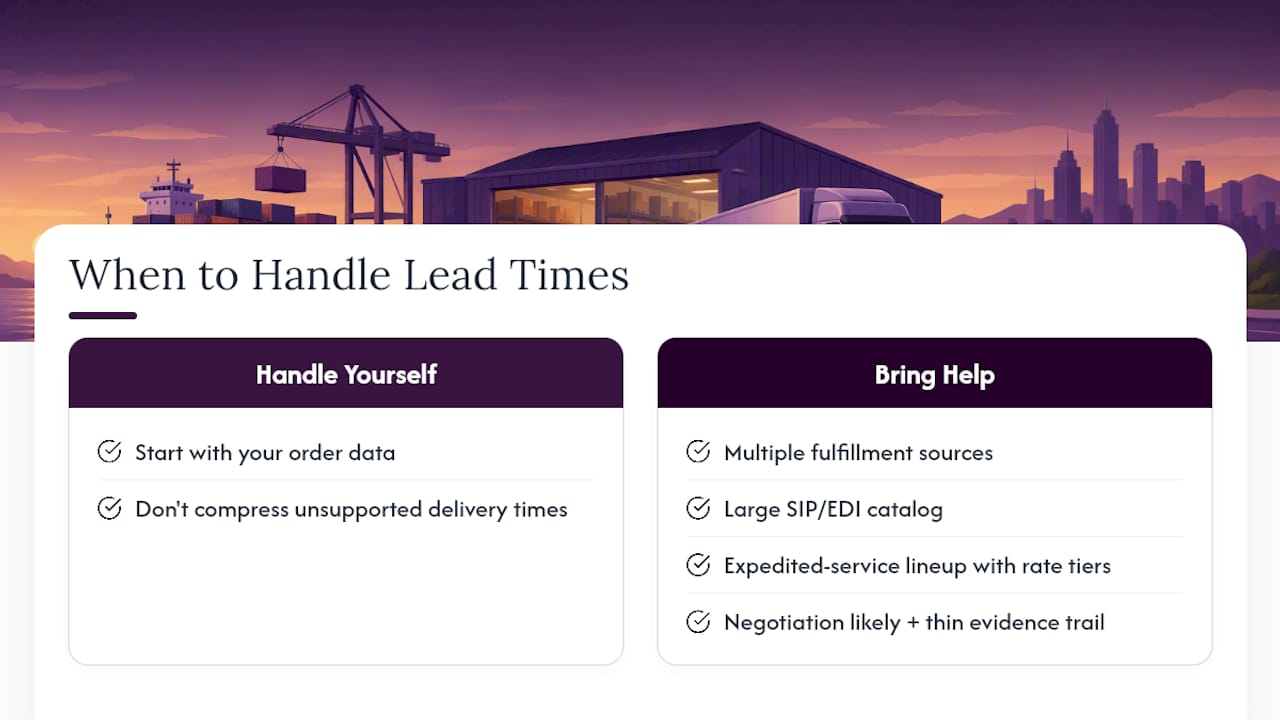
Start with your own order data before touching anything else. Compressing a delivery time you can’t back up is the fastest way to create a breach-of-contract situation down the line.
Where this gets harder to manage solo: multiple fulfillment sources, a large SIP/EDI catalog, or an expedited-service lineup with several rate tiers. If negotiation pressure from a contracting officer feels likely and your evidence trail is thin, that’s the signal to bring in help rather than guess.
— Josh
How Gsascheduleservices Helps You Publish Compliant Lead Times
Getting your delivery days right on paper is one task. Keeping your price list, cover sheet, and electronic catalog in sync across every modification cycle is another, and it’s where most SMBs lose time they don’t have. Gsascheduleservices handles both: readiness assessment on your current fulfillment data, price-list drafting that reflects real ARO numbers, SIP/EDI synchronization so your catalog and T&C price list never drift apart, and negotiation support when a contracting officer pushes back on your delivery terms. Vendors using professional consulting services typically move through the full schedule process in a shorter time and with less personal time commitment than those going it alone, who often face a much longer process with multiple rejections. If you’re deciding whether to document this yourself or get it right the first time, start with a free eligibility check and see where your current lead-time setup stands.
Sources
- Acquisition
- GSA Advantage product titles and delivery requirements | Vendor Support Center
- Acquisition
- MAS Consolidation Mass Mod A812 Price List Text File Guide | Vendor Support Center
FAQ
What Does “Days ARO” Mean on a GSA Price List?
ARO stands for “after receipt of order.” It’s the number of calendar days between when an ordering activity places an order and when you must deliver, as defined under 552.238-86.
Can I List a Delivery Range Like 30 to 90 Days?
You can propose a range, but contracting officers generally push back and ask you to segment items into specific, narrower delivery windows under GSAM Subpart 511.4. A specific number tied to real fulfillment data holds up better in negotiation than a wide spread.
What Happens if I Miss My Published Delivery Time?
Missing a stated lead time can expose you to order nonacceptance or a breach-of-contract claim, since 552.238-86 treats your published time as a binding commitment, not an estimate.
Do I Need to List a Minimum Delivery Area?
Yes. GSA Advantage listings require a stated delivery area, and vendors must at minimum be capable of delivering to the continental 48 states, per Vendor Support Center guidance.
Does Gsascheduleservices Help With Ongoing Lead Time Updates?
Yes. Gsascheduleservices offers maintenance plans, including one, two, three, and four modification packages per year, built for vendors who need to keep delivery terms synchronized across contract modifications.
Recommended
- How Small Businesses Can Get Started With A GSA Contract? 5 Steps!
- GSA Readiness: Why It Matters for Federal Contracts
- GSA Compliance: Don’t Get Lost
- Government procurement strategies that help SMBs win GSA bids