
Federal buyer research is the systematic review of public procurement data and agency signals to figure out who buys what you sell, at what price, and through which contract vehicle. The first move is tactical: pull three to five years of award data from USAspending and FPDS, then confirm your eligibility status on SAM.gov. That single step tells you whether an agency’s buying pattern fits your business before you spend a day on outreach.
TL;DR:
- Agencies are most likely to buy from vendors with a consistent presence in the last three to five years of award data, so regular data refreshes are essential.
- Focusing outreach on agencies with usually recurring spend in your NAICS code and realistic capacity increases your chances of success.
- Engaging early through sources-sought notices, RFIs, or industry days influences requirement development and improves visibility before solicitation posting.
- Monitoring final option year expiration dates and set-aside utilization helps identify prime recompete opportunities and avoid missed renewal signals.
- Using professional services to streamline GSA Schedule application and maintenance significantly reduces time to award, often to about ninety days, compared to DIY approaches lasting six months or longer.
Table of Contents
- What Is Federal Buyer Research and Why Does FAR Part 10 Matter?
- Where Do Federal Buyers Look for Vendors?
- How Do You Actually Run a Federal Market Research Process?
- How Do You Turn Research Into a Bid Decision?
- What Do Practitioners Get Right (and Wrong) About Buyer Research?
- Which Federal Agencies Should You Target First?
- How Do You Shape Requirements Before the RFP Drops?
- How Do You Stay Visible to Buyers Beyond the Contracting Officer?
- The Shift Toward Continuous Capture, Not One-Off Research
- How Gsascheduleservices Turns Research Into an Awarded Contract
- Sources Worth Bookmarking
- Sources
- FAQ
What Is Federal Buyer Research and Why Does FAR Part 10 Matter?
FAR Part 10 requires federal agencies to conduct market research before writing a requirement, and it explicitly permits reusing research from the prior 18 months if it’s still current. That’s the regulatory backbone of everything a contracting officer does before a solicitation ever posts, and it’s why your visibility during that window matters more than your proposal writing later.
FAR 10.001 and 10.002 direct agencies to determine whether commercial items can satisfy a need, whether small businesses can perform the work, and what contract type fits best. The research an agency does here decide three things that determine whether you ever see the opportunity:
- Whether the requirement becomes a small business set-aside, a full and open competition, or a sole-source award
- Whether it’s structured as a commercial item buy (faster, lighter paperwork) or a negotiated contract
- Which existing contract vehicles, including GSA Schedules, get considered as the acquisition path
Recent GSA class deviation guidance has loosened some procedural rigidity around market research techniques, giving acquisition teams more room to use interchange meetings, RFIs, and informal industry contact. For contractors, that flexibility is an opening. It means showing up early and being easy to find carries more weight than it did five years ago.
Where Do Federal Buyers Look for Vendors?
Buyers don’t discover contractors by accident. They pull from a specific set of public tools, and each one answers a different question.
- SAM.gov confirms your registration status, your NAICS codes, and your certifications (small business, 8(a), service-disabled veteran-owned, and so on). Contracting officers check this first to see if you’re even eligible to receive an award.
- USAspending.gov shows where the money actually went, agency by agency and fiscal year by fiscal year. Filter by NAICS code and recipient location to see who’s winning in your space.
- FPDS (Federal Procurement Data System) holds the transaction-level detail behind those dollar totals: contract type, award date, period of performance, and option years. USAspending pulls from FPDS, but FPDS gives you the granular fields.
- SBA’s Small Business Search (SBS) lets you check whether a competitor is registered as small for a given NAICS code, and whether your own small business profile is showing up the way it should.
- GSA eBuy is where agencies post RFQs against existing Schedule contracts. If you hold a Schedule, this is your live opportunity feed.
- Agency forecast pages and sources-sought notices round out the picture with what’s coming, not just what already happened.
Data point: analysts who study award patterns recommend pulling three to five years of historical data and refreshing that pull at least quarterly. A single year of awards can mislead you if it happened to be a light procurement cycle for that office.
A short USAspending query for “IT professional services, Department of Veterans Affairs, past 4 fiscal years” filtered to your NAICS code and PSC will usually surface the incumbent, the award size, and the option structure in under ten minutes. GSA’s own tutorial on pulling this data walks through the filters step by step.
How Do You Actually Run a Federal Market Research Process?
Treat this as a five-step workflow, not a one-time report.
- Set your scope. Pick your NAICS codes, your target agencies or program offices, and a data window (three to five years is standard). Narrow scope beats broad scope every time; a research project covering “the federal government” produces nothing usable.
- Pull and normalize award history. Export from USAspending and cross-check against FPDS for the contract-type and option-year detail. Watch for name reconciliation problems: agencies list vendors under legal entity names that don’t match the DBA you market under, and mergers or acquisitions create duplicate-looking records.
- Check eligibility signals. Confirm your SAM.gov registration is current and your NAICS/PSC codes match what you’re pursuing. Cross-reference SBA’s Small Business Search to see how you and your competitors are categorized.
- Monitor live signals. Sources-sought notices, RFIs, industry days, and agency forecast pages are where near-term opportunities surface before a solicitation drops. FAR 10.002 lists these as recognized techniques, which means agencies expect vendors to engage through them.
- Score and prioritize. Rank opportunities by vehicle dependence (does the agency mostly buy through GSA Schedule, GWAC, or open market?), option years remaining on incumbent contracts, and whether a prime/sub relationship makes more sense than a direct bid.
- Build a simple spreadsheet: agency, NAICS, incumbent, award value, option end date, vehicle used
- Flag any award reaching its final option year. That’s your clearest recompete signal
- Note every set-aside type an agency actually used in the past three years, not just what the current solicitation says
Pro Tip: Set a calendar reminder tied to option-year expiration dates, not solicitation dates. By the time a recompete solicitation posts, informal industry engagement is often already closed. Watching expiration dates gets you into the conversation eight to twelve months earlier.
How Do You Turn Research Into a Bid Decision?
Raw data doesn’t win contracts. What you do with it does.
If the same data shows heavy concentration on one contract vehicle, chasing an open-market bid against that pattern is usually a losing move. Go get on the vehicle instead, or team with someone who already holds it.
- If you find an incumbent with two option years left, that’s a subcontracting and relationship-building window, not a bid opportunity yet
- If sources-sought responses show three or fewer likely small business respondents, that’s a signal worth an RFI response
- If a program office keeps issuing bridge contracts, that’s usually evidence of a stalled recompete, worth a direct outreach email to the contracting officer
Pro Tip: Draft your capability statement before you need it. When a sources-sought notice or RFI hits your inbox, you’ll have hours, not weeks, to respond credibly.
Refresh this whole exercise quarterly, or immediately when you spot a new forecast entry or an incumbent contract nearing its final option year. Static research goes stale fast in a market where budgets and priorities shift every appropriations cycle.
What Do Practitioners Get Right (and Wrong) About Buyer Research?
The contractors who win consistently treat a few habits as non-negotiable, and the ones who stall usually skip the same steps.
- Track option end dates on every contract in your space, not just the ones you’re currently chasing
- Keep your SAM.gov and SBA SBS profiles current with the exact NAICS and keyword phrases buyers actually search for, reviewed at SAM.gov
- Write capability statements tight enough to read in ninety seconds, because that’s about how long a contracting specialist gives an unsolicited one
- Watch for poor name reconciliation between your legal entity, your DBA, and how agencies recorded past awards. It quietly erases your own track record from searches
- Don’t ignore vehicle ceilings. A contract that’s hit its maximum value is functionally closed no matter how good your capture plan is
- Get help when data normalization, negotiation, or Schedule paperwork is eating time you should be spending on outreach
Which Federal Agencies Should You Target First?
Not every agency is worth your attention, and figuring that out early saves months. Start with the agencies that already buy in your NAICS code at meaningful volume, not the ones that seem prestigious or high-profile.
Pull your USAspending export sorted by total obligated dollars per agency, filtered to your NAICS code, across the last three fiscal years. Rank the results. An agency showing consistent, repeated spend in your category, even at moderate dollar amounts, is a better target than one with a single large one-time buy, because repeated spend means a recurring need and a program office that’s used to procuring what you sell.
Cross-reference that ranking against your actual delivery capacity. A Department of Defense component spending heavily in your NAICS code is worthless to you if the work requires a facility clearance you don’t hold or a bonding capacity you can’t meet. Filter out anything outside your realistic performance range before you spend outreach time on it.
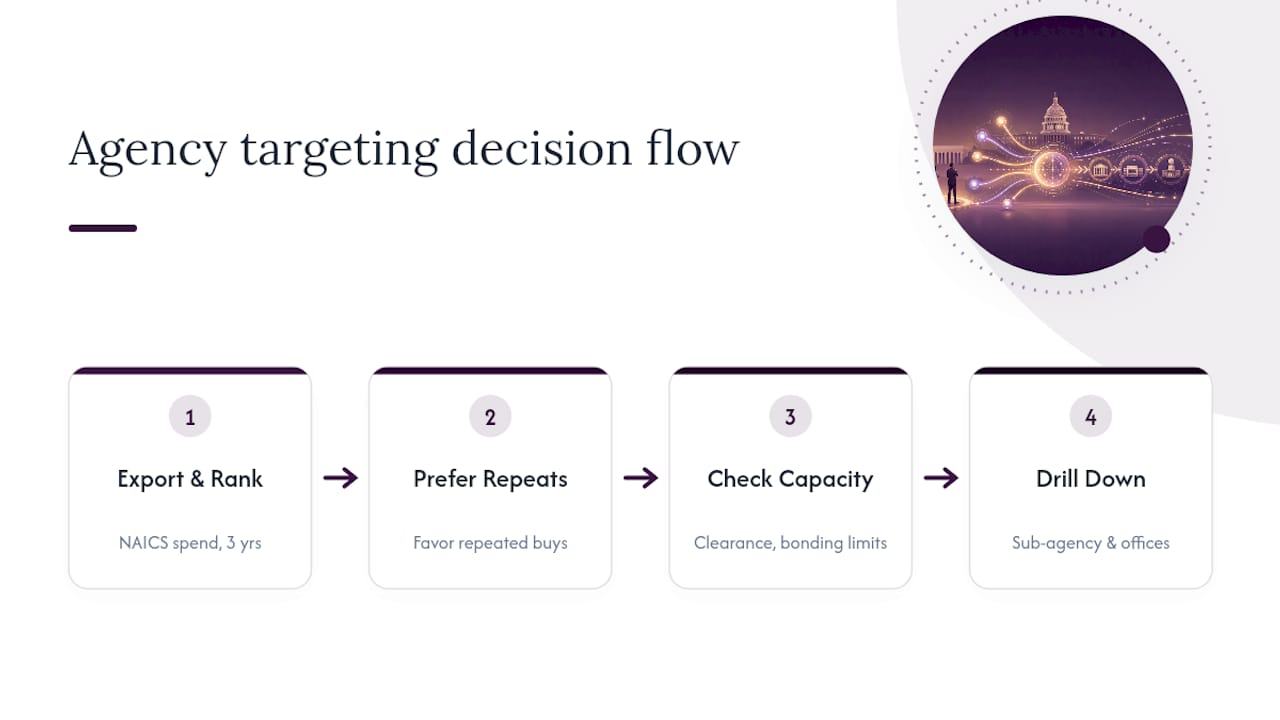
Look one layer deeper at sub-agency and program office level, too. The Department of Veterans Affairs and the General Services Administration, for instance, each run dozens of program offices with distinct buying patterns; a research pass at the department level alone will miss the office that’s actually your best fit. GSA eBuy postings, viewable through your GSA Advantage and eBuy access, often reveal which program offices are actively buying against a Schedule right now, which is a faster signal than waiting on a full agency-level report.
How Do You Shape Requirements Before the RFP Drops?
Waiting for a solicitation to post means you’re reacting to a requirement someone else already defined, often around an incumbent’s strengths. Shaping the requirement earlier changes that dynamic entirely.
FAR Part 10 explicitly recognizes RFIs, interchange meetings, and direct contact with knowledgeable individuals as legitimate market research techniques, so engaging isn’t just tolerated, it’s expected. When you respond to a sources-sought notice or an RFI with specific, well-supported input, a technically detailed answer, a realistic cost range, a note on an approach the draft requirement missed, that response can genuinely influence how the final requirement gets written.
Industry days work the same way, just live instead of written. Attending one and asking a sharp, specific question in front of the program office does more for your visibility than a polished one-pager mailed in cold. The goal isn’t to lobby for a particular outcome. It’s to make sure the requirement, as finally written, reflects what’s actually available in the market rather than a narrow spec built around one existing vendor’s product.

This is also where your past performance record does quiet work. If your public contract history shows relevant delivery at a comparable scale, contracting staff doing their own research will find it during the same searches you’re running on your competitors. That’s one more reason accurate, reconciled naming across your SAM.gov, FPDS award history, and marketing materials matters as much as the outreach itself.
How Do You Stay Visible to Buyers Beyond the Contracting Officer?
Contracting officers execute the paperwork, but they rarely originate the requirement. Program managers, technical leads, and end users typically drive what actually gets bought, and most contractors never talk to any of them.
Industry days and RFI responses put you in front of technical staff, not just acquisition staff, and that’s exactly where influence over the eventual requirement lives. Following up after those events with a short, specific note, not a generic capability statement, tends to land better than a cold email months later when a solicitation finally posts.
Small business liaison officers and OSDBU (Office of Small and Disadvantaged Business Utilization) staff at each agency are worth a direct relationship too. They often know which program offices are actively looking for new vendors in a given category before that information shows up anywhere public. A quarterly check-in, even a short one, keeps you on their radar when they’re fielding a program office’s request for vendor recommendations.
Discoverability matters here in a way it didn’t five years ago. Buyers and their staff increasingly use AI-assisted search to scan for capable vendors, which means your public-facing content, your SAM.gov profile, and your capability statements need to answer specific questions directly rather than bury them in marketing language. A contractor whose online materials read like a direct answer to “who does X in Y region” gets surfaced more often than one whose site is all mission statements. If your public visibility strategy needs outside expertise, firms that specialize in sector-specific search visibility, like those offering construction-focused SEO strategies, apply the same logic to public and private buyers alike.
The Shift Toward Continuous Capture, Not One-Off Research
FAR’s growing flexibility around research techniques rewards contractors who stay engaged, not those who run one report and wait. Industry days and RFIs shape requirements before they’re written. Now add AI-driven discovery to that mix: buyers and their staff increasingly get their first vendor impression from an AI-generated summary, not a manual search. That means your SAM.gov profile and public capability statements need to answer direct questions plainly. Federal buyer research isn’t a report you file once. It’s a habit you keep running.
— Josh
How Gsascheduleservices Turns Research Into an Awarded Contract
Running the research yourself gets you the intelligence. Turning that intelligence into an actual GSA Schedule award, with compliant pricing, the right SIN mapping, and paperwork that survives negotiation, is a different job entirely, and it’s the one that stalls most small businesses for months. Specialized consulting services exist to close that gap: eligibility assessment, full documentation preparation, price list development, NAICS/SIN code mapping, and negotiation support with contracting officers, handled by experienced professionals.
The honest comparison is time and risk. DIY research and application work can take a motivated team six months or more of trial and error, often with rejected submissions along the way. The done-for-you route through packages like Startups, Specialty, or Streamline typically gets clients to award in about ninety days, with roughly three hours of your own time required across the process. Once you’re on schedule, ongoing compliance runs through maintenance plans like 1 Mod per year up to Custom Mods, so your price list and terms stay current without becoming a part-time job.
If you’ve already pulled your award data and confirmed there’s real demand in your NAICS code, the next move is simple: check your eligibility and find out how fast your business could actually get to award.
Sources Worth Bookmarking
- FAR Part 10 for the exact regulatory language on market research obligations
- GSA’s market research guidance for the recommended source list and how to act on findings
- FAR 10.002 for the full list of approved research techniques
Sources
SAM.gov, USAspending.gov, FPDS, SBA’s Small Business Search, and GSA eBuy together give contractors the eligibility, historical award, and live-opportunity data needed to research federal buyers without paid tools.
FAQ
What Are the Easiest Federal Contracts to Get?
Simplified acquisition purchases under the federal micro-purchase and simplified acquisition thresholds, and commercial-item buys under an existing vehicle like a GSA Schedule, tend to move fastest because they carry lighter documentation and competition requirements than a full negotiated procurement.
What Is FAR Part 10?
FAR Part 10 is the federal regulation requiring agencies to conduct market research before developing a new requirement or issuing a solicitation, and it permits reusing research completed in the prior 18 months if it’s still accurate.
Who Are the Federal Government’s Biggest Buying Agencies?
The Department of Defense, the Department of Veterans Affairs, and the General Services Administration consistently rank among the largest buyers by obligated dollars, but the right target for your business depends on which agencies actually spend in your specific NAICS code, which you can check directly on USAspending.
How Much Does Gsascheduleservices Charge to Help With a GSA Schedule?
Pricing depends on the service package. Ongoing maintenance plans start at $99 per month for one modification a year, and current pricing for full application packages is available directly on the Gsascheduleservices pricing page.
Recommended
- Federal Government Procurement Forecast 2023 Guide
- Federal Procurement Training Essentials Guide
- Guide to Becoming a Government Contractor: Your Path To Success
- Secure Success with Expert Guide on Government Bids