

You qualify as a small business for a given federal procurement if your company, counting affiliates, falls at or below the SBA size standard tied to that contract’s NAICS code, measured by average annual receipts or average number of employees. That is the entire test. Everything else in small business classification is detail work: finding the right code, running the right math, and catching the affiliation traps that pull other companies’ numbers into yours.
Here’s the fast path to an answer:
- Find the NAICS code. Every solicitation has one assigned by the contracting officer. If you’re checking your general status, match your primary revenue-generating activity to a NAICS code.
- Pull the size standard for that code. Use the SBA Size Standards Tool to see whether the cap is a receipts figure or an employee count.
- Calculate your number, including affiliates. Average annual receipts over five years, or average employees over the trailing 24 months, per 13 CFR Part 121.
If your calculated figure sits under the standard, you self-certify as small in SAM.gov for that NAICS code. If it’s over, you’re “other than small” for that procurement, even if you qualified last year or on a different contract.
Key Takeaways
Small business classification hinges on one calculation: your average receipts or employee count, including affiliates, measured against the SBA size standard tied to a contract’s specific NAICS code.
| Point | Details |
|---|---|
| Size standards are NAICS-specific | Every six-digit NAICS code carries its own receipts or employee cap, so check the exact code, not a general industry assumption. |
| Know your basis before calculating | Confirm whether your code’s standard is measured in receipts or employees using the SBA Size Standards Tool. |
| Affiliation can disqualify you | Control through ownership, shared management, or contracts can add another firm’s numbers to yours and push you over the line. |
| Timeframes matter | Receipts average over five fiscal years; employees average over the trailing 24 months, per 13 CFR §121.104 and §121.106. |
| SAM.gov needs manual updates | Your registration won’t auto-correct after an SBA size standard revision; you must update it yourself. |
| Get expert help for complex cases | Gsascheduleservices verifies NAICS/SIN mapping, affiliation analysis, and SAM.gov accuracy for businesses preparing for federal contracting. |
Table of Contents
- Small Business Classification: What an SBA Size Standard Actually Is
- Receipts or Employees: How to Tell Which Standard Applies to Your NAICS Code
- Affiliation Rules: When Someone Else’s Numbers Count as Yours
- How to Find Your NAICS Code and Match It to a Size Standard
- Calculating Average Annual Receipts and Average Employees
- Why Classification Matters: Set-Asides, Certifications, and the Nonmanufacturer Rule
- Self-Certifying and Keeping Your Status Current in SAM.gov
- When You Need to Re-Check Your Small Business Status
- When to Bring in Outside Help for Size Verification
- Sources
- FAQ
Small Business Classification: What an SBA Size Standard Actually Is
A size standard is the ceiling the SBA sets on how big a company (plus its affiliates) can be and still count as small for a specific industry. The standard isn’t universal. It’s assigned industry by industry, which means two companies with identical revenue can land on opposite sides of the line depending on what they sell.
Size standards live in two places you should bookmark. The rules and legal definitions sit in 13 CFR Part 121, the federal regulation governing small business size. The actual numbers, matched against every six-digit NAICS code, sit in the SBA’s Table of Small Business Size Standards, last revised effective March 17, 2023. That table is the reference document. The Size Standards Tool is the faster, interactive way to get the same answer without scrolling a PDF.
A size standard is always one of two things:
- An employee cap — a maximum headcount, commonly 500, 1,000, or 1,500 depending on the industry.
- A receipts cap — a maximum average annual revenue figure, commonly in the $7.5 million to $47 million range depending on the sector.
Nothing about this is arbitrary. The SBA’s Office of Size Standards reviews and periodically revises these numbers based on industry structure, competition, and economic data. That office is also who issues clarifications when a NAICS code’s classification gets disputed or when a new code is added to the North American Industry Classification System.
Here’s the part that trips people up: your size standard isn’t fixed to your company. It’s fixed to the NAICS code on the contract you’re bidding. Pursue five different contracts across five different NAICS codes, and you could legitimately be “small” on three of them and “other than small” on the other two. Small business classification, in the federal contracting context, is contract-specific, not a permanent label stamped on your company.
Pro Tip: Don’t rely on a size determination from two years ago. Standards get revised, your revenue moves, and your affiliate structure changes. Treat every new solicitation as a fresh calculation, not a rubber stamp of your last answer.
Receipts or Employees: How to Tell Which Standard Applies to Your NAICS Code
Open the SBA’s size standards table and you’ll notice each NAICS code row lists either a dollar figure or a plain number. That’s your answer, and it’s the first thing to check before you do any math.
A dollar figure means the standard is measured by average annual receipts. A plain number, without a dollar sign, means it’s an employee count. The industry sector usually predicts which one you’ll see, though there are enough exceptions that you should never assume.
Manufacturing and industrial NAICS codes tend to use employee counts. A typical manufacturing size standard runs up to several hundred employees, though some subsectors have higher limits depending on production complexity and capital intensity. If you run a fabrication shop, an assembly operation, or an industrial equipment manufacturer, expect to be counting heads, not dollars.
Service, retail, and construction NAICS codes tend to use average annual receipts. Many professional services codes set the threshold in the single-digit millions of dollars range, though this varies meaningfully by specific code. A management consulting firm and an environmental remediation firm can carry very different receipts caps despite both falling under “services” in a general sense.
A few things to check before you assume anything:
- Some NAICS codes carry industry-specific exceptions that don’t follow the sector’s general pattern, so pull up your exact six-digit code rather than eyeballing a neighboring one.
- A handful of codes use alternate size standards for specific federal programs, layered on top of the general standard.
- The number attached to your code can change when SBA issues a periodic revision, so a figure you remember from a prior bid cycle may no longer be current.
The lesson here isn’t complicated: never generalize from “services companies use receipts” or “manufacturers use employees” without confirming the specific row for your NAICS code. The exceptions are common enough to catch experienced contractors off guard.
Affiliation Rules: When Someone Else’s Numbers Count as Yours
This is where most classification mistakes happen, and it’s rarely because a company lied about its own revenue. It’s because a company didn’t realize another entity’s receipts or employees had to be added to its own.
The SBA’s affiliation rules trigger when one entity has, or has the power to have, control over another. Control doesn’t require majority ownership. It can exist through minority stock positions combined with other factors, management overlap, or contractual arrangements that functionally hand one party decision-making authority over another. This is a well-documented source of unexpected disqualification, because ownership below 50% can still create affiliation if the control test is met.
A few scenarios that commonly trigger aggregation:
- Majority ownership. If Company A owns more than 50% of Company B, their receipts and employees are combined, full stop.
- Shared management. If the same individuals sit on both companies’ boards or hold key officer positions in both, control may be presumed even without an ownership majority.
- Family ownership across entities. Spouses, parents, and children who each own separate companies in the same or related industries can be found affiliated under “identity of interest” rules, particularly when the companies do business together.
- Contractual control. A franchise agreement, an exclusive supply contract, or a management services agreement that gives one company outsized influence over another’s operations can create affiliation even with zero equity involved.
- Newly acquired ownership stakes. An outside investor who takes a board seat and veto rights over major decisions, even at a 20% or 30% equity stake, can trigger affiliation depending on the specific rights negotiated.
The consequence is straightforward and unforgiving: if aggregating your affiliate’s receipts or employees pushes your combined total over the size standard, you are no longer small for that NAICS code, even though your own standalone numbers would have qualified. That disqualification can surface after a bid is submitted, which is a far worse time to discover it than before.
If any of those raise questions, get an opinion from an SBA Size Specialist or your local SBA Government Contracting Area Office before you certify, not after.*
How to Find Your NAICS Code and Match It to a Size Standard
- List your primary business activity. Identify the product or service that generates the largest share of your revenue, since NAICS classification is based on your principal business activity, not everything you happen to offer.
- Search the NAICS structure by activity. Use the Census Bureau’s NAICS search tool to match your activity description to a specific six-digit code. Generic terms return multiple candidates, so read the full code description before settling on one.
- Confirm the six-digit code, not a truncated version. NAICS codes narrow in specificity as you add digits. A two-digit or four-digit code is a sector, not a classification; you need the full six digits for size standard purposes.
- Look up that code in the SBA’s Size Standards Tool. Enter the six-digit code into the Size Standards Tool to pull the current receipts or employee threshold.
- For an active solicitation, use the contracting officer’s assigned code, not your own guess. The contracting officer designates the NAICS code for each specific procurement, and that assignment controls which size standard applies, regardless of what code you’d normally use for your business generally.
- If your company operates across multiple activities, expect to check multiple codes over time. A firm bidding on an IT services contract one month and a facilities maintenance contract the next needs a separate NAICS lookup for each, since size standard eligibility is tied to the individual procurement, not to a single company-wide classification.
Calculating Average Annual Receipts and Average Employees
Once you have your NAICS code and know whether the standard is receipts based or employee based, the actual math follows a fixed formula under 13 CFR Part 121. Neither calculation is complicated, but both have timing rules that catch companies off guard.
Receipts calculation (13 CFR §121.104): Receipts are generally averaged over the firm’s latest five completed fiscal years. “Receipts” means total income plus cost of goods sold, as reported on federal tax returns, not just net revenue or profit. If your company has been operating for fewer than five years, you average over however many completed fiscal years you have, plus any partial year, annualized.
Worked example: A firm with fiscal-year receipts of $6.2 million, $7.1 million, $8.4 million, $9.0 million, and $9.8 million averages to $8.1 million over five years. If the applicable size standard for its NAICS code is $8.5 million, that firm qualifies as small, even though its most recent year alone exceeded the threshold.
Employee calculation (13 CFR §121.106): Employee count is the average number of employees per pay period over the trailing 24 months, including part-time and temporary staff, not just full-time equivalents. Owners and officers count. Leased employees performing work for the firm generally count too, which is a detail companies frequently miss.
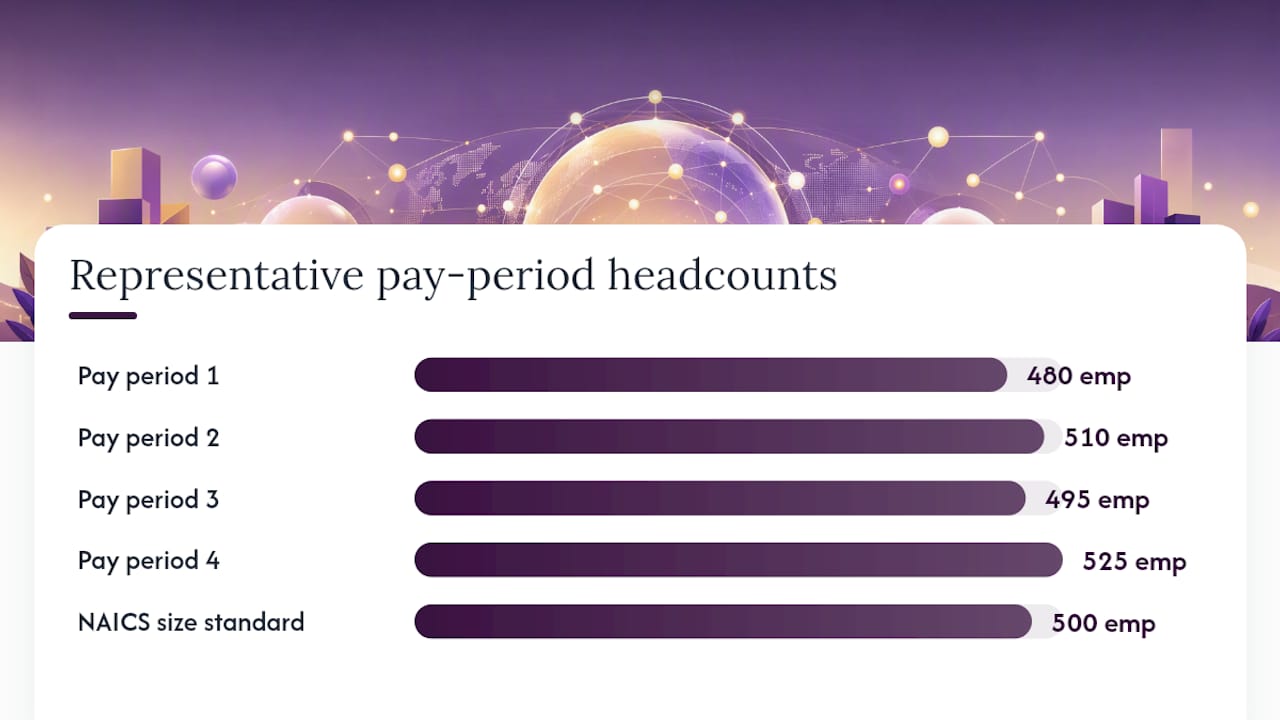
Worked example: A manufacturer reports headcounts of 480, 510, 495, and 525 across four representative pay periods over the past two years. Averaging those gives roughly 503 employees. If the standard for its NAICS code is 500 employees, this firm is over the line by three employees on average, meaning it does not qualify as small for that code despite dipping under 500 in some individual pay periods.
| Basis | Timeframe | Formula reference | What counts |
|---|---|---|---|
| Average annual receipts | Latest 5 completed fiscal years (or fewer if newer firm) | 13 CFR §121.104 | Total income plus cost of goods sold, per tax return |
| Average number of employees | Trailing 24 months, per pay period | 13 CFR §121.106 | Full-time, part-time, temporary, and generally leased staff |
Both calculations must include affiliates. A standalone number that clears the threshold means nothing if adding an affiliate’s receipts or headcount pushes the combined total over it.
Why Classification Matters: Set-Asides, Certifications, and the Nonmanufacturer Rule
Small business classification isn’t a paperwork formality. It’s the gateway to an entire category of federal contracts that larger competitors legally cannot bid on.
Qualifying as small under a solicitation’s NAICS code opens the door to small business set-asides, where the contracting officer restricts competition to small firms only. It’s also the prerequisite for the SBA’s socio-economic certification programs, including 8(a), Women-Owned Small Business (WOSB), HUBZone, and Service-Disabled Veteran-Owned Small Business (SDVOSB). None of these certifications matter if the underlying size standard isn’t met first; size classification is the foundation everything else sits on.
For supply and product contracts specifically, there’s an added layer called the nonmanufacturer rule. A small business bidding to supply a manufactured product generally must either manufacture the item itself or supply a product manufactured by another small business. A small reseller supplying a large manufacturer’s product typically needs a waiver from the SBA to qualify for a set-aside contract, because the rule exists to prevent small businesses from acting as pass-through distributors for large manufacturers on set-aside awards.
A few things worth repeating because they get overlooked constantly:
- The contracting officer’s NAICS assignment controls, not your own preferred classification.
- Being small on one contract doesn’t carry over to another with a different NAICS code.
- Socio-economic certifications layer on top of size standard eligibility; they don’t replace it.
Self-Certifying and Keeping Your Status Current in SAM.gov
- Log into your SAM.gov entity registration. Your business must maintain an active, current registration to be visible to contracting officers and to self-certify status at all.
- Update your business type and socio-economic representations. SAM.gov includes fields where you declare small business status and any applicable certifications like WOSB or HUBZone; these need to reflect your current, calculated status, not a stale prior entry.
- Attach or reference documentation supporting your size calculation. Keep your receipts and employee calculations on file in case a contracting officer or the SBA requests support for a size protest.
- Re-certify after any material change. A merger, an acquisition, a major revenue jump, or a new SBA size standard revision all warrant an updated SAM entry.
- Never assume SAM.gov reflects a recent SBA size standard change automatically. SAM does not auto-update when the SBA revises a size standard. Your registration will keep showing your old status until you manually go in and correct it, which means a company that was small under an old standard but not under a revised one could be misrepresenting its status without realizing it.
Our guide to SAM.gov registration covers the mechanics of the registration process in more depth if you’re setting one up for the first time.
When You Need to Re-Check Your Small Business Status
Size status isn’t something you calculate once and file away. Several events should trigger an immediate re-check, and treating classification as a one-time task is one of the more expensive mistakes a growing contractor can make.
Check your status before responding to any new solicitation, especially one assigned a different NAICS code than your last contract. Re-run the numbers after a merger, an acquisition, or any change in ownership structure that could create new affiliation. Recalculate after crossing a major revenue or headcount milestone, even if you haven’t pursued a new contract yet, so you know where you stand before the next bid. And check specifically whenever the SBA publishes a size standard revision for your NAICS code, since those updates happen periodically and won’t announce themselves in your inbox.
A short red-flag list worth keeping on hand: a sudden revenue spike from a single large contract, the acquisition of a competitor or supplier, or an outside equity investment that comes with board seats or approval rights. Any of those three can quietly move you from “small” to “other than small” without a single change to your day-to-day operations.
When to Bring in Outside Help for Size Verification
Some companies can run this entire process internally with a spreadsheet and an afternoon. Others have ownership structures, pending transactions, or growth trajectories complicated enough that a wrong calculation carries real financial risk, and that’s when outside expertise earns its cost.
A consultant experienced in SBA size rules typically handles:
- NAICS and SIN code mapping across your full product or service line, not just your primary offering.
- Full affiliation analysis, including reviewing ownership documents, board composition, and contracts for hidden control relationships.
- Independent verification of your receipts and employee calculations against the CFR formulas.
- SAM.gov registration updates and socio-economic certification alignment.
- Broader proposal readiness for set-aside pursuits, once size eligibility is confirmed.
Consider bringing in help specifically if you have a complex or layered ownership structure, an acquisition or investment in progress, headcount or revenue growing fast enough that last year’s calculation is already stale, or if this is your first time pursuing federal contracts and you’d rather not learn the affiliation rules the hard way on a live bid.
If you’re evaluating a consultant, ask about their specific experience with SBA size determinations and affiliation analysis, not just general government contracting familiarity, and ask for examples of past size-standard work they can speak to concretely.
Author’s Practical Next Steps and Recommended Priorities
If you’re starting from zero, work this list in order: identify your NAICS code for the specific opportunity in front of you, run it through the SBA Size Standards Tool, then stop and do the affiliation check before you touch a calculator. Affiliation is where the real risk hides, not in the receipts math itself.
Once affiliation is clear, compute your average receipts or average employees using the correct timeframe, update SAM.gov to match, and move on. If anything about your ownership structure feels the least bit tangled, a shared officer, a minority investor with board rights, a family member’s company in the same industry, get an opinion from an SBA Size Specialist before you self-certify, not after.
Getting this wrong isn’t a paperwork inconvenience. A size protest that finds you misclassified can mean a rejected bid or a terminated award. Verify first. Certify second.
How Gsascheduleservices Supports Your Size Verification and GSA Readiness
Running your own NAICS mapping and affiliation analysis is doable, but it’s also exactly the kind of work where one missed control relationship or one miscounted pay period turns into a rejected bid months later. Gsascheduleservices exists to close that gap for companies pursuing a GSA Schedule: we handle NAICS and SIN code mapping, verify your receipts and employee calculations against the correct CFR formulas, and make sure your SAM.gov registration actually reflects your current status instead of a stale one. If you’re weighing whether to hire a consultant versus doing this alone, the moment your ownership structure gets complicated or your first federal pursuit is on the line is the moment it pays to have someone check the math with you. Once your size status is confirmed, we also help translate that eligibility into an actual GSA Schedule growth strategy. Start with a discovery call to see where your business stands.
Sources
Confirm anything in this article directly against the primary sources rather than relying on secondhand summaries, since size standards and affiliation determinations carry real consequences for bid eligibility.
- Size Standards Tool | U.S. Small Business Administration
- 13 CFR Part 121 – Small Business Size Regulations (eCFR)
For unresolved affiliation questions or a size determination you’re not confident about, contact an SBA Size Specialist or your local SBA Government Contracting Area Office directly rather than guessing.
FAQ
What Are the Four Types of Small Businesses?
There’s no single official “four types” list under SBA rules; classification instead runs along a spectrum from micro-enterprises with a handful of employees up to firms approaching the full NAICS-based size standard, plus specific certification categories like 8(a), WOSB, HUBZone, and SDVOSB for socio-economic programs.
How Do I Know My Business Classification?
Identify the NAICS code for your primary activity or the specific contract you’re pursuing, then check that code’s receipts or employee threshold in the SBA Size Standards Tool against your own average figures, including affiliates.
How Does the SBA Classify a Small Business?
The SBA classifies a business as small when its average annual receipts or average number of employees, calculated together with any affiliates, falls at or below the size standard assigned to the NAICS code for a given procurement under 13 CFR Part 121.
Is an LLC a Small Business?
An LLC can qualify as a small business, since SBA size standards apply based on receipts, employees, and affiliation rather than legal entity structure; an LLC still has to meet the same NAICS-linked size standard as a corporation or sole proprietorship in the same industry.
Does Small Business Status Apply to Every Contract I Bid On?
No. Size classification is tied to the NAICS code assigned to each specific solicitation, so a firm can qualify as small on one contract and not on another with a different code.
Recommended
- How to Grow a Small Business Through a GSA Schedule
- Certifying Your Small Business Size in 4 Simple Steps | GSA Focus
- Maximize Federal Sales with a Solid GSA NAICS Code Strategy
- Will my SBA Designation help get a GSA Contract?