

In federal procurement, program contracts are the formal agreements that govern how agencies buy recurring programs of work — covering everything from a multi-year IT modernization effort to ongoing logistics support. The five contract types every bidder must know are:
- Firm-fixed-price (FFP) and fixed-price variants — you carry the cost risk; the government pays a set price
- Cost-reimbursement types (CPFF, CPIF, CPAF) — the government reimburses allowable costs plus a fee; you carry less cost risk but face strict accounting requirements
- Incentive contracts — fixed-price or cost-reimbursement structures layered with a formula that rewards beating cost or performance targets
- Indefinite-delivery/indefinite-quantity (IDIQ) vehicles — umbrella contracts that issue task or delivery orders over time; GWACs and GSA Schedules are the most prominent examples
- Time-and-materials (T&M) and labor-hour contracts — the government pays fixed labor rates plus materials at cost; used when scope cannot be defined upfront
Your immediate next step: verify your Sam registration is active, your UEI is current, and your NAICS codes match the work you actually want to win.
Key Takeaways
Federal program contracts are governed by FAR Part 16, and the contract type an agency selects determines your cost risk, accounting requirements, and proposal strategy — getting that alignment right before you bid is what separates competitive proposals from also-rans.
| Point | Details |
|---|---|
| FAR Part 16 governs all contract types | Every federal contract type — FFP, cost-reimbursement, IDIQ, T&M — is defined and governed by FAR Part 16 and its subparts. |
| Risk allocation varies sharply by type | Fixed-price puts cost risk on the contractor; cost-reimbursement shifts it to the government but demands a DCAA-compliant accounting system. |
| Entry thresholds favor small businesses | The micro-purchase threshold is $15,000 and the simplified acquisition threshold is $350,000 — both are fast-entry points for building past performance. |
| SAM.gov is both compliance and marketing | An optimized SAM and DSBS profile with correct NAICS codes makes you discoverable before solicitations are posted, not just eligible after. |
| Gsascheduleservices accelerates readiness | Gsascheduleservices provides end-to-end support — from SAM registration and NAICS mapping to price list development and GSA Schedule application — for contractors pursuing federal program work. |
Table of Contents
- What are the main program contract types under FAR Part 16?
- How do contracting officers choose a contract type?
- How should contractors prepare for each contract type?
- How do you find and pursue federal program contracting opportunities?
- Why this guide reflects FAR guidance and real-world practice
- What most contractors overlook about discoverability
- Gsascheduleservices helps you compete for program contracts from day one
- Sources
- FAQ
What are the main program contract types under FAR Part 16?
FAR Part 16 is the governing reference for every contract type used in federal procurement. It groups contracts into broad families, each with distinct subtypes, risk profiles, and administrative demands. Understanding the differences before you bid is not optional — it shapes your pricing, your accounting infrastructure, and your proposal strategy.
Fixed-price contracts
Firm-fixed-price (FFP) is the government’s preferred default. The price is set at award and does not change regardless of what it costs you to perform. Agencies reach for FFP when requirements are well-defined and commercial pricing data exists. For contractors, the upside is straightforward profit if you execute efficiently; the downside is that every cost overrun comes out of your margin.
Fixed-price variants add flexibility for specific situations. Fixed-price with economic price adjustment (FP/EPA) allows the contract price to move with a specified index — useful for multi-year contracts where labor or material costs are volatile. Fixed-price incentive (FPI) sets a target cost, a target profit, a ceiling price, and a share ratio; if you beat the target cost, you split the savings with the government. Fixed-price with prospective or retroactive redetermination is used for initial production runs where pricing data is thin — the price is set firm for an initial period, then renegotiated based on actual cost experience.
Cost-reimbursement contracts
Cost-reimbursement contracts shift most cost risk to the government. You bill allowable, allocable costs under FAR Part 31 and receive a fee on top. The trade-off: you need a compliant accounting system, and the government scrutinizes every dollar.
The main subtypes:
- Cost-plus-fixed-fee (CPFF) — the most common cost-type; fee is negotiated upfront and does not change with performance
- Cost-plus-incentive-fee (CPIF) — fee adjusts based on a cost or performance formula; rewards efficiency
- Cost-plus-award-fee (CPAF) — a base fee plus a discretionary award fee scored by a government evaluation board; used when performance is hard to quantify in advance
- Cost and cost-sharing — cost contracts pay no fee (typically used for research); cost-sharing requires the contractor to absorb a portion of costs, often in exchange for commercial rights
The CRS report on federal procurement contracts notes that cost-reimbursement contracts are appropriate when uncertainties in performance prevent firm pricing — but they require written justification and, for commercial items, are generally prohibited. The CRS PDF details the approval requirements agencies must satisfy before using cost-reimbursement on a given acquisition.
Incentive contracts
Incentive contracts sit across both families. Fixed-price incentive (FPI) and cost-plus-incentive-fee (CPIF) both use a share ratio to align your financial interest with the government’s cost and performance goals. The mechanics: a target cost and target profit are negotiated; actual costs above or below target are split according to the share ratio (e.g., 80/20 government/contractor). The ceiling price caps your exposure on FPI contracts. These structures work best on development programs where cost uncertainty is real but not extreme.
Indefinite-delivery vehicles
IDIQ contracts do not specify a firm quantity upfront — they set a minimum and maximum and then issue task orders or delivery orders against the vehicle over the ordering period. Three subtypes exist under FAR Part 16:
- IDIQ — quantity is indefinite; orders are placed as needs arise
- Requirements contracts — the government commits to buying all of its actual requirements from you during the contract period
- Definite-quantity contracts — a fixed quantity is specified, but delivery schedule is flexible
GSA’s Governmentwide Acquisition Contracts (GWACs) are pre-competed, multiple-award IDIQ vehicles for IT and related services. Getting onto a GWAC or a GSA Multiple Award Schedule (MAS) gives you a long-term ordering vehicle that agencies can use without a new full-and-open competition.
Time-and-materials and labor-hour contracts
T&M contracts pay fixed hourly labor rates (which include overhead, G&A, and profit) plus materials at cost. Labor-hour contracts are identical but exclude materials. Both are used when the scope of work cannot be defined well enough to price a fixed-price contract. FAR requires a determination that no other type is suitable before a T&M or labor-hour contract is awarded, and they typically include a ceiling price the contractor may not exceed without authorization.
Letter contracts
A letter contract is a preliminary written instrument authorizing a contractor to begin work immediately while negotiations on final contract terms continue. They are used in urgent situations and must be definitized — converted to a final contract — within a specified period. They carry significant risk for both parties and are not a preferred vehicle.
Contract type reference:
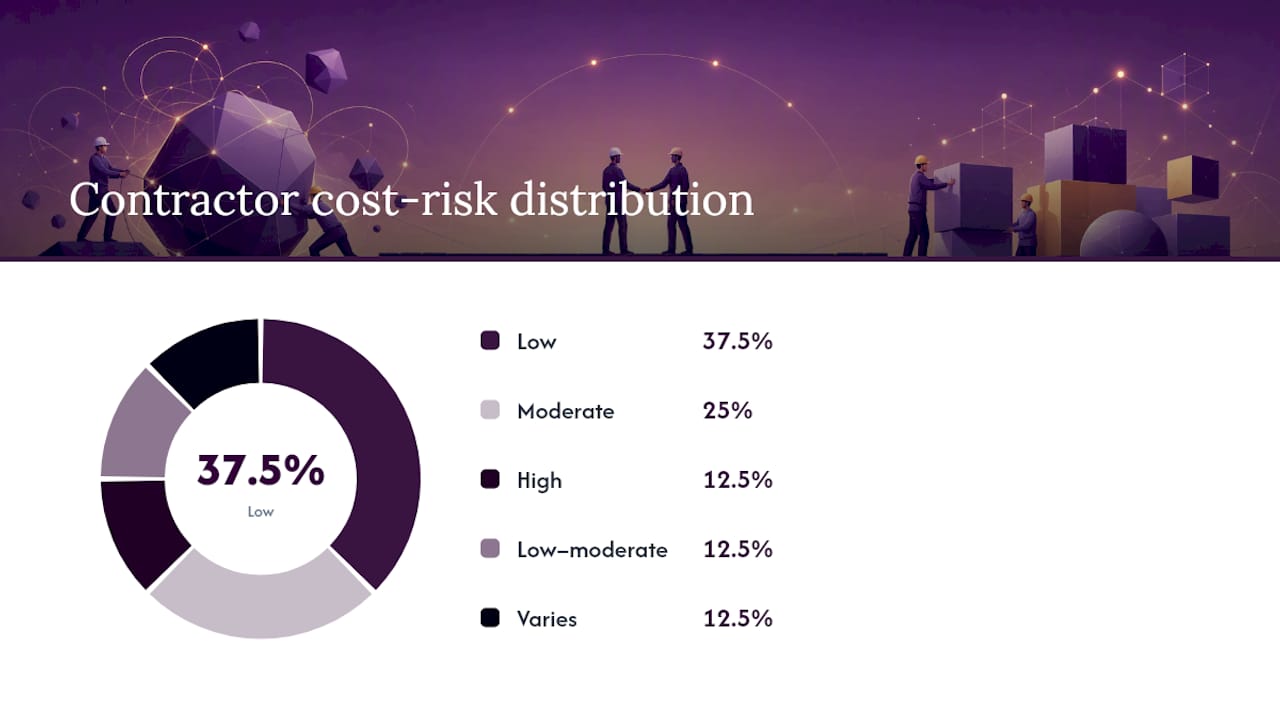
| Contract subtype | Typical use case | Contractor cost risk | Accounting burden |
|---|---|---|---|
| Firm-fixed-price (FFP) | Well-defined supplies or services with market pricing | High — all overruns absorbed by contractor | Low |
| Fixed-price incentive (FPI) | Development or production with cost uncertainty | Moderate — shared via share ratio up to ceiling | Moderate |
| FP with economic price adjustment | Multi-year contracts with volatile labor/material costs | Moderate — price adjusts with index | Low–moderate |
| Cost-plus-fixed-fee (CPFF) | R&D, early-stage development | Low — government reimburses allowable costs | High |
| Cost-plus-incentive-fee (CPIF) | Programs with measurable cost/performance targets | Low–moderate — fee varies with performance | High |
| Cost-plus-award-fee (CPAF) | Complex programs with subjective performance criteria | Low — base fee guaranteed; award fee discretionary | High |
| IDIQ / task order | Recurring services or supplies over a period of years | Varies by task order type | Moderate–high |
| Time-and-materials | Undefined scope; expert labor services | Low on cost; risk is in rate adequacy | Moderate |
| Labor-hour | Same as T&M, no materials component | Low on cost | Moderate |
| Letter contract | Urgent start before terms are finalized | High — definitization risk | Moderate |
How do contracting officers choose a contract type?
Contract type selection is not arbitrary. FAR Subpart 16.1 requires contracting officers to negotiate contract type and price together, and FAR 16.104 lists the specific factors they must weigh. Knowing these factors lets you anticipate the likely contract type before a solicitation drops — and tailor your proposal accordingly.
The FAR 16.104 factors:
- Price competition — robust competition with comparable commercial pricing pushes toward fixed-price
- Price analysis — if catalog or market prices exist, fixed-price is easier to justify
- Cost analysis — when cost data must be analyzed (no market price), cost-reimbursement becomes more defensible
- Type and complexity of the requirement — production of a known item favors FFP; R&D or prototype work favors cost-reimbursement
- Urgency — urgent requirements may justify letter contracts or T&M to start work fast
- Period of performance — long periods with uncertain costs push toward cost-reimbursement or FP/EPA
- Contractor’s accounting system — if your accounting system cannot segregate costs, cost-reimbursement is off the table
- Subcontracting extent — heavy subcontracting with uncertain sub-costs can push toward cost-reimbursement
- Acquisition history — prior contract performance data supports moving toward fixed-price on follow-on work
The practical implication: if you are bidding on a mature, well-defined service with historical pricing, expect FFP. If the agency is funding early-stage R&D or a prototype with no cost history, expect cost-reimbursement. IDIQ vehicles appear when the agency needs recurring buys but cannot predict exact quantities or timing.
Selection dimension comparison:
| Selection dimension | Government prefers fixed-price when… | Government prefers cost-reimbursement when… | Government uses IDIQ when… |
|---|---|---|---|
| Requirement definition | Scope is clear and stable | Scope is uncertain or evolving | Recurring needs, variable quantity |
| Pricing data | Market or catalog prices exist | No reliable market price | Pricing set at task-order level |
| Cost risk | Contractor can absorb overruns | Uncertainties prevent firm pricing | Varies by task order type |
| Contractor accounting | Basic commercial accounting sufficient | DCAA-compliant system required | Depends on task order type |
| Acquisition history | Mature program with cost history | New program, first-of-kind | Established vehicle, new orders |
Contracting officers must document their contract type selection in the contract file. FAR subparts require a written determination when using cost-reimbursement, T&M, or labor-hour contracts. If you receive a solicitation for a cost-reimbursement contract, the agency has already made that determination — your proposal must demonstrate accounting system adequacy, not just technical capability.
How should contractors prepare for each contract type?
Preparation is type-specific. A proposal strategy that wins an FFP contract can get you disqualified on a cost-reimbursement award if your accounting system does not pass scrutiny.

Fixed-price readiness
On FFP bids, your cost estimate is your profit margin. Use a bottom-up build: direct labor hours by labor category, fringe rates, overhead, G&A, and profit. Do not bury contingency in a single line item — evaluators will notice, and it invites a price realism challenge. Instead, document your assumptions explicitly and show your basis of estimate.
Define deliverables with precision. Vague statements of work are the leading cause of scope disputes on fixed-price contracts. If the SOW is ambiguous, ask questions during the Q&A period — every clarification you get in writing reduces your risk at performance.
Cost-reimbursement readiness
Cost-reimbursement contracts require an accounting system that segregates direct costs, accumulates indirect costs in pools, and provides a reliable basis for allocating those indirect costs. The Defense Contract Audit Agency (DCAA) audits these systems, and many small firms must invest in contract-focused accounting software or ERP to comply with FAR Part 31 cost principles.
Allowable costs are those that are reasonable, allocable, and not specifically prohibited by FAR Part 31. Unallowable costs — entertainment, certain lobbying expenses, fines — must be identified and excluded from billings. Getting this wrong triggers audit findings and potential repayment demands.
Know the cap before you negotiate.
Incentive contract mechanics
On CPIF or FPI contracts, the share ratio is the number that matters most. A 70/30 share ratio means the government absorbs 70 cents of every dollar of cost overrun and you absorb 30 cents — but you also keep 30 cents of every dollar saved. Model your incentive formula before you sign: calculate your break-even point, your best-case fee, and your worst-case exposure at the ceiling price. Align your internal performance metrics with the contract’s incentive targets so your team is pulling in the same direction.
IDIQ and task order readiness
Getting onto an IDIQ vehicle is the beginning, not the finish line. You win revenue through individual task orders, each of which may be competed among all vehicle holders. Maintain a bench of qualified staff at each labor category on your price list, and keep your rates competitive without pricing yourself out of profitability. Staffing scalability is the hidden challenge: agencies issue task orders on short timelines, and you need to be able to ramp up quickly. For pricing and procurement frameworks that apply to enterprise IDIQ structures, Anthropos’s pricing and procurement FAQ offers useful context on structuring competitive rates.
T&M and labor-hour readiness
Your labor rates on T&M contracts must cover direct labor, fringe, overhead, G&A, and profit — all baked into a single hourly rate by labor category. Build your rate card carefully: underpricing a category to win and then discovering you cannot staff it is a common and painful mistake. Timekeeping discipline is non-negotiable; DCAA expects contemporaneous timesheets, and missing or reconstructed records are an audit red flag.
Pre-bid readiness checklist:
- Confirm active SAM.gov registration with current UEI and no lapsed renewal
- Verify NAICS codes match the specific work you are pursuing — not just your broadest industry category
- Confirm your accounting system can segregate direct and indirect costs (required for cost-reimbursement)
- Assess cash flow: government payment cycles average 30 days net, but cost-reimbursement billing can lag further
- Compile past performance references — at least three relevant contracts with contact information
- Draft or update a one-page capability statement tailored to the agency and contract type
- Confirm subcontractor relationships if teaming is required for size or capability gaps
- Review your small business certifications (8(a), WOSB, HUBZone, SDVOSB) for any that apply
Pro Tip: On cost-reimbursement proposals, submit a cost realism narrative alongside your cost volume. Explain why your indirect rates are what they are, reference your DCAA audit history if you have one, and show your rate trend over three years. Contracting officers performing cost realism analysis are looking for this exact evidence — giving it to them proactively signals maturity and reduces the chance of a downward adjustment to your proposed costs.
How do you find and pursue federal program contracting opportunities?
Discovery is where most new contractors underinvest. The opportunities exist — the challenge is finding the right ones before the solicitation closes and positioning yourself to win.
Where opportunities appear
SAM.gov is the primary posting site for federal solicitations above the micro-purchase threshold. Set up saved searches by NAICS code and keyword, and configure email alerts so you see new postings the day they appear. Agency websites often post pre-solicitation notices and sources-sought notices before a formal RFP — these are your earliest warning and your best chance to shape requirements.
GSA Schedules (MAS) and GWACs are ordering vehicles, not individual contracts. Once you are on a schedule or GWAC, agencies can place orders directly without a new competition. The SBA’s Dynamic Small Business Search (DSBS), linked from your SAM.gov profile, is a separate discovery tool that contracting officers use to find small business sources — keep it current.
The micro-purchase and simplified acquisition thresholds represent the fastest entry points for contractors building past performance. Purchases below $15,000 can be made by government purchase card holders without a formal solicitation. Purchases between $15,000 and $350,000 follow simplified acquisition procedures — faster timelines, less documentation, and set-aside preferences for small businesses. These thresholds represent the fastest entry points for contractors building their first past performance record.
Step-by-step pursuit process
- Opportunity identification — monitor SAM.gov daily alerts, agency forecast pages, and industry days; prioritize sources-sought notices where you can submit a capability statement before the RFP is written
- Capability statement — a one-page document with your core competencies, differentiators, past performance highlights, NAICS codes, and contact information; tailor it to the specific agency and requirement
- Capture plan — before writing a proposal, answer: Do you know the customer? Do you understand their evaluation criteria? Do you have a competitive price? If you cannot answer all three, your win probability is low
- Proposal submission — follow the RFP instructions exactly; non-compliant proposals are eliminated before evaluation begins; address every evaluation factor with evidence, not assertions
- Debrief — request a debrief after every award decision, win or lose; the feedback is free market intelligence
Prime, sub, or team?
New contractors often face a choice: bid as a prime, join a team as a subcontractor, or form a joint venture. Subcontracting is the fastest path to past performance when you lack it — find prime contractors already on vehicles you want to access and offer a specific capability they need. Teaming agreements must be in place before proposal submission and should clearly define each partner’s work share and responsibilities.
Capital planning matters more than most contractors expect. Proposal preparation costs money — staff time, consultants, graphics. Payment on cost-reimbursement contracts lags billing by 30 days or more. Build a cash reserve before pursuing large cost-type awards.
The SBA’s guidance on winning contracts recommends using micro-purchases and simplified acquisitions as the entry strategy: build past performance on smaller awards, then pursue larger vehicles. Getting onto a GSA Multiple Award Schedule is a multi-month effort but creates recurring ordering access — most small businesses should pursue micro-purchases and simplified acquisitions first, then apply for a schedule once they have documented past performance to reference.
For a detailed walkthrough of SAM registration and profile optimization, the SAM.gov portal guide from Gsascheduleservices covers saved searches, solicitation alerts, and award data in practical terms.
Why this guide reflects FAR guidance and real-world practice
This article draws on primary federal acquisition sources and practitioner synthesis, not secondary summaries. The core references:
- FAR Part 16 — the authoritative text on contract types, subtypes, and selection guidance; every contract type described here maps directly to a FAR subpart
- FAR Subpart 16.1 — the specific subpart governing contract type selection factors (FAR 16.104) and documentation requirements
- FAR Part 31 — cost principles governing allowable and unallowable costs on cost-reimbursement contracts
- CRS Report R48784 — a congressional research summary of federal contract types, risk allocation, and usage context; the PDF version provides detailed cost-reimbursement rules and approval requirements
- Sam — the central registration and solicitation portal; registration and annual renewal requirements cited directly from the platform
- SBA guidance on winning contracts — NAICS mapping, DSBS, capability statements, and micro-purchase strategy
- GSA GWAC guidance — multiple-award IDIQ vehicle descriptions and agency usage patterns
The guidance in this article was developed by synthesizing FAR text with practitioner literature on contractor accounting, proposal strategy, and capture management. Where FAR language is specific (fee caps, approval requirements, threshold amounts), it is cited directly. Where practitioner experience informs the advice (rate card construction, cost realism narratives, teaming strategy), it is presented as guidance rather than regulation.
What most contractors overlook about discoverability
The contractors who consistently win program work share one habit that their competitors skip: they treat their SAM.gov profile as a marketing document, not a compliance checkbox. The SBA’s guidance is explicit on this point — contracting officers search DSBS before solicitations are posted, looking for sources to include in market research. If your NAICS codes are too broad, your capability statement is generic, or your profile has not been updated in 18 months, you are invisible to that search.
The fix takes one to two days. Pull your SAM.gov profile, audit every NAICS code against the specific work you want to win, and rewrite your capability statement with three concrete past performance examples and a single differentiating sentence about what you do better than comparable firms. Then update your DSBS profile to match. That combination — correct NAICS mapping plus a sharp one-page capability statement — is the fastest discoverability improvement available to any contractor, and most skip it entirely because it feels administrative rather than strategic.
Gsascheduleservices helps you compete for program contracts from day one
Winning a federal program contract requires more than reading the FAR. It requires a compliant SAM registration, the right NAICS and SIN codes, a price list that holds up under scrutiny, and an accounting system that survives a DCAA review. Most small businesses get one of those wrong and lose months recovering.
Gsascheduleservices handles the full preparation stack: eligibility assessment, SAM and DSBS profile optimization, NAICS and SIN code mapping, price list development, proposal support, and ongoing compliance maintenance. For contractors pursuing a GSA Schedule, the firm manages the entire application process and negotiates on your behalf. For those already holding a schedule, ongoing contract modifications and compliance support keep you in good standing.
If your firm has fewer than 50 employees or is pursuing its first federal vehicle, the complexity-to-capacity ratio almost always favors bringing in a specialist rather than building the expertise in-house. Start with a discovery call to assess your readiness and identify the fastest path to your first award.
Sources
The following primary sources are the authoritative references for federal program contracting. Read them in this order if you are building your knowledge from scratch:
- Part 16 – Types of Contracts
- Subpart 16.1 – Selecting Contract Types
- Types of Federal Procurement Contracts
- Types of Federal Procurement Contracts (CRS report PDF)
- How to win contracts – Small Business Administration
- Governmentwide Acquisition Contracts
- Sam
FAQ
What is a program contract in federal procurement?
A program contract is a formal government agreement that structures how an agency buys a recurring program of work — covering the contract type, pricing mechanism, period of performance, and ordering terms. The most common forms are fixed-price, cost-reimbursement, and IDIQ vehicles governed by FAR Part 16.
What are the four main types of federal contracts?
FAR Part 16 organizes federal contracts into four primary categories: fixed-price (including FFP and variants), cost-reimbursement (CPFF, CPIF, CPAF), incentive contracts (fixed-price or cost-reimbursement with performance formulas), and indefinite-delivery contracts (IDIQ, requirements, and definite-quantity). Time-and-materials and labor-hour contracts are a fifth category used when scope cannot be defined upfront.
What is the easiest government contract to get?
Micro-purchase awards — those at or below the $15,000 threshold — are the fastest entry point because they require no formal solicitation and can be made by government purchase card holders. Simplified acquisition contracts up to $350,000 follow faster procedures with set-aside preferences for small businesses, making them the next step for building past performance.
What is the difference between an IDIQ contract and a task order?
An IDIQ contract is the umbrella vehicle that establishes terms, pricing, and ordering rules over a period of years; a task order is an individual work assignment issued against that vehicle. Contractors win revenue through task orders, not through the IDIQ award itself — which is why maintaining competitive readiness and staffing capacity after award is as important as winning the vehicle.
Do you need a special accounting system for cost-reimbursement contracts?
Yes. Cost-reimbursement contracts require an accounting system that segregates direct costs, accumulates indirect costs in pools, and allocates them on a consistent basis — all in compliance with FAR Part 31. DCAA audits these systems, and firms without a compliant system are ineligible for cost-type awards regardless of their technical qualifications.
Recommended
- Understanding Federal Contractor Requirements: A Guide
- Professional Federal Contractor Services in the United States
- Federal Procurement Guidelines Simplified
- Mastering Government Contracts: Professional Guide and Tips